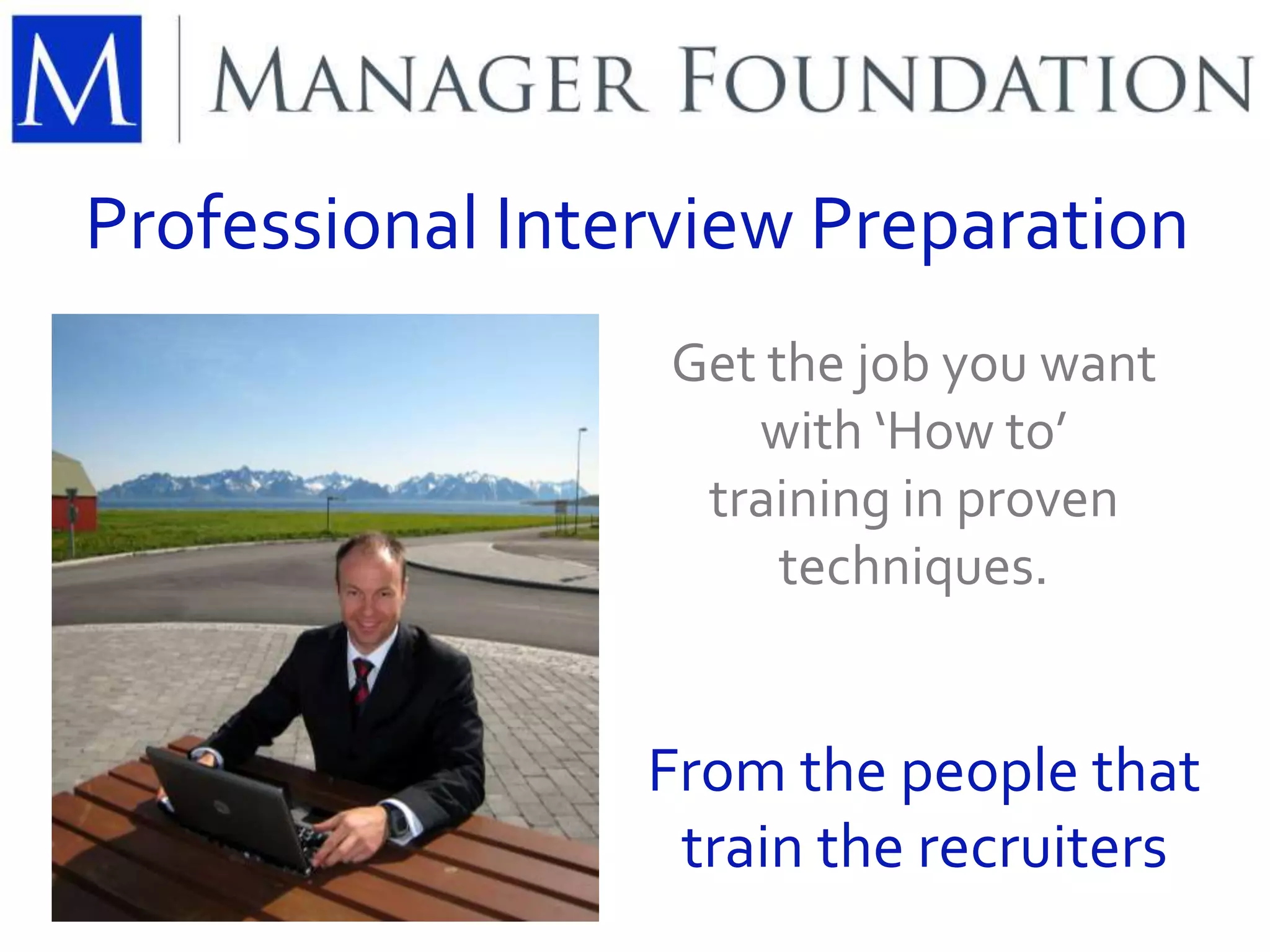
Professional Interview Preparation 
Get the job you want 
with ‘How to’ 
training in proven 
techniques. 
From the people that 
train the recruiters
You know how 
• You finally get an interview for a job 
• The interview is pretty tough 
• You don’t get any real feedback 
• There’s a lot of competition for the job 
• You don’t get the offer and 
• You’re back in the job search 
This guide will fix that
Successful Interviewing 
A job interview is your opportunity to: 
– Work for a better company 
– Develop your skills and relationships 
– And not to forget, make more money 
But there are no prizes for second place 
– Interviewing is difficult, competitive & stressful 
– Interviewing is a skill that we don’t practice often 
which means we’re not as good as we could be 
The solution is Interview Preparation
You’re in the right place 
Manager Foundation trains managers how to 
interview and we partner with recruitment 
companies. 
This is why we know better than anyone else 
what recruiters are looking for in job candidates 
A little interview preparation can go a long way. 
Because the average job candidate is 
unprepared and untrained in interviewing skills
7 Ways to Prepare for Interviews 
There are many ways to prepare for an interview, 
including: 
1. Use a checklist 
2. Revise interview questions & prepare answers 
3. Research the company and the interviewer 
4. Review your own resume 
5. Take a psychometric assessment 
6. Mock interviews with friends and family 
7. Professional Interview Coaching
The Best Interview Preparation Method 
Professional Interview Coaching is the best way to 
prepare for interviews. Because a coach can: 
• Adapt training to your needs 
• Identify what mistakes you’re making 
• Give you open, actionable feedback 
The problem is professional coaches cost money. If 
would like to invest in your career then go here: 
http://goo.gl/CQoHdW 
Otherwise continue with this on-line interview 
training course.
Overview 
Interviewing for a job is a multidisciplinary activity. This guide 
will cover the following topics: 
• What recruiters want 
• Using Interview Checklists 
• Body language & building rapport 
• Company & interviewer research 
• Resumes and interviewing 
• Finding and communicating your USP 
• Difficult interview questions 
• Expected interview questions 
• Behavioural interview questions 
• Psychometric tests 
• Anxiety & self confidence
Are you right for this guide? 
Interview preparation isn’t for everyone. 
• Would you like a new (better) job? 
• Is it a competitive job market? 
• Do you want to control interview anxiety or improve 
your confidence? 
• Have you failed at interviews in the past? 
• Do you want to take control of the interview process? 
• Do you want to know what recruiters do with your 
psychometric assessment? 
If any of the above apply to you then interview 
preparation will improve your interview success. But you 
must also be prepared to follow the process.
What recruiters want 
Recruiters want to know that you: 
• Have the skills & abilities to do the job, 
• Are motivated to apply yourself and stay and 
• Will fit in with the organisation (team, values and 
culture) 
In short recruiters want to know that you will add value. 
The problem is that interviewing is a flawed method: 
• Candidates misrepresent themselves 
• Interviewers are not objective 
• Having job skills is not the same as interview skills 
The result is you could be great for a job but fail at an 
interview
Using Checklists 
Checklists are an excellent method to not miss 
important steps. The con is that checklists are a 
bit light on content - they tell you what to do, 
not how to do it. 
Good for: 
• Planning 
• Dress code 
• On the day drill
Body Language & Building Rapport 
Body language and “connecting” with the 
interviewer are at least as important as saying 
the right things. A couple of easy to follow 
recommendations: 
• Making eye contact and smiling – surprisingly 
effective 
• Mirroring the other person
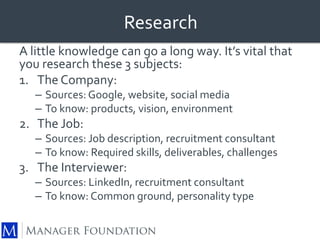
Research 
A little knowledge can go a long way. It’s vital that 
you research these 3 subjects: 
1. The Company: 
– Sources: Google, website, social media 
– To know: products, vision, environment 
2. The Job: 
– Sources: Job description, recruitment consultant 
– To know: Required skills, deliverables, challenges 
3. The Interviewer: 
– Sources: LinkedIn, recruitment consultant 
– To know: Common ground, personality type
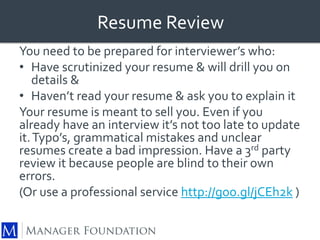
Resume Review 
You need to be prepared for interviewer’s who: 
• Have scrutinized your resume & will drill you on 
details & 
• Haven’t read your resume & ask you to explain it 
Your resume is meant to sell you. Even if you 
already have an interview it’s not too late to update 
it. Typo’s, grammatical mistakes and unclear 
resumes create a bad impression. Have a 3rd party 
review it because people are blind to their own 
errors. 
(Or use a professional service http://goo.gl/jCEh2k )
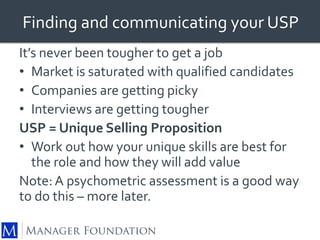
Finding and communicating your USP 
It’s never been tougher to get a job 
• Market is saturated with qualified candidates 
• Companies are getting picky 
• Interviews are getting tougher 
USP = Unique Selling Proposition 
• Work out how your unique skills are best for 
the role and how they will add value 
Note: A psychometric assessment is a good way 
to do this – more later.
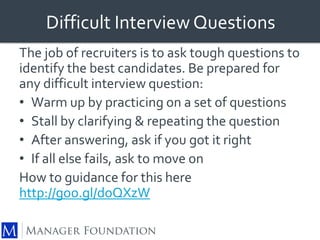
Difficult Interview Questions 
The job of recruiters is to ask tough questions to 
identify the best candidates. Be prepared for 
any difficult interview question: 
• Warm up by practicing on a set of questions 
• Stall by clarifying & repeating the question 
• After answering, ask if you got it right 
• If all else fails, ask to move on 
How to guidance for this here 
http://goo.gl/doQXzW
Developing interview skills 
• Interviewing is a complex skill 
• Unfortunately being good at a job doesn’t make 
you good at interviewing 
• Ironically better workers stay in jobs longer and 
practice their interview skills less 
But interviewing skills are an important life skill 
that gives you the ability to get the job you want. 
That’s why we recommend that you invest in your 
interviewing skills whether by study, practice or 
coaching. Developing your interview skills can do 
more for your career than other skills.
Expected Interview Questions 
Certain interview questions are so common 
interviewers expect you to be prepared for 
them. For example you need to prepare for: 
• Tell me about yourself 
• What is your biggest weakness 
• Where do you see yourself in 5 years 
The real key is to understand exactly what the 
interviewer is looking for.
Behavioral Interview Questions 
More sophisticated interviewers use behavioral interview 
questions. Behavioral questions ask what you did in a 
past scenario. 
• Spot them: They sound like “Tell me about a time 
when you XYZ” 
• Complete them. Use the STAR technique (Situation, 
Target/Task, Action, Result) 
• Expect them: Behavioral interview questions relate to 
job competencies. Knowing the required job 
competencies warns you which questions to expect 
• Smash them: Recruiters are looking for certain 
indicators 
See example overleaf
Behavioral Interview Questions Example 
• Spot them: 
– Non behavioral question: “Can you manage a budget?” 
– Behavioral question: “Tell me about a time when you had to achieve a 
challenging budget” 
• Expect them: 
– This question is asked when budget management is a key job 
competency 
• Evaluation criteria: 
– Positive: Achieved target, planned in advance, monitored, 
consultative, made contingency plans, didn’t reduce service levels 
– Negative: Missed target, complained, reduced service 
• Example answer 
– “I managed a cost budget of $3.7m in the operations department and 
I had to make a 10% saving. I brain stormed with my team to identify 
and evaluate our options. We agreed what to cut to achieve the target 
plus a contingency fund. I implemented monthly reporting and a 
standing agenda item. We achieved a total saving of $0.4m with 
minimal impact on operations.”
The need for feedback 
Have you ever done an interview, not got the job 
and then wondered what you did wrong? In job 
interviews: 
• Interviewer doesn’t give you open, useful 
feedback, 
• This makes it difficult to improve 
• A little objective feedback will increase your 
interview success. 
When preparing for interviews, get feedback from 
objective, skilled persons. Whether friends or a 
professional coach.
Psychometric tests in interviewing 
The truth is that a personality test can eliminate you from a job 
• Different types of people suit different types of jobs 
• Recruiters use psychometric assessments (commonly called 
personality tests) to match applicants to jobs 
• If the recruiter knows your behavior profile but you don't, you will 
be at a disadvantage 
• Worst case: many job applicants are eliminated because of 
concerns raised from their psychometric assessment 
• But it is possible to address these concerns if you know what they 
are and how 
This is an advanced interview technique and may not be for everyone. 
You can find out your strengths and weaknesses by taking a 
Psychometric Test http://goo.gl/D7djfL But as an advanced technique 
this is better dealt with by using the assistance of an Interview Coach. 
The advanced interviewing course explains how to use a personality 
test to interview better
Anxiety & Self Confidence 
Interviews are stressful, important and we don’t 
practice them often. Understandably this leads 
to high anxiety which decreases interview 
performance. 
• Anxiety can be controlled through breathing 
exercises 
• Questioning techniques can build self 
confidence
Next steps 
Congratulations on completing this interview 
preparation. Already you are on the path to 
being a much better interviewer. The next steps 
are: 
• Identify problem areas 
• Learn how to apply the techniques in practice 
The following pages identify options
Options: Developing Interview Skills 
1. Professional Coaching 
2. How to Guide 
3. Resume Review 
Special mention: 
• Salary Negotiation 
• New Job Transitions 
• Managing your Boss
Professional Interview Coaching 
The best way to succeed at interviewing is to do 
professional interview coaching. It’s not for 
everyone because it costs money. But interview 
coaches do the following better than anyone else: 
• Identify interview mistakes you’re making 
• Give tailored coaching and objective feedback 
• Identify your relevant strengths 
• Work out strategies to compensate for 
weaknesses 
• Know what questions you will most likely face in 
your interviews (these vary for different jobs)
An example of what interview coaching can do 
“Before my Interview Skills Training, I was struggling to get away from a job I hated because 
I wasn’t getting job offers from my interviews. I was frustrated because I knew I must be 
doing something wrong in my interviews but I didn’t know how to fix it. Being rejected from 
jobs I thought I was qualified for was starting to affect my confidence and I felt trapped. 
I struggled to connect with interviewers and clearly my interview answers weren’t what the 
interviewers were looking for but I was at a loss as to how to improve. I know I have to “sell” 
myself in interviews but I don’t like bragging or stretching the truth. 
I got an interview for a job that I didn’t want to miss out on. So I decided to try interview 
training. I thought - what can I lose! 
Getting constructive expert feedback was an eye opening experience. Finding out what 
interviewers thought of me and why and was what I needed. Even if there were a few 
“uncomfortable truths”! All those interviews I went to and practice interview questions 
didn’t improve my interview skills as much as one session of coaching. 
My interview was a totally different experience, I was confident, I knew what I was doing 
and I felt like a total pro. Needless to say I got the job! I’m looking forward to changing jobs. 
But better than that I know that I now have the freedom and the skills to easily change jobs 
in the future.” – Alison
Developing interview skills 
The guide that you have just completed is introduction and overview 
to interview training. The next step is to develop your skills by using 
using a more advanced guide. A more advanced guide covers a lot of 
what a professional interview coach would cover but is more of a “self 
service” model. It’s suitable for people who: 
• Are disciplined at on-line learning, 
• Aren’t ready to invest in an Interview Coach 
• Are able to progress without an Interview Coach 
The guide contains: 
• How to answer Interview Questions 
• What interview mistakes to avoid 
• How to control anxiety and increase confidence 
And more
Special Mentions 
Fact: More than half of all workers do not enjoy 
their jobs. But it doesn’t have to be this way. 
The mission of Manager Foundation is to “Make 
Work Work” by sharing practical tactics in order to 
• Increase employee job satisfaction 
• Show managers time proven, saving people 
management techniques and 
• That results in companies achieving their goals 
If you are a worker you will at some point need one 
of the following solutions.
Resume Review 
To get an interview, you need an exceptional 
resume. Interviews revolve around your resume. 
We offer a number of resume review services to 
suit your needs 
• Identifying typo’s, mistakes, unclear language 
• Expert recommendations 
• Expert rewrites 
• Designer resumes to really stand out 
Find out more: http://goo.gl/IQWFfg & get y0ur 
free template here: http://goo.gl/sU2fB3
Special mention: Salary Negotiation 
The best time to increase your salary is in a job 
transition. Negotiation can create the job you 
want: whether it’s pay, healthcare benefits, 
extra vacation, development or flexible working 
conditions. Find out: 
• How a salary negotiation works 
• Tactics to get you what you want 
• What your salary package should look like 
http://goo.gl/3N5Xu8
New Job Transitions 
You’re optimistic about your new job. The 
opportunity to progress, meet new people, learn 
new things and have a better working 
environment. 
But then things start to go wrong. 
Why? Because a job transition is one of the most 
complicated and challenges changes we can make. 
You can’t take for granted that you will integrate 
well with your colleagues or fulfill your bosses 
expectations. And a good job can turn bad. 
This is why we made the New Job Success Guide 
http://goo.gl/BLJtBI

Interview Preparation

  • 1.
    Professional Interview Preparation Get the job you want with ‘How to’ training in proven techniques. From the people that train the recruiters
  • 2.
    You know how • You finally get an interview for a job • The interview is pretty tough • You don’t get any real feedback • There’s a lot of competition for the job • You don’t get the offer and • You’re back in the job search This guide will fix that
  • 3.
    Successful Interviewing Ajob interview is your opportunity to: – Work for a better company – Develop your skills and relationships – And not to forget, make more money But there are no prizes for second place – Interviewing is difficult, competitive & stressful – Interviewing is a skill that we don’t practice often which means we’re not as good as we could be The solution is Interview Preparation
  • 4.
    You’re in theright place Manager Foundation trains managers how to interview and we partner with recruitment companies. This is why we know better than anyone else what recruiters are looking for in job candidates A little interview preparation can go a long way. Because the average job candidate is unprepared and untrained in interviewing skills
  • 5.
    7 Ways toPrepare for Interviews There are many ways to prepare for an interview, including: 1. Use a checklist 2. Revise interview questions & prepare answers 3. Research the company and the interviewer 4. Review your own resume 5. Take a psychometric assessment 6. Mock interviews with friends and family 7. Professional Interview Coaching
  • 6.
    The Best InterviewPreparation Method Professional Interview Coaching is the best way to prepare for interviews. Because a coach can: • Adapt training to your needs • Identify what mistakes you’re making • Give you open, actionable feedback The problem is professional coaches cost money. If would like to invest in your career then go here: http://goo.gl/CQoHdW Otherwise continue with this on-line interview training course.
  • 7.
    Overview Interviewing fora job is a multidisciplinary activity. This guide will cover the following topics: • What recruiters want • Using Interview Checklists • Body language & building rapport • Company & interviewer research • Resumes and interviewing • Finding and communicating your USP • Difficult interview questions • Expected interview questions • Behavioural interview questions • Psychometric tests • Anxiety & self confidence
  • 8.
    Are you rightfor this guide? Interview preparation isn’t for everyone. • Would you like a new (better) job? • Is it a competitive job market? • Do you want to control interview anxiety or improve your confidence? • Have you failed at interviews in the past? • Do you want to take control of the interview process? • Do you want to know what recruiters do with your psychometric assessment? If any of the above apply to you then interview preparation will improve your interview success. But you must also be prepared to follow the process.
  • 9.
    What recruiters want Recruiters want to know that you: • Have the skills & abilities to do the job, • Are motivated to apply yourself and stay and • Will fit in with the organisation (team, values and culture) In short recruiters want to know that you will add value. The problem is that interviewing is a flawed method: • Candidates misrepresent themselves • Interviewers are not objective • Having job skills is not the same as interview skills The result is you could be great for a job but fail at an interview
  • 10.
    Using Checklists Checklistsare an excellent method to not miss important steps. The con is that checklists are a bit light on content - they tell you what to do, not how to do it. Good for: • Planning • Dress code • On the day drill
  • 11.
    Body Language &Building Rapport Body language and “connecting” with the interviewer are at least as important as saying the right things. A couple of easy to follow recommendations: • Making eye contact and smiling – surprisingly effective • Mirroring the other person
  • 12.
    Research A littleknowledge can go a long way. It’s vital that you research these 3 subjects: 1. The Company: – Sources: Google, website, social media – To know: products, vision, environment 2. The Job: – Sources: Job description, recruitment consultant – To know: Required skills, deliverables, challenges 3. The Interviewer: – Sources: LinkedIn, recruitment consultant – To know: Common ground, personality type
  • 13.
    Resume Review Youneed to be prepared for interviewer’s who: • Have scrutinized your resume & will drill you on details & • Haven’t read your resume & ask you to explain it Your resume is meant to sell you. Even if you already have an interview it’s not too late to update it. Typo’s, grammatical mistakes and unclear resumes create a bad impression. Have a 3rd party review it because people are blind to their own errors. (Or use a professional service http://goo.gl/jCEh2k )
  • 14.
    Finding and communicatingyour USP It’s never been tougher to get a job • Market is saturated with qualified candidates • Companies are getting picky • Interviews are getting tougher USP = Unique Selling Proposition • Work out how your unique skills are best for the role and how they will add value Note: A psychometric assessment is a good way to do this – more later.
  • 15.
    Difficult Interview Questions The job of recruiters is to ask tough questions to identify the best candidates. Be prepared for any difficult interview question: • Warm up by practicing on a set of questions • Stall by clarifying & repeating the question • After answering, ask if you got it right • If all else fails, ask to move on How to guidance for this here http://goo.gl/doQXzW
  • 16.
    Developing interview skills • Interviewing is a complex skill • Unfortunately being good at a job doesn’t make you good at interviewing • Ironically better workers stay in jobs longer and practice their interview skills less But interviewing skills are an important life skill that gives you the ability to get the job you want. That’s why we recommend that you invest in your interviewing skills whether by study, practice or coaching. Developing your interview skills can do more for your career than other skills.
  • 17.
    Expected Interview Questions Certain interview questions are so common interviewers expect you to be prepared for them. For example you need to prepare for: • Tell me about yourself • What is your biggest weakness • Where do you see yourself in 5 years The real key is to understand exactly what the interviewer is looking for.
  • 18.
    Behavioral Interview Questions More sophisticated interviewers use behavioral interview questions. Behavioral questions ask what you did in a past scenario. • Spot them: They sound like “Tell me about a time when you XYZ” • Complete them. Use the STAR technique (Situation, Target/Task, Action, Result) • Expect them: Behavioral interview questions relate to job competencies. Knowing the required job competencies warns you which questions to expect • Smash them: Recruiters are looking for certain indicators See example overleaf
  • 19.
    Behavioral Interview QuestionsExample • Spot them: – Non behavioral question: “Can you manage a budget?” – Behavioral question: “Tell me about a time when you had to achieve a challenging budget” • Expect them: – This question is asked when budget management is a key job competency • Evaluation criteria: – Positive: Achieved target, planned in advance, monitored, consultative, made contingency plans, didn’t reduce service levels – Negative: Missed target, complained, reduced service • Example answer – “I managed a cost budget of $3.7m in the operations department and I had to make a 10% saving. I brain stormed with my team to identify and evaluate our options. We agreed what to cut to achieve the target plus a contingency fund. I implemented monthly reporting and a standing agenda item. We achieved a total saving of $0.4m with minimal impact on operations.”
  • 20.
    The need forfeedback Have you ever done an interview, not got the job and then wondered what you did wrong? In job interviews: • Interviewer doesn’t give you open, useful feedback, • This makes it difficult to improve • A little objective feedback will increase your interview success. When preparing for interviews, get feedback from objective, skilled persons. Whether friends or a professional coach.
  • 21.
    Psychometric tests ininterviewing The truth is that a personality test can eliminate you from a job • Different types of people suit different types of jobs • Recruiters use psychometric assessments (commonly called personality tests) to match applicants to jobs • If the recruiter knows your behavior profile but you don't, you will be at a disadvantage • Worst case: many job applicants are eliminated because of concerns raised from their psychometric assessment • But it is possible to address these concerns if you know what they are and how This is an advanced interview technique and may not be for everyone. You can find out your strengths and weaknesses by taking a Psychometric Test http://goo.gl/D7djfL But as an advanced technique this is better dealt with by using the assistance of an Interview Coach. The advanced interviewing course explains how to use a personality test to interview better
  • 22.
    Anxiety & SelfConfidence Interviews are stressful, important and we don’t practice them often. Understandably this leads to high anxiety which decreases interview performance. • Anxiety can be controlled through breathing exercises • Questioning techniques can build self confidence
  • 23.
    Next steps Congratulationson completing this interview preparation. Already you are on the path to being a much better interviewer. The next steps are: • Identify problem areas • Learn how to apply the techniques in practice The following pages identify options
  • 24.
    Options: Developing InterviewSkills 1. Professional Coaching 2. How to Guide 3. Resume Review Special mention: • Salary Negotiation • New Job Transitions • Managing your Boss
  • 25.
    Professional Interview Coaching The best way to succeed at interviewing is to do professional interview coaching. It’s not for everyone because it costs money. But interview coaches do the following better than anyone else: • Identify interview mistakes you’re making • Give tailored coaching and objective feedback • Identify your relevant strengths • Work out strategies to compensate for weaknesses • Know what questions you will most likely face in your interviews (these vary for different jobs)
  • 26.
    An example ofwhat interview coaching can do “Before my Interview Skills Training, I was struggling to get away from a job I hated because I wasn’t getting job offers from my interviews. I was frustrated because I knew I must be doing something wrong in my interviews but I didn’t know how to fix it. Being rejected from jobs I thought I was qualified for was starting to affect my confidence and I felt trapped. I struggled to connect with interviewers and clearly my interview answers weren’t what the interviewers were looking for but I was at a loss as to how to improve. I know I have to “sell” myself in interviews but I don’t like bragging or stretching the truth. I got an interview for a job that I didn’t want to miss out on. So I decided to try interview training. I thought - what can I lose! Getting constructive expert feedback was an eye opening experience. Finding out what interviewers thought of me and why and was what I needed. Even if there were a few “uncomfortable truths”! All those interviews I went to and practice interview questions didn’t improve my interview skills as much as one session of coaching. My interview was a totally different experience, I was confident, I knew what I was doing and I felt like a total pro. Needless to say I got the job! I’m looking forward to changing jobs. But better than that I know that I now have the freedom and the skills to easily change jobs in the future.” – Alison
  • 27.
    Developing interview skills The guide that you have just completed is introduction and overview to interview training. The next step is to develop your skills by using using a more advanced guide. A more advanced guide covers a lot of what a professional interview coach would cover but is more of a “self service” model. It’s suitable for people who: • Are disciplined at on-line learning, • Aren’t ready to invest in an Interview Coach • Are able to progress without an Interview Coach The guide contains: • How to answer Interview Questions • What interview mistakes to avoid • How to control anxiety and increase confidence And more
  • 28.
    Special Mentions Fact:More than half of all workers do not enjoy their jobs. But it doesn’t have to be this way. The mission of Manager Foundation is to “Make Work Work” by sharing practical tactics in order to • Increase employee job satisfaction • Show managers time proven, saving people management techniques and • That results in companies achieving their goals If you are a worker you will at some point need one of the following solutions.
  • 29.
    Resume Review Toget an interview, you need an exceptional resume. Interviews revolve around your resume. We offer a number of resume review services to suit your needs • Identifying typo’s, mistakes, unclear language • Expert recommendations • Expert rewrites • Designer resumes to really stand out Find out more: http://goo.gl/IQWFfg & get y0ur free template here: http://goo.gl/sU2fB3
  • 30.
    Special mention: SalaryNegotiation The best time to increase your salary is in a job transition. Negotiation can create the job you want: whether it’s pay, healthcare benefits, extra vacation, development or flexible working conditions. Find out: • How a salary negotiation works • Tactics to get you what you want • What your salary package should look like http://goo.gl/3N5Xu8
  • 31.
    New Job Transitions You’re optimistic about your new job. The opportunity to progress, meet new people, learn new things and have a better working environment. But then things start to go wrong. Why? Because a job transition is one of the most complicated and challenges changes we can make. You can’t take for granted that you will integrate well with your colleagues or fulfill your bosses expectations. And a good job can turn bad. This is why we made the New Job Success Guide http://goo.gl/BLJtBI