Budgeting & Saving: Don’t Go Broke!
Can You Believe? On average, teens earn about $5.70 per hour and work about 15 hours per week, for a weekly paycheck of over $80. In 1998, the average teenager earned almost $2,300 for the year. The average teen receives $50 a week from parents.
Can You Believe? Teenagers in the U.S. spent over $155 billion in 2000. Teen girls spend about $91 per week on average, while teen boys spend about $87.
Can You Believe? A little over 1/3 of teens receive a regular allowance, and about 20% of teens have a full- or part-time job. 22% of teens have checking accounts.
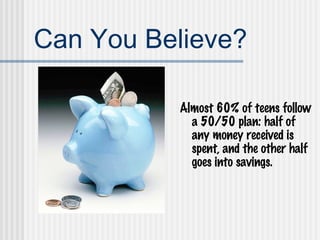
Can You Believe? Almost 60% of teens follow a 50/50 plan: half of any money received is spent, and the other half goes into savings.
What Is A Budget? A  budget  is a plan for managing money during a given period of time. Income : Any money coming in >What’s the difference between  gross income  and  net income ?
What Is A Budget? Expenses : The money you spend on your needs and wants; Money going out >What’s the difference between fixed expenses and variable expenses? - Fixed expenses  have set dollar amounts and are the  exact amount every time (Ex: Rent or car payment) - Variable expenses  can change, which means you have  more control over them  (Ex: What you spend on car gas or entertainment)
Benefits of a Budget Will help you live within your means Can help you save toward important goals Forces you to evaluate and modify your spending patterns
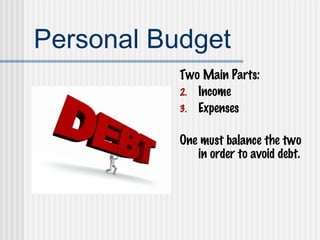
Personal Budget Two Main Parts: Income Expenses One must balance the two in order to avoid debt.
Building Your Own Budget When you’re in control of your spending, you are able to make clear, planned decisions on the best way to spend your money and make your money work for you.
Building Your Own Budget Step 1: Consider Financial Goals Write down long-term and short-term goals Step 2: Estimate Income Think about net income as well as other sources of income Step 3: Estimate Expenses Look at previous billing statements Take note of fixed and variable expenses
Building Your Own Budget Step 4: Plan for Savings Aim to save anywhere from 3 to 9 months’ income to cover emergencies Further savings should be invested appropriately (consider a  50/50 plan ) Step 5: Develop a Trial Budget Fill out what you expect to earn and spend, then record actual income and expenses
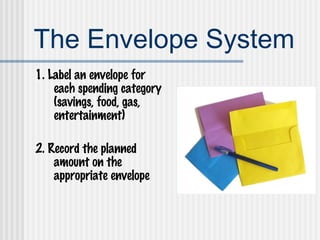
The Envelope System 1. Label an envelope for each spending category (savings, food, gas, entertainment) 2. Record the planned amount on the appropriate envelope
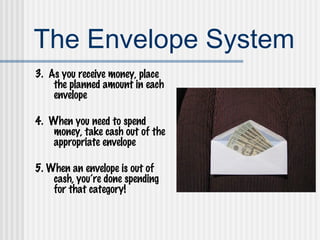
The Envelope System 3.  As you receive money, place the planned amount in each envelope 4.  When you need to spend money, take cash out of the appropriate envelope 5. When an envelope is out of cash, you’re done spending for that category!
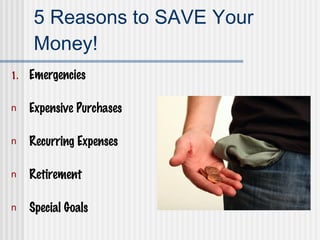
5 Reasons to SAVE Your Money! Emergencies Expensive Purchases Recurring Expenses Retirement Special Goals

Budgeting & Saving PowerPoint

  • 1.
    Budgeting & Saving:Don’t Go Broke!
  • 2.
    Can You Believe?On average, teens earn about $5.70 per hour and work about 15 hours per week, for a weekly paycheck of over $80. In 1998, the average teenager earned almost $2,300 for the year. The average teen receives $50 a week from parents.
  • 3.
    Can You Believe?Teenagers in the U.S. spent over $155 billion in 2000. Teen girls spend about $91 per week on average, while teen boys spend about $87.
  • 4.
    Can You Believe?A little over 1/3 of teens receive a regular allowance, and about 20% of teens have a full- or part-time job. 22% of teens have checking accounts.
  • 5.
    Can You Believe?Almost 60% of teens follow a 50/50 plan: half of any money received is spent, and the other half goes into savings.
  • 6.
    What Is ABudget? A budget is a plan for managing money during a given period of time. Income : Any money coming in >What’s the difference between gross income and net income ?
  • 7.
    What Is ABudget? Expenses : The money you spend on your needs and wants; Money going out >What’s the difference between fixed expenses and variable expenses? - Fixed expenses have set dollar amounts and are the exact amount every time (Ex: Rent or car payment) - Variable expenses can change, which means you have more control over them (Ex: What you spend on car gas or entertainment)
  • 8.
    Benefits of aBudget Will help you live within your means Can help you save toward important goals Forces you to evaluate and modify your spending patterns
  • 9.
    Personal Budget TwoMain Parts: Income Expenses One must balance the two in order to avoid debt.
  • 10.
    Building Your OwnBudget When you’re in control of your spending, you are able to make clear, planned decisions on the best way to spend your money and make your money work for you.
  • 11.
    Building Your OwnBudget Step 1: Consider Financial Goals Write down long-term and short-term goals Step 2: Estimate Income Think about net income as well as other sources of income Step 3: Estimate Expenses Look at previous billing statements Take note of fixed and variable expenses
  • 12.
    Building Your OwnBudget Step 4: Plan for Savings Aim to save anywhere from 3 to 9 months’ income to cover emergencies Further savings should be invested appropriately (consider a 50/50 plan ) Step 5: Develop a Trial Budget Fill out what you expect to earn and spend, then record actual income and expenses
  • 13.
    The Envelope System1. Label an envelope for each spending category (savings, food, gas, entertainment) 2. Record the planned amount on the appropriate envelope
  • 14.
    The Envelope System3. As you receive money, place the planned amount in each envelope 4. When you need to spend money, take cash out of the appropriate envelope 5. When an envelope is out of cash, you’re done spending for that category!
  • 15.
    5 Reasons toSAVE Your Money! Emergencies Expensive Purchases Recurring Expenses Retirement Special Goals