paget’s disease
Haley Anderson, Heather Anderson, Christen
      biddle, Susan Cole, Amber Ennis
Paget’s Disease
        Pathophysiology
• A chronic form of osteitis,
  most commonly affecting
  older people, causing
  thickening and hypertrophy
  of the long bones and
  deformity of the flat bones.
• The bone is excessively
  broken down (osteoclastic
  activity) and re-formed
  (osteoblastic activity).      VIDEO
Interventions for Paget’s Disease

•  Pain prevention
  • Drug therapy
  • Gentle massage
  • Heat application
  • ROM
• Fall Prevention r/t increased risk of bone fractures
  • Use a cane or walker
  • Remove rugs and floor coverings
  • Install handrails
• Diet Modifications
  • Increase calcium intake
  • Increase vitamin D intake
  • Promote reabsorption of calcium
Interventions for Paget’s Disease

  •  Smoking Cessation
    • Smoking increases bone loss
  • Avoid Excessive Alcohol
    • Alcohol inhibits formation of bone
    • Inhibits ability to absorb calcium
    • Increased fall risk
  • Exercise
      •   Maintains mobility and strength
      •   Talk to you doctor before beginning an
          exercise plan because too much stress on
          bones can cause excess damage
Assessment for Paget’s Disease

•80% of patient may be asymptomatic
•Ask about history of fracture and current bone
pain
•Hip and pelvis is the most common places where
pain occurs
•If the pain is radiating or throbbing pain
•Observe posture, stance, and gait
•Assess for kyphosis or scoliosis of the spinal
column
Assessment for Paget’s Disease

•   Assess the shape and size of the skull (typically
    soft, thick & enlarged)
•   Patient may c/o of loss of hearing or vertigo
    due to enlarged temporal bone
•   Patient could have hydrocephalus due to
    blocked CSF
•   Assess skin for color and temerature
•   Assess energy level
•   Lab Tests (serum ALP, urinary hydroxproline,
    calcium, uric acid)
•   X-Rays, CT Scan, and MRI
Diagnosis

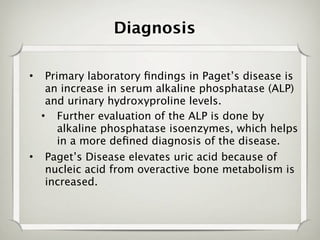
•  Primary laboratory findings in Paget’s disease is
   an increase in serum alkaline phosphatase (ALP)
   and urinary hydroxyproline levels.
  • Further evaluation of the ALP is done by
      alkaline phosphatase isoenzymes, which helps
      in a more defined diagnosis of the disease.
• Paget’s Disease elevates uric acid because of
   nucleic acid from overactive bone metabolism is
   increased.
Diagnosis
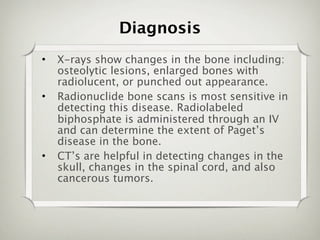
•   X-rays show changes in the bone including:
    osteolytic lesions, enlarged bones with
    radiolucent, or punched out appearance.
•   Radionuclide bone scans is most sensitive in
    detecting this disease. Radiolabeled
    biphosphate is administered through an IV
    and can determine the extent of Paget’s
    disease in the bone.
•   CT’s are helpful in detecting changes in the
    skull, changes in the spinal cord, and also
    cancerous tumors.
Cultural Considerations

Both environmental and genetics contribute to
Paget’s disease, though the etiology is unknown.

Paget’s disease is most commonly found in:
Europe
North America
Australia
New Zealand

Paget’s disease is rarely found in Asia and Africa
Cultural Considerations
•   In the United states, Paget’s disease is most
    commonly found in white ethnicity
•   Paget’s disease can be found all over the
    world but is most often found in Europe
    and Australia
•   Affects an estimated 3% of people over the
    age of 40
•   The most popular descent with Paget’s
    disease is Anglo-Saxon, this has led
    researchers to think a genetic factor may be
    important in the development of Paget’s
    disease
Commonly Used Treatment
    Methods For Paget’s Disease
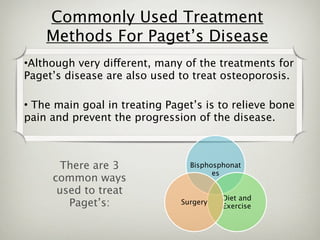
•Although very different, many of the treatments for
Paget’s disease are also used to treat osteoporosis.

• The main goal in treating Paget’s is to relieve bone
pain and prevent the progression of the disease.


       There are 3               Bisphosphonat
                                       es
     common ways
      used to treat
                                         Diet and
        Paget’s:               Surgery
                                         Exercise
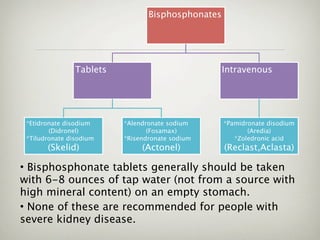
Bisphosphonates


                Tablets                            Intravenous


 *Etidronate disodium     *Alendronate sodium      *Pamidronate disodium
        (Didronel)               (Fosamax)                (Aredia)
 *Tiludronate disodium    *Risendronate sodium        *Zoledronic acid
       (Skelid)                (Actonel)           (Reclast,Aclasta)

• Bisphosphonate tablets generally should be taken
with 6-8 ounces of tap water (not from a source with
high mineral content) on an empty stomach.
• None of these are recommended for people with
severe kidney disease.
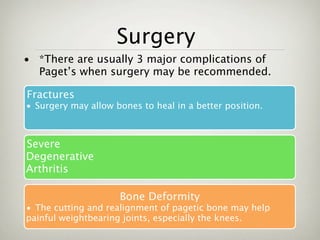
Surgery
• *There are usually 3 major complications of
  Paget’s when surgery may be recommended.

Fractures
• Surgery may allow bones to heal in a better position.


Severe
Degenerative
Arthritis

                     Bone Deformity
• The cutting and realignment of pagetic bone may help
painful weightbearing joints, especially the knees.
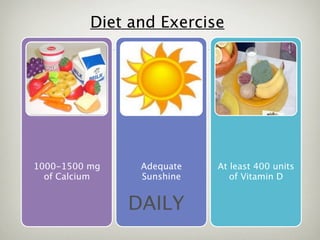
Diet and Exercise


1000-1500 mg    Adequate   At least 400 units
  of Calcium    Sunshine      of Vitamin D


               DAILY
DIAGNOSIS
 Disturbed body image r/t possible enlarged
head, bowed tibias, and kyphosis.
• Deficient knowledge r/t appropriate high in
protein and calcium, mild exercise.


 Chronic sorrow r/t chronic condition with
altered body image.
• Risk for trauma: fracture r/t excessive bone
destruction.
Sources

• http://www.arthritis.ca/types%20of
  %20arthritis/pagets/default.asp?
  s=1&province=bc
• Ignatavicius. Medical-Surgical
  Nursing, 6th edition. Pg 1162-1164
• Taber, C. W., & Thomas, C. L. (1997).
  Taber's cyclopedic medical dictionary.
  Philadelphia: F.A. Davis.
Teaching Plan
1. Patients over the age of 40 can be at risk for Paget’s disease.

2. Medical treatment may not cure current health problems associated with Paget’s
disease

3. Surgery may be needed to reduce pain and increase activity.

4. When taking oral medications, patients should drink 6-8 oz of water.

5. Patients should remain in an upright position 30 minutes following taking medications.

6. Patient should also refrain from eating for 30 minutes following oral medication

7. Patients may experience heartburn with oral medications.

8. Although the condition is a chronic illness, Paget’s disease focuses on the bones
associated with the spine, pelvic, hip, thighs, head and arms but does not spread to new
bone.

9. Patient needs to adhere to frequent, regular check-ups with treating physicians

10. Paget’s disease does not majorly impact the quality of patient life. Research shows
many have no critical complaints while living with Paget’s disease.

Paget's disease group project

  • 1.
    paget’s disease Haley Anderson,Heather Anderson, Christen biddle, Susan Cole, Amber Ennis
  • 2.
    Paget’s Disease Pathophysiology • A chronic form of osteitis, most commonly affecting older people, causing thickening and hypertrophy of the long bones and deformity of the flat bones. • The bone is excessively broken down (osteoclastic activity) and re-formed (osteoblastic activity). VIDEO
  • 3.
    Interventions for Paget’sDisease • Pain prevention • Drug therapy • Gentle massage • Heat application • ROM • Fall Prevention r/t increased risk of bone fractures • Use a cane or walker • Remove rugs and floor coverings • Install handrails • Diet Modifications • Increase calcium intake • Increase vitamin D intake • Promote reabsorption of calcium
  • 4.
    Interventions for Paget’sDisease • Smoking Cessation • Smoking increases bone loss • Avoid Excessive Alcohol • Alcohol inhibits formation of bone • Inhibits ability to absorb calcium • Increased fall risk • Exercise • Maintains mobility and strength • Talk to you doctor before beginning an exercise plan because too much stress on bones can cause excess damage
  • 5.
    Assessment for Paget’sDisease •80% of patient may be asymptomatic •Ask about history of fracture and current bone pain •Hip and pelvis is the most common places where pain occurs •If the pain is radiating or throbbing pain •Observe posture, stance, and gait •Assess for kyphosis or scoliosis of the spinal column
  • 6.
    Assessment for Paget’sDisease • Assess the shape and size of the skull (typically soft, thick & enlarged) • Patient may c/o of loss of hearing or vertigo due to enlarged temporal bone • Patient could have hydrocephalus due to blocked CSF • Assess skin for color and temerature • Assess energy level • Lab Tests (serum ALP, urinary hydroxproline, calcium, uric acid) • X-Rays, CT Scan, and MRI
  • 7.
    Diagnosis • Primarylaboratory findings in Paget’s disease is an increase in serum alkaline phosphatase (ALP) and urinary hydroxyproline levels. • Further evaluation of the ALP is done by alkaline phosphatase isoenzymes, which helps in a more defined diagnosis of the disease. • Paget’s Disease elevates uric acid because of nucleic acid from overactive bone metabolism is increased.
  • 8.
    Diagnosis • X-rays show changes in the bone including: osteolytic lesions, enlarged bones with radiolucent, or punched out appearance. • Radionuclide bone scans is most sensitive in detecting this disease. Radiolabeled biphosphate is administered through an IV and can determine the extent of Paget’s disease in the bone. • CT’s are helpful in detecting changes in the skull, changes in the spinal cord, and also cancerous tumors.
  • 9.
    Cultural Considerations Both environmentaland genetics contribute to Paget’s disease, though the etiology is unknown. Paget’s disease is most commonly found in: Europe North America Australia New Zealand Paget’s disease is rarely found in Asia and Africa
  • 10.
    Cultural Considerations • In the United states, Paget’s disease is most commonly found in white ethnicity • Paget’s disease can be found all over the world but is most often found in Europe and Australia • Affects an estimated 3% of people over the age of 40 • The most popular descent with Paget’s disease is Anglo-Saxon, this has led researchers to think a genetic factor may be important in the development of Paget’s disease
  • 11.
    Commonly Used Treatment Methods For Paget’s Disease •Although very different, many of the treatments for Paget’s disease are also used to treat osteoporosis. • The main goal in treating Paget’s is to relieve bone pain and prevent the progression of the disease. There are 3 Bisphosphonat es common ways used to treat Diet and Paget’s: Surgery Exercise
  • 12.
    Bisphosphonates Tablets Intravenous *Etidronate disodium *Alendronate sodium *Pamidronate disodium (Didronel) (Fosamax) (Aredia) *Tiludronate disodium *Risendronate sodium *Zoledronic acid (Skelid) (Actonel) (Reclast,Aclasta) • Bisphosphonate tablets generally should be taken with 6-8 ounces of tap water (not from a source with high mineral content) on an empty stomach. • None of these are recommended for people with severe kidney disease.
  • 13.
    Surgery • *There areusually 3 major complications of Paget’s when surgery may be recommended. Fractures • Surgery may allow bones to heal in a better position. Severe Degenerative Arthritis Bone Deformity • The cutting and realignment of pagetic bone may help painful weightbearing joints, especially the knees.
  • 14.
    Diet and Exercise 1000-1500mg Adequate At least 400 units of Calcium Sunshine of Vitamin D DAILY
  • 15.
    DIAGNOSIS Disturbed bodyimage r/t possible enlarged head, bowed tibias, and kyphosis. • Deficient knowledge r/t appropriate high in protein and calcium, mild exercise. Chronic sorrow r/t chronic condition with altered body image. • Risk for trauma: fracture r/t excessive bone destruction.
  • 16.
    Sources • http://www.arthritis.ca/types%20of %20arthritis/pagets/default.asp? s=1&province=bc • Ignatavicius. Medical-Surgical Nursing, 6th edition. Pg 1162-1164 • Taber, C. W., & Thomas, C. L. (1997). Taber's cyclopedic medical dictionary. Philadelphia: F.A. Davis.
  • 17.
    Teaching Plan 1. Patientsover the age of 40 can be at risk for Paget’s disease. 2. Medical treatment may not cure current health problems associated with Paget’s disease 3. Surgery may be needed to reduce pain and increase activity. 4. When taking oral medications, patients should drink 6-8 oz of water. 5. Patients should remain in an upright position 30 minutes following taking medications. 6. Patient should also refrain from eating for 30 minutes following oral medication 7. Patients may experience heartburn with oral medications. 8. Although the condition is a chronic illness, Paget’s disease focuses on the bones associated with the spine, pelvic, hip, thighs, head and arms but does not spread to new bone. 9. Patient needs to adhere to frequent, regular check-ups with treating physicians 10. Paget’s disease does not majorly impact the quality of patient life. Research shows many have no critical complaints while living with Paget’s disease.