Interpreting Geologic History
THE PRINCIPLE OF UNIFORMITY: Geologists can infer events of the past by Looking  at features  of rocks and rock outcrops
Uniformitarianism (Principle of   states that the forces that acted upon the  ___________ crust… Uniformity) Earth’s
in the __________ are the same as those that are ____________ today. past active ** THE KEY TO THE PAST IS THE PRESENT**
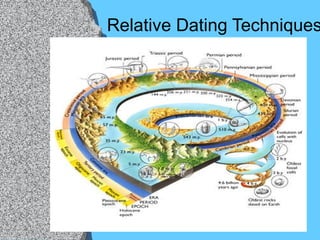
Relative Dating Techniques
5 Basic Laws:  1. Law of  Original Horizontality 2. Law of  Superposition 3. Law of  Inclusions 4. Law of  Cross-Cutting Relationships 5. Law of  Original Lateral Continuity
Law of Original Horizontality Strata is originally  deposited in flat horizontal layers because sedimentary particles settle from air and water under the  influence of gravity
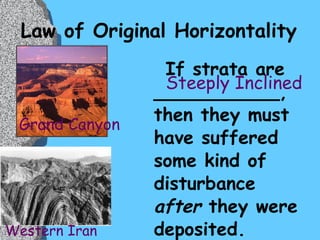
Law of Original Horizontality If strata are ___________,  then they must have suffered some kind of disturbance  after  they were deposited. Grand Canyon Western Iran Steeply Inclined
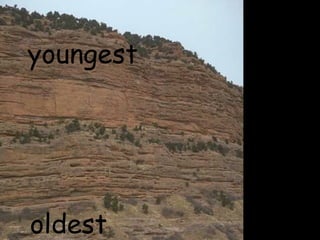
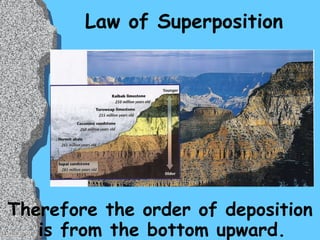
THE LAW OF SUPERPOSITION: the principle that the _________ layers in a sequence of rock strata must have been deposited __________ the layers above, unless the rock strata have been ___________ or___________ bottom before disturbed uplifted
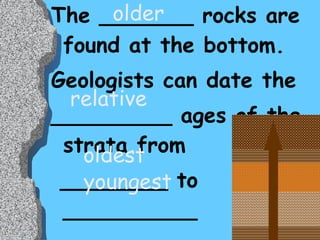
The _______ rocks are found at the bottom.  Geologists can date the _________ ages of the strata from ________ to __________ older relative oldest youngest
oldest youngest
Law of Superposition Therefore the order of deposition is from the bottom upward.
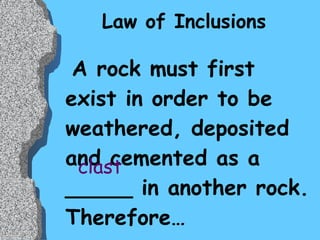
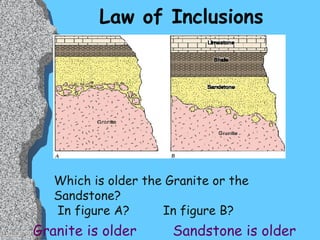
Law of Inclusions A rock must first exist in order to be weathered, deposited and cemented as a _____ in another rock. Therefore… clast
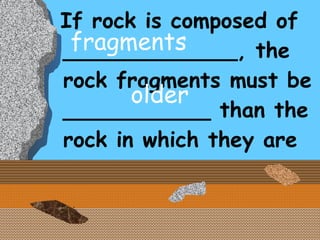
If rock is composed of _____________, the rock fragments must be ___________ than the rock in which they are found. fragments older
Law of Inclusions Which is older the Granite or the Sandstone? In figure A?  In figure B?  Sandstone is older Granite is older
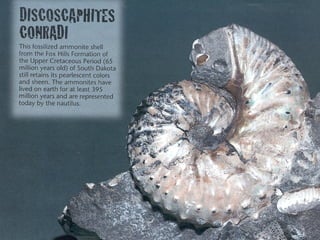
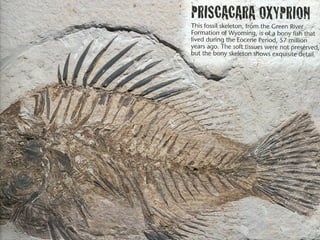
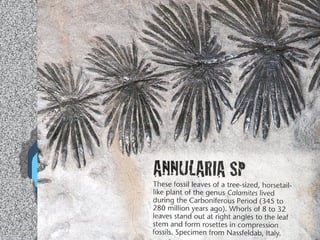
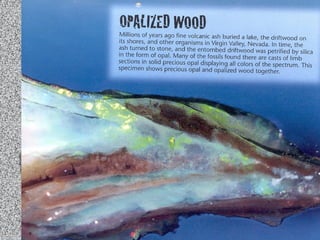
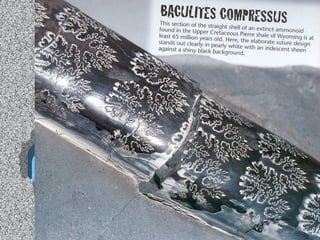
The law of inclusions also applies to fossils preserved in the bedrock.
_________ are any naturally preserved remains or impressions of living things.  Fossils


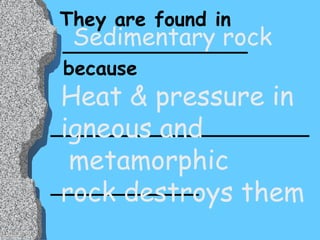
They are found in _______________ because  _____________________ ____________ Sedimentary rock Heat & pressure in  igneous and metamorphic  rock destroys them
FOSSILS GIVE US INFORMATION ABOUT THE ANCIENT ENVIRONMENT  AND CLIMATE
Law of Cross-Cutting Relationships Any __________ or ______, must be younger than all rocks through which it cuts.  Simply put, the body of rock that is cross-cut had to be there first in order to be cut by an intruding igneous body or fault.  Igneous rock fault
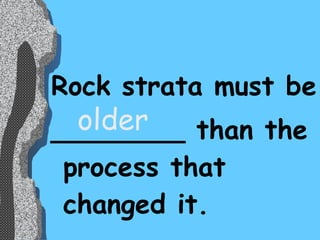
In general  rock is always_________ than the  process   that changed it. older
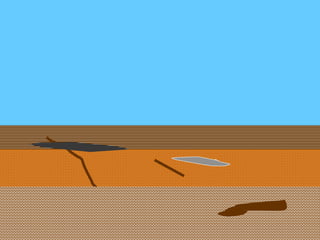
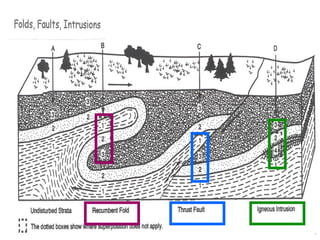
Some Processes Include: folds faults tilts intrusions extrusions
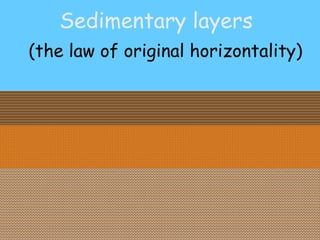
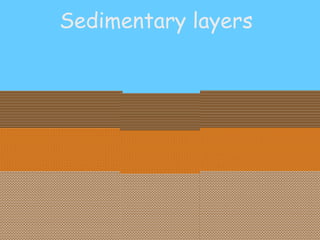
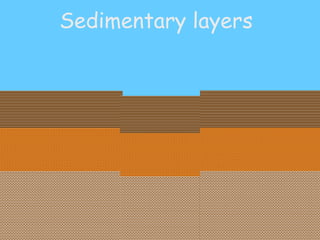
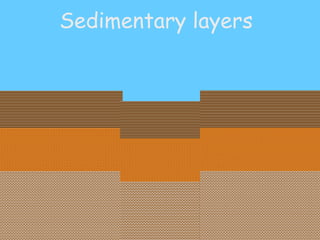
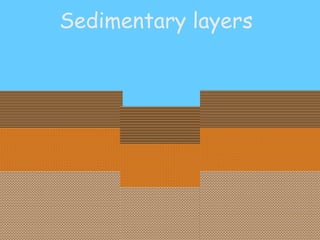
Sedimentary layers (the law of original horizontality)
Sedimentary layers
Sedimentary layers
Sedimentary layers
Sedimentary layers
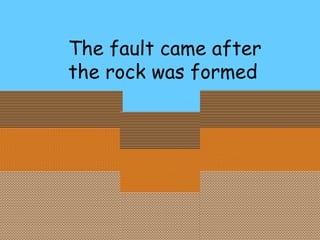
The fault came after  the rock was formed
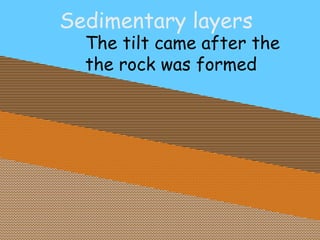
Sedimentary layers The tilt came after the  the rock was formed
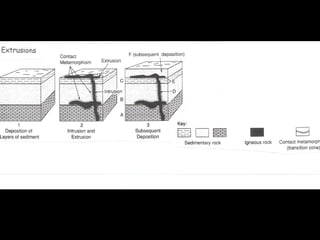
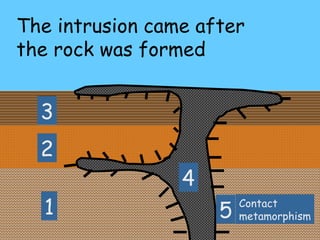
The extrusion came after the rock was formed 1 2 3 4 5 Contact metamorphism
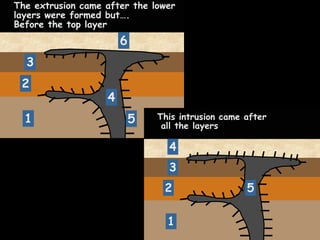
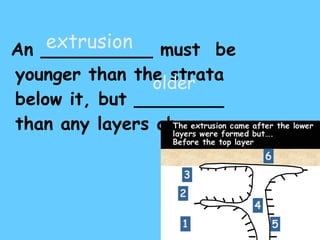
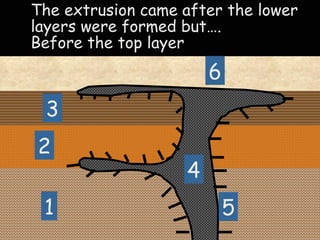
1 2 3 4 5 6 The extrusion came after the lower layers were formed but…. Before the top layer
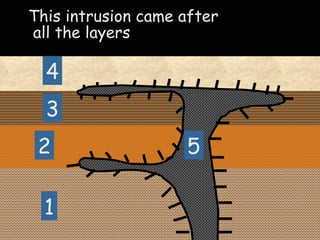
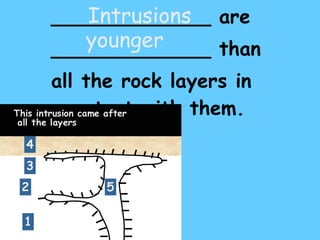
1 2 3 4 5 This intrusion came after all the layers
 
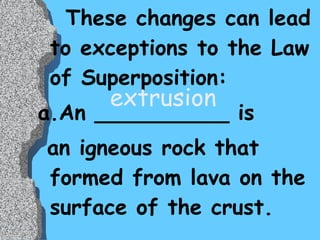
These changes can lead to exceptions to the Law of Superposition: a.An __________ is  an igneous rock that formed from lava on the surface of the crust. extrusion
An __________ must  be younger than the strata below it, but ________ than any layers above. extrusion older
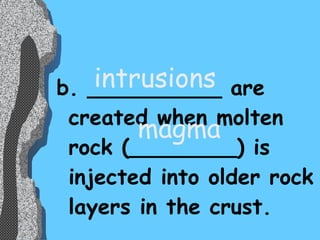
b. __________ are created when molten rock (________) is injected into older rock layers in the crust.  intrusions magma
_____________ are _____________ than all the rock layers in contact with them. Intrusions younger
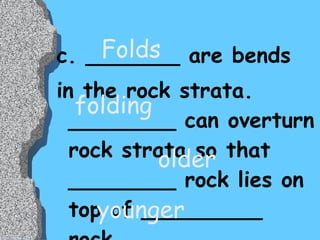
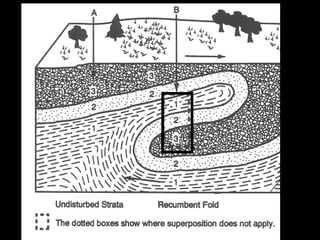
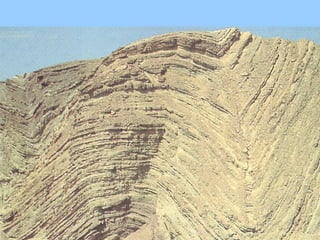
c. _______ are bends  in the rock strata. ________ can overturn rock strata so that ________ rock lies on top of _________ rock. Folds folding older younger
 
 
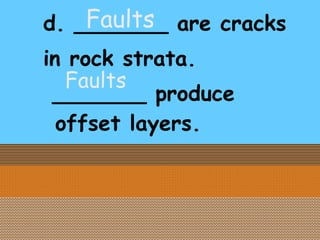
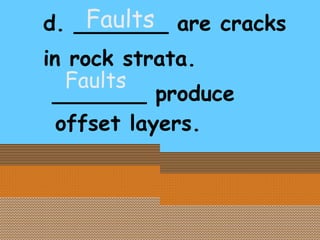
d. _______ are cracks in rock strata. _______ produce offset layers. Faults Faults
Rock strata must be ________ than the process that changed it. older
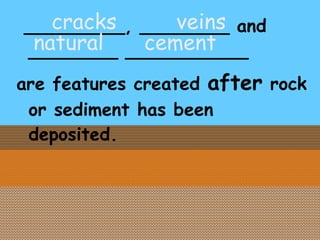
_________, ________ and ________ ___________ are features created  after  rock or sediment has been deposited. cracks veins natural cement
 
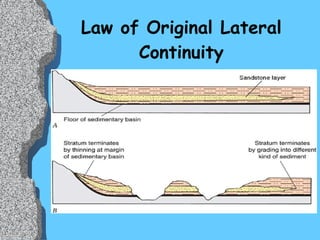
Law of Original Lateral Continuity . When sediment is dumped by an agent of erosion, strata extends from the source until it gradually thins to zero, or until it reaches the edges of the basin of __________.  deposition
Law of Original Lateral Continuity
Law of Original Lateral Continuity This concept enables us to correlate outcrops of strata that has been dissected by processes of ________. erosion
CORRELATION OF ROCK STRATA: Correlation is  Matching similar rock strata at different locations  to see  if they formed at the same time
Ways to correlate rock formations: “ Walking the outcrop” is done by  Walking from  end to end
This is correlation by continuity
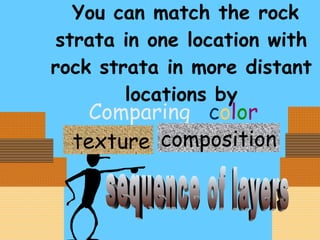
You can match the rock strata in one location with rock strata in more distant locations by Comparing ,  c o l o r texture composition sequence of layers
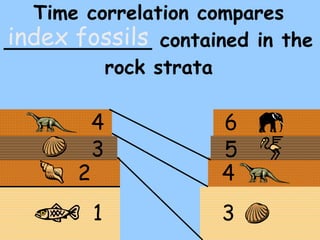
Time correlation compares ____________ contained in the rock strata index fossils 1 2 3 4 4 5 6 3
The best index fossils: a. _________________ b. _________________ Exist for a brief  period of time are widespread
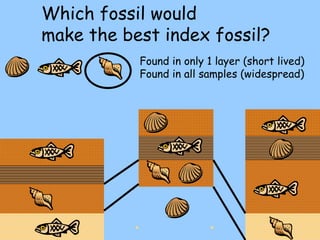
Which fossil would  make the best index fossil? Found in only 1 layer (short lived) Found in all samples (widespread)
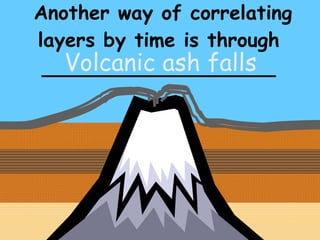
Another way of correlating layers by time is through ___________________ Volcanic ash falls
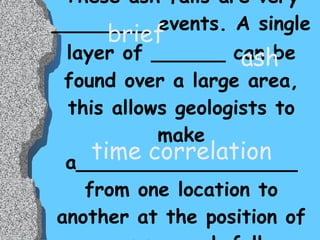
These ash falls are very ________ events. A single layer of ______ can be   found over a large area, this allows geologists to make a__________________ from one location to another at the position of a common ash fall. brief ash time correlation
GEOLOGIC TIME SCALE: A. Geologists noticed that rock _________ can be identified by the  fossils  they contained.  formations
They also found that certain __________ were consistently located ________ or _________ other formations. formations above below
From these observations they established a  ______ ____ ______ with a sequence of fossil groups from ______ to ______________ relative  time  scale oldest youngest
Each of these groups was named for a location where its ____________ ______ could be observed in the rocks. Characteristic  fossil Example: Devon fossil  “ Devonian ”  found in  Devon England
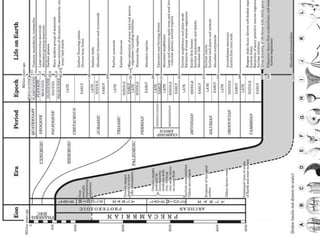
Further observations from around the world established a  ________ _____ _____ Geologic  time  scale
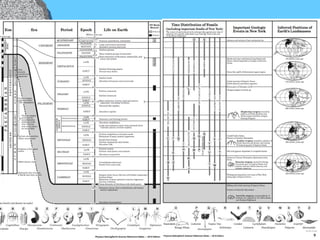
Based on __________________________________ and ________________ ________ _____ _____ Inferred positions of Earth’s Landmasses  Major Geologic Events (ex. Ice ages & Orogenys)
An ________ is the process of mountain building TURN TO PAGES 8 & 9 IN YOU ESRT! Orogeny
 
 
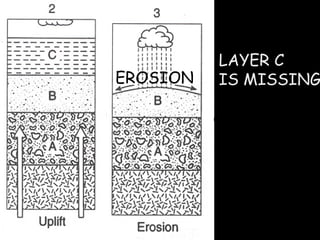
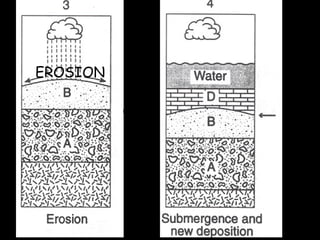
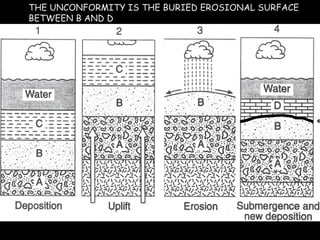
GEOLOGIC EVENTS OF THE PAST: _________ causes gaps in the geologic record. Erosion MISSING LAYERS
When a new layer  of rock is laid down on a surface that has been _______ it forms a buried erosional surface or an ___________________ Eroded, unconformity
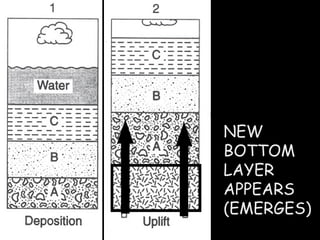
NEW BOTTOM LAYER  APPEARS (EMERGES)
LAYER C IS MISSING EROSION
EROSION
THE UNCONFORMITY IS THE BURIED EROSIONAL SURFACE BETWEEN B AND D
 
 
ACTIVITY WHICH IS OLDER
VII. RADIOACTIVE DATING: A. Fossils enabled geologists to give ___________ time, relative
Relative Time Compares rock ages to _______________. Ex: The Limestone is older than the Sandstone.  each other
However,  B. Measurements of natural ___________in ( metamorphic and  igneous) rocks have allowed the _________ time scale to be an ________ time scale. geologic absolute radioactivity
The _________ _____ of an object is measured in years. Ex: The limestone formed 5 mya and the sandstone formed  2 mya absolute  age
C. Chemical elements often have several forms called _______________ isotopes
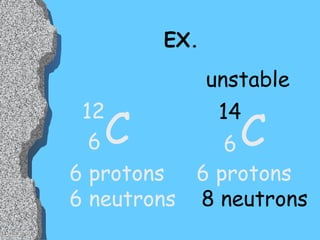
ISOTOPE: An unstable element with different number of neutrons than a normal (stable) element.  (Its unstable so wants to change to stable)
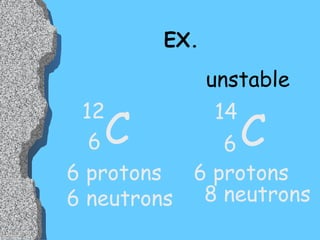
EX. C C 6 6 12 14 6 protons  6 protons 6 neutrons Unstable 8 neutrons
EX. C C 6 6 12 14 6 protons  6 protons 6 neutrons  8 neutrons unstable
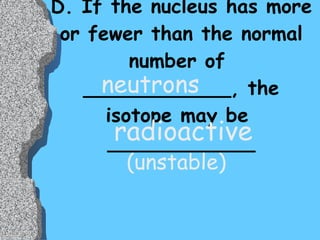
D. If the nucleus has more or fewer than the normal number of  ____________, the isotope may be  ____________ neutrons radioactive (unstable)
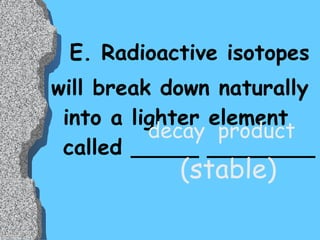
E. A radioactive isotope will break down naturally into a lighter element called  _____ ________ which is  stable.  decay  product
This process is called… Radioactive Decay
RADIOACTIVE DECAY: WHEN AN UNSTABLE ________ ELEMENT CHANGES INTO A COMPLETELY DIFFERENT (BUT STABLE) __________ ELEMENT DAUGHTER PARENT
F. A sample starts out at “Time zero” with _______ Percent of radioactive material. 100
Time Zero: when the sample is originally formed by cooling or solidification of igneous or metamorphic rock
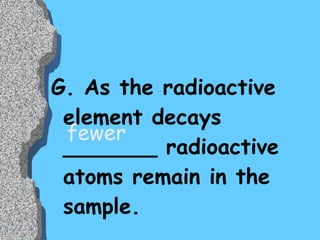
As time goes by and the sample gets older, the radioactive element decay, and  _______ radioactive atoms remain in the sample.  fewer
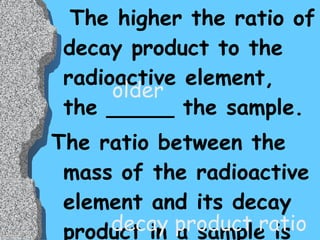
Therefore, the higher the ratio of decay product to the radioactive element, the _____ the sample. older
The ratio between the mass of the radioactive element and its decay product in a sample is the _______________ decay product ratio
G. The decay of the parent atoms in a sample to daughter atoms is a _________ process…  random
That happens at _____________ rates for different radioactive elements. Lets model this with pennies… different
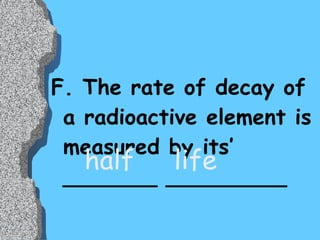
H. The rate of decay of a radioactive element is measured by its’ _______ _________ half  life
HALF-LIFE: THE AMOUNT OF TIME IT TAKES FOR  HALF  OF THE UNSTABLE ATOMS IN A SAMPLE TO CHANGE TO THE STABLE DECAY PRODUCT
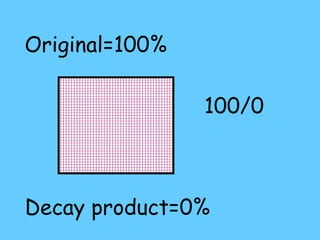
Original=100% Decay product=0% 100/0 Or  1 to 0
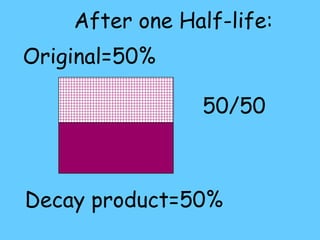
Original=50% Decay product=50% 50/50  Or  1 to 1 After one Half-life:
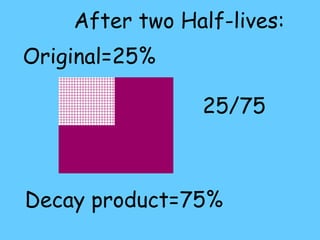
Original=25% Decay product=75% 25/75 Or  1:3  After two Half-lives:
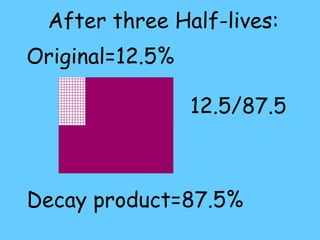
Original=12.5% Decay product=87.5% 12.5/87.5 After three Half-lives:
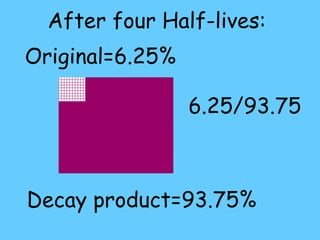
Original=6.25% Decay product=93.75% 6.25/93.75 After four Half-lives:
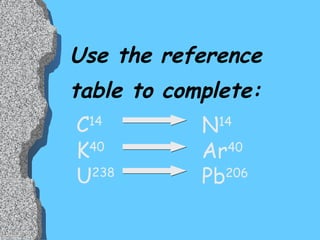
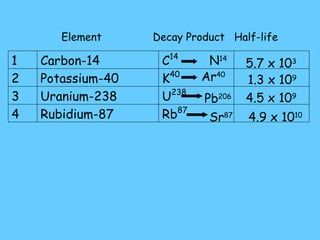
N 14 Ar 40 Pb 206 Sr 87 5.7 x 10 3 1.3 x 10 9 4.5 x 10 9 4.9 x 10 10 Element  Decay Product  Half-life
H. Calculating the age of a rock: 1. What would be the age of the rock if it has equal amounts of C-14 and its decay product N-14?
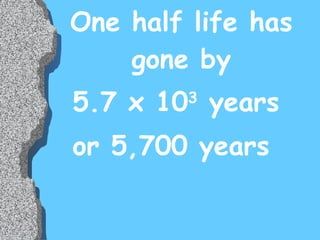
One half life has gone by 5.7 x 10 3  years or 5,700 years
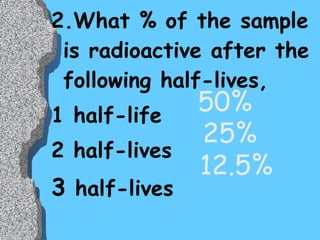
2.What % of the sample is radioactive after the following half-lives, 1 half-life 2 half-lives 3  half-lives 50% 25% 12.5%
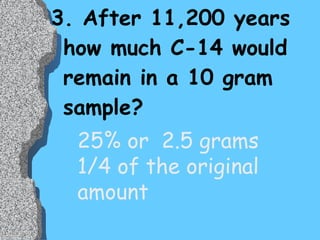
3. After 11,200 years how much C-14 would remain in a 10 gram sample? 25% or  2.5 grams 1/4 of the original  amount
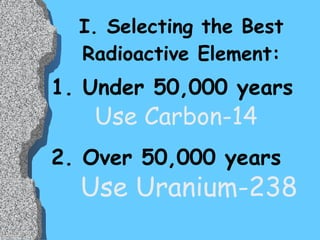
I. Selecting the Best Radioactive Element: 1. Under 50,000 years 2. Over 50,000 years Use Carbon-14 Use Uranium-238
Carbon 14 is used for dating   organic material And ancient wood fires
“Time Zero” for carbon dating begins when the organism ___________ or when the ________ burns out.  dies wood fire
 

Interpreting Geologic History Updated

  • 1.
  • 2.
    THE PRINCIPLE OFUNIFORMITY: Geologists can infer events of the past by Looking at features of rocks and rock outcrops
  • 3.
    Uniformitarianism (Principle of states that the forces that acted upon the ___________ crust… Uniformity) Earth’s
  • 4.
    in the __________are the same as those that are ____________ today. past active ** THE KEY TO THE PAST IS THE PRESENT**
  • 5.
  • 6.
    5 Basic Laws: 1. Law of Original Horizontality 2. Law of Superposition 3. Law of Inclusions 4. Law of Cross-Cutting Relationships 5. Law of Original Lateral Continuity
  • 7.
    Law of OriginalHorizontality Strata is originally deposited in flat horizontal layers because sedimentary particles settle from air and water under the influence of gravity
  • 8.
    Law of OriginalHorizontality If strata are ___________, then they must have suffered some kind of disturbance after they were deposited. Grand Canyon Western Iran Steeply Inclined
  • 9.
    THE LAW OFSUPERPOSITION: the principle that the _________ layers in a sequence of rock strata must have been deposited __________ the layers above, unless the rock strata have been ___________ or___________ bottom before disturbed uplifted
  • 10.
    The _______ rocksare found at the bottom. Geologists can date the _________ ages of the strata from ________ to __________ older relative oldest youngest
  • 11.
  • 12.
    Law of SuperpositionTherefore the order of deposition is from the bottom upward.
  • 13.
    Law of InclusionsA rock must first exist in order to be weathered, deposited and cemented as a _____ in another rock. Therefore… clast
  • 14.
    If rock iscomposed of _____________, the rock fragments must be ___________ than the rock in which they are found. fragments older
  • 15.
    Law of InclusionsWhich is older the Granite or the Sandstone? In figure A? In figure B? Sandstone is older Granite is older
  • 16.
    The law ofinclusions also applies to fossils preserved in the bedrock.
  • 17.
    _________ are anynaturally preserved remains or impressions of living things. Fossils
  • 18.
  • 19.
  • 20.
  • 21.
  • 22.
  • 23.
  • 24.
  • 25.
  • 26.
    They are foundin _______________ because _____________________ ____________ Sedimentary rock Heat & pressure in igneous and metamorphic rock destroys them
  • 27.
    FOSSILS GIVE USINFORMATION ABOUT THE ANCIENT ENVIRONMENT AND CLIMATE
  • 28.
    Law of Cross-CuttingRelationships Any __________ or ______, must be younger than all rocks through which it cuts. Simply put, the body of rock that is cross-cut had to be there first in order to be cut by an intruding igneous body or fault. Igneous rock fault
  • 29.
    In general rock is always_________ than the process that changed it. older
  • 30.
    Some Processes Include:folds faults tilts intrusions extrusions
  • 31.
    Sedimentary layers (thelaw of original horizontality)
  • 32.
  • 33.
  • 34.
  • 35.
  • 36.
    The fault cameafter the rock was formed
  • 37.
    Sedimentary layers Thetilt came after the the rock was formed
  • 38.
    The extrusion cameafter the rock was formed 1 2 3 4 5 Contact metamorphism
  • 39.
    1 2 34 5 6 The extrusion came after the lower layers were formed but…. Before the top layer
  • 40.
    1 2 34 5 This intrusion came after all the layers
  • 41.
  • 42.
    These changes canlead to exceptions to the Law of Superposition: a.An __________ is an igneous rock that formed from lava on the surface of the crust. extrusion
  • 43.
    An __________ must be younger than the strata below it, but ________ than any layers above. extrusion older
  • 44.
    b. __________ arecreated when molten rock (________) is injected into older rock layers in the crust. intrusions magma
  • 45.
    _____________ are _____________than all the rock layers in contact with them. Intrusions younger
  • 46.
    c. _______ arebends in the rock strata. ________ can overturn rock strata so that ________ rock lies on top of _________ rock. Folds folding older younger
  • 47.
  • 48.
  • 49.
    d. _______ arecracks in rock strata. _______ produce offset layers. Faults Faults
  • 50.
    d. _______ arecracks in rock strata. _______ produce offset layers. Faults Faults
  • 51.
    Rock strata mustbe ________ than the process that changed it. older
  • 52.
    _________, ________ and________ ___________ are features created after rock or sediment has been deposited. cracks veins natural cement
  • 53.
  • 54.
    Law of OriginalLateral Continuity . When sediment is dumped by an agent of erosion, strata extends from the source until it gradually thins to zero, or until it reaches the edges of the basin of __________. deposition
  • 55.
    Law of OriginalLateral Continuity
  • 56.
    Law of OriginalLateral Continuity This concept enables us to correlate outcrops of strata that has been dissected by processes of ________. erosion
  • 57.
    CORRELATION OF ROCKSTRATA: Correlation is Matching similar rock strata at different locations to see if they formed at the same time
  • 58.
    Ways to correlaterock formations: “ Walking the outcrop” is done by Walking from end to end
  • 59.
    This is correlationby continuity
  • 60.
    You can matchthe rock strata in one location with rock strata in more distant locations by Comparing , c o l o r texture composition sequence of layers
  • 61.
    Time correlation compares____________ contained in the rock strata index fossils 1 2 3 4 4 5 6 3
  • 62.
    The best indexfossils: a. _________________ b. _________________ Exist for a brief period of time are widespread
  • 63.
    Which fossil would make the best index fossil? Found in only 1 layer (short lived) Found in all samples (widespread)
  • 64.
    Another way ofcorrelating layers by time is through ___________________ Volcanic ash falls
  • 65.
    These ash fallsare very ________ events. A single layer of ______ can be found over a large area, this allows geologists to make a__________________ from one location to another at the position of a common ash fall. brief ash time correlation
  • 66.
    GEOLOGIC TIME SCALE:A. Geologists noticed that rock _________ can be identified by the fossils they contained. formations
  • 67.
    They also foundthat certain __________ were consistently located ________ or _________ other formations. formations above below
  • 68.
    From these observationsthey established a ______ ____ ______ with a sequence of fossil groups from ______ to ______________ relative time scale oldest youngest
  • 69.
    Each of thesegroups was named for a location where its ____________ ______ could be observed in the rocks. Characteristic fossil Example: Devon fossil “ Devonian ” found in Devon England
  • 70.
    Further observations fromaround the world established a ________ _____ _____ Geologic time scale
  • 71.
    Based on __________________________________and ________________ ________ _____ _____ Inferred positions of Earth’s Landmasses Major Geologic Events (ex. Ice ages & Orogenys)
  • 72.
    An ________ isthe process of mountain building TURN TO PAGES 8 & 9 IN YOU ESRT! Orogeny
  • 73.
  • 74.
  • 75.
    GEOLOGIC EVENTS OFTHE PAST: _________ causes gaps in the geologic record. Erosion MISSING LAYERS
  • 76.
    When a newlayer of rock is laid down on a surface that has been _______ it forms a buried erosional surface or an ___________________ Eroded, unconformity
  • 77.
    NEW BOTTOM LAYER APPEARS (EMERGES)
  • 78.
    LAYER C ISMISSING EROSION
  • 79.
  • 80.
    THE UNCONFORMITY ISTHE BURIED EROSIONAL SURFACE BETWEEN B AND D
  • 81.
  • 82.
  • 83.
  • 84.
    VII. RADIOACTIVE DATING:A. Fossils enabled geologists to give ___________ time, relative
  • 85.
    Relative Time Comparesrock ages to _______________. Ex: The Limestone is older than the Sandstone. each other
  • 86.
    However, B.Measurements of natural ___________in ( metamorphic and igneous) rocks have allowed the _________ time scale to be an ________ time scale. geologic absolute radioactivity
  • 87.
    The _________ _____of an object is measured in years. Ex: The limestone formed 5 mya and the sandstone formed 2 mya absolute age
  • 88.
    C. Chemical elementsoften have several forms called _______________ isotopes
  • 89.
    ISOTOPE: An unstableelement with different number of neutrons than a normal (stable) element. (Its unstable so wants to change to stable)
  • 90.
    EX. C C6 6 12 14 6 protons 6 protons 6 neutrons Unstable 8 neutrons
  • 91.
    EX. C C6 6 12 14 6 protons 6 protons 6 neutrons 8 neutrons unstable
  • 92.
    D. If thenucleus has more or fewer than the normal number of ____________, the isotope may be ____________ neutrons radioactive (unstable)
  • 93.
    E. A radioactiveisotope will break down naturally into a lighter element called _____ ________ which is stable. decay product
  • 94.
    This process iscalled… Radioactive Decay
  • 95.
    RADIOACTIVE DECAY: WHENAN UNSTABLE ________ ELEMENT CHANGES INTO A COMPLETELY DIFFERENT (BUT STABLE) __________ ELEMENT DAUGHTER PARENT
  • 96.
    F. A samplestarts out at “Time zero” with _______ Percent of radioactive material. 100
  • 97.
    Time Zero: whenthe sample is originally formed by cooling or solidification of igneous or metamorphic rock
  • 98.
    As time goesby and the sample gets older, the radioactive element decay, and _______ radioactive atoms remain in the sample. fewer
  • 99.
    Therefore, the higherthe ratio of decay product to the radioactive element, the _____ the sample. older
  • 100.
    The ratio betweenthe mass of the radioactive element and its decay product in a sample is the _______________ decay product ratio
  • 101.
    G. The decayof the parent atoms in a sample to daughter atoms is a _________ process… random
  • 102.
    That happens at_____________ rates for different radioactive elements. Lets model this with pennies… different
  • 103.
    H. The rateof decay of a radioactive element is measured by its’ _______ _________ half life
  • 104.
    HALF-LIFE: THE AMOUNTOF TIME IT TAKES FOR HALF OF THE UNSTABLE ATOMS IN A SAMPLE TO CHANGE TO THE STABLE DECAY PRODUCT
  • 105.
  • 106.
    Original=50% Decay product=50%50/50 Or 1 to 1 After one Half-life:
  • 107.
    Original=25% Decay product=75%25/75 Or 1:3 After two Half-lives:
  • 108.
    Original=12.5% Decay product=87.5%12.5/87.5 After three Half-lives:
  • 109.
    Original=6.25% Decay product=93.75%6.25/93.75 After four Half-lives:
  • 110.
    N 14 Ar40 Pb 206 Sr 87 5.7 x 10 3 1.3 x 10 9 4.5 x 10 9 4.9 x 10 10 Element Decay Product Half-life
  • 111.
    H. Calculating theage of a rock: 1. What would be the age of the rock if it has equal amounts of C-14 and its decay product N-14?
  • 112.
    One half lifehas gone by 5.7 x 10 3 years or 5,700 years
  • 113.
    2.What % ofthe sample is radioactive after the following half-lives, 1 half-life 2 half-lives 3 half-lives 50% 25% 12.5%
  • 114.
    3. After 11,200years how much C-14 would remain in a 10 gram sample? 25% or 2.5 grams 1/4 of the original amount
  • 115.
    I. Selecting theBest Radioactive Element: 1. Under 50,000 years 2. Over 50,000 years Use Carbon-14 Use Uranium-238
  • 116.
    Carbon 14 isused for dating organic material And ancient wood fires
  • 117.
    “Time Zero” forcarbon dating begins when the organism ___________ or when the ________ burns out. dies wood fire
  • 118.