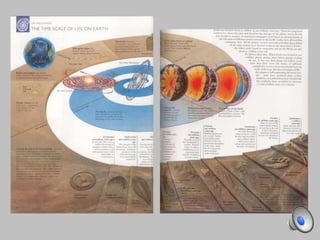
Guide to Rock Dating
Geologic Time
Guide to Geologic Record
• How do we understand the Earth and its
formation?
– By studying the past we may unlock the
secrets of the formation of the earth
– AND look at patterns that may affect the
Earth’s future inhabitants
• How do we examine the Earth’s past?
– By examining the evidence left behind
Evaluating Earth’s Past
• Methods for evaluating Earth’s past
include:
– Geologic samples
• Rock records & fossils
– Tree rings
– Plant pollen
– Oxygen isotopes in glacial ice
– Glacial evidence
– Plankton and isotopes in ocean sediment
Geologic Records
• Rock formations and fossils have given us
valuable information about the past
– Fossils provide information on organisms that
have lived on Earth
• Their physiology helps to understand the
conditions on earth at the time they lived
• Their physiology also gives clues as to their
lifestyle – feeding habits & environmental context
clues
– Rock formations provide
• Clues about the atmospheric and hydrospheric
processes occurring
Geologic Records
Rock Dating
• How do you date a rock?
• Sedimentary
– Very gently they break up easily!
• Igneous
– These guys are too cool to be dated!
• Metamorphic
– Frequently – they love change!
But seriously….
• The age of rocks is important to establish
time frames and context for other data
• Two types of Rock Dating
– Relative
– Absolute
• Relative dating
– Order of events
• Absolute Dating
– The (measured) age in years
Principles of Relative Dating
Principle of original horizontality
– Layers started flat
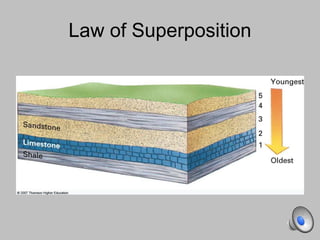
Law of Superposition:
– One layer of rock is older than the one above it and younger than
the one below it.
Principle of crosscutting relationships
– A rock MUST be older than a thing that cuts it
Principle of faunal succession
– Species lived in a recognizable order through time and relative
ages can be deduced from their fossils
• Principle of Uniformitarianism
– The processes of the past are the same as they are today
Law of Superposition
Hazards to Relative Dating
• Conformable – deposited without interruption
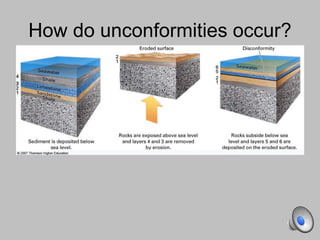
• Unconformity – an interruption in deposition of
the rock record. Represent a time gap.
• Disconformity – sedimentary layers parallel to
each other.
• Angular unconformity – tilted layers with newer
flat material atop
• Nonconformity – sedimentary rocks atop
igneous or metamorphic rock.
How do unconformities occur?
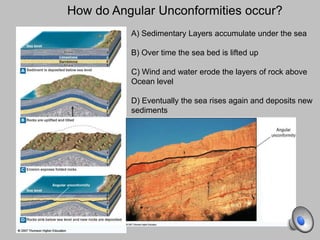
How do Angular Unconformities occur?
A) Sedimentary Layers accumulate under the sea
B) Over time the sea bed is lifted up
C) Wind and water erode the layers of rock above
Ocean level
D) Eventually the sea rises again and deposits new
sediments
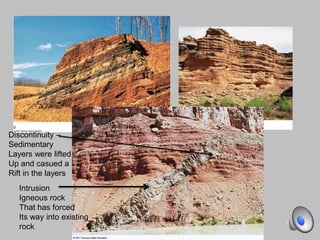
Intrusion
Igneous rock
That has forced
Its way into existing
rock
Discontinuity –
Sedimentary
Layers were lifted
Up and casued a
Rift in the layers
What can be used to date layers?
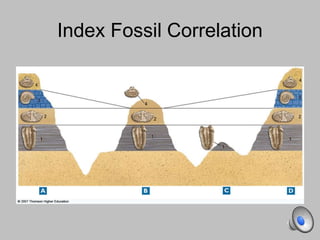
• Correlation – matching up rocks of similar
age in different locales
• Index fossils – accurately indicates the
age of a rock
• Key bed – a thin, widespread,
synchronous sedimentary layer
Index Fossil Correlation
Absolute Dating
• Radiometric dating – using half-lives to determine
absolute ages of rocks.
• Half-life – the time it takes for one-half the atoms of a
radioisotope to decompose to another isotope or
element
• Isotopes – radioactive varieties of an element
– Vary by the number of neutrons
• Carbon -12 and Carbon 14
• Uranium 238 and Uranium 235
• Decay occurs at a constant rate
• Half-lives range from thousands to billions of years
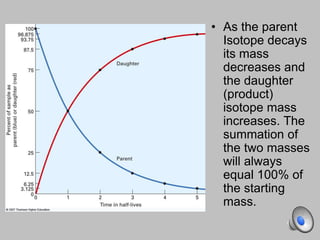
• As the parent
Isotope decays
its mass
decreases and
the daughter
(product)
isotope mass
increases. The
summation of
the two masses
will always
equal 100% of
the starting
mass.
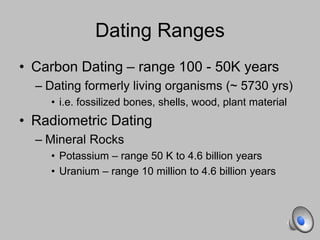
Dating Ranges
• Carbon Dating – range 100 - 50K years
– Dating formerly living organisms (~ 5730 yrs)
• i.e. fossilized bones, shells, wood, plant material
• Radiometric Dating
– Mineral Rocks
• Potassium – range 50 K to 4.6 billion years
• Uranium – range 10 million to 4.6 billion years
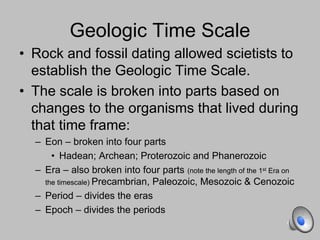
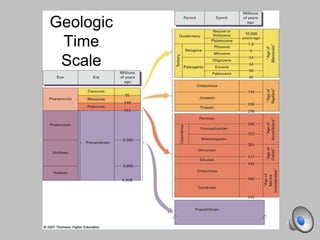
Geologic Time Scale
• Rock and fossil dating allowed scietists to
establish the Geologic Time Scale.
• The scale is broken into parts based on
changes to the organisms that lived during
that time frame:
– Eon – broken into four parts
• Hadean; Archean; Proterozoic and Phanerozoic
– Era – also broken into four parts (note the length of the 1st Era on
the timescale) Precambrian, Paleozoic, Mesozoic & Cenozoic
– Period – divides the eras
– Epoch – divides the periods
Geologic
Time
Scale
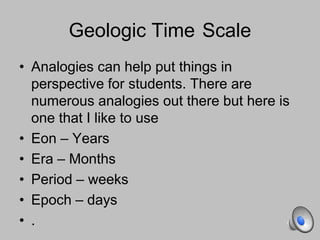
Geologic Time Scale
• Analogies can help put things in
perspective for students. There are
numerous analogies out there but here is
one that I like to use
• Eon – Years
• Era – Months
• Period – weeks
• Epoch – days
• .
Guide to rock dating chap 4

Guide to rock dating chap 4

  • 1.
    Guide to RockDating Geologic Time
  • 2.
    Guide to GeologicRecord • How do we understand the Earth and its formation? – By studying the past we may unlock the secrets of the formation of the earth – AND look at patterns that may affect the Earth’s future inhabitants • How do we examine the Earth’s past? – By examining the evidence left behind
  • 3.
    Evaluating Earth’s Past •Methods for evaluating Earth’s past include: – Geologic samples • Rock records & fossils – Tree rings – Plant pollen – Oxygen isotopes in glacial ice – Glacial evidence – Plankton and isotopes in ocean sediment
  • 4.
    Geologic Records • Rockformations and fossils have given us valuable information about the past – Fossils provide information on organisms that have lived on Earth • Their physiology helps to understand the conditions on earth at the time they lived • Their physiology also gives clues as to their lifestyle – feeding habits & environmental context clues – Rock formations provide • Clues about the atmospheric and hydrospheric processes occurring
  • 5.
    Geologic Records Rock Dating •How do you date a rock? • Sedimentary – Very gently they break up easily! • Igneous – These guys are too cool to be dated! • Metamorphic – Frequently – they love change!
  • 6.
    But seriously…. • Theage of rocks is important to establish time frames and context for other data • Two types of Rock Dating – Relative – Absolute • Relative dating – Order of events • Absolute Dating – The (measured) age in years
  • 7.
    Principles of RelativeDating Principle of original horizontality – Layers started flat Law of Superposition: – One layer of rock is older than the one above it and younger than the one below it. Principle of crosscutting relationships – A rock MUST be older than a thing that cuts it Principle of faunal succession – Species lived in a recognizable order through time and relative ages can be deduced from their fossils • Principle of Uniformitarianism – The processes of the past are the same as they are today
  • 8.
  • 9.
    Hazards to RelativeDating • Conformable – deposited without interruption • Unconformity – an interruption in deposition of the rock record. Represent a time gap. • Disconformity – sedimentary layers parallel to each other. • Angular unconformity – tilted layers with newer flat material atop • Nonconformity – sedimentary rocks atop igneous or metamorphic rock.
  • 10.
  • 11.
    How do AngularUnconformities occur? A) Sedimentary Layers accumulate under the sea B) Over time the sea bed is lifted up C) Wind and water erode the layers of rock above Ocean level D) Eventually the sea rises again and deposits new sediments
  • 12.
    Intrusion Igneous rock That hasforced Its way into existing rock Discontinuity – Sedimentary Layers were lifted Up and casued a Rift in the layers
  • 13.
    What can beused to date layers? • Correlation – matching up rocks of similar age in different locales • Index fossils – accurately indicates the age of a rock • Key bed – a thin, widespread, synchronous sedimentary layer
  • 14.
  • 15.
    Absolute Dating • Radiometricdating – using half-lives to determine absolute ages of rocks. • Half-life – the time it takes for one-half the atoms of a radioisotope to decompose to another isotope or element • Isotopes – radioactive varieties of an element – Vary by the number of neutrons • Carbon -12 and Carbon 14 • Uranium 238 and Uranium 235 • Decay occurs at a constant rate • Half-lives range from thousands to billions of years
  • 16.
    • As theparent Isotope decays its mass decreases and the daughter (product) isotope mass increases. The summation of the two masses will always equal 100% of the starting mass.
  • 17.
    Dating Ranges • CarbonDating – range 100 - 50K years – Dating formerly living organisms (~ 5730 yrs) • i.e. fossilized bones, shells, wood, plant material • Radiometric Dating – Mineral Rocks • Potassium – range 50 K to 4.6 billion years • Uranium – range 10 million to 4.6 billion years
  • 18.
    Geologic Time Scale •Rock and fossil dating allowed scietists to establish the Geologic Time Scale. • The scale is broken into parts based on changes to the organisms that lived during that time frame: – Eon – broken into four parts • Hadean; Archean; Proterozoic and Phanerozoic – Era – also broken into four parts (note the length of the 1st Era on the timescale) Precambrian, Paleozoic, Mesozoic & Cenozoic – Period – divides the eras – Epoch – divides the periods
  • 19.
  • 20.
    Geologic Time Scale •Analogies can help put things in perspective for students. There are numerous analogies out there but here is one that I like to use • Eon – Years • Era – Months • Period – weeks • Epoch – days • .