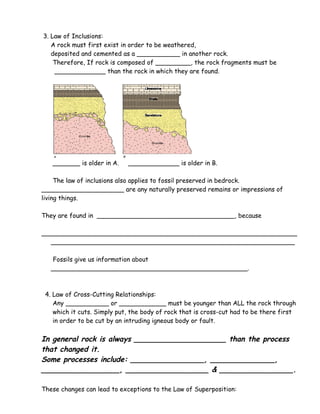
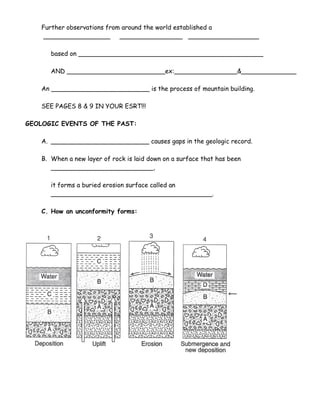
The document discusses principles of relative dating techniques and radioactive dating methods used to interpret geologic history. It explains five basic laws of relative dating including the law of superposition and cross-cutting relationships. Radioactive isotopes are used to provide absolute ages by measuring their decay over time. Examples include carbon-14 for dating recent samples under 50,000 years old, and potassium-argon or uranium-lead dating for older samples over 50,000 years. Geologists use these dating methods along with examining fossils and rock formations to construct the geologic time scale.