Energy Sources
Physical Science
At the end of this module, you are expected
to:
• Describe how energy is harnessed from
different sources:
(a) fossil fuels, (b) biogas, (c) geothermal, (d)
hydrothermal, (e) batteries, (f) solar cells, and
(g) biomass. (S11/12PS-IIIf-h-25)
• Identify the advantages and disadvantages of
each energy source (S11/12PS-IIIf-h-25)
• Express awareness on the conservation of
our energy sources (S11/12-PS-IIIf-h-25)
Activity 1: Classifying Energy Sources
Direction: Classify whether the following is either renewable or
nonrenewable. Write RE if it is renewable and NRE if it is
nonrenewable. Write your answers in your NOTEBOOK.
1. Geothermal
2. Natural gas
3. Hydropower
4. Coal
5. Oil
6. Biogas
7. Solar
8. Ordinary batteries
9. Biomass
10. Wind
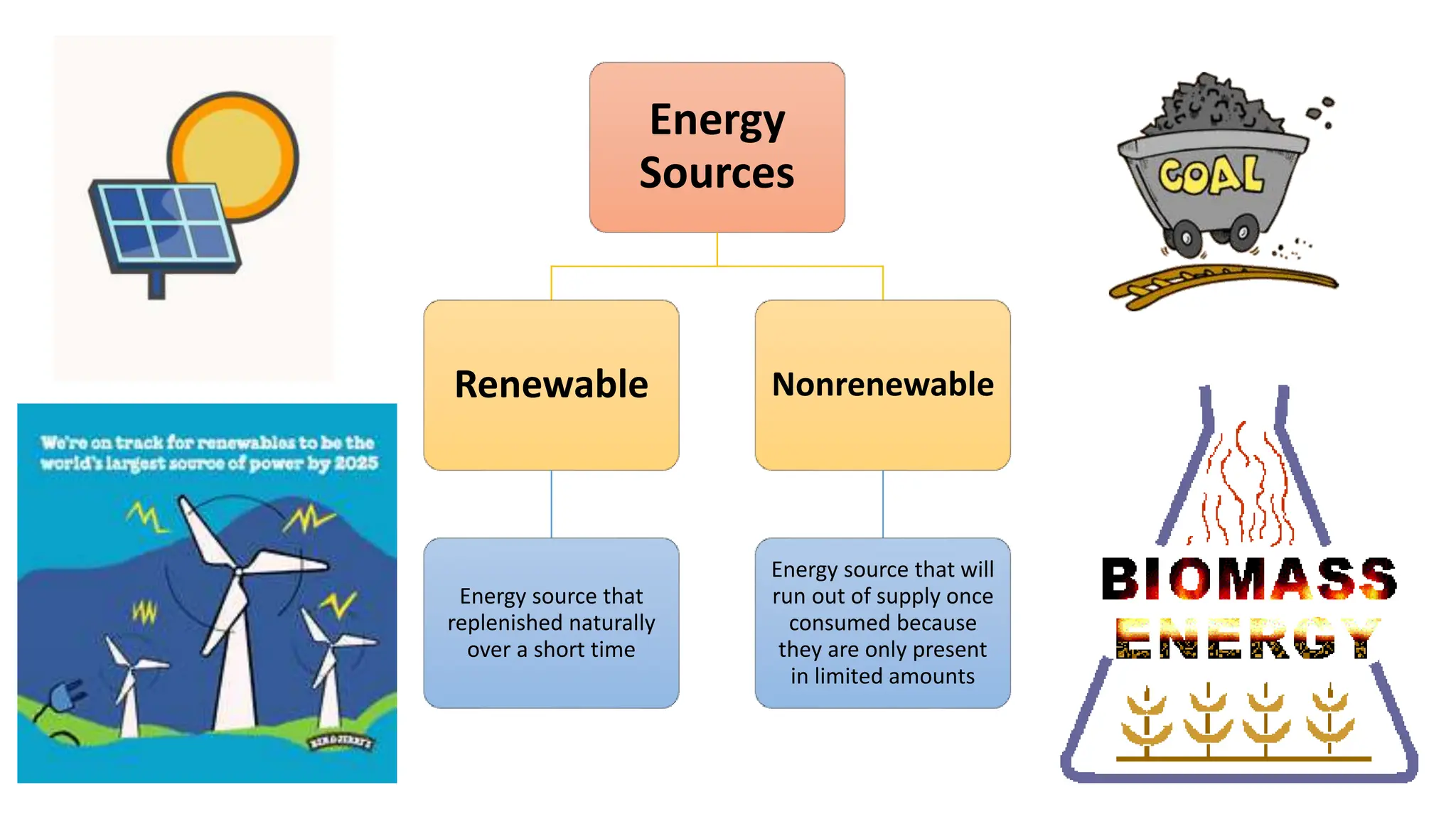
Energy
Sources
Renewable
Energy source that
replenished naturally
over a short time
Nonrenewable
Energy source that will
run out of supply once
consumed because
they are only present
in limited amounts
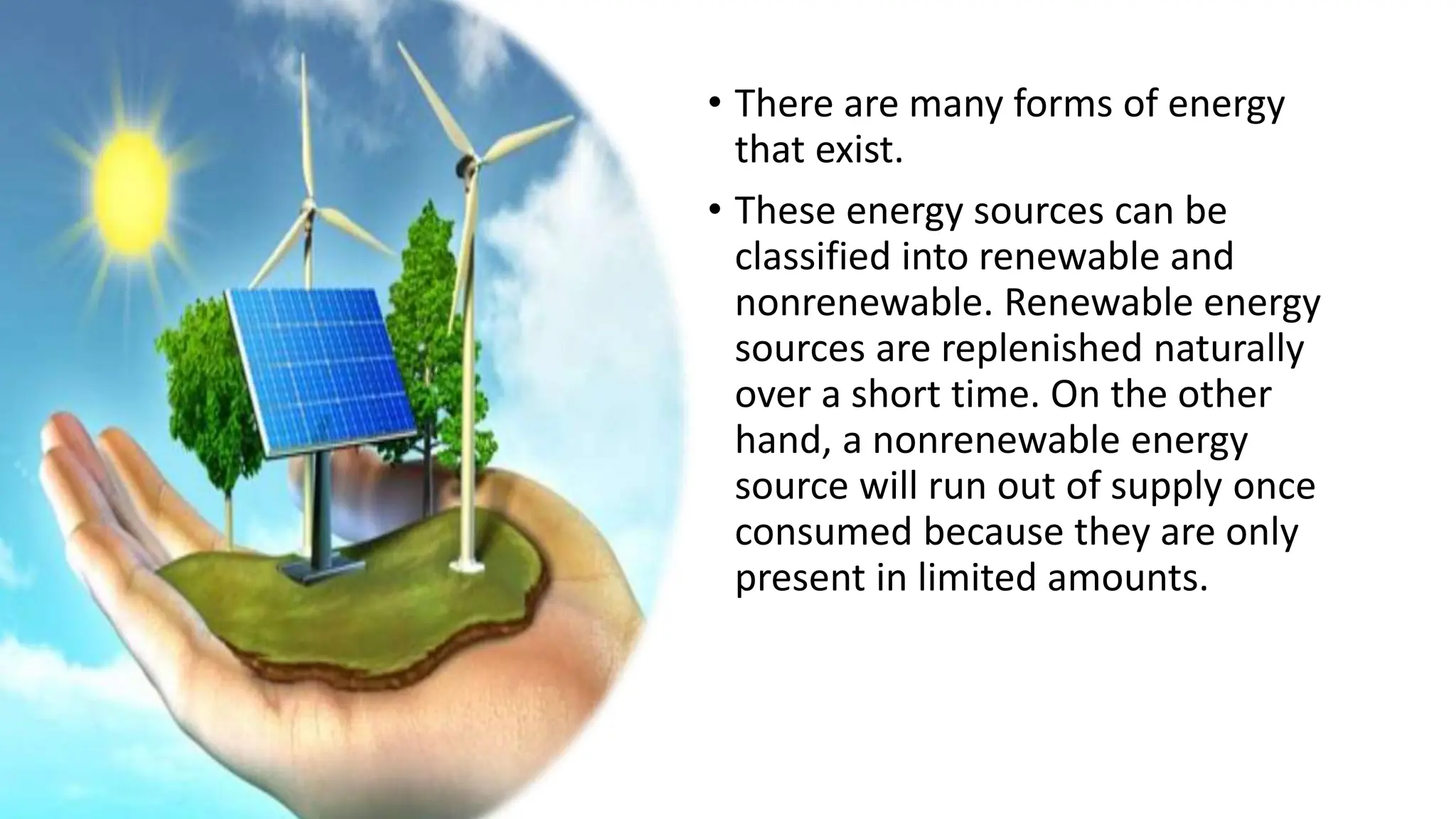
Energy Sources • There are many forms of energy
that exist.
• These energy sources can be
classified into renewable and
nonrenewable. Renewable energy
sources are replenished naturally
over a short time. On the other
hand, a nonrenewable energy
source will run out of supply once
consumed because they are only
present in limited amounts.
Renewable Sources:
• Solar:
Solar energy is the radiation from the Sun capable of producing heat, causing chemical reactions, or
generating electricity.
• From home rooftops to utility-scale farms, solar power is reshaping energy markets around the
world.
• In addition to solar panels, which convert the sun's light to electricity, concentrating solar power
(CSP) plants use mirrors to concentrate the sun's heat, deriving thermal energy instead. China,
Japan, and the U.S. are leading the solar transformation, but solar still has a long way to go,
accounting for around two percent of the total electricity generated in the U.S. in 2017.
• Solar thermal energy is also being used worldwide for hot water, heating, and cooling.
• Solar Cells
These devices are made up of elemental silicon.
Photovoltaic cells or solar cells convert sunlight into electricity. Light
energy is collected over panels.
The collected energy can be stored in batteries or can be directly
converted to electrical energy. Solar batteries power spaceships and
are used to provide electricity for weather instruments in remote areas.
• Wind
Wind farms capture the
energy of wind flow by using
turbines and converting it into
electricity. There are several
forms of systems used to convert
wind energy and each vary
Benefits
• Wind energy is a clean energy
source, which means that it
doesn’t pollute the air like other
forms of energy.
• Wind energy doesn’t produce
carbon dioxide, or release any
harmful products that can cause
environmental degradation or
negatively affect human health
like smog, acid rain, or other
heat-trapping gases.
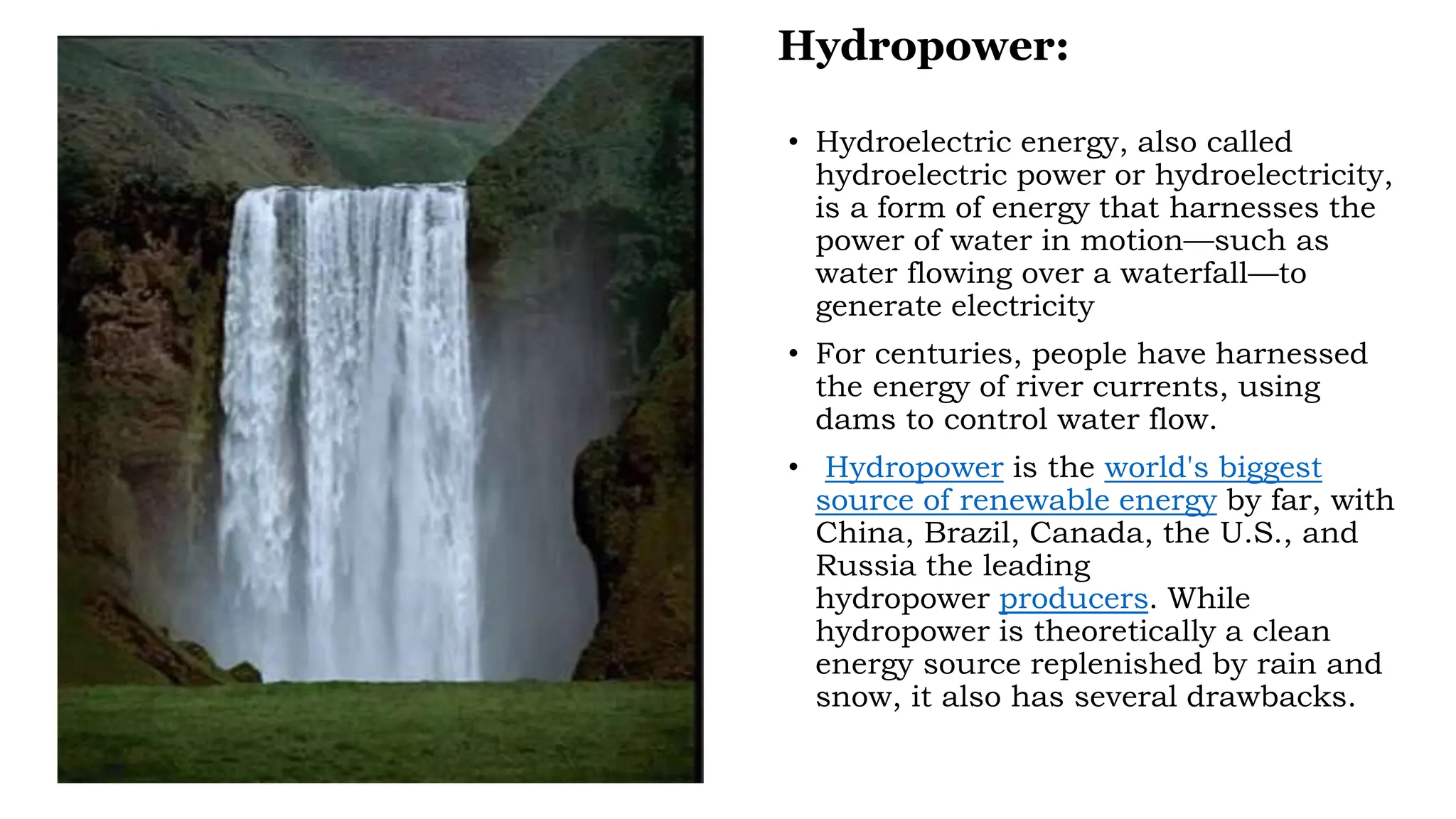
Hydropower:
• Hydroelectric energy, also called
hydroelectric power or hydroelectricity,
is a form of energy that harnesses the
power of water in motion—such as
water flowing over a waterfall—to
generate electricity
• For centuries, people have harnessed
the energy of river currents, using
dams to control water flow.
• Hydropower is the world's biggest
source of renewable energy by far, with
China, Brazil, Canada, the U.S., and
Russia the leading
hydropower producers. While
hydropower is theoretically a clean
energy source replenished by rain and
snow, it also has several drawbacks.
Hydropower:
• The Agus VI HEP is a 200 MW
hydroelectric power plant. It is the
oldest among the six (6) cascading
power plants. With five (5) generating
units, Agus VI has proven to be a
steady source of electric power in
Mindanao.
• known as the Maria Cristina Falls
Hydroelectric Plant, named after the
famous scenic waterfalls just 100
meters in the background. The
majestic and imposing waterfalls
cascades from around 320 feet down
to a sheer cliff and is a sight to
behold.
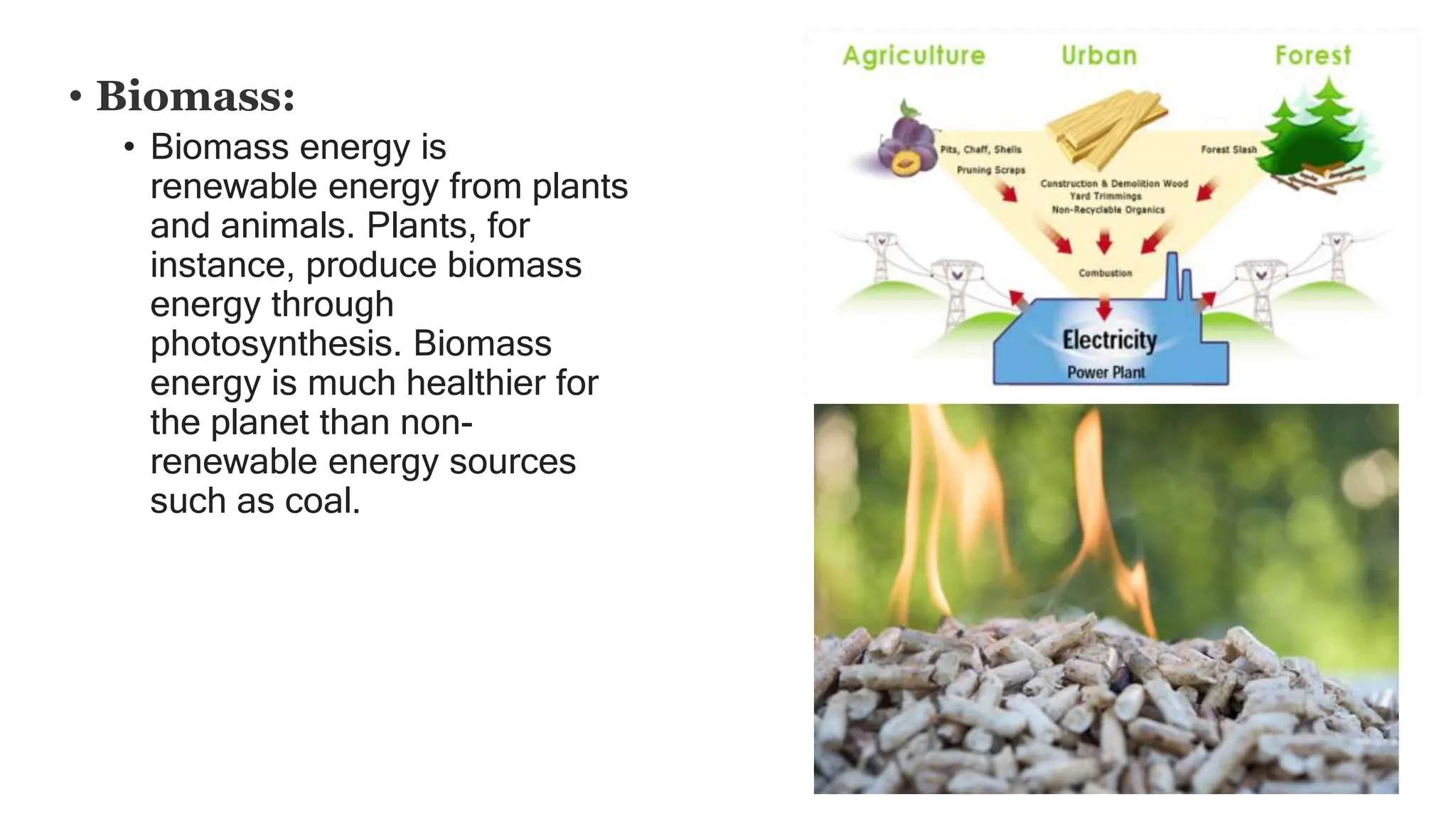
• Biomass:
• Biomass energy is
renewable energy from plants
and animals. Plants, for
instance, produce biomass
energy through
photosynthesis. Biomass
energy is much healthier for
the planet than non-
renewable energy sources
such as coal.
• Biomass is renewable organic material that comes from plants and animals.
Biomass was the largest source of total annual U.S. energy consumption until the
mid-1800s. Biomass continues to be an important fuel in many countries,
especially for cooking and heating in developing countries. The use of biomass
fuels for transportation and for electricity generation is increasing in many
developed countries as a means of avoiding carbon dioxide emissions from fossil
fuel use. In 2021, biomass provided nearly 5 quadrillion British thermal units (Btu)
and about 5% of total primary energy use in the United States.
• Biomass contains stored chemical energy from the sun. Plants produce biomass
through photosynthesis. Biomass can be burned directly for heat or converted to
renewable liquid and gaseous fuels through various processes.
• Biomass sources for energy include:
• Wood and wood processing wastes—firewood, wood pellets, and wood chips,
lumber and furniture mill sawdust and waste, and black liquor from pulp and
paper mills
• Agricultural crops and waste materials—corn, soybeans, sugar cane,
switchgrass, woody plants, and algae, and crop and food processing residues,
mostly to produce biofuels
• Biogenic materials in municipal solid waste—paper, cotton, and wool products,
and food, yard, and wood wastes
• Animal manure and human sewage for producing biogas/renewable natural gas
• Geothermal:
Geothermal energy is
heat that is generated within the
Earth. (Geo means “earth,”
and thermal means “heat” in
Greek.) It is a renewable
resource that can be harvested for
human use.
• Geothermal energy is the energy
harnessed from beneath the earth.
• Magma heats nearby rocks and
underground aquifers. Hot water can
be released through geysers, hot
springs, steam vents,
underwater hydrothermal vents,
and mud pots.
• It is clean, sustainable, and environment-friendly. The problem with this is it can only be produced at selected sites
worldwide. The largest group of geothermal power plants in the world is located at The Geysers, a geothermal field in
California, United States. In the Philippines, some geothermal power plants include Makiling-Banahaw (MakBan)
Geothermal Power Plant in Laguna, Leyte Geothermal Power Plant in Leyte, and Tiwi Geothermal Power plant in Tiwi,
Albay.
NON-RENEWABLE RESOURCES:
• A. Fossil Fuels
Fossil fuels are the general term
used to refer to combustible products of
buried organic matter which underwent
partial decomposition under extreme
temperature and pressure.
These include coal, oil, and natural gas.
The components of fossil fuels are heated
and vaporized to steam which drives the
turbines and generates electricity. Fossil
fuel is known to pollute the environment.
Its reservoir is limited and will last for 100
years.
B. Batteries
Batteries are devices that store and
convert chemical energy into electrical energy.
The energy produced results from a chemical
reaction; however, they do not have carbon
dioxide emissions. When it is connected to an
external circuit, electrolytes move within the
battery, and the chemical reactions are completed
at the two terminals of the battery.
The movement of electrons generates the current
and sends electricity to the external circuit. For
households, batteries can be used to provide
back- up power in case of blackouts. Batteries are
not considered as major energy supply because of
performance and safety issues, regulatory
barriers, the resistance of utilities, and cost.
Quiz: Part 1
1.
2.
Quiz
3.
4.
Part 2:
• Have you once imagined being the President of our country? Try the
activity below and let us see how well can you manage such a problem.
Direction: Using the information and the template below, answer the
activity. Write your response on your 1 whole sheet of paper.
Topic: Demands on Energy Source
Problem: Like many countries in the world, the Philippines confronts
compound challenges of exponential population growth and rising energy
demands. If you are the President of the country, how would you solve the
problem?

Earth and Life Science: Energy Sources.pptx

  • 1.
  • 2.
    At the endof this module, you are expected to: • Describe how energy is harnessed from different sources: (a) fossil fuels, (b) biogas, (c) geothermal, (d) hydrothermal, (e) batteries, (f) solar cells, and (g) biomass. (S11/12PS-IIIf-h-25) • Identify the advantages and disadvantages of each energy source (S11/12PS-IIIf-h-25) • Express awareness on the conservation of our energy sources (S11/12-PS-IIIf-h-25)
  • 3.
    Activity 1: ClassifyingEnergy Sources Direction: Classify whether the following is either renewable or nonrenewable. Write RE if it is renewable and NRE if it is nonrenewable. Write your answers in your NOTEBOOK. 1. Geothermal 2. Natural gas 3. Hydropower 4. Coal 5. Oil 6. Biogas 7. Solar 8. Ordinary batteries 9. Biomass 10. Wind
  • 4.
    Energy Sources Renewable Energy source that replenishednaturally over a short time Nonrenewable Energy source that will run out of supply once consumed because they are only present in limited amounts
  • 5.
    Energy Sources •There are many forms of energy that exist. • These energy sources can be classified into renewable and nonrenewable. Renewable energy sources are replenished naturally over a short time. On the other hand, a nonrenewable energy source will run out of supply once consumed because they are only present in limited amounts.
  • 6.
  • 7.
    • Solar: Solar energyis the radiation from the Sun capable of producing heat, causing chemical reactions, or generating electricity. • From home rooftops to utility-scale farms, solar power is reshaping energy markets around the world. • In addition to solar panels, which convert the sun's light to electricity, concentrating solar power (CSP) plants use mirrors to concentrate the sun's heat, deriving thermal energy instead. China, Japan, and the U.S. are leading the solar transformation, but solar still has a long way to go, accounting for around two percent of the total electricity generated in the U.S. in 2017. • Solar thermal energy is also being used worldwide for hot water, heating, and cooling.
  • 8.
    • Solar Cells Thesedevices are made up of elemental silicon. Photovoltaic cells or solar cells convert sunlight into electricity. Light energy is collected over panels. The collected energy can be stored in batteries or can be directly converted to electrical energy. Solar batteries power spaceships and are used to provide electricity for weather instruments in remote areas.
  • 9.
    • Wind Wind farmscapture the energy of wind flow by using turbines and converting it into electricity. There are several forms of systems used to convert wind energy and each vary Benefits • Wind energy is a clean energy source, which means that it doesn’t pollute the air like other forms of energy. • Wind energy doesn’t produce carbon dioxide, or release any harmful products that can cause environmental degradation or negatively affect human health like smog, acid rain, or other heat-trapping gases.
  • 10.
    Hydropower: • Hydroelectric energy,also called hydroelectric power or hydroelectricity, is a form of energy that harnesses the power of water in motion—such as water flowing over a waterfall—to generate electricity • For centuries, people have harnessed the energy of river currents, using dams to control water flow. • Hydropower is the world's biggest source of renewable energy by far, with China, Brazil, Canada, the U.S., and Russia the leading hydropower producers. While hydropower is theoretically a clean energy source replenished by rain and snow, it also has several drawbacks.
  • 11.
    Hydropower: • The AgusVI HEP is a 200 MW hydroelectric power plant. It is the oldest among the six (6) cascading power plants. With five (5) generating units, Agus VI has proven to be a steady source of electric power in Mindanao. • known as the Maria Cristina Falls Hydroelectric Plant, named after the famous scenic waterfalls just 100 meters in the background. The majestic and imposing waterfalls cascades from around 320 feet down to a sheer cliff and is a sight to behold.
  • 12.
    • Biomass: • Biomassenergy is renewable energy from plants and animals. Plants, for instance, produce biomass energy through photosynthesis. Biomass energy is much healthier for the planet than non- renewable energy sources such as coal.
  • 14.
    • Biomass isrenewable organic material that comes from plants and animals. Biomass was the largest source of total annual U.S. energy consumption until the mid-1800s. Biomass continues to be an important fuel in many countries, especially for cooking and heating in developing countries. The use of biomass fuels for transportation and for electricity generation is increasing in many developed countries as a means of avoiding carbon dioxide emissions from fossil fuel use. In 2021, biomass provided nearly 5 quadrillion British thermal units (Btu) and about 5% of total primary energy use in the United States. • Biomass contains stored chemical energy from the sun. Plants produce biomass through photosynthesis. Biomass can be burned directly for heat or converted to renewable liquid and gaseous fuels through various processes. • Biomass sources for energy include: • Wood and wood processing wastes—firewood, wood pellets, and wood chips, lumber and furniture mill sawdust and waste, and black liquor from pulp and paper mills • Agricultural crops and waste materials—corn, soybeans, sugar cane, switchgrass, woody plants, and algae, and crop and food processing residues, mostly to produce biofuels • Biogenic materials in municipal solid waste—paper, cotton, and wool products, and food, yard, and wood wastes • Animal manure and human sewage for producing biogas/renewable natural gas
  • 15.
    • Geothermal: Geothermal energyis heat that is generated within the Earth. (Geo means “earth,” and thermal means “heat” in Greek.) It is a renewable resource that can be harvested for human use. • Geothermal energy is the energy harnessed from beneath the earth. • Magma heats nearby rocks and underground aquifers. Hot water can be released through geysers, hot springs, steam vents, underwater hydrothermal vents, and mud pots. • It is clean, sustainable, and environment-friendly. The problem with this is it can only be produced at selected sites worldwide. The largest group of geothermal power plants in the world is located at The Geysers, a geothermal field in California, United States. In the Philippines, some geothermal power plants include Makiling-Banahaw (MakBan) Geothermal Power Plant in Laguna, Leyte Geothermal Power Plant in Leyte, and Tiwi Geothermal Power plant in Tiwi, Albay.
  • 16.
    NON-RENEWABLE RESOURCES: • A.Fossil Fuels Fossil fuels are the general term used to refer to combustible products of buried organic matter which underwent partial decomposition under extreme temperature and pressure. These include coal, oil, and natural gas. The components of fossil fuels are heated and vaporized to steam which drives the turbines and generates electricity. Fossil fuel is known to pollute the environment. Its reservoir is limited and will last for 100 years.
  • 17.
    B. Batteries Batteries aredevices that store and convert chemical energy into electrical energy. The energy produced results from a chemical reaction; however, they do not have carbon dioxide emissions. When it is connected to an external circuit, electrolytes move within the battery, and the chemical reactions are completed at the two terminals of the battery. The movement of electrons generates the current and sends electricity to the external circuit. For households, batteries can be used to provide back- up power in case of blackouts. Batteries are not considered as major energy supply because of performance and safety issues, regulatory barriers, the resistance of utilities, and cost.
  • 18.
  • 19.
  • 21.
    Part 2: • Haveyou once imagined being the President of our country? Try the activity below and let us see how well can you manage such a problem. Direction: Using the information and the template below, answer the activity. Write your response on your 1 whole sheet of paper. Topic: Demands on Energy Source Problem: Like many countries in the world, the Philippines confronts compound challenges of exponential population growth and rising energy demands. If you are the President of the country, how would you solve the problem?

Editor's Notes

  • #5 There are many forms of energy that exist. These energy sources can be classified into renewable and nonrenewable. Renewable energy sources are replenished naturally over a short time. On the other hand, a nonrenewable energy source will run out of supply once consumed because they are only present in limited amounts.
  • #8 In the decade from 2007 and 2017 the world's total installed energy capacity from photovoltaic panels increased a whopping 4,300 percent.
  • #9 Large solar panel fields are often used in the desert to charge small substations, and many homes use solar systems to provide for hot water, cooling and supplement their electricity. The problem with solar cells is only certain part of the world get enough direct power of the sun to generate usable power from this source because of its geographical location. Aside from that solar energy storage is expensive, weather dependent, and uses a lot of space. Solar energy reduces electricity bills and a renewable source of energy.
  • #11 Large dams can disrupt river ecosystems and surrounding communities, harming wildlife and displacing residents. Hydropower generation is vulnerable to silt buildup, which can compromise capacity and harm equipment. Drought can also cause problems. In the western U.S., carbon dioxide emissions over a 15-year period were 100 megatons higher than they normally would have been, according to a 2018 study, as utilities turned to coal and gas to replace hydropower lost to drought. Even hydropower at full capacity bears its own emissions problems, as decaying organic material in reservoirs releases methane. Dams aren't the only way to use water for power: Tidal and wave energy projects around the world aim to capture the ocean's natural rhythms. Marine energy projects currently generate an estimated 500 megawatts of power—less than one percent of all renewables—but the potential is far greater. Programs like Scotland’s Saltire Prize have encouraged innovation in this area.
  • #12 Construction of the project was authorized by the late President Elpidio Quirino.  Units 1 (25 MW) and 2 (25 MW) of the power plant were commissioned in the early 1950s. After more than fifty years of operation, these two (2) generating units are now due for complete rehabilitation and up-rating. The Agus VI HEP Plant was originally In order to showcase Mindanao Generation’s efforts to help protect and conserve nature, it had developed a Nature’s Park which now hosts various tourists attractions and outdoor activities, e.g. bird’s sanctuary, crocodile park, butterfly garden, mini zoo, zip line. Central to the Nature’s Park is its main attraction—the Maria Cristina Falls. To date, tourists from around the country continue to flock to NPC’s Nature’s Park located inside the Agus VI and VII power plant
  • #13 Biomass energy includes biofuels such as ethanol and biodiesel, wood and wood waste, biogas from landfills, and municipal solid waste. Like solar power, biomass is a flexible energy source, able to fuel vehicles, heat buildings, and produce electricity. But biomass can raise thorny issues. Critics of corn-based ethanol, for example, say it competes with the food market for corn and supports the same harmful agricultural practices that have led to toxic algae blooms and other environmental hazards. Similarly, debates have erupted over whether it's a good idea to ship wood pellets from U.S. forests over to Europe so that it can be burned for electricity. Meanwhile, scientists and companies are working on ways to more efficiently convert corn stover, wastewater sludge, and other biomass sources into energy, aiming to extract value from material that would otherwise go to waste.
  • #16 Geothermal energy is the energy harnessed from beneath the earth. There is a high temperature inside the earth’s crust caused by the slow delay of radioactive particles. Groundwater will be heated up by the hot rock which will later produce steam. The steam moves turbines. The rotating turbines run the generators. It is clean, sustainable, and environment-friendly. The problem with this is it can only be produced at selected sites worldwide. The largest group of geothermal power plants in the world is located at The Geysers, a geothermal field in California, United States. In the Philippines, some geothermal power plants include Makiling-Banahaw (MakBan) Geothermal Power Plant in Laguna, Leyte Geothermal Power Plant in Leyte, and Tiwi Geothermal Power plant in Tiwi, Albay.
  • #17 Oil in the form of gasoline is used as engine fuel for vehicles and in generators, lawnmowers, leaf blowers, and small boat motors. Heating applications use natural gas and coal. However,