Prepared by:-
Mrs. D. Melba Sahaya Sweety
Msc Nursing
Pediatric Nursing Department
GIMSAR
Chinna Chadayan & Melba Sahaya Sweety
INTRODUCTION
• Hildegard E. Peplau (September 1, 1909 – March
17, 1999) was an American nurse and the first
published nursing theorist since Florence
Nightingale. She created the middle-range nursing
theory of interpersonal relations, which helped to
revolutionize the scholarly work of nurses. As a
primary contributor to mental health law reform, she
led the way towards humane treatment of patients
with behavior and personality disorders.
Chinna Chadayan & Melba Sahaya Sweety
MAJOR CONCEPTS & DEFINITIONS
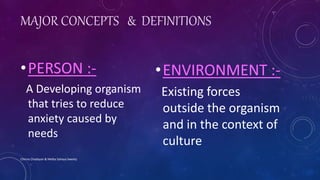
•PERSON :-
A Developing organism
that tries to reduce
anxiety caused by
needs
•ENVIRONMENT :-
Existing forces
outside the organism
and in the context of
culture
Chinna Chadayan & Melba Sahaya Sweety
MAJOR CONCEPTS & DEFINITIONS
HEALTH :-
A word symbol that implies
forward movement of
personality and other
onoing human processes
in the direction of
creative, constructive,
productive,personal and
community living.
• NURSING :-
A significant therapeutic
interpersonal process. It
functions cooperatively
with other human process
that make heaith possible
for individuals in
communtiesChinna Chadayan & Melba Sahaya Sweety
• Peplau describes the six nursing roles that lead into the
different phases:
• Stranger role: Peplau states that when the nurse and patient
first meet, they are strangers to one another. Therefore, the
patient should be treated with respect and courtesy, as
anybody would expect to be treated. The nurse should not
prejudge the patient or make assumptions about the patient,
but take the patient as he or she is. The nurse should treat
the patient as emotionally stable unless evidence states
otherwise.Chinna Chadayan & Melba Sahaya Sweety
• Resource role: The nurse provides answers to
questions primarily on health information. The
resource person is also in charge of relaying
information to the patient about the treatment plan.
Usually the questions arise from larger problems,
therefore the nurse would determine what type of
response is appropriate for constructive learning.
The nurse should provide straightforward answers
when providing information on counseling.
Chinna Chadayan & Melba Sahaya Sweety
• Teaching role: The teaching role is a role that is a
combination of all roles. Peplau determined that
there are two categories that the teaching role
consists of: Instructional and experimental. The
instructional consists of giving a wide variety of
information that is given to the patients and
experimental is using the experience of the learner
as a starting point to later form products of learning
which the patient makes about their experiences.
Chinna Chadayan & Melba Sahaya Sweety
• Counseling role: Peplau believes that
counselling has the biggest emphasis in
psychiatric nursing. The counselor role
helps the patient understand and remember
what is going on and what is happening to
them in current life situations. Also, to
provide guidance and encouragement to
make changes.
Chinna Chadayan & Melba Sahaya Sweety
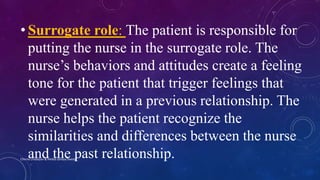
• Surrogate role: The patient is responsible for
putting the nurse in the surrogate role. The
nurse’s behaviors and attitudes create a feeling
tone for the patient that trigger feelings that
were generated in a previous relationship. The
nurse helps the patient recognize the
similarities and differences between the nurse
and the past relationship.Chinna Chadayan & Melba Sahaya Sweety
• Leadership role: Helps the patient assume
maximum responsibility for meeting
treatment goals in a mutually satisfying
way. The nurse helps the patient meet
these goals through cooperation and active
participation with the nurse.
Chinna Chadayan & Melba Sahaya Sweety
PEPLAU'S DEVELOPMENTAL STAGES OF THE NURSE-CLIENT
RELATIONSHIP
Orientation Phase
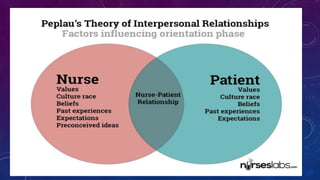
• The orientation phase is initiated by the nurse. This is the
phase during which the nurse and the patient become
acquainted, and set the tone for their relationship, which will
ultimately be patient centered. During this stage, it is important
that a professional relationship is established, as opposed to a
social relationship. This includes clarifying that the patient is
the center of the relationship, and that all interactions are, and
will be centered around helping the patient.
Chinna Chadayan & Melba Sahaya Sweety
• This phase is usually progressed through during a
highly impressionable phase in the nurse-client
relationship, because the orientation phase occurs
shortly after admission to a hospital, when the client
is becoming accustomed to a new environment and
new people. The nurse begins to know the patient as
a unique individual, and the patient should sense
that the nurse is genuinely interested in them. Trust
begins to develop, and the client begins to
understand their role, the nurse's role, and the
parameters and boundaries of their relationship.Chinna Chadayan & Melba Sahaya Sweety
•Identification Phase
•The client begins to identify problems
to be worked on within relationship.
The goal of the nurse is to help the
patient to recognize his/her own
interdependent/participation role and
promote responsibility for self.
Chinna Chadayan & Melba Sahaya Sweety
• Exploitation Phase / Working Phase
• During the Working Phase, the nurse and the patient
work to achieve the patient's full potential, and meet
their goals for the relationship. A sign that the transition
from the orientation phase to the working phase has been
made, is if the patient can approach the nurse as a
resource, instead of feeling a social obligation to the
nurse (Peplau, 1997). The client fully trusts the nurse,
and makes full use of the nurse's services and
professional abilities. The nurse and the patient work
towards discharge and termination goal.
Chinna Chadayan & Melba Sahaya Sweety
• Resolution Phase/Termination Phase
• The termination phase of the nurse client
relationship occurs after the current goals for the
client have been met. The nurse and the client
summarize and end their relationship. One of the
key aspects of a nurse-client relationship, as
opposed to a social relationship, is that it is
temporary, and often of short duration (Peplau,
1997).
Chinna Chadayan & Melba Sahaya Sweety
• In a more long term relationship, termination can
commonly occur when a patient is discharged from a
hospital setting, or a patient dies. In more short term
relationships, such as a clinic visit, an emergency room
visit, or a health bus vaccination visit, the termination
occurs when the patient leaves, and the relationship is
usually less complex. However, in most situations, the
relationship should terminate once the client has
established increased self-reliance to deal with their own
problems.
Chinna Chadayan & Melba Sahaya Sweety
THANK YOU
Chinna Chadayan & Melba Sahaya Sweety

Interpersonal theory

  • 1.
    Prepared by:- Mrs. D.Melba Sahaya Sweety Msc Nursing Pediatric Nursing Department GIMSAR Chinna Chadayan & Melba Sahaya Sweety
  • 2.
    INTRODUCTION • Hildegard E.Peplau (September 1, 1909 – March 17, 1999) was an American nurse and the first published nursing theorist since Florence Nightingale. She created the middle-range nursing theory of interpersonal relations, which helped to revolutionize the scholarly work of nurses. As a primary contributor to mental health law reform, she led the way towards humane treatment of patients with behavior and personality disorders. Chinna Chadayan & Melba Sahaya Sweety
  • 3.
    MAJOR CONCEPTS &DEFINITIONS •PERSON :- A Developing organism that tries to reduce anxiety caused by needs •ENVIRONMENT :- Existing forces outside the organism and in the context of culture Chinna Chadayan & Melba Sahaya Sweety
  • 4.
    MAJOR CONCEPTS &DEFINITIONS HEALTH :- A word symbol that implies forward movement of personality and other onoing human processes in the direction of creative, constructive, productive,personal and community living. • NURSING :- A significant therapeutic interpersonal process. It functions cooperatively with other human process that make heaith possible for individuals in communtiesChinna Chadayan & Melba Sahaya Sweety
  • 5.
    • Peplau describesthe six nursing roles that lead into the different phases: • Stranger role: Peplau states that when the nurse and patient first meet, they are strangers to one another. Therefore, the patient should be treated with respect and courtesy, as anybody would expect to be treated. The nurse should not prejudge the patient or make assumptions about the patient, but take the patient as he or she is. The nurse should treat the patient as emotionally stable unless evidence states otherwise.Chinna Chadayan & Melba Sahaya Sweety
  • 6.
    • Resource role:The nurse provides answers to questions primarily on health information. The resource person is also in charge of relaying information to the patient about the treatment plan. Usually the questions arise from larger problems, therefore the nurse would determine what type of response is appropriate for constructive learning. The nurse should provide straightforward answers when providing information on counseling. Chinna Chadayan & Melba Sahaya Sweety
  • 7.
    • Teaching role:The teaching role is a role that is a combination of all roles. Peplau determined that there are two categories that the teaching role consists of: Instructional and experimental. The instructional consists of giving a wide variety of information that is given to the patients and experimental is using the experience of the learner as a starting point to later form products of learning which the patient makes about their experiences. Chinna Chadayan & Melba Sahaya Sweety
  • 8.
    • Counseling role:Peplau believes that counselling has the biggest emphasis in psychiatric nursing. The counselor role helps the patient understand and remember what is going on and what is happening to them in current life situations. Also, to provide guidance and encouragement to make changes. Chinna Chadayan & Melba Sahaya Sweety
  • 9.
    • Surrogate role:The patient is responsible for putting the nurse in the surrogate role. The nurse’s behaviors and attitudes create a feeling tone for the patient that trigger feelings that were generated in a previous relationship. The nurse helps the patient recognize the similarities and differences between the nurse and the past relationship.Chinna Chadayan & Melba Sahaya Sweety
  • 10.
    • Leadership role:Helps the patient assume maximum responsibility for meeting treatment goals in a mutually satisfying way. The nurse helps the patient meet these goals through cooperation and active participation with the nurse. Chinna Chadayan & Melba Sahaya Sweety
  • 11.
    Chinna Chadayan &Melba Sahaya Sweety
  • 12.
    PEPLAU'S DEVELOPMENTAL STAGESOF THE NURSE-CLIENT RELATIONSHIP Orientation Phase • The orientation phase is initiated by the nurse. This is the phase during which the nurse and the patient become acquainted, and set the tone for their relationship, which will ultimately be patient centered. During this stage, it is important that a professional relationship is established, as opposed to a social relationship. This includes clarifying that the patient is the center of the relationship, and that all interactions are, and will be centered around helping the patient. Chinna Chadayan & Melba Sahaya Sweety
  • 13.
    • This phaseis usually progressed through during a highly impressionable phase in the nurse-client relationship, because the orientation phase occurs shortly after admission to a hospital, when the client is becoming accustomed to a new environment and new people. The nurse begins to know the patient as a unique individual, and the patient should sense that the nurse is genuinely interested in them. Trust begins to develop, and the client begins to understand their role, the nurse's role, and the parameters and boundaries of their relationship.Chinna Chadayan & Melba Sahaya Sweety
  • 14.
    •Identification Phase •The clientbegins to identify problems to be worked on within relationship. The goal of the nurse is to help the patient to recognize his/her own interdependent/participation role and promote responsibility for self. Chinna Chadayan & Melba Sahaya Sweety
  • 15.
    • Exploitation Phase/ Working Phase • During the Working Phase, the nurse and the patient work to achieve the patient's full potential, and meet their goals for the relationship. A sign that the transition from the orientation phase to the working phase has been made, is if the patient can approach the nurse as a resource, instead of feeling a social obligation to the nurse (Peplau, 1997). The client fully trusts the nurse, and makes full use of the nurse's services and professional abilities. The nurse and the patient work towards discharge and termination goal. Chinna Chadayan & Melba Sahaya Sweety
  • 16.
    • Resolution Phase/TerminationPhase • The termination phase of the nurse client relationship occurs after the current goals for the client have been met. The nurse and the client summarize and end their relationship. One of the key aspects of a nurse-client relationship, as opposed to a social relationship, is that it is temporary, and often of short duration (Peplau, 1997). Chinna Chadayan & Melba Sahaya Sweety
  • 17.
    • In amore long term relationship, termination can commonly occur when a patient is discharged from a hospital setting, or a patient dies. In more short term relationships, such as a clinic visit, an emergency room visit, or a health bus vaccination visit, the termination occurs when the patient leaves, and the relationship is usually less complex. However, in most situations, the relationship should terminate once the client has established increased self-reliance to deal with their own problems. Chinna Chadayan & Melba Sahaya Sweety
  • 18.
    THANK YOU Chinna Chadayan& Melba Sahaya Sweety