Family planning program in Nepal
• Family planning is an investment in future prosperity
and is one of the most cost effective health
interventions in developing world.
• Today, family planning program has been
incorporated as one of the important part of health
program in almost all the countries of around the
world.
• The main aim of the National family planning is to
ensure that individuals and couple are able to fulfill
reproductive needs by using appropriate family
planning method based on informed choice.
Cont,….
• Family planning can reduce unmet need for
contraceptives and unintended pregnancy which
ultimately helps to improve maternal and child health,
empowers women by allowing them to invest more in
their children and earn wages outside the home.
• In addition, it also helps communities and country to
boost economic growth by expanding healthy and skillful
labor force and allowing them to invest more money in
school, health care and infrastructure development.
• In overall National Family Planning Program helps to
improve the quality of life of people and develop a
nation.
Cont…...
• Family planning is one of priority program of Government
of Nepal, Ministry of Health and Population.
• It is also considered as a component of reproductive
health package and essential health care services of Nepal
Health Sector Program II (2010‐2015).
• To fulfill above aim, family planning information and
services are being provided through government, social
marketing, non‐governmental organizations and private
sectors.
• In government health system, currently, temporary family
planning methods (male condoms, pills and injectable) are
provided on a regular basis through health posts, sub
health posts, PHC Outreach clinics.
Cont…
• Female Community Health Volunteers are providing
information to community people, and distribute
Condom and resupply of pills.
• Services such as IUCD and Implants are available
only at limited number of Primary Health Care
Centers and health posts where trained personnel
are available.
• Depending on the district, sterilization services are
provided at static sites or through scheduled
“seasonal” or mobile outreach services.
• Almost all district FP MCH clinics are providing all
types of temporary FP methods regularly.
Policies
• Emphasize in providing quality family planning
services including informed choice to males and
females residing in any part of county based on
fact and comprehensive information.
• Family planning services will be made available
through government, private, non‐ governmental
organization and social marketing approaches.
Encourage role of the private sectors in providing
family planning services. Establish family planning
as reproductive rights of females and males.
Cont,
• Increase access to and availability of family
planning services.
• Effective integration of family planning services
with other health services.
• Implement various activities to develop capacity
of service providers and managers.
• Establish an effective logistics management
system to ensure regular availability of family
planning services.
• Initiate various innovative approaches to engage
males in family planning services.
FP Program activities at Various level
Trends in selected FP indicators
(Nepal DHS 1996 to 2016)
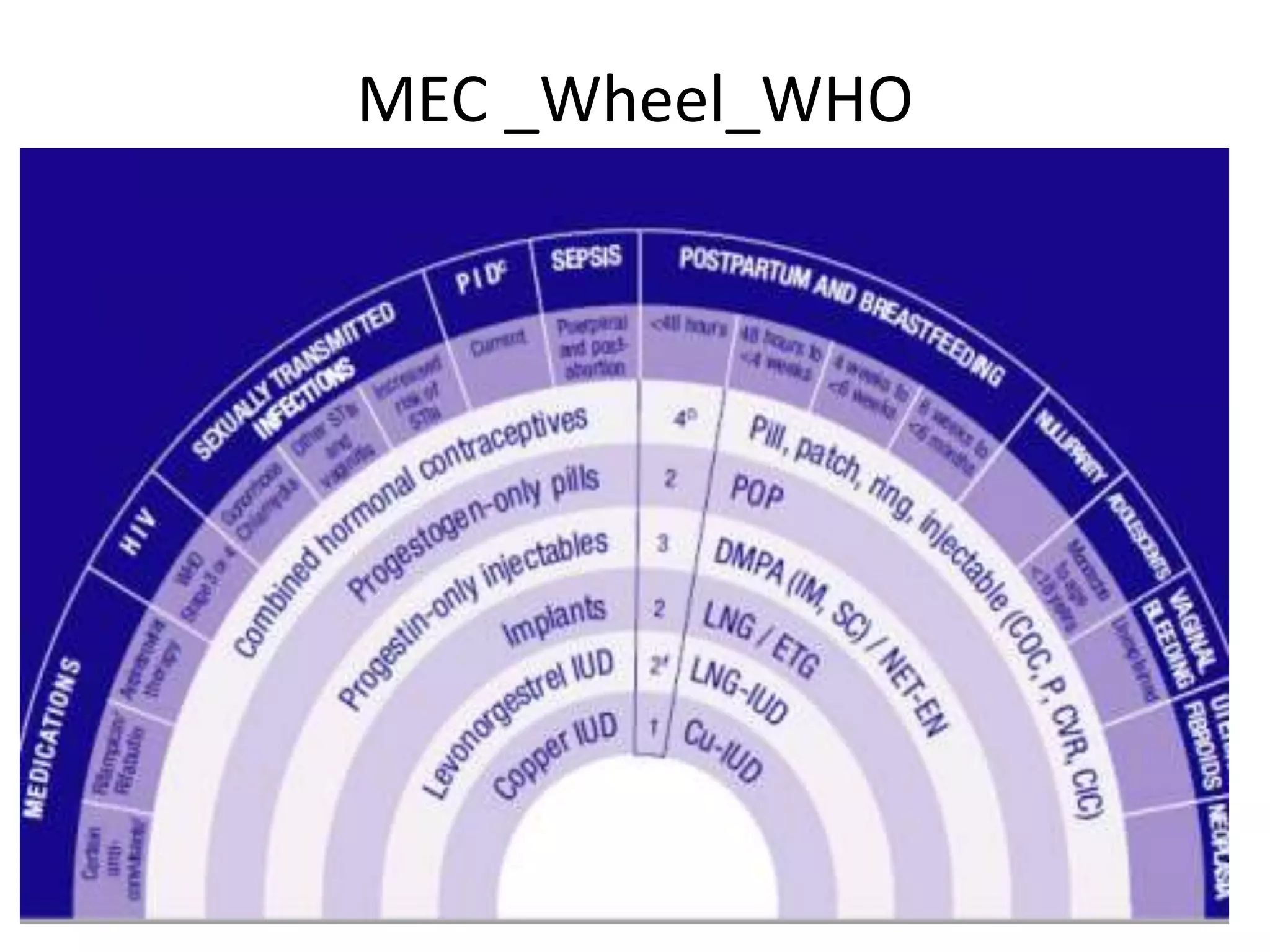
MEC _Wheel_WHO
Organization working in family
planning services /program in Nepal
• Family Planning Association of Nepal, (FPAN)
• Sunaulo Paribar Nepal,(SPN)
• Marie Stopes Nepal International,(MSI)
• Adventist Development and Relief Agency International
(ADRA International )
• United Nations Population Fund ,(UNFPA)
• Population Service International, (PSI)
• Individual Personal Assistance Services, (Ipas)
• Nepal Contraceptive Retail Sales, (CRS)
• International Planned Parenthood Federation,(IPPF)
• United states Agency for International Development,
(USAID)
Terms used in FP
• Current users:- No. of women or partner who are
estimated be using contraception method at given
point of time, that can be reported by type of
method, region, source or other relevant variables
Information on the current level of contraceptive use
(or contraceptive prevalence) is important for
measuring the success of the National Family
Planning Movement.
• Contraceptive prevalence is defined as the
proportion of currently married women age 15-49
who were using some method of family planning.
Contraceptive prevalence
• Contraceptive prevalence =
(Women of reproductive age (15-49) who are
married or in union and who are currently using
any method of contraception / Total number of
women of reproductive age (15-49) who are
married or in union) x 100
Cont,..
• New acceptors are typically defined as new users
of contraceptives or new clients to the clinic.
Upon the clients' return to the clinic, they are
recorded as continuing users or as revisits.
• Unmet Needs: Unmet need for family planning is
defined as the percentage of women of
reproductive age, either married or in a union,
who have an unmet need for family planning.
• Women with unmet need are those who are want
to stop or delay childbearing but are not using
any method of contraception.
cont…
• Target couple:-Couple who have has 2-3 living
children and family planning was largely directed to
such couples.
The definition of a target couple has been gradually
enlarged to include families with one child or even
newly married couples with a view to develop
acceptance of the idea of family planning from the
earliest possible stage.
• Eligible couple:- A currently married couple where in
the wife is in the reproductive age. Which is
generally assumed to lie between the age of 15-45.
Definition of Family planning
• An expert committee 1971 of the WHO family
planning as “a way of thinking and living that is
adopted voluntarily, upon the basic of knowledge,
attitudes and responsible decisions by individual or
couple, in order to promote the health and welfare of
the family group and thus contribute effectively to
the social development of a country “
• The World Health Organization definition is this:
“Family planning allows individuals and couples to
anticipate and attain their desired number of
children and the spacing and timing of their births. It
is achieved through use of contraceptive methods
and the treatment of involuntary infertility.2010
Purpose of Family Planning
• To avoid unwanted births
• To bring about wanted births
• To regulate the interval between pregnancy
• To control the time at which births occurs in
relation to age of parents.
• To determine numbers of children in the family
• To decrease the maternal and child mortality and
morbidity rate
Importance of Family Planning
Advantage of Natural Method of FP
• No side effects.
• No cost implied.
• Natural menstruation no affected.
• Culturally and morally accepted.
• Does not need follow up
Disadvantage of natural Method of FP
• Need commitment, motivation, training and
the cooperation of both partners.
• Less effective
• Unsuitable for women with irregular cycles.
• Do not give protection against STI and HIV.
Sayana Press
• Sayana Press, a successor to
Depo-Provera, is being
launched in Nepal in two
districts: Nawalpur and
Sindhuli, by the reproductive
health agency Ipas Nepal in
coordination with the UK’s
Department for International
Development (DFID) and the
Ministry of Health and
Population (MoH
Sayana Press , Cont,..
• The drug has already been tried and
approved, and is available for use in 40
European countries.
• What sets Sayana apart from Depo-Provera is
the smaller dosage (104 mg compared to 150),
it comes with its own needle, it can be stored
at room temperature and is injected sub-
cutaneously (just under the skin), rather than
in the muscles like Depo-Provera.
Emergency Contraception (EC)
Emergency contraception (EC)
• Emergency contraception refers to
methods of contraception that can be
used to prevent pregnancy after sexual
intercourse.
• These are recommended for use within 5
days but are more effective the sooner
they are used after the act of intercourse.
Cont,…
• The emergency contraceptive pill regimens
recommended by WHO are ulipristal
acetate, levonorgestrel, or combined
oral contraceptives (COCs) consisting of
ethinyl estradiol plus levonorgestrel.
Cont…
• Emergency contraception (EC) can prevent up to
over 95% of pregnancies when taken within 5
days after intercourse.
EC can be used in the following situations:
Unprotected intercourse,
Concerns about possible contraceptive failure,
Incorrect use of contraceptives,
Sexual assault
Global Scenario
• Worldwide, 25 million unsafe abortions
(45% of all abortions) occurred every year
between 2010 and 2014, according to a
new study by WHO
• The majority of unsafe abortions, or 97%,
occurred in developing countries in Africa,
Asia and Latin America.
Nepal scenario
• In 2014, women in Nepal had 323,100
abortions, of which 137,000 were legal, and
63,200 women were treated for abortion
complications.
• The abortion rate was 42 per 1,000 women
aged 15–49,
Mode of action
• Emergency contraceptive pills prevent
pregnancy by preventing or delaying
ovulation and they do not induce an
abortion.
Mode of Action of EC
Characteristics of EC
• EC is a back up plan.
• It cannot be used as a ongoing method of
contraception because:
i) Relatively high failure rates
ii) High incidence of irregular
bleeding
Cont…
• It is a one time procedure & not an routine
approach to contraception.
• Used postcoitally.
• Its objective is prevention of pregnancy
Indications
Indications for the use of emergency
contraception include:-
• Sexual assault in case of rape and incest.
• Unprotected intercourse,
• Condom breakage or slippage
• Missed or late doses of hormonal contraceptives
• including the oral contraceptive
(pill contraceptive patch)
• Contraceptive ring (ie, improper placement or
loss/expulsion)
• Injectables
Contraceptive patch
• The contraceptive patch
is a small sticky patch
that releases hormones
into your body through
your skin to prevent
pregnancy. In the UK, the
patch's brand name is
Evra.
Advantage of EC
• Saves the couple from unwanted pregnancies
• From unnecessary operative interferences for
fear of pregnancy.
• From the agony of waiting for the next menstrual
cycle.
• Prevents adolescent pregnancies.
• Helps to reduce unsafe abortion.
Side effects
• Common side effects :
• Change in bleeding patterns including :
• Slight irregular bleeding for 1-2 days after taking
ECPs
• Monthly bleeding that starts earlier or later than
expected
• Abdominal pain
• Feeling sick (Fatigue, Headache , Dizziness)
• Breast Tenderness
Note:
• ECP cannot dislodge an established
• They do not cause abortion
• ECPs do not affect fetal development.
• No evidence that their repeated use causes
ectopic pregnancy.
References
• https://www.fphighimpactpractices.org/briefs/ad
olescent-responsive-contraceptive-services/
• https://www.afro.who.int/news/increased-
access-quality-family-planning-services-key-
health-adolescent-girls-and-young-women
• https://www.ncbi.nlm.nih.gov/pmc/articles/PMC
7053440/
• https://www.glowm.com/section-
view/heading/adolescent-
contraception/item/376#.YLUuqKgzbDc
Family Planning Program in Nepal

Family Planning Program in Nepal

  • 1.
    Family planning programin Nepal • Family planning is an investment in future prosperity and is one of the most cost effective health interventions in developing world. • Today, family planning program has been incorporated as one of the important part of health program in almost all the countries of around the world. • The main aim of the National family planning is to ensure that individuals and couple are able to fulfill reproductive needs by using appropriate family planning method based on informed choice.
  • 2.
    Cont,…. • Family planningcan reduce unmet need for contraceptives and unintended pregnancy which ultimately helps to improve maternal and child health, empowers women by allowing them to invest more in their children and earn wages outside the home. • In addition, it also helps communities and country to boost economic growth by expanding healthy and skillful labor force and allowing them to invest more money in school, health care and infrastructure development. • In overall National Family Planning Program helps to improve the quality of life of people and develop a nation.
  • 3.
    Cont…... • Family planningis one of priority program of Government of Nepal, Ministry of Health and Population. • It is also considered as a component of reproductive health package and essential health care services of Nepal Health Sector Program II (2010‐2015). • To fulfill above aim, family planning information and services are being provided through government, social marketing, non‐governmental organizations and private sectors. • In government health system, currently, temporary family planning methods (male condoms, pills and injectable) are provided on a regular basis through health posts, sub health posts, PHC Outreach clinics.
  • 4.
    Cont… • Female CommunityHealth Volunteers are providing information to community people, and distribute Condom and resupply of pills. • Services such as IUCD and Implants are available only at limited number of Primary Health Care Centers and health posts where trained personnel are available. • Depending on the district, sterilization services are provided at static sites or through scheduled “seasonal” or mobile outreach services. • Almost all district FP MCH clinics are providing all types of temporary FP methods regularly.
  • 5.
    Policies • Emphasize inproviding quality family planning services including informed choice to males and females residing in any part of county based on fact and comprehensive information. • Family planning services will be made available through government, private, non‐ governmental organization and social marketing approaches. Encourage role of the private sectors in providing family planning services. Establish family planning as reproductive rights of females and males.
  • 6.
    Cont, • Increase accessto and availability of family planning services. • Effective integration of family planning services with other health services. • Implement various activities to develop capacity of service providers and managers. • Establish an effective logistics management system to ensure regular availability of family planning services. • Initiate various innovative approaches to engage males in family planning services.
  • 7.
    FP Program activitiesat Various level
  • 8.
    Trends in selectedFP indicators (Nepal DHS 1996 to 2016)
  • 10.
  • 12.
    Organization working infamily planning services /program in Nepal • Family Planning Association of Nepal, (FPAN) • Sunaulo Paribar Nepal,(SPN) • Marie Stopes Nepal International,(MSI) • Adventist Development and Relief Agency International (ADRA International ) • United Nations Population Fund ,(UNFPA) • Population Service International, (PSI) • Individual Personal Assistance Services, (Ipas) • Nepal Contraceptive Retail Sales, (CRS) • International Planned Parenthood Federation,(IPPF) • United states Agency for International Development, (USAID)
  • 13.
    Terms used inFP • Current users:- No. of women or partner who are estimated be using contraception method at given point of time, that can be reported by type of method, region, source or other relevant variables Information on the current level of contraceptive use (or contraceptive prevalence) is important for measuring the success of the National Family Planning Movement. • Contraceptive prevalence is defined as the proportion of currently married women age 15-49 who were using some method of family planning.
  • 14.
    Contraceptive prevalence • Contraceptiveprevalence = (Women of reproductive age (15-49) who are married or in union and who are currently using any method of contraception / Total number of women of reproductive age (15-49) who are married or in union) x 100
  • 15.
    Cont,.. • New acceptorsare typically defined as new users of contraceptives or new clients to the clinic. Upon the clients' return to the clinic, they are recorded as continuing users or as revisits. • Unmet Needs: Unmet need for family planning is defined as the percentage of women of reproductive age, either married or in a union, who have an unmet need for family planning. • Women with unmet need are those who are want to stop or delay childbearing but are not using any method of contraception.
  • 16.
    cont… • Target couple:-Couplewho have has 2-3 living children and family planning was largely directed to such couples. The definition of a target couple has been gradually enlarged to include families with one child or even newly married couples with a view to develop acceptance of the idea of family planning from the earliest possible stage. • Eligible couple:- A currently married couple where in the wife is in the reproductive age. Which is generally assumed to lie between the age of 15-45.
  • 17.
    Definition of Familyplanning • An expert committee 1971 of the WHO family planning as “a way of thinking and living that is adopted voluntarily, upon the basic of knowledge, attitudes and responsible decisions by individual or couple, in order to promote the health and welfare of the family group and thus contribute effectively to the social development of a country “ • The World Health Organization definition is this: “Family planning allows individuals and couples to anticipate and attain their desired number of children and the spacing and timing of their births. It is achieved through use of contraceptive methods and the treatment of involuntary infertility.2010
  • 18.
    Purpose of FamilyPlanning • To avoid unwanted births • To bring about wanted births • To regulate the interval between pregnancy • To control the time at which births occurs in relation to age of parents. • To determine numbers of children in the family • To decrease the maternal and child mortality and morbidity rate
  • 19.
  • 25.
    Advantage of NaturalMethod of FP • No side effects. • No cost implied. • Natural menstruation no affected. • Culturally and morally accepted. • Does not need follow up
  • 26.
    Disadvantage of naturalMethod of FP • Need commitment, motivation, training and the cooperation of both partners. • Less effective • Unsuitable for women with irregular cycles. • Do not give protection against STI and HIV.
  • 27.
    Sayana Press • SayanaPress, a successor to Depo-Provera, is being launched in Nepal in two districts: Nawalpur and Sindhuli, by the reproductive health agency Ipas Nepal in coordination with the UK’s Department for International Development (DFID) and the Ministry of Health and Population (MoH
  • 28.
    Sayana Press ,Cont,.. • The drug has already been tried and approved, and is available for use in 40 European countries. • What sets Sayana apart from Depo-Provera is the smaller dosage (104 mg compared to 150), it comes with its own needle, it can be stored at room temperature and is injected sub- cutaneously (just under the skin), rather than in the muscles like Depo-Provera.
  • 29.
  • 30.
    Emergency contraception (EC) •Emergency contraception refers to methods of contraception that can be used to prevent pregnancy after sexual intercourse. • These are recommended for use within 5 days but are more effective the sooner they are used after the act of intercourse.
  • 31.
    Cont,… • The emergencycontraceptive pill regimens recommended by WHO are ulipristal acetate, levonorgestrel, or combined oral contraceptives (COCs) consisting of ethinyl estradiol plus levonorgestrel.
  • 32.
    Cont… • Emergency contraception(EC) can prevent up to over 95% of pregnancies when taken within 5 days after intercourse. EC can be used in the following situations: Unprotected intercourse, Concerns about possible contraceptive failure, Incorrect use of contraceptives, Sexual assault
  • 33.
    Global Scenario • Worldwide,25 million unsafe abortions (45% of all abortions) occurred every year between 2010 and 2014, according to a new study by WHO • The majority of unsafe abortions, or 97%, occurred in developing countries in Africa, Asia and Latin America.
  • 34.
    Nepal scenario • In2014, women in Nepal had 323,100 abortions, of which 137,000 were legal, and 63,200 women were treated for abortion complications. • The abortion rate was 42 per 1,000 women aged 15–49,
  • 35.
    Mode of action •Emergency contraceptive pills prevent pregnancy by preventing or delaying ovulation and they do not induce an abortion.
  • 36.
  • 37.
    Characteristics of EC •EC is a back up plan. • It cannot be used as a ongoing method of contraception because: i) Relatively high failure rates ii) High incidence of irregular bleeding
  • 38.
    Cont… • It isa one time procedure & not an routine approach to contraception. • Used postcoitally. • Its objective is prevention of pregnancy
  • 39.
    Indications Indications for theuse of emergency contraception include:- • Sexual assault in case of rape and incest. • Unprotected intercourse, • Condom breakage or slippage • Missed or late doses of hormonal contraceptives • including the oral contraceptive (pill contraceptive patch) • Contraceptive ring (ie, improper placement or loss/expulsion) • Injectables
  • 40.
    Contraceptive patch • Thecontraceptive patch is a small sticky patch that releases hormones into your body through your skin to prevent pregnancy. In the UK, the patch's brand name is Evra.
  • 41.
    Advantage of EC •Saves the couple from unwanted pregnancies • From unnecessary operative interferences for fear of pregnancy. • From the agony of waiting for the next menstrual cycle. • Prevents adolescent pregnancies. • Helps to reduce unsafe abortion.
  • 42.
    Side effects • Commonside effects : • Change in bleeding patterns including : • Slight irregular bleeding for 1-2 days after taking ECPs • Monthly bleeding that starts earlier or later than expected • Abdominal pain • Feeling sick (Fatigue, Headache , Dizziness) • Breast Tenderness
  • 43.
    Note: • ECP cannotdislodge an established • They do not cause abortion • ECPs do not affect fetal development. • No evidence that their repeated use causes ectopic pregnancy.
  • 44.