 Cooperation generally means working
together to achieve a common goal
 “cooperation is a form of organization in
which persons voluntarily associate together
on the basis of equality for the promotion of
their economic interests.”
 Motto of cooperation “each for all and all for
each”
 Principle of open and voluntary association
 Principle of service
 Principle of democratic organization
 Principle of selphelp and mutual help
 Principle of distribution of profits and surplus
 Principle of political and religious neutrality
 Principle of education
 Principle of thrift
 Principle of publicity
 Principle of honorary service
 1. Initiation stage (1904-1911)
 Dominance of non- institutional agencies debts
 revolting against money lenders (Poona and Ahmadabad)
 Deccan Agriculture Relief Act (1879)
 Land Improvement Loan Act (1883)
 Agricultural loan act (1884)
 Madras (Fed rick Nicholson) study village banks--
cooperative lines– Germany
 Slogan “Find Raiffeissen”
 Indian famine commission (1901)
 Sir Edward law (credit societies)
 Cooperative credit societies act (1904)
 Rural –urban classification (4/5th of farmers)
 Control -societies
 Real (immovable security)

 Rectified – cooperative societies act 1912
 Legal protection
 New focus
 Registration of all types of cooperative
societies
 1914, Sir Edward Mac lagan- performance of
societies
 Observations a. illiteracy b. funds c. sanction
of loans 3. repayment of loans
 Effective measures a. awareness b. strictly
confined c. honesty d. scrutinized e.
speculative purpose f. thrift g. strictness h.
savings i. punctual payment.
 Montague – Chelmsford act (1919)
 Further impetus to the movement
 Land mortgage banks “Punjab” first madras….
 Indian central bank enquiry committee (1931)
 Madras cooperative societies act (1932)
 Madras land Mortgage act (1934)
 Growth of cooperative movement.
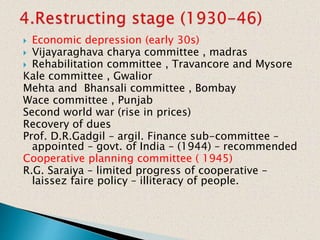
 Economic depression (early 30s)
 Vijayaraghava charya committee , madras
 Rehabilitation committee , Travancore and Mysore
Kale committee , Gwalior
Mehta and Bhansali committee , Bombay
Wace committee , Punjab
Second world war (rise in prices)
Recovery of dues
Prof. D.R.Gadgil – argil. Finance sub-committee –
appointed – govt. of India – (1944) – recommended
Cooperative planning committee ( 1945)
R.G. Saraiya – limited progress of cooperative –
laissez faire policy – illiteracy of people.
 (1959)- Shri V.L.Mehta- viability of
cooperatives
 Membership (farmers only)
 Distance (3to 4 miles)
 Shri B. P. Patel (1961-1962)
 Cooperatives – agril. Loans – agril. operations
and land development.
 Grass root level (supervision) (PACS)
 Responsibility – Shri V. L. Mehta – district
coop. banks (DCCB) – Supervision (PACS)
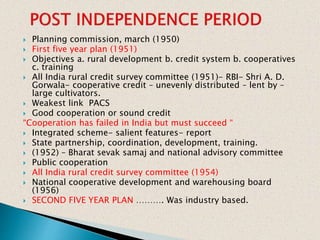
 Planning commission, march (1950)
 First five year plan (1951)
 Objectives a. rural development b. credit system b. cooperatives
c. training
 All India rural credit survey committee (1951)- RBI- Shri A. D.
Gorwala- cooperative credit – unevenly distributed – lent by –
large cultivators.
 Weakest link PACS
 Good cooperation or sound credit
“Cooperation has failed in India but must succeed “
 Integrated scheme- salient features- report
 State partnership, coordination, development, training.
 (1952) – Bharat sevak samaj and national advisory committee
 Public cooperation
 All India rural credit survey committee (1954)
 National cooperative development and warehousing board
(1956)
 SECOND FIVE YEAR PLAN ………. Was industry based.
 National cooperative development
corporation (1963)
 National Federation of cooperative of Sugar
factories (1961-66)
 AIRCRC- Report – B. Venkatappaiah- (1969)-
setting –(SFDA)
 Rural Electrification corporation
 Greater flexibility
 Economic activities
 Strengthening dairy cooperatives
 Transport cooperatives
 (1967) (VAMNICON) –PONNA- establishment-
 Rehabilitation and reorganization of DCCB’S
 Smooth flow of coop. credit orgn’s.
 IFFICO- Establishment – Kandla
 New fertilizers project (vista)
 Success of fertilizer project
 SIXTH FIVE YEAR PLAN
 NABARD – Establishment
 Strengthen economic activities ,dairy
cooperatives, regional coordination.
 SEVENTH FIVE YEAR PLAN
 Recovery camps, retail sale of fertilizers
 Strengthen – national state consumer
federation
 Introduction- (SINGLE WINDOW SYSTEM) -
credit
 Emphasized of ANAND PATTERN – dairy, milk
proccessing
 Cooperatives – only alternatives – providing
loans –rural people- (AIRCARD) Report
 Substantial help by RBI – loan policy
 Development of weaker sections through
cooperative societies
 Structure change in cooperative credit
 Unitary structure- Bihar,U.P.,M.S.,J&K
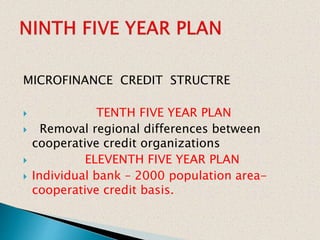
MICROFINANCE CREDIT STRUCTRE
 TENTH FIVE YEAR PLAN
 Removal regional differences between
cooperative credit organizations
 ELEVENTH FIVE YEAR PLAN
 Individual bank – 2000 population area-
cooperative credit basis.
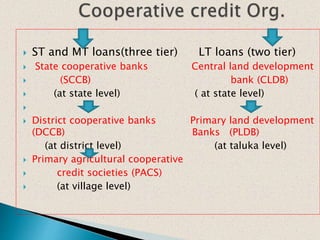
 ST and MT loans(three tier) LT loans (two tier)
 State cooperative banks Central land development
 (SCCB) bank (CLDB)
 (at state level) ( at state level)

 District cooperative banks Primary land development
(DCCB) Banks (PLDB)
(at district level) (at taluka level)
 Primary agricultural cooperative
 credit societies (PACS)
 (at village level)
 State level
 DCCB’s & PACCS Members
 Supervise, mobilize& deploy
 Link between RBI & PACS
 FUNCTIONS
 Formulating development policies
 Uniform credit policies
 Banker’s bank to DCCB
 Grant Subsidies
 Similar to CB’s (banking operations)
 Cooperative credit societies act (1904)
 Link between SCB’s & PACS
 Meet credit requirement of PACS
 Undertake banking business
(cheques,drafts,bills,credit disbursement)
 Confined to Taluka level
 Membership a. societies (farming, consumers)
 Individuals c. working in that area.
 FUNCTIONS
 Supreme & inspect (PACS)
 Guide (PACS) leadership
 Non-credit activities (seeds,manure,
fertilizers,sugar,kerosene)
 Control and accept deposits
 RAIFFESON MODEL- suggestions
 ( limited liability , limited area operation ,
honorary management, voluntary participation of
villages)
 Smooth functioning of villages (above
requirements)
 Short-term & medium term loans disursbesment
 Agril. input supply & other essential commodities
 Formulating & implementing agril. Development
plans
 production-finance-marketing cycle fulfillment
 Long term finance to PLDB’s & its branches
 Members a. PLDB’s b. enterprenurers c. CLDB’s
branches
 NABARD & LIC (debenture) supply
 NABARD (Refinancing agency) – CLDB’s
 Link between NABARD & govt. (transactions of
 Of long term loans)
 Supervise , inspect, guide PLDB’s
 Floats debenture – raising funds
 Spirit & practice of thrift- (stimulate habit of
savings & capital formation)
 Functions
 Give loans to PLDB’s for…..
 Debt clearance, purchase land, land
development, machinery, minor irrigations.
 Land mortgage bank on the lines of
cooperative (Punjab) – 1920
 Progress in post independence (madras,
Mysore, Assam, Bengal)
 Only large farmers benefited.
 Supported by RBI, SBI, & GOVT., ARC, LIC
 Reoriented agril. Policies for small and
marginal farmers
 1974- (Land Mortgage Bank )renamed as-
(Land development bank)
 Taluka level (working)
 FUNCTIONS
 Long term finance
 Development, production, productivity
 Loan for minor irrigations
 Redemption of old debts
 Purchasing tractors & machinery
 Finance for construction of farm structure
 Savings (encourage)
 Credit (three tier structure) Marketing (two tier st.)
 (ST,MT, and LT)
 The A.P. state Cooperative bank The A.P. state
Cooperative
 For Agriculture and Rural Marketing Federation
Ltd.
 Development(APCOBARD) (MARKFED)
 District Cooperative Bank District Cooperative
 For Agriculture and Rural Marketing Societies
 Development (DISCOBARD) (DCMS)
 Primary Agricultural Cooperative
 Credit Societies (PACS)
Cooperation

Cooperation

  • 1.
     Cooperation generallymeans working together to achieve a common goal  “cooperation is a form of organization in which persons voluntarily associate together on the basis of equality for the promotion of their economic interests.”  Motto of cooperation “each for all and all for each”
  • 2.
     Principle ofopen and voluntary association  Principle of service  Principle of democratic organization  Principle of selphelp and mutual help  Principle of distribution of profits and surplus  Principle of political and religious neutrality  Principle of education  Principle of thrift  Principle of publicity  Principle of honorary service
  • 3.
     1. Initiationstage (1904-1911)  Dominance of non- institutional agencies debts  revolting against money lenders (Poona and Ahmadabad)  Deccan Agriculture Relief Act (1879)  Land Improvement Loan Act (1883)  Agricultural loan act (1884)  Madras (Fed rick Nicholson) study village banks-- cooperative lines– Germany  Slogan “Find Raiffeissen”  Indian famine commission (1901)  Sir Edward law (credit societies)  Cooperative credit societies act (1904)  Rural –urban classification (4/5th of farmers)  Control -societies  Real (immovable security) 
  • 4.
     Rectified –cooperative societies act 1912  Legal protection  New focus  Registration of all types of cooperative societies  1914, Sir Edward Mac lagan- performance of societies  Observations a. illiteracy b. funds c. sanction of loans 3. repayment of loans  Effective measures a. awareness b. strictly confined c. honesty d. scrutinized e. speculative purpose f. thrift g. strictness h. savings i. punctual payment.
  • 5.
     Montague –Chelmsford act (1919)  Further impetus to the movement  Land mortgage banks “Punjab” first madras….  Indian central bank enquiry committee (1931)  Madras cooperative societies act (1932)  Madras land Mortgage act (1934)  Growth of cooperative movement.
  • 6.
     Economic depression(early 30s)  Vijayaraghava charya committee , madras  Rehabilitation committee , Travancore and Mysore Kale committee , Gwalior Mehta and Bhansali committee , Bombay Wace committee , Punjab Second world war (rise in prices) Recovery of dues Prof. D.R.Gadgil – argil. Finance sub-committee – appointed – govt. of India – (1944) – recommended Cooperative planning committee ( 1945) R.G. Saraiya – limited progress of cooperative – laissez faire policy – illiteracy of people.
  • 7.
     (1959)- ShriV.L.Mehta- viability of cooperatives  Membership (farmers only)  Distance (3to 4 miles)  Shri B. P. Patel (1961-1962)  Cooperatives – agril. Loans – agril. operations and land development.  Grass root level (supervision) (PACS)  Responsibility – Shri V. L. Mehta – district coop. banks (DCCB) – Supervision (PACS)
  • 8.
     Planning commission,march (1950)  First five year plan (1951)  Objectives a. rural development b. credit system b. cooperatives c. training  All India rural credit survey committee (1951)- RBI- Shri A. D. Gorwala- cooperative credit – unevenly distributed – lent by – large cultivators.  Weakest link PACS  Good cooperation or sound credit “Cooperation has failed in India but must succeed “  Integrated scheme- salient features- report  State partnership, coordination, development, training.  (1952) – Bharat sevak samaj and national advisory committee  Public cooperation  All India rural credit survey committee (1954)  National cooperative development and warehousing board (1956)  SECOND FIVE YEAR PLAN ………. Was industry based.
  • 9.
     National cooperativedevelopment corporation (1963)  National Federation of cooperative of Sugar factories (1961-66)  AIRCRC- Report – B. Venkatappaiah- (1969)- setting –(SFDA)  Rural Electrification corporation  Greater flexibility  Economic activities  Strengthening dairy cooperatives  Transport cooperatives  (1967) (VAMNICON) –PONNA- establishment-
  • 10.
     Rehabilitation andreorganization of DCCB’S  Smooth flow of coop. credit orgn’s.  IFFICO- Establishment – Kandla  New fertilizers project (vista)
  • 11.
     Success offertilizer project  SIXTH FIVE YEAR PLAN  NABARD – Establishment  Strengthen economic activities ,dairy cooperatives, regional coordination.  SEVENTH FIVE YEAR PLAN  Recovery camps, retail sale of fertilizers  Strengthen – national state consumer federation  Introduction- (SINGLE WINDOW SYSTEM) - credit
  • 12.
     Emphasized ofANAND PATTERN – dairy, milk proccessing  Cooperatives – only alternatives – providing loans –rural people- (AIRCARD) Report  Substantial help by RBI – loan policy  Development of weaker sections through cooperative societies  Structure change in cooperative credit  Unitary structure- Bihar,U.P.,M.S.,J&K
  • 13.
    MICROFINANCE CREDIT STRUCTRE TENTH FIVE YEAR PLAN  Removal regional differences between cooperative credit organizations  ELEVENTH FIVE YEAR PLAN  Individual bank – 2000 population area- cooperative credit basis.
  • 14.
     ST andMT loans(three tier) LT loans (two tier)  State cooperative banks Central land development  (SCCB) bank (CLDB)  (at state level) ( at state level)   District cooperative banks Primary land development (DCCB) Banks (PLDB) (at district level) (at taluka level)  Primary agricultural cooperative  credit societies (PACS)  (at village level)
  • 15.
     State level DCCB’s & PACCS Members  Supervise, mobilize& deploy  Link between RBI & PACS  FUNCTIONS  Formulating development policies  Uniform credit policies  Banker’s bank to DCCB  Grant Subsidies  Similar to CB’s (banking operations)
  • 16.
     Cooperative creditsocieties act (1904)  Link between SCB’s & PACS  Meet credit requirement of PACS  Undertake banking business (cheques,drafts,bills,credit disbursement)  Confined to Taluka level  Membership a. societies (farming, consumers)  Individuals c. working in that area.  FUNCTIONS  Supreme & inspect (PACS)  Guide (PACS) leadership  Non-credit activities (seeds,manure, fertilizers,sugar,kerosene)  Control and accept deposits
  • 17.
     RAIFFESON MODEL-suggestions  ( limited liability , limited area operation , honorary management, voluntary participation of villages)  Smooth functioning of villages (above requirements)  Short-term & medium term loans disursbesment  Agril. input supply & other essential commodities  Formulating & implementing agril. Development plans  production-finance-marketing cycle fulfillment
  • 18.
     Long termfinance to PLDB’s & its branches  Members a. PLDB’s b. enterprenurers c. CLDB’s branches  NABARD & LIC (debenture) supply  NABARD (Refinancing agency) – CLDB’s  Link between NABARD & govt. (transactions of  Of long term loans)  Supervise , inspect, guide PLDB’s  Floats debenture – raising funds  Spirit & practice of thrift- (stimulate habit of savings & capital formation)
  • 19.
     Functions  Giveloans to PLDB’s for…..  Debt clearance, purchase land, land development, machinery, minor irrigations.
  • 20.
     Land mortgagebank on the lines of cooperative (Punjab) – 1920  Progress in post independence (madras, Mysore, Assam, Bengal)  Only large farmers benefited.  Supported by RBI, SBI, & GOVT., ARC, LIC  Reoriented agril. Policies for small and marginal farmers  1974- (Land Mortgage Bank )renamed as- (Land development bank)  Taluka level (working)
  • 21.
     FUNCTIONS  Longterm finance  Development, production, productivity  Loan for minor irrigations  Redemption of old debts  Purchasing tractors & machinery  Finance for construction of farm structure  Savings (encourage)
  • 22.
     Credit (threetier structure) Marketing (two tier st.)  (ST,MT, and LT)  The A.P. state Cooperative bank The A.P. state Cooperative  For Agriculture and Rural Marketing Federation Ltd.  Development(APCOBARD) (MARKFED)  District Cooperative Bank District Cooperative  For Agriculture and Rural Marketing Societies  Development (DISCOBARD) (DCMS)  Primary Agricultural Cooperative  Credit Societies (PACS)