COMMUNITY HEALTH
AUDIT AND SANCTIONS
PRESENTED BY
REENA YADAV
LECTURER
PUSHPANJALI COLLEGE
OF NURSING, AGRA
DEFINITION OF AUDIT
Nursing audit is a review of the
patient record designed to identify,
examine, or verify the
performance of certain specified
aspects of nursing care by using
established criteria.
DEFINITION OF AUDIT
Nursing audit is the process of
collecting information from nursing
reports and other documented
evidence about patient care and
assessing the quality of care by the
use of quality assurance
programmes.
Sanction
Authoritative permission or approval that makes
a course of action valid or permission.
Support or encouragement, as from public
opinion or established custom.
A consideration, influence, or principle that
dictates an ethical choice.
Auditing for community health
services in India
 It is also the evaluation of health services.
The general steps are:
 Determine what is to be evaluated
 Establish standards and criteria
 Plan the methodology to be applied
 Gather information
 Analyze the results
 Take action
 Re-evaluate
Importance of auditing
For community health service
 Errors are located
 Frauds are discovered
 Advice about weakness
 High moral values
 Efficiency improves
 Dispute is settled
 Planning becomes possible
 Improvement of the internal control
For government
 Better performance
 Progress of economy
Auditors
External auditors
 It is an independent public accounting firm
engaged by the client subject to the audit, to
express an opinion of whether the
companies financial statements are free of
material misstatement, whether due to fraud
or error.
 External auditors are regarded as
independent auditors. They are also called
as statutory auditors.
Internal auditors
internal auditors are not considered
independent of the company they perform
audit procedures for,
internal auditors of publically traded
companies are required to report directly
to the board of directors or a sub-
committee of the board of directors, or not
to management, so to reduce the risk that
internal auditors will be pressured to
produce favorable assessments.
Purpose of community health
services audits:
 monitor the progress of national health programs.
 modify the deficiency of certain programs.
assess the performance of physicians, nurses,
and other paramedical.
 Record auditing: to see the records whether they
are properly maintained and updated or not.
 Financial auditing.
 Auditing of vaccines preventable diseases and
other communicable diseases and non
communicable diseases.
 Audits of stocks and inventory.
Audit process
it consist of 6 steps
 Step 1: Identify the problem or issue
This stage involves the selection of a topic
or issue to be audited, and is likely to
involve measuring adherence to
healthcare processes that have been
shown to produce best outcomes for
patients.
Step 2: Define criteria & standards
Decisions regarding the overall purpose of
the audit, either as what should happen as
a result of the audit,
what question you want the audit to answer
. criteria are explicit statements that define
what is being measured and represent
elements of care that can be measured
objectively.
The standards define the aspect of care to
be measured,
based on the best available evidence.
 Step 3: Data collection
To ensure that the data collected are precise,
and that only essential information is
collected, certain details of what is to be
audited must be established from the
outset.
Data to be collected may be available in a
computerized information system, or in
other cases it may be appropriate to collect
data manually or electronically using data
capture solutions.
Step 4: Compare performance with
criteria and standards
 This is the analysis stage.
 the results of the data collection are
compared with criteria and standards.
 The end stage of analysis is concluding how
well the standards were met and, if
applicable, identifying reasons why the
standards weren't met in all cases.
 These reasons might be agreed to be
acceptable,
Step 5: Implementing change
Once the results of the audit have been
published and discussed, an agreement
must be reached about the
recommendations for change.
Using an action plan to record these
recommendations is good practice; this
should include who has agreed to do what
why and when.
Each point needs to be well defined, with an
individual named as responsible for it, and an
agreed timescale for its completion.
Step 6: Re-audit: Sustaining
Improvements
 After an agreed period, the audit should be
repeated.
 The same strategies for identifying the
sample, methods and data analysis should
be used to ensure comparability with the
original audit.
 The re-audit should demonstrate that the
changes have been implemented and that
improvements have been made. Further
changes may then be required, leading to
additional re-audits.
This stage is critical to the successful
outcome of an audit process - as it verifies
whether the changes implemented have
had an effect and to see if further
improvements are required to achieve the
standards of healthcare delivery identified
in stage 2.
Types of audit
Internal auditing
Internal auditing is a control technique
performed by an external auditors who is
not a employee of the organization. He
makes an independent appraisal of the
policies, plan and the points deficits in the
policies or plans and give suggestion for
eliminating deficits.
External auditing
It is an independent appraisal of the
organizations, finances, accounts and
statements. The external auditors is the
qualified persons who has to certify the
annual profits and accounts and prepare
a balance sheet after careful
examinations of the relevant books,
accounts and documents.
Types of internal audit
Retrospective audit:
It evaluates the quality of care through
appraisal of nursing process after the client’s
discharge from the health care system.
This refers to an in-depth assessment of quality
after the patient has been discharged, and uses
the patient’s chart as the source of data.
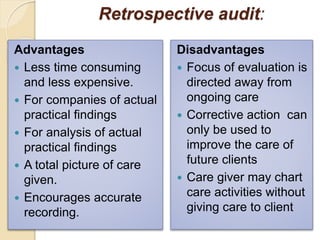
Retrospective audit:
Advantages
 Less time consuming
and less expensive.
 For companies of actual
practical findings
 For analysis of actual
practical findings
 A total picture of care
given.
 Encourages accurate
recording.
Disadvantages
 Focus of evaluation is
directed away from
ongoing care
 Corrective action can
only be used to
improve the care of
future clients
 Care giver may chart
care activities without
giving care to client
Types of internal audit
Concurrent audit :
It is the method of evaluating the quality of
ongoing care through appraisal of nursing
process.
This refers to the evaluations conducted on
behalf of patients who are still undergoing
care. It includes assessment the patient at
bedside in relation to pre-determined criteria,
interviewing the staff responsible for his care
and reviewing the patient record and care
plan.
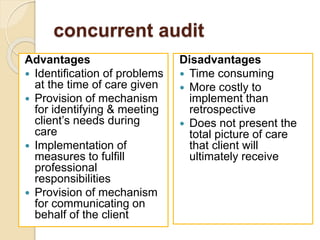
concurrent audit
Advantages
 Identification of problems
at the time of care given
 Provision of mechanism
for identifying & meeting
client’s needs during
care
 Implementation of
measures to fulfill
professional
responsibilities
 Provision of mechanism
for communicating on
behalf of the client
Disadvantages
 Time consuming
 More costly to
implement than
retrospective
 Does not present the
total picture of care
that client will
ultimately receive
Peer review
peer review nurses functioning in same capacity that is
peer appraise the quality of care or practice
performed by others equally qualified nurses. The
peer review is based on pre established standards or
criteria.
 There are two types of nurses review
 Individual peer review - Focuses on the
performance of an individual nurses.
 Nursing audit – focus on evaluating the nursing care
through the records.

Quality audits
are performed to verify conformance to
standards through review of objectives
evidence.
quality audits may verify the effectiveness
of a quality management system.
This is a part of certification such as ISO.
Quality audits are essentials to verify the
existence of objective evidence showing
conformation to required process, to
assess how successfully processes have
been implemented, for judging the
effectiveness of achieving any defined
target levels,
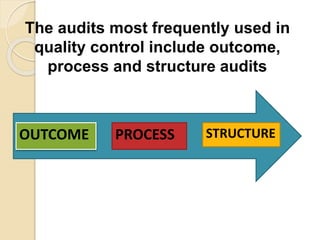
OUTCOME PROCESS STRUCTURE
The audits most frequently used in
quality control include outcome,
process and structure audits
Outcome audit
It is the end result of care.
The changes in the patients health status and
can be attributed to delivery of health care
services.
It determines the results of specific nursing
intervention.
Process audit
It is used to measure the process of care or
how the care was carried out.
This audit is task oriented and focuses on
whether or not practice standards are being
fulfilled.
Structure audit
This type of audit monitors the structure or
setting in which the patient care occurs.
The audit is done for assessing the physical
facilities, equipments and supplies describe
whether they fulfill the set standards or not.
Energy audits
An energy audit is an inspection, survey
and analysis of energy flows for energy
conservation in a building, process or
system to reduce the amount of energy
into the system without negatively
affecting the outputs.
Instruments of community
health services audit
 Numerous audit instruments can be
found.
 Two valid and reliable tools are phaneuf
nursing are the slater nursing
competencies rating scale and the
quality patient care scale.
phaneuf nursing audit.
 This 50 item instrument measures seven
functions of professional nursing as they
relate to nursing process.
 his instrument is the example of
retrospective audit instrument
 The slater nursing competencies scale
is an 84 item scale intended to rate
nurses performance in the clinical setting
after direct observation of an identified
number of nurses and client encounters.
 The quality of patient care scale is a
68item scale intended to measure the
quality of care received by a client either
through direct nurse client encounters or
interventions with others on behalf of the
client.
 Other nursing audits instruments are
 Rush- Presbyterian – st. luke’s medical
centre medicus methodology for
monitoring quality patient care.
 The professional practitioner’s
performance rating scale.
 The CASH nursing care evaluation
instrument.
 The critical incident performance
appraisal system.
Regular health check audits
 Regulatory audits
The aim of regulatory audit is to verify that a
project is compliant with regulations and
standards.
Record audit
A commonly used method for collecting
performance data in community health
services is the record audit. Both concurrent
and retrospective record auditing is carried
out.
The audit committee
is a committee of the board of community health
services. Its primarily function is to assist the
board in fulfilling its oversight responsibility by
reviewing the independent audit report as to the
system of internal controls.
The committee experts advised of:
 The financial information provided to the
governmental regulatory bodies.
 The status of examinations/ audits conducted
by other government states or regulatory
bodies.
Responsibilities of audit committee
 It provides an open avenue of
communication between the board,
management and the independent auditors.
 It also provides insight with regard to the
manner in which the financial reporting of the
department of community health services.
 The audit committee is appointed annually by the
board of community health services.
 The audit committee consists of at least three
members of whom at least one should have
background in financial reporting, accounting,
and auditing.
 There is chairperson in audit committee. It is the
responsibility of the chairperson to schedule the
meeting of the committee and to suggest agenda
items for the committee’s consideration.
 The audit committee meets as often as it
determines necessary, but not less frequently
than 4 times per calendar year. The audit
committee meets the management and
independent auditors in separate executive
sessions.
Responsibilities and duties of
audit
 Review and reassess the adequacy of the
charter annually and recommended any
proposed changes to the board for
approval.
 Maintain other records of meetings and
activities.
 Review management’s independent audit
procurement process and confirm the
selection of independent auditors.
 Review reports from independent auditors
regarding their independent audit . At the
committee’s discretion, discuss such
reports with the auditors and if
appropriate, recommend that the board
take action to satisfy itself or the
independent auditor.
 Review of department’s periodic report of
major financial risk exposure includes:
 Fraud and other misconduct.
 Change in accounting to policies and
procedure.
 Review the annual audited financial
statements with management including:
 Major accounting issues and
changes to accounting principles and
auditing standards.
 Adequacy of internal controls that
could significantly affects the
department’s financial statements
 Meet with the independent auditors as necessary
to monitor the progress of the annual financial
and single audit. Evaluate the results of annual
audits including, but not limited to:
 The audited financial statements
 The adequacy of the system of internal controls.
 The adequacy of the department’s accounting
policies and procedures, including the level of
compliance with governmental regulations
 Discuss with the independent auditor the matters
required by AICPA professional standards.
 8. Establish guidelines in accordance with
applicable laws and government auditing
standards.
9. Review a current list of examinations and/ or
audit of DCH in process or recently
completed conducted by:
 Governmental or other authorities.
 Internal audit staff.
1o. Periodically review and evaluate the
adequacy of department’s monitoring of
compliance with reporting requirements of
governmental agencies and other
organization.
11. Initiate investigation of other matters the
committee deems appropriate and relevant
to the committee’s purpose.
What need to be done in health
sector in india
 The audit has benefitted in the
implementation of the program and
increasing transparent accountability.
 It become an important tool for effective
program implement awareness generation,
program monitoring and evaluation, reducing
the chances of corrupt and grievance
redressal, and follow up on corrective
actions.
What need to be done in health
sector in india
 As of now, there are only a few examples of
use of audits in health sectors in india,
 however, it is expected that with the time will
increase. The use of this approach in
maternal death audits and infant mortality
audit a long way in achieving millennium
development goals.
Thank you

Community health audit

  • 1.
    COMMUNITY HEALTH AUDIT ANDSANCTIONS PRESENTED BY REENA YADAV LECTURER PUSHPANJALI COLLEGE OF NURSING, AGRA
  • 2.
    DEFINITION OF AUDIT Nursingaudit is a review of the patient record designed to identify, examine, or verify the performance of certain specified aspects of nursing care by using established criteria.
  • 3.
    DEFINITION OF AUDIT Nursingaudit is the process of collecting information from nursing reports and other documented evidence about patient care and assessing the quality of care by the use of quality assurance programmes.
  • 4.
    Sanction Authoritative permission orapproval that makes a course of action valid or permission. Support or encouragement, as from public opinion or established custom. A consideration, influence, or principle that dictates an ethical choice.
  • 5.
    Auditing for communityhealth services in India  It is also the evaluation of health services. The general steps are:  Determine what is to be evaluated  Establish standards and criteria  Plan the methodology to be applied  Gather information  Analyze the results  Take action  Re-evaluate
  • 6.
    Importance of auditing Forcommunity health service  Errors are located  Frauds are discovered  Advice about weakness  High moral values  Efficiency improves  Dispute is settled  Planning becomes possible  Improvement of the internal control For government  Better performance  Progress of economy
  • 7.
    Auditors External auditors  Itis an independent public accounting firm engaged by the client subject to the audit, to express an opinion of whether the companies financial statements are free of material misstatement, whether due to fraud or error.  External auditors are regarded as independent auditors. They are also called as statutory auditors.
  • 8.
    Internal auditors internal auditorsare not considered independent of the company they perform audit procedures for, internal auditors of publically traded companies are required to report directly to the board of directors or a sub- committee of the board of directors, or not to management, so to reduce the risk that internal auditors will be pressured to produce favorable assessments.
  • 9.
    Purpose of communityhealth services audits:  monitor the progress of national health programs.  modify the deficiency of certain programs. assess the performance of physicians, nurses, and other paramedical.  Record auditing: to see the records whether they are properly maintained and updated or not.  Financial auditing.  Auditing of vaccines preventable diseases and other communicable diseases and non communicable diseases.  Audits of stocks and inventory.
  • 10.
    Audit process it consistof 6 steps  Step 1: Identify the problem or issue This stage involves the selection of a topic or issue to be audited, and is likely to involve measuring adherence to healthcare processes that have been shown to produce best outcomes for patients.
  • 11.
    Step 2: Definecriteria & standards Decisions regarding the overall purpose of the audit, either as what should happen as a result of the audit, what question you want the audit to answer . criteria are explicit statements that define what is being measured and represent elements of care that can be measured objectively. The standards define the aspect of care to be measured, based on the best available evidence.
  • 12.
     Step 3:Data collection To ensure that the data collected are precise, and that only essential information is collected, certain details of what is to be audited must be established from the outset. Data to be collected may be available in a computerized information system, or in other cases it may be appropriate to collect data manually or electronically using data capture solutions.
  • 13.
    Step 4: Compareperformance with criteria and standards  This is the analysis stage.  the results of the data collection are compared with criteria and standards.  The end stage of analysis is concluding how well the standards were met and, if applicable, identifying reasons why the standards weren't met in all cases.  These reasons might be agreed to be acceptable,
  • 14.
    Step 5: Implementingchange Once the results of the audit have been published and discussed, an agreement must be reached about the recommendations for change. Using an action plan to record these recommendations is good practice; this should include who has agreed to do what why and when. Each point needs to be well defined, with an individual named as responsible for it, and an agreed timescale for its completion.
  • 15.
    Step 6: Re-audit:Sustaining Improvements  After an agreed period, the audit should be repeated.  The same strategies for identifying the sample, methods and data analysis should be used to ensure comparability with the original audit.  The re-audit should demonstrate that the changes have been implemented and that improvements have been made. Further changes may then be required, leading to additional re-audits.
  • 16.
    This stage iscritical to the successful outcome of an audit process - as it verifies whether the changes implemented have had an effect and to see if further improvements are required to achieve the standards of healthcare delivery identified in stage 2.
  • 17.
    Types of audit Internalauditing Internal auditing is a control technique performed by an external auditors who is not a employee of the organization. He makes an independent appraisal of the policies, plan and the points deficits in the policies or plans and give suggestion for eliminating deficits.
  • 18.
    External auditing It isan independent appraisal of the organizations, finances, accounts and statements. The external auditors is the qualified persons who has to certify the annual profits and accounts and prepare a balance sheet after careful examinations of the relevant books, accounts and documents.
  • 19.
    Types of internalaudit Retrospective audit: It evaluates the quality of care through appraisal of nursing process after the client’s discharge from the health care system. This refers to an in-depth assessment of quality after the patient has been discharged, and uses the patient’s chart as the source of data.
  • 20.
    Retrospective audit: Advantages  Lesstime consuming and less expensive.  For companies of actual practical findings  For analysis of actual practical findings  A total picture of care given.  Encourages accurate recording. Disadvantages  Focus of evaluation is directed away from ongoing care  Corrective action can only be used to improve the care of future clients  Care giver may chart care activities without giving care to client
  • 21.
    Types of internalaudit Concurrent audit : It is the method of evaluating the quality of ongoing care through appraisal of nursing process. This refers to the evaluations conducted on behalf of patients who are still undergoing care. It includes assessment the patient at bedside in relation to pre-determined criteria, interviewing the staff responsible for his care and reviewing the patient record and care plan.
  • 22.
    concurrent audit Advantages  Identificationof problems at the time of care given  Provision of mechanism for identifying & meeting client’s needs during care  Implementation of measures to fulfill professional responsibilities  Provision of mechanism for communicating on behalf of the client Disadvantages  Time consuming  More costly to implement than retrospective  Does not present the total picture of care that client will ultimately receive
  • 23.
    Peer review peer reviewnurses functioning in same capacity that is peer appraise the quality of care or practice performed by others equally qualified nurses. The peer review is based on pre established standards or criteria.  There are two types of nurses review  Individual peer review - Focuses on the performance of an individual nurses.  Nursing audit – focus on evaluating the nursing care through the records. 
  • 24.
    Quality audits are performedto verify conformance to standards through review of objectives evidence. quality audits may verify the effectiveness of a quality management system. This is a part of certification such as ISO. Quality audits are essentials to verify the existence of objective evidence showing conformation to required process, to assess how successfully processes have been implemented, for judging the effectiveness of achieving any defined target levels,
  • 25.
    OUTCOME PROCESS STRUCTURE Theaudits most frequently used in quality control include outcome, process and structure audits
  • 26.
    Outcome audit It isthe end result of care. The changes in the patients health status and can be attributed to delivery of health care services. It determines the results of specific nursing intervention.
  • 27.
    Process audit It isused to measure the process of care or how the care was carried out. This audit is task oriented and focuses on whether or not practice standards are being fulfilled.
  • 28.
    Structure audit This typeof audit monitors the structure or setting in which the patient care occurs. The audit is done for assessing the physical facilities, equipments and supplies describe whether they fulfill the set standards or not.
  • 29.
    Energy audits An energyaudit is an inspection, survey and analysis of energy flows for energy conservation in a building, process or system to reduce the amount of energy into the system without negatively affecting the outputs.
  • 30.
    Instruments of community healthservices audit  Numerous audit instruments can be found.  Two valid and reliable tools are phaneuf nursing are the slater nursing competencies rating scale and the quality patient care scale.
  • 31.
    phaneuf nursing audit. This 50 item instrument measures seven functions of professional nursing as they relate to nursing process.  his instrument is the example of retrospective audit instrument
  • 32.
     The slaternursing competencies scale is an 84 item scale intended to rate nurses performance in the clinical setting after direct observation of an identified number of nurses and client encounters.  The quality of patient care scale is a 68item scale intended to measure the quality of care received by a client either through direct nurse client encounters or interventions with others on behalf of the client.
  • 33.
     Other nursingaudits instruments are  Rush- Presbyterian – st. luke’s medical centre medicus methodology for monitoring quality patient care.  The professional practitioner’s performance rating scale.  The CASH nursing care evaluation instrument.  The critical incident performance appraisal system.
  • 34.
    Regular health checkaudits  Regulatory audits The aim of regulatory audit is to verify that a project is compliant with regulations and standards. Record audit A commonly used method for collecting performance data in community health services is the record audit. Both concurrent and retrospective record auditing is carried out.
  • 35.
    The audit committee isa committee of the board of community health services. Its primarily function is to assist the board in fulfilling its oversight responsibility by reviewing the independent audit report as to the system of internal controls. The committee experts advised of:  The financial information provided to the governmental regulatory bodies.  The status of examinations/ audits conducted by other government states or regulatory bodies.
  • 36.
    Responsibilities of auditcommittee  It provides an open avenue of communication between the board, management and the independent auditors.  It also provides insight with regard to the manner in which the financial reporting of the department of community health services.
  • 37.
     The auditcommittee is appointed annually by the board of community health services.  The audit committee consists of at least three members of whom at least one should have background in financial reporting, accounting, and auditing.  There is chairperson in audit committee. It is the responsibility of the chairperson to schedule the meeting of the committee and to suggest agenda items for the committee’s consideration.  The audit committee meets as often as it determines necessary, but not less frequently than 4 times per calendar year. The audit committee meets the management and independent auditors in separate executive sessions.
  • 38.
    Responsibilities and dutiesof audit  Review and reassess the adequacy of the charter annually and recommended any proposed changes to the board for approval.  Maintain other records of meetings and activities.  Review management’s independent audit procurement process and confirm the selection of independent auditors.
  • 39.
     Review reportsfrom independent auditors regarding their independent audit . At the committee’s discretion, discuss such reports with the auditors and if appropriate, recommend that the board take action to satisfy itself or the independent auditor.
  • 40.
     Review ofdepartment’s periodic report of major financial risk exposure includes:  Fraud and other misconduct.  Change in accounting to policies and procedure.
  • 41.
     Review theannual audited financial statements with management including:  Major accounting issues and changes to accounting principles and auditing standards.  Adequacy of internal controls that could significantly affects the department’s financial statements
  • 42.
     Meet withthe independent auditors as necessary to monitor the progress of the annual financial and single audit. Evaluate the results of annual audits including, but not limited to:  The audited financial statements  The adequacy of the system of internal controls.  The adequacy of the department’s accounting policies and procedures, including the level of compliance with governmental regulations  Discuss with the independent auditor the matters required by AICPA professional standards.
  • 43.
     8. Establishguidelines in accordance with applicable laws and government auditing standards. 9. Review a current list of examinations and/ or audit of DCH in process or recently completed conducted by:  Governmental or other authorities.  Internal audit staff.
  • 44.
    1o. Periodically reviewand evaluate the adequacy of department’s monitoring of compliance with reporting requirements of governmental agencies and other organization. 11. Initiate investigation of other matters the committee deems appropriate and relevant to the committee’s purpose.
  • 45.
    What need tobe done in health sector in india  The audit has benefitted in the implementation of the program and increasing transparent accountability.  It become an important tool for effective program implement awareness generation, program monitoring and evaluation, reducing the chances of corrupt and grievance redressal, and follow up on corrective actions.
  • 46.
    What need tobe done in health sector in india  As of now, there are only a few examples of use of audits in health sectors in india,  however, it is expected that with the time will increase. The use of this approach in maternal death audits and infant mortality audit a long way in achieving millennium development goals.
  • 47.