INTERNATIONAL
RELATIONS
COURSE SCHEDULE
 CHAPTER 1: INTERNATIONAL RELATIONS
INTRODUCTION AND STATES
 CHAPTER 2: NON-STATES
 CHAPTER 3: INTERGOVERNMENTAL ORGANIZATIONS
(IGOs)
 CHAPTER 4: PROBLEMS AND CHALLENGES
DEFINING THE IGOs
• Intergovernmental Organizations (IGOs) are
founded by governments which recognize that
it is in their national interests to obtain
multilateral agreements and pursue actions to
deal with threats, challenges or problems that
cannot be dealt with effectively at the
unilateral level.
VARIETIES OF IGOs
An important variety of IGO is the special interest
organization which has a very specific issue area and
a domain that crosses all regional boundaries.
A good example is the Organization of Petroleum
Exporting Countries (OPEC).
One of the first specialized IGOs is the International
Police Organization, better known by its acronym,
INTERPOL, an association of over 100 national police
forces devoted to fighting international crime.
One category of IGO which expanded very rapidly in
the 20th century is the regional IGO, including the
European Union (EU), the Organization of American
States (OAS), and the Association of South East Asian
Nations (ASEAN).
These IGOs were formed to strengthen cooperation
by states at regional level.
Similarly, there are IGOs which have been
established with the objective of promoting regional
security.
The North Atlantic Treaty Organization (NATO) is one
of the most famous; others include:
OSCE (Organization for Security and Cooperation in
Europe)
ANZUS (Australia, New Zealand and US Security
Treaty Group)
The only world IGO:
United Nations (UN)
First we will discuss the League of Nations before
tackling the UN.
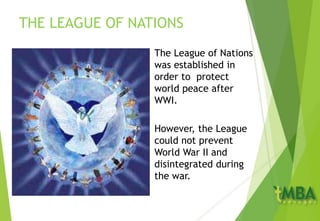
THE LEAGUE OF NATIONS
The League of Nations
was established in
order to protect
world peace after
WWI.
However, the League
could not prevent
World War II and
disintegrated during
the war.
THE UNITED NATIONS
The United Nations was founded by the victorious
countries of WWII in 1945 in order to resolve the
disputes at the end of the war and to warrant peace
and security in the world.
The Aim:
The United Nations describes itself as a global
foundation that ensures:
• The justice and security, economic
development and social equity to all the
countries in the international arena.
 The UN is founded on the twin principles of the
sovereignty of states and an essentially voluntary
system of collective security, meaning that the
organization has no means of enforcing its
decisions.
 The number of members of the organization
which was 51 when established and is now 194.
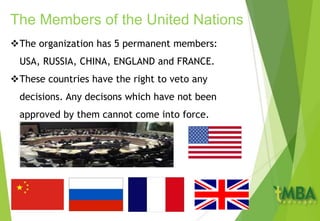
The organization has 5 permanent members:
USA, RUSSIA, CHINA, ENGLAND and FRANCE.
These countries have the right to veto any
decisions. Any decisons which have not been
approved by them cannot come into force.
The Members of the United Nations
THE EUROPEAN UNION
The European Union Process
1. European Coal and Steel Community - ECSC (1951)
2. European Atomic Community – EURATOM (1957)
3. European Economic Community – EEC (1957)
4. European Community – EC (1965)
5. European Union – EU (1991- Maastricht Treaty)
The Enlargement Process Of The EU
The First Enlargement (1973)
The United Kingdom, Ireland, Denmark
The Second Enlargement (1981)
Greece
The Third Enlargement (1986)
Spain, Portugal
The Fourth Enlargement (1995)
Sweden, Austria, Finland
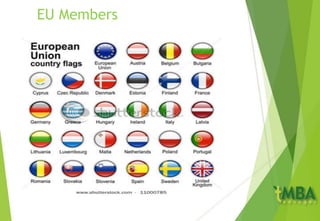
EU Members
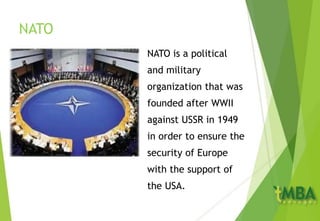
NATO
NATO is a political
and military
organization that was
founded after WWII
against USSR in 1949
in order to ensure the
security of Europe
with the support of
the USA.
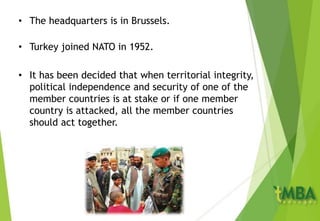
• The headquarters is in Brussels.
• Turkey joined NATO in 1952.
• It has been decided that when territorial integrity,
political independence and security of one of the
member countries is at stake or if one member
country is attacked, all the member countries
should act together.
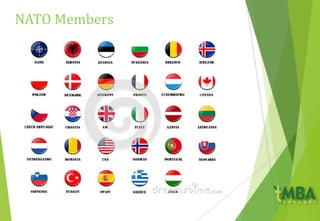
NATO Members
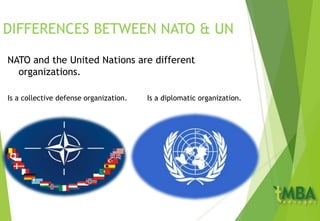
DIFFERENCES BETWEEN NATO & UN
NATO and the United Nations are different
organizations.
Is a collective defense organization. Is a diplomatic organization.
ANOTHER REGIONAL IGO: ASEAN
• The Association of South East Asian Nations (ASEAN)
was founded in 1967, after the Bangkok Declaration
by Thailand, Singapore, Indonesia, the Phillippines
and Malesia. Brunei joined ASEAN in 1984 and
Vietnam in 1995.
• It aims to promote regional economic, social and
cultural cooperation.

International relations chapter 3 ig os

  • 1.
  • 2.
    COURSE SCHEDULE  CHAPTER1: INTERNATIONAL RELATIONS INTRODUCTION AND STATES  CHAPTER 2: NON-STATES  CHAPTER 3: INTERGOVERNMENTAL ORGANIZATIONS (IGOs)  CHAPTER 4: PROBLEMS AND CHALLENGES
  • 3.
    DEFINING THE IGOs •Intergovernmental Organizations (IGOs) are founded by governments which recognize that it is in their national interests to obtain multilateral agreements and pursue actions to deal with threats, challenges or problems that cannot be dealt with effectively at the unilateral level.
  • 4.
    VARIETIES OF IGOs Animportant variety of IGO is the special interest organization which has a very specific issue area and a domain that crosses all regional boundaries. A good example is the Organization of Petroleum Exporting Countries (OPEC).
  • 5.
    One of thefirst specialized IGOs is the International Police Organization, better known by its acronym, INTERPOL, an association of over 100 national police forces devoted to fighting international crime.
  • 6.
    One category ofIGO which expanded very rapidly in the 20th century is the regional IGO, including the European Union (EU), the Organization of American States (OAS), and the Association of South East Asian Nations (ASEAN). These IGOs were formed to strengthen cooperation by states at regional level.
  • 7.
    Similarly, there areIGOs which have been established with the objective of promoting regional security. The North Atlantic Treaty Organization (NATO) is one of the most famous; others include: OSCE (Organization for Security and Cooperation in Europe) ANZUS (Australia, New Zealand and US Security Treaty Group)
  • 8.
    The only worldIGO: United Nations (UN) First we will discuss the League of Nations before tackling the UN.
  • 9.
    THE LEAGUE OFNATIONS The League of Nations was established in order to protect world peace after WWI. However, the League could not prevent World War II and disintegrated during the war.
  • 10.
    THE UNITED NATIONS TheUnited Nations was founded by the victorious countries of WWII in 1945 in order to resolve the disputes at the end of the war and to warrant peace and security in the world.
  • 11.
    The Aim: The UnitedNations describes itself as a global foundation that ensures: • The justice and security, economic development and social equity to all the countries in the international arena.
  • 12.
     The UNis founded on the twin principles of the sovereignty of states and an essentially voluntary system of collective security, meaning that the organization has no means of enforcing its decisions.  The number of members of the organization which was 51 when established and is now 194.
  • 13.
    The organization has5 permanent members: USA, RUSSIA, CHINA, ENGLAND and FRANCE. These countries have the right to veto any decisions. Any decisons which have not been approved by them cannot come into force. The Members of the United Nations
  • 14.
  • 15.
    The European UnionProcess 1. European Coal and Steel Community - ECSC (1951) 2. European Atomic Community – EURATOM (1957) 3. European Economic Community – EEC (1957) 4. European Community – EC (1965) 5. European Union – EU (1991- Maastricht Treaty)
  • 16.
    The Enlargement ProcessOf The EU The First Enlargement (1973) The United Kingdom, Ireland, Denmark The Second Enlargement (1981) Greece The Third Enlargement (1986) Spain, Portugal The Fourth Enlargement (1995) Sweden, Austria, Finland
  • 17.
  • 18.
    NATO NATO is apolitical and military organization that was founded after WWII against USSR in 1949 in order to ensure the security of Europe with the support of the USA.
  • 19.
    • The headquartersis in Brussels. • Turkey joined NATO in 1952. • It has been decided that when territorial integrity, political independence and security of one of the member countries is at stake or if one member country is attacked, all the member countries should act together.
  • 20.
  • 21.
    DIFFERENCES BETWEEN NATO& UN NATO and the United Nations are different organizations. Is a collective defense organization. Is a diplomatic organization.
  • 22.
    ANOTHER REGIONAL IGO:ASEAN • The Association of South East Asian Nations (ASEAN) was founded in 1967, after the Bangkok Declaration by Thailand, Singapore, Indonesia, the Phillippines and Malesia. Brunei joined ASEAN in 1984 and Vietnam in 1995. • It aims to promote regional economic, social and cultural cooperation.