Deterrence
Theory
• Deterrence, military strategy under which one power used as
preventive force that could be protected against destruction by a
surprise attack.
• This doctrine gained increased prominence as a military strategy
during the Cold War with regard to the use of nuclear weapons and.
• Deterrence is a strategy intended to dissuade an adversary from
taking an action not yet started by means of threat of reprisal or to
prevent them from doing something that another state desires.
• The strategy is based on the psychological concept of the same name.
A credible nuclear deterrent, Bernard Brodie wrote in 1959, must be
always at the ready, yet never used.
• The doctrine gained increased prominence as a military stragy
during the cold war with regard to the use of nuclear weapons.
• Deterrence gained importance in strategic studies through Thomas
Schelling’s (1966) classical work on deterrence.
• According to Schelling “the capacity to harm another state is now
used as a motivating factor for other states to avoid it and influence
another state’s behaviour. Deterrence is significant theory in
Strategic Studies and International Relations.
• Deterrence gained global recognition after Cuban missile Crisis
event.
• Deterrence is implemented and executed to ensure its opponents
abide by its will.
• Deterrence is a belief on strategic capability to avoid or prevent itself
from being attacked by its opponents.
Assumptions
• Ratonality
• Mutual Vulnerability
• Cost/Benefit Analysis
• Perceptions are the key
• Credibility is effective for the effective function of deterrence
Narrow vs Broad concept of Deterrence
• The Narrowest definitions hold that deterrence refers solely to
military tools of statecraft- using the threat of military response to
prevent a state from taking action.
• In Broader conception keeps focus on threats but expands the scope
to non-military actions. A State can deter using threats Economic
Sanctions, Diplomatic Exclusion or Information Operations.
Types of Deterrence
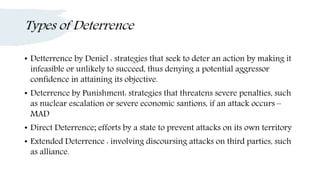
• Detterrence by Deniel : strategies that seek to deter an action by making it
infeasible or unlikely to succeed, thus denying a potential aggressor
confidence in attaining its objective.
• Deterrence by Punishment: strategies that threatens severe penalties, such
as nuclear escalation or severe economic santions, if an attack occurs –
MAD
• Direct Deterrence; efforts by a state to prevent attacks on its own territory
• Extended Deterrence : involving discoursing attacks on third parties, such
as alliance.
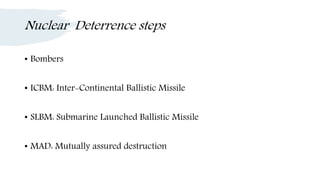
Nuclear Deterrence steps
• Bombers
• ICBM: Inter-Continental Ballistic Missile
• SLBM: Submarine Launched Ballistic Missile
• MAD: Mutually assured destruction

Deterrence Theory in International Relations

  • 1.
  • 2.
    • Deterrence, militarystrategy under which one power used as preventive force that could be protected against destruction by a surprise attack. • This doctrine gained increased prominence as a military strategy during the Cold War with regard to the use of nuclear weapons and. • Deterrence is a strategy intended to dissuade an adversary from taking an action not yet started by means of threat of reprisal or to prevent them from doing something that another state desires. • The strategy is based on the psychological concept of the same name. A credible nuclear deterrent, Bernard Brodie wrote in 1959, must be always at the ready, yet never used.
  • 3.
    • The doctrinegained increased prominence as a military stragy during the cold war with regard to the use of nuclear weapons. • Deterrence gained importance in strategic studies through Thomas Schelling’s (1966) classical work on deterrence. • According to Schelling “the capacity to harm another state is now used as a motivating factor for other states to avoid it and influence another state’s behaviour. Deterrence is significant theory in Strategic Studies and International Relations. • Deterrence gained global recognition after Cuban missile Crisis event. • Deterrence is implemented and executed to ensure its opponents abide by its will. • Deterrence is a belief on strategic capability to avoid or prevent itself from being attacked by its opponents.
  • 4.
    Assumptions • Ratonality • MutualVulnerability • Cost/Benefit Analysis • Perceptions are the key • Credibility is effective for the effective function of deterrence
  • 5.
    Narrow vs Broadconcept of Deterrence • The Narrowest definitions hold that deterrence refers solely to military tools of statecraft- using the threat of military response to prevent a state from taking action. • In Broader conception keeps focus on threats but expands the scope to non-military actions. A State can deter using threats Economic Sanctions, Diplomatic Exclusion or Information Operations.
  • 6.
    Types of Deterrence •Detterrence by Deniel : strategies that seek to deter an action by making it infeasible or unlikely to succeed, thus denying a potential aggressor confidence in attaining its objective. • Deterrence by Punishment: strategies that threatens severe penalties, such as nuclear escalation or severe economic santions, if an attack occurs – MAD • Direct Deterrence; efforts by a state to prevent attacks on its own territory • Extended Deterrence : involving discoursing attacks on third parties, such as alliance.
  • 7.
    Nuclear Deterrence steps •Bombers • ICBM: Inter-Continental Ballistic Missile • SLBM: Submarine Launched Ballistic Missile • MAD: Mutually assured destruction