lab.class 06/11/15
FOREIGN POLICY ANALYSIS
•As a field of study, foreign policy analysis is
characterized by its actor-specific focus.
•In the simplest terms, it is the study of the process,
effects, causes, or outputs of foreign policy decision-
making in either a comparative or case-specific
manner.
•The underlying and often implicit argument theorizes
that human beings, acting as a group or within a
group, compose and cause change in international
politics.
lab.class 06/11/15
FOREIGN POLICY
•A State’s action to achieve power (External sources)
through international community
• It could be done in either domestic or external area
•Foreign policy analysis involves the study of decision
making process, FPA involves the study of both
international and domestic politics.
lab.class 06/11/15
LEVEL OF ANALYSIS
INDIVIDUAL-LEVEL ANALYSIS
STATE-LEVEL ANALYSIS
SYSTEM-LEVEL ANALYSIS
lab.class 06/11/15
INDIVIDUAL-LEVEL ANALYSIS
•Humans as a Species
•Cognitive Factors
•Emotional Factors
•Psychological Factors
•Biological Factors
•Perceptions
•Organizational Behavior
•Role Behavior
lab.class 06/11/15
INDIVIDUAL-LEVEL ANALYSIS
•Decision-Making Behavior within Organizations
•Leaders and Their Individual Traits
•Personality
•Physical and Mental Health
•Ego and Ambition
•Political History and Personal Experiences
•Perceptions and Operational Reality
•Policy as a Mix of Rational and Irrational Factors
lab.class 06/11/15
STATE-LEVEL ANALYSIS
Making Foreign Policy: Type of Government,
Situation, and Policy
Type of Government and the Foreign Policy
Process
Type of Situation and the Foreign Policy
Process
Type of Policy and the Foreign Policy
Process
lab.class 06/11/15
STATE-LEVEL ANALYSIS
•Making Foreign Policy: Political Culture
•Foreign Policy–Making Actors
•Heads of Government and Other Political
•Executives
•Bureaucracies
•Legislatures
•Interest Groups
•The People
lab.class 06/11/15
SYSTEM-LEVEL ANALYSIS
•Structural Characteristics
•The Organization of Authority
•Scope, Level, and Intensity of
Interactions
•Power Relationships
lab.class 06/11/15
SYSTEM-LEVEL ANALYSIS
The Number of Powerful Actors
The Context of Power
Economic Realities
Norms
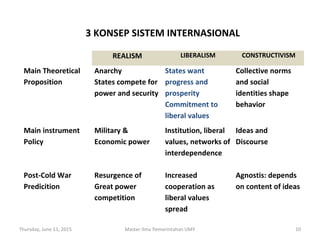
REALISM LIBERALISM CONSTRUCTIVISM
Main Theoretical
Proposition
Anarchy
States compete for
power and security
States want
progress and
prosperity
Commitment to
liberal values
Collective norms
and social
identities shape
behavior
Main instrument
Policy
Military &
Economic power
Institution, liberal
values, networks of
interdependence
Ideas and
Discourse
Post-Cold War
Predicition
Resurgence of
Great power
competition
Increased
cooperation as
liberal values
spread
Agnostis: depends
on content of ideas
3 KONSEP SISTEM INTERNASIONAL
Thursday, June 11, 2015 Master Ilmu Pemerintahan UMY 10
06/11/15 lab.class
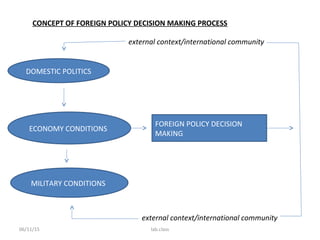
external context/international community
FOREIGN POLICY DECISION
MAKING
DOMESTIC POLITICS
ECONOMY CONDITIONS
MILITARY CONDITIONS
CONCEPT OF FOREIGN POLICY DECISION MAKING PROCESS
Which one is more proper to cut a tree?
Which one is more proper fit to shave beard?
FOREIGN POLICY ANALYSIS

  • 1.
    lab.class 06/11/15 FOREIGN POLICYANALYSIS •As a field of study, foreign policy analysis is characterized by its actor-specific focus. •In the simplest terms, it is the study of the process, effects, causes, or outputs of foreign policy decision- making in either a comparative or case-specific manner. •The underlying and often implicit argument theorizes that human beings, acting as a group or within a group, compose and cause change in international politics.
  • 2.
    lab.class 06/11/15 FOREIGN POLICY •AState’s action to achieve power (External sources) through international community • It could be done in either domestic or external area •Foreign policy analysis involves the study of decision making process, FPA involves the study of both international and domestic politics.
  • 3.
    lab.class 06/11/15 LEVEL OFANALYSIS INDIVIDUAL-LEVEL ANALYSIS STATE-LEVEL ANALYSIS SYSTEM-LEVEL ANALYSIS
  • 4.
    lab.class 06/11/15 INDIVIDUAL-LEVEL ANALYSIS •Humansas a Species •Cognitive Factors •Emotional Factors •Psychological Factors •Biological Factors •Perceptions •Organizational Behavior •Role Behavior
  • 5.
    lab.class 06/11/15 INDIVIDUAL-LEVEL ANALYSIS •Decision-MakingBehavior within Organizations •Leaders and Their Individual Traits •Personality •Physical and Mental Health •Ego and Ambition •Political History and Personal Experiences •Perceptions and Operational Reality •Policy as a Mix of Rational and Irrational Factors
  • 6.
    lab.class 06/11/15 STATE-LEVEL ANALYSIS MakingForeign Policy: Type of Government, Situation, and Policy Type of Government and the Foreign Policy Process Type of Situation and the Foreign Policy Process Type of Policy and the Foreign Policy Process
  • 7.
    lab.class 06/11/15 STATE-LEVEL ANALYSIS •MakingForeign Policy: Political Culture •Foreign Policy–Making Actors •Heads of Government and Other Political •Executives •Bureaucracies •Legislatures •Interest Groups •The People
  • 8.
    lab.class 06/11/15 SYSTEM-LEVEL ANALYSIS •StructuralCharacteristics •The Organization of Authority •Scope, Level, and Intensity of Interactions •Power Relationships
  • 9.
    lab.class 06/11/15 SYSTEM-LEVEL ANALYSIS TheNumber of Powerful Actors The Context of Power Economic Realities Norms
  • 10.
    REALISM LIBERALISM CONSTRUCTIVISM MainTheoretical Proposition Anarchy States compete for power and security States want progress and prosperity Commitment to liberal values Collective norms and social identities shape behavior Main instrument Policy Military & Economic power Institution, liberal values, networks of interdependence Ideas and Discourse Post-Cold War Predicition Resurgence of Great power competition Increased cooperation as liberal values spread Agnostis: depends on content of ideas 3 KONSEP SISTEM INTERNASIONAL Thursday, June 11, 2015 Master Ilmu Pemerintahan UMY 10
  • 11.
    06/11/15 lab.class external context/internationalcommunity external context/international community FOREIGN POLICY DECISION MAKING DOMESTIC POLITICS ECONOMY CONDITIONS MILITARY CONDITIONS CONCEPT OF FOREIGN POLICY DECISION MAKING PROCESS
  • 12.
    Which one ismore proper to cut a tree? Which one is more proper fit to shave beard?