ECONOMICS
COURSE SCHEDULE
 CHAPTER 1: SUBJECT & AIM of ECONOMICS
 CHAPTER 2: MARKET MECHANISM: DEMAND – SUPPLY
and PRICE MAKING
 CHAPTER 3: ECONOMIC GROWTH – NATIONAL ECONOMIC
PERFORMANCE
Chapter 2 Market Mechanism:
Demand – Supply and Price Making
What is a market?
 Each household and firm do all of their buying
and selling activities in a market.
 Each household and each firm operates in
many markets, sometimes as a buyer, and
sometimes as a seller.
Ideal Market
1. A Single Market
2. Interdependent Market
Single Market
Imagine that
There is a Commodity X Market and there are
many firms that potentially supply the
commodity X, and there are many households
that are potential consumers of the commodity
X.
Firms bring their supplies of X to the market and
households make their purchase of X.
Households and Firms
 Households are the consumers
 Firms are the producers
 Firms produce the commodity X
 Households purchase the commodity X
Demand
 Demand shows consumers’ willingness to buy
specific goods and services at a specific price
level and also the quantity of the goods and
services that is wanted by the consumers.
 By household demand for X we mean the
quantity of the good households wish to
purchase at a P.
Demand
What affects demand?
 Income
 Tastes and preferences
 Relative Prices of other goods and
services
 Consumer expectation of future
pricing
Demand Curve
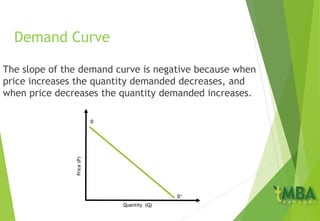
The slope of the demand curve is negative because when
price increases the quantity demanded decreases, and
when price decreases the quantity demanded increases.
Price(P)
Quantity (Q)
D
D’
Supply
 Supply shows the producers willingness to sell
specific goods and services at a specific price
level, and also the quantity of the goods and
services produced by the producers.
 By a firms supply of X at P we mean the
quantity it would be willing to sell at P.
Supply
Supply is influenced by
 Production costs
 Technology
 Firms expectations of future pricing
Supply Curve
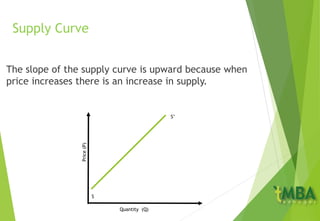
The slope of the supply curve is upward because when
price increases there is an increase in supply.Price(P)
Quantity (Q)
S
S’
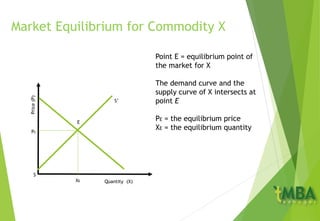
Market Equilibrium for Commodity XPrice(P)
Quantity (X)
S
S’
E
PE
XE
Point E = equilibrium point of
the market for X
The demand curve and the
supply curve of X intersects at
point E
PE = the equilibrium price
XE = the equilibrium quantity
Equilibrium of Interdependent
Markets
 A market equilibrium (competitive
equilibrium) is a set of prices quoted today
for each and every commodity, such that the
total demand for each equals its total supply.
 Equilibrium prices coordinate the production
and allocation of all goods and services.
Price Mechanism
When demand increases and supply stays the
same equilibrium prices will rise.
When demand decreases and supply stays the
same equilibrium prices will go down.
Price Mechanism
If demand stays the same and supply increases
equilibrium prices will decrease.
If the demand stays the same and supply
decreases equilibrium prices will increase.

Economics chapter2

  • 1.
  • 2.
    COURSE SCHEDULE  CHAPTER1: SUBJECT & AIM of ECONOMICS  CHAPTER 2: MARKET MECHANISM: DEMAND – SUPPLY and PRICE MAKING  CHAPTER 3: ECONOMIC GROWTH – NATIONAL ECONOMIC PERFORMANCE
  • 3.
    Chapter 2 MarketMechanism: Demand – Supply and Price Making
  • 4.
    What is amarket?  Each household and firm do all of their buying and selling activities in a market.  Each household and each firm operates in many markets, sometimes as a buyer, and sometimes as a seller.
  • 5.
    Ideal Market 1. ASingle Market 2. Interdependent Market
  • 6.
    Single Market Imagine that Thereis a Commodity X Market and there are many firms that potentially supply the commodity X, and there are many households that are potential consumers of the commodity X. Firms bring their supplies of X to the market and households make their purchase of X.
  • 7.
    Households and Firms Households are the consumers  Firms are the producers  Firms produce the commodity X  Households purchase the commodity X
  • 8.
    Demand  Demand showsconsumers’ willingness to buy specific goods and services at a specific price level and also the quantity of the goods and services that is wanted by the consumers.  By household demand for X we mean the quantity of the good households wish to purchase at a P.
  • 9.
    Demand What affects demand? Income  Tastes and preferences  Relative Prices of other goods and services  Consumer expectation of future pricing
  • 10.
    Demand Curve The slopeof the demand curve is negative because when price increases the quantity demanded decreases, and when price decreases the quantity demanded increases. Price(P) Quantity (Q) D D’
  • 11.
    Supply  Supply showsthe producers willingness to sell specific goods and services at a specific price level, and also the quantity of the goods and services produced by the producers.  By a firms supply of X at P we mean the quantity it would be willing to sell at P.
  • 12.
    Supply Supply is influencedby  Production costs  Technology  Firms expectations of future pricing
  • 13.
    Supply Curve The slopeof the supply curve is upward because when price increases there is an increase in supply.Price(P) Quantity (Q) S S’
  • 14.
    Market Equilibrium forCommodity XPrice(P) Quantity (X) S S’ E PE XE Point E = equilibrium point of the market for X The demand curve and the supply curve of X intersects at point E PE = the equilibrium price XE = the equilibrium quantity
  • 15.
    Equilibrium of Interdependent Markets A market equilibrium (competitive equilibrium) is a set of prices quoted today for each and every commodity, such that the total demand for each equals its total supply.  Equilibrium prices coordinate the production and allocation of all goods and services.
  • 16.
    Price Mechanism When demandincreases and supply stays the same equilibrium prices will rise. When demand decreases and supply stays the same equilibrium prices will go down.
  • 17.
    Price Mechanism If demandstays the same and supply increases equilibrium prices will decrease. If the demand stays the same and supply decreases equilibrium prices will increase.