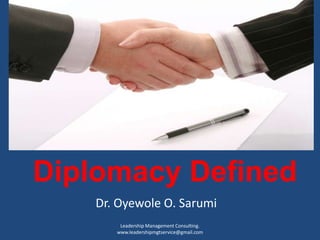
Diplomacy Defined
Dr. Oyewole O. Sarumi
Leadership Management Consulting.
www.leadershipmgtservice@gmail.com
Definitions
• Diplomacy is broadly described as the art of
conducting negotiations, agreements and
relations between two or more parties in a
sensitive way.
• These parties could be anything from husband
and wife to two countries.
Leadership Management Consulting.
www.leadershipmgtservice@gmail.com
• Usually, when the word "diplomacy" is
mentioned, people think of international
relations and communications, as this is the
most common context in which the word is
heard.
Leadership Management Consulting.
www.leadershipmgtservice@gmail.com
• Diplomacy is basically a term that is widely
important for International relations between
various nations. Diplomacy is the art of
negotiations between various countries. In
international relations it forms the basis for
peace making, economics, culture, trade, wars
etc.
Diplomacy: What it involves..
• Diplomacy is generally understood to
be governments communicating with
governments. It is primarily practiced through
embassies and consulates around the world,
and involves foreign service officers and
ambassadors advancing their governments’
foreign policy objectives while collecting and
researching essential political and economic
information.
The Goal of Diplomacy
• The goal of diplomacy is to further the state's
interests as dictated by geography, history,
and economics. Safeguarding the state's
independence, security, and integrity is of
prime importance; preserving the widest
possible freedom of action for the state is
nearly as important. Beyond that, diplomacy
seeks maximum national advantage without
using force and preferably without causing
resentment.
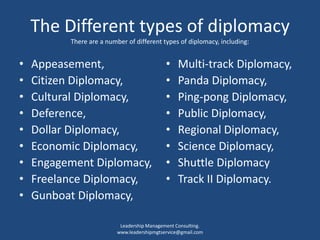
The Different types of diplomacy
There are a number of different types of diplomacy, including:
• Appeasement,
• Citizen Diplomacy,
• Cultural Diplomacy,
• Deference,
• Dollar Diplomacy,
• Economic Diplomacy,
• Engagement Diplomacy,
• Freelance Diplomacy,
• Gunboat Diplomacy,
• Multi-track Diplomacy,
• Panda Diplomacy,
• Ping-pong Diplomacy,
• Public Diplomacy,
• Regional Diplomacy,
• Science Diplomacy,
• Shuttle Diplomacy
• Track II Diplomacy.
Leadership Management Consulting.
www.leadershipmgtservice@gmail.com
Some others examples of diplomacy…
• Bilateral diplomacy, war diplomacy, preventive
diplomacy, multilateral diplomacy,
developmental diplomacy, multi track
diplomacy and public diplomacy are examples
of diplomacy.
Leadership Management Consulting.
www.leadershipmgtservice@gmail.com
Here are outlines of a few of these
types of diplomacy:
Leadership Management Consulting.
www.leadershipmgtservice@gmail.com
Appeasement
• Appeasement is a specific type of diplomacy where the
main aim of communication is to avoid full-frontal war.
• This is done by making concessions to, and
negotiations with, powers or leaders who are acting in
an aggressive way.
• The term was originally developed by Neville
Chamberlain, the British Prime Minister of the interwar
period, and was implemented by the "Allies", as they
would come to be known, in order to prevent Hitler
from taking aggressive action.
Leadership Management Consulting.
www.leadershipmgtservice@gmail.com
Citizen diplomacy
• Citizen diplomacy is the political idea that
average citizens can act as representatives of a
cause or country, if "official" or governmental
interactions are inappropriate.
• Citizen diplomacy does not have to involve
direct address or conversation - it can take the
form of sporting events or scientific
exchanges.
Leadership Management Consulting.
www.leadershipmgtservice@gmail.com
Deterrence
• Deference is the idea that people should
recognize and submit to the authority of their
superiors.
• It is seen, for example, in the workplace - it would
be deemed acceptable for your boss to tell you
what to do, but unacceptable for you to tell your
boss what to do.
• This is because, due to the concept of deference,
your boss has more authority than you do, and
therefore has the power to control your actions
and behaviour (to an extent).
Leadership Management Consulting.
www.leadershipmgtservice@gmail.com
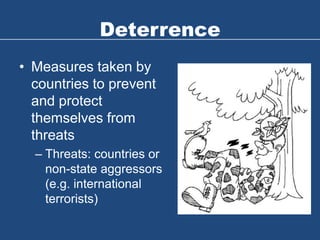
Deterrence
• Measures taken by
countries to prevent
and protect
themselves from
threats
– Threats: countries or
non-state aggressors
(e.g. international
terrorists)
Deterrence
• Deterrence policy is based on being prepared
for any form of threats while developing
diplomatic relationships with as many countries
as possible.
• Deterrence refers to the measures to prevent
and protect a country from various threats
such as other countries and terrorists.
• Deterrence is necessary to protect a country
and to give people a sense of security.
Multilateral Diplomacy
• Multilateral Diplomacy:
This was a more resent development with its
origins dating near or after the end of the First
World War. Its various types are:
War diplomacy- A form of diplomacy adopted when
there is no alternative to war.
Preventive diplomacy- This is an extremely delicate
process as it requires the most trust and confidence
between antagonists. It also requires extreme
patience and an independence from coercion.
Leadership Management Consulting.
www.leadershipmgtservice@gmail.com
Bilateral diplomacy
• Bilateral diplomacy involves two nations or
interests while public diplomacy involves
government public relations.
Leadership Management Consulting.
www.leadershipmgtservice@gmail.com
War diplomacy
• War diplomacy is adopted when there is no
alternative to war and….
Leadership Management Consulting.
www.leadershipmgtservice@gmail.com
Developmental Diplomacy
• Developmental diplomacy is more
economically oriented.
Leadership Management Consulting.
www.leadershipmgtservice@gmail.com
Public Diplomacy
• Public Diplomacy-
-One which encompasses government public
relations.
Leadership Management Consulting.
www.leadershipmgtservice@gmail.com
Developmental Diplomacy-
• Developmental diplomacy-
This is more an economic form of
diplomacy which seeks a promotion of
economic interests.
Leadership Management Consulting.
www.leadershipmgtservice@gmail.com
Diplomacy In Economy
• Diplomacy in economy is usually thought of as
something only related to policy-making and
representation of the home-government’s trade
interests, which leads to crucial qualifications of
exceptional business skills, flexibility and sensible
judgment on the side of the diplomats.
• But on a more in-depth look, it should primarily
deal with reporting and monitoring of trade
policies, economic resources and regulations of
the destination countries so the sending-state
would have a better picture of the economic
atmosphere there
Leadership Management Consulting.
www.leadershipmgtservice@gmail.com
Bilateral Diplomacy
• Bilateral Diplomacy:
Between two nations or interests. Mutual
benefit or relations are the only ones which
are considered important. It is in some
measure the basis for other more complex
relationships.
Leadership Management Consulting.
www.leadershipmgtservice@gmail.com
Multi-track Diplomacy
• Multi track diplomacy-
– A more pragmatic and modern approach which
encompasses all the other diplomacy types and
focuses on the issue at hand from the rival's point
of you.
Leadership Management Consulting.
www.leadershipmgtservice@gmail.com
Last line
Leadership Management Consulting.
www.leadershipmgtservice@gmail.com
• Please contact Dr. Oyewole O. Sarumi for
speaking engagements and conferences.

Diplomacy defined

  • 1.
    Diplomacy Defined Dr. OyewoleO. Sarumi Leadership Management Consulting. www.leadershipmgtservice@gmail.com
  • 2.
    Definitions • Diplomacy isbroadly described as the art of conducting negotiations, agreements and relations between two or more parties in a sensitive way. • These parties could be anything from husband and wife to two countries. Leadership Management Consulting. www.leadershipmgtservice@gmail.com
  • 3.
    • Usually, whenthe word "diplomacy" is mentioned, people think of international relations and communications, as this is the most common context in which the word is heard. Leadership Management Consulting. www.leadershipmgtservice@gmail.com
  • 4.
    • Diplomacy isbasically a term that is widely important for International relations between various nations. Diplomacy is the art of negotiations between various countries. In international relations it forms the basis for peace making, economics, culture, trade, wars etc.
  • 5.
    Diplomacy: What itinvolves.. • Diplomacy is generally understood to be governments communicating with governments. It is primarily practiced through embassies and consulates around the world, and involves foreign service officers and ambassadors advancing their governments’ foreign policy objectives while collecting and researching essential political and economic information.
  • 6.
    The Goal ofDiplomacy • The goal of diplomacy is to further the state's interests as dictated by geography, history, and economics. Safeguarding the state's independence, security, and integrity is of prime importance; preserving the widest possible freedom of action for the state is nearly as important. Beyond that, diplomacy seeks maximum national advantage without using force and preferably without causing resentment.
  • 7.
    The Different typesof diplomacy There are a number of different types of diplomacy, including: • Appeasement, • Citizen Diplomacy, • Cultural Diplomacy, • Deference, • Dollar Diplomacy, • Economic Diplomacy, • Engagement Diplomacy, • Freelance Diplomacy, • Gunboat Diplomacy, • Multi-track Diplomacy, • Panda Diplomacy, • Ping-pong Diplomacy, • Public Diplomacy, • Regional Diplomacy, • Science Diplomacy, • Shuttle Diplomacy • Track II Diplomacy. Leadership Management Consulting. www.leadershipmgtservice@gmail.com
  • 8.
    Some others examplesof diplomacy… • Bilateral diplomacy, war diplomacy, preventive diplomacy, multilateral diplomacy, developmental diplomacy, multi track diplomacy and public diplomacy are examples of diplomacy. Leadership Management Consulting. www.leadershipmgtservice@gmail.com
  • 9.
    Here are outlinesof a few of these types of diplomacy: Leadership Management Consulting. www.leadershipmgtservice@gmail.com
  • 10.
    Appeasement • Appeasement isa specific type of diplomacy where the main aim of communication is to avoid full-frontal war. • This is done by making concessions to, and negotiations with, powers or leaders who are acting in an aggressive way. • The term was originally developed by Neville Chamberlain, the British Prime Minister of the interwar period, and was implemented by the "Allies", as they would come to be known, in order to prevent Hitler from taking aggressive action. Leadership Management Consulting. www.leadershipmgtservice@gmail.com
  • 11.
    Citizen diplomacy • Citizendiplomacy is the political idea that average citizens can act as representatives of a cause or country, if "official" or governmental interactions are inappropriate. • Citizen diplomacy does not have to involve direct address or conversation - it can take the form of sporting events or scientific exchanges. Leadership Management Consulting. www.leadershipmgtservice@gmail.com
  • 12.
    Deterrence • Deference isthe idea that people should recognize and submit to the authority of their superiors. • It is seen, for example, in the workplace - it would be deemed acceptable for your boss to tell you what to do, but unacceptable for you to tell your boss what to do. • This is because, due to the concept of deference, your boss has more authority than you do, and therefore has the power to control your actions and behaviour (to an extent). Leadership Management Consulting. www.leadershipmgtservice@gmail.com
  • 13.
    Deterrence • Measures takenby countries to prevent and protect themselves from threats – Threats: countries or non-state aggressors (e.g. international terrorists)
  • 14.
    Deterrence • Deterrence policyis based on being prepared for any form of threats while developing diplomatic relationships with as many countries as possible. • Deterrence refers to the measures to prevent and protect a country from various threats such as other countries and terrorists. • Deterrence is necessary to protect a country and to give people a sense of security.
  • 15.
    Multilateral Diplomacy • MultilateralDiplomacy: This was a more resent development with its origins dating near or after the end of the First World War. Its various types are: War diplomacy- A form of diplomacy adopted when there is no alternative to war. Preventive diplomacy- This is an extremely delicate process as it requires the most trust and confidence between antagonists. It also requires extreme patience and an independence from coercion. Leadership Management Consulting. www.leadershipmgtservice@gmail.com
  • 16.
    Bilateral diplomacy • Bilateraldiplomacy involves two nations or interests while public diplomacy involves government public relations. Leadership Management Consulting. www.leadershipmgtservice@gmail.com
  • 17.
    War diplomacy • Wardiplomacy is adopted when there is no alternative to war and…. Leadership Management Consulting. www.leadershipmgtservice@gmail.com
  • 18.
    Developmental Diplomacy • Developmentaldiplomacy is more economically oriented. Leadership Management Consulting. www.leadershipmgtservice@gmail.com
  • 19.
    Public Diplomacy • PublicDiplomacy- -One which encompasses government public relations. Leadership Management Consulting. www.leadershipmgtservice@gmail.com
  • 20.
    Developmental Diplomacy- • Developmentaldiplomacy- This is more an economic form of diplomacy which seeks a promotion of economic interests. Leadership Management Consulting. www.leadershipmgtservice@gmail.com
  • 21.
    Diplomacy In Economy •Diplomacy in economy is usually thought of as something only related to policy-making and representation of the home-government’s trade interests, which leads to crucial qualifications of exceptional business skills, flexibility and sensible judgment on the side of the diplomats. • But on a more in-depth look, it should primarily deal with reporting and monitoring of trade policies, economic resources and regulations of the destination countries so the sending-state would have a better picture of the economic atmosphere there Leadership Management Consulting. www.leadershipmgtservice@gmail.com
  • 22.
    Bilateral Diplomacy • BilateralDiplomacy: Between two nations or interests. Mutual benefit or relations are the only ones which are considered important. It is in some measure the basis for other more complex relationships. Leadership Management Consulting. www.leadershipmgtservice@gmail.com
  • 23.
    Multi-track Diplomacy • Multitrack diplomacy- – A more pragmatic and modern approach which encompasses all the other diplomacy types and focuses on the issue at hand from the rival's point of you. Leadership Management Consulting. www.leadershipmgtservice@gmail.com
  • 24.
    Last line Leadership ManagementConsulting. www.leadershipmgtservice@gmail.com • Please contact Dr. Oyewole O. Sarumi for speaking engagements and conferences.