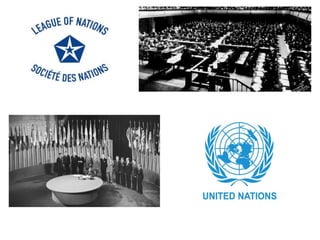
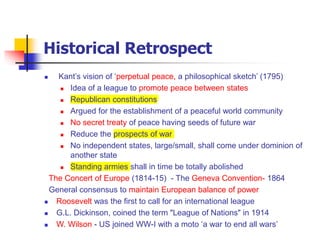
Historical Retrospect
 Kant’s vision of ‘perpetual peace, a philosophical sketch’ (1795)
 Idea of a league to promote peace between states
 Republican constitutions
 Argued for the establishment of a peaceful world community
 No secret treaty of peace having seeds of future war
 Reduce the prospects of war
 No independent states, large/small, shall come under dominion of
another state
 Standing armies shall in time be totally abolished
The Concert of Europe (1814-15) - The Geneva Convention- 1864
General consensus to maintain European balance of power
 Roosevelt was the first to call for an international league
 G.L. Dickinson, coined the term "League of Nations" in 1914
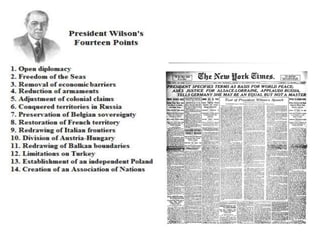
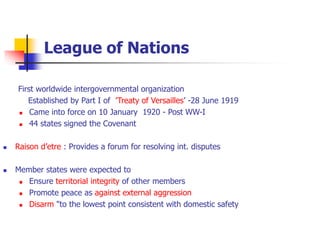
 W. Wilson - US joined WW-I with a moto ‘a war to end all wars’
League of Nations
First worldwide intergovernmental organization
Established by Part I of ’Treaty of Versailles’ -28 June 1919
 Came into force on 10 January 1920 - Post WW-I
 44 states signed the Covenant
 Raison d’etre : Provides a forum for resolving int. disputes
 Member states were expected to
 Ensure territorial integrity of other members
 Promote peace as against external aggression
 Disarm "to the lowest point consistent with domestic safety
Structure & Functions
Submit complaints for arbitration/judicial inquiry before going to war
 The Executive Council created a Permanent Court of Int. Justice
 1 Nov 1920, headquarters was moved from London to Geneva
 The League’s main organs
 Gen. Assembly (representing all member states with 1 vote)
 Executive Council ( 4 permanent (Britain, France, Italy and
Japan) plus 4 rotating members – later 11)
 Council’s membership limited to major powers
 Permanent Secretariat
 Int. Court of Justice
 Guarantee territorial integrity & pol independence of states
League of Nations (Mandate)
Principal mission was to maintain world peace
 Its primary goals, as stated in its Covenant
 Preventing wars
 Collective security
 Disarmament
 Settling int disputes through negotiation and arbitration
 The Covenant authorized the League to
 take any action to safeguard the peace
 establish procedures for arbitration
 create the mechanisms for eco and military sanctions
League of Nations (Mandate)
 Other issues in the treaties included
 labor conditions
 human and drug trafficking and arms trade
 global health
 prisoners of war
 protection of minorities
 At its greatest extent from 1934 to 1935, it had 58 members
 Soviet Union was expelled in 1939, following its invasion of Finland
 Germany and Japan voluntarily withdrew in 1933, Italy left in 1937
 Sep 1931 – Japan assault on Chinese Garrison
 Japan rejected LN Commission's findings and withdrew in 1933
The Idea of Collective Security
 Article 16 of the Covenant of the League
 The members agreed to leave other states alone
 In a dispute,2 sides were to refrain from war for3 months while
the League looked for a solution
 If one party turned out to be the aggressor, all League members
were required to break all ties
 If that could not work, Council could recommend military actions
 The notion of collective security failed due to;
1. Defining what the ‘Aggression’ is
2. Forcing members to be with Council for applying sanctions
3. Contribution for finances and military
Analysis – Stumbling blocks
Wilson’s insistence to link covenant with treaty of Versailles - blunder
 Discredited treaty : unenforceable, parochial, too extreme
provisions
 The League failed either to enforce or revise it
 The Treaty of Versailles contained the seeds of war in it
 Absence of Big Powers
 Domination Of France and England
 Hyper-nationalism at the end of the WW1
 Period of Extraordinary eco turbulence and turmoil – Great
Depression
 Rise of Dictatorship, Populism and authoritarian strongmen
 Unanimity for decisions made it really hard for the League to do
anything
Stumbling blocks
 Loss of Faith In League
 Lack of Mutual Co-Operation
 Policy of appeasement
 The League lacked its own armed force
 Depended on the victorious Great Powers of World War I
 to enforce its resolutions
 keep to its economic sanctions
 provide an army when needed
 The Great Powers were often reluctant to do so
 Ineffective Sanction regime
could hurt League members, so they were reluctant to comply with them
 https://www.bbc.co.uk/bitesize/guides/zbg4t39/revision/9
Accomplishments
Honeymoon Period - Genuine desire for peace after the horrors of WW1
 First time a bunch of sovereign nations got together
 Modest successes - particularly dealing with certain territorial disputes
 Sweden & Finland (Aaland Islands 1921)
 Split Upper Silesia between Germany and Poland (1921)
 1923, Bloody war in Turkey – Humanitarian crisis (1.4mn refugees)
 In 1925, helped to resolve a dispute between Greece and Bulgaria
 League extended considerable aid to refugees
 It helped to suppress white slave and opium traffic
 Pioneering work in surveys of health ------------ It extended financial aid to needy
states
 League furthered international cooperation in labor relations
 Several agencies & Commissions – ILO, Disarmament Commission, The Health Org
(precursor to WHO), Permanent Central Opium Board, Commission for Refugees,
Slavery Commission, Int- Commission on intellectual cooperation (Today’s UNESCO) ,
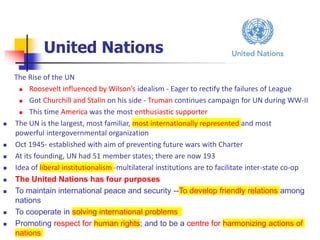
United Nations
The Rise of the UN
 Roosevelt influenced by Wilson’s idealism - Eager to rectify the failures of League
 Got Churchill and Stalin on his side - Truman continues campaign for UN during WW-II
 This time America was the most enthusiastic supporter
 The UN is the largest, most familiar, most internationally represented and most
powerful intergovernmental organization
 Oct 1945- established with aim of preventing future wars with Charter
 At its founding, UN had 51 member states; there are now 193
 Idea of liberal institutionalism -multilateral institutions are to facilitate inter-state co-op
 The United Nations has four purposes
 To maintain international peace and security --To develop friendly relations among
nations
 To cooperate in solving international problems
 Promoting respect for human rights; and to be a centre for harmonizing actions of
nations
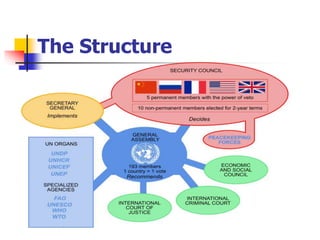
The Structure
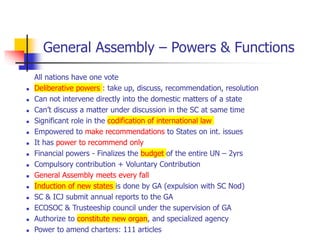
General Assembly – Powers & Functions
All nations have one vote
 Deliberative powers : take up, discuss, recommendation, resolution
 Can not intervene directly into the domestic matters of a state
 Can’t discuss a matter under discussion in the SC at same time
 Significant role in the codification of international law
 Empowered to make recommendations to States on int. issues
 It has power to recommend only
 Financial powers - Finalizes the budget of the entire UN – 2yrs
 Compulsory contribution + Voluntary Contribution
 General Assembly meets every fall
 Induction of new states is done by GA (expulsion with SC Nod)
 SC & ICJ submit annual reports to the GA
 ECOSOC & Trusteeship council under the supervision of GA
 Authorize to constitute new organ, and specialized agency
 Power to amend charters: 111 articles
UNSC
 Security Council; can meet any time to preserve peace
 Primary responsibility for maintenance of int. peace & security
 It has 15 Members (5 permanent and 10 non-permanent members)
 Non- Permanent members :5 Afro+Asia , 2W. Europe & others, 2 Latin. America
+Caribbean Islands, 1 from eastern Europe
 Each Member has one vote
 9 votes needed for a resolution to be passed out of 15 votes
 Each of the five can veto any of the resolution
 10 non-permanent members are elected by GA for two-year term
 All member States to comply with Council decisions
 Takes lead in determining existence of a threat or act of aggression
A Secretariat to run the organization
 A SG is elected by the GA for renewable 5-year term
 The bureaucratic administration of day to day affairs of the UN
UNSC Powers & Functions
 The establishment of peacekeeping and special political missions
 Authorization of military enforcement action
 The imposition of international sanctions on member states
 The ability to refer matters to the International Criminal Court
• To maintain international peace and security
• To investigate dispute or situation which might lead to international friction
• To recommend methods of adjusting such disputes or the terms of settlement
• To formulate plans for the establishment of a system to regulate armaments
• To determine the existence of a threat to the peace or act of aggression and to
recommend what action should be taken
• Chapter VII - Threats to the Peace, Breaches, and Acts of Aggression
• To call on Members to apply economic sanctions and other measures not
involving the use of force to prevent or stop aggression
• To recommend the admission of new Members
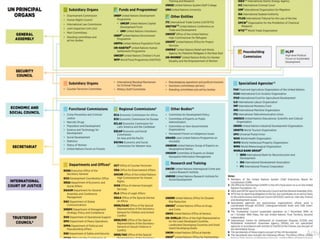
UN Specialized agencies
 Specialized Agencies are mentioned in the Charter in
• Chapter IX, International Economic and Social Co-operation
• Chapter X, The Economic and Social Council
 There are 17* Specialized Agencies:
• FAO: Food and Agriculture Organization of the United Nations
• ICAO: International Civil Aviation Organization
• IFAD: International Fund for Agricultural Development
• ILO: International Labour Organization
• IMF: International Monetary Fund
• IMO: International Maritime Organization
• ITU: International Telecommunication Union
• UNESCO: United Nations Educational, Scientific and Cultural
Organization
UN Specialized agencies
• UNIDO: United Nations Industrial Development Organization
• UNWTO: World Tourism Organization
• UPU: Universal Postal Union
• WHO: World Health Organization
• WIPO: World Intellectual Property Organization
• WMO: World Meteorological Organization
• World Bank Group
• IBRD: International Bank for Reconstruction and Development
• IDA: International Development Association
• IFC: International Finance Corporation
 Article 58 of the Charter states that the UN will
make "recommendations for the co-ordination of the policies and
activities of the specialized agencies
 Coordination is facilitated through ECOSOC and the Chief Executives
Board
UN accomplishment
Its supreme goal was to end war, but by the end of the 20th century the
organization had expanded its mandate to cover a varied agenda that
included such issues as human rights, world poverty, public health, and
environmental concerns. Membership was eventually extended to almost
every country on Earth, growing from the initial 51 member nations in 1945 to
191 by 2002
 In human development during 20th century ,the UN and its agencies
certainly helped the world become a more hospitable and livable place for
millions
 Evaluating the first 50 years of the UN's history, the author Stanley
Meisler writes that "the United Nations never fulfilled the hopes of its
founders, but it accomplished a great deal nevertheless" citing its role in
decolonization and its many successful peacekeeping efforts
 British historian Paul Kennedy states that while the organization has
suffered some major setbacks,"when all its aspects are considered, UN
UN Success strokes
Decolonization
 Idea of racial equality and of a people’s right to self-determination was
discussed in the wake of World War I and rejected
 After World War II, those principles were endorsed within the UN system,
and the Trusteeship Council, which monitored the process of
decolonization, was one of the initial bodies of the UN
 Although many national independence movements only won liberation
through bloody conflicts, the UN has overseen a process of
decolonisation that has transformed international politics
 1945, around 1/3rd of the world’s population lived under colonial rule
UN Success strokes
A cease-fire in the Iran-Iraq War (1980-90)
 The independence of Namibia (from SA, 1990)
 The end of the civil wars in Angola, Cambodia and El Salvador
 MDGs and SDGs
 Climate change - Human rights protection - Refugees management
 Scientific, cultural and human development
 Law of the Sea (Negotiated between 1973 and 1982)
 Peacekeeping - soldiers as a catalyst for peace rather war instruments
 UN Convention on the Law of the Sea (UNCLOS) set up the current
international law of the seas) - states’ rights and creates concepts such as
exclusive economic zones, procedures for the settling of disputes, new
arrangements for governing deep sea bed mining, new provisions for the
protection of marine resources and ocean conservation
Dilemma with the UN
The Kashmir Issue- 1947 to date
 The Palestine Issue-1947 to date
 The Korean War- 1950-54 and Korean Peninsula today
 Rwanda massacres
 Somalia Famine and civil war
 First Iraq War
 Bosnia-Herzegovina massacre and the Serbs
 The Responsibility to Protect is a global political commitment
 Endorsed by all states of United Nations at the 2005 World Summit
 To address its four key concerns - prevent genocide, war crimes,
ethnic cleansing and crimes against humanity
Analysis
Are these five really most important or powerful countries in world?
 Germany & Japan have overtaken UK and France in terms of economy
 India; rising power demanded permanent seat
 Russia and China are struggling to stand firmly
 Latin America, and Africa, have no permanent membership
 Who is to decide which nations can keep the peace?
 Why any major country should have a veto power over the will of the
majority?
 The veto could render the SC toothless but would keep the big powers
talking instead of leaving
 The veto system has kept the UN alive but the price for holding the system
together is its powerlessness to resolve many disputes
 Problem - No mechanism for adding new permanent SC members
Reforming the UN
 Cold War - US and USSR accused UN of favoring the other
 Unilateral actions were preferred over multilateral solutions
 UN charter continues to preserve primacy of the major powers
 It tramples on legitimate aspirations of the weak
 Bureaucratic inefficiency, waste of money and time, corruption
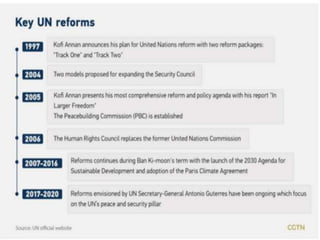
 Demands for System-wide reform and Security Council reform
 Restructuring SC - Comprehensive and meaningful reforms
 Democratic, transparent & accountable structure & functioning
Reforming the UN
 Process of institutional change and transformation
 Strengthen GA -reflects common conscience of Int. Community
 Little consensus on how to do so
 Some want UN to play more effective role in world affairs
 Others want its role reduced to humanitarian work
 Calls for UN Security Council's membership to be increased
 Intergovernmental Negotiations Framework
 Full-scale negotiations to reform SC began in GA in Feb 2009
 Areas - veto, regional representation, membership, working
methods of council & relationship with GA
Reforming the UN Needs Rebirth
 Underserved by global financial architecture
 Reforms needed for democratization of global eco governance
 Chance to re-imagine global financing frameworks
 Reform of macroeconomic and financing mechanisms –SDG
 Kofi Annan - Razali Plan (2004) proposed enlarging the SC
 2 stage plan to reform the SC by increasing membership from
15 to 24
 Adding 5 new permanent members (without veto power)
 Four new non-permanent member
 New SC will have to be endorsed by a two-thirds majority from
over 190 members of the UN
 Veto-bearing permanent members of SC will have to pass the
plan
Reforming the UN
 To respond extremely complex and multidimensional challenges
 By 2030 - 9 billion people inhabiting a crowded and tired Planet
 Weapons manufacturers continue to profit from the business of
death
 We are facing implosions of fragile States - mass atrocities
 Reinvent working methods for agile, responsive & accountable
UN
 75 yro old System does not fully deliver on purpose of Charter
 Past SG’s and the current one launched ground breaking
initiatives at reform, improve and perfect doctrines and
operational capabilities
 UN is undercut by realpolitik, super powers and regional powers
relationships - UN Senior Leadership is blameless
Reforming UN
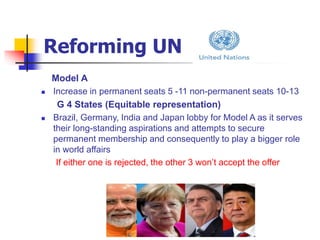
Model A
 Increase in permanent seats 5 -11 non-permanent seats 10-13
G 4 States (Equitable representation)
 Brazil, Germany, India and Japan lobby for Model A as it serves
their long-standing aspirations and attempts to secure
permanent membership and consequently to play a bigger role
in world affairs
If either one is rejected, the other 3 won’t accept the offer
Indian maneuvers for permanent SC seat
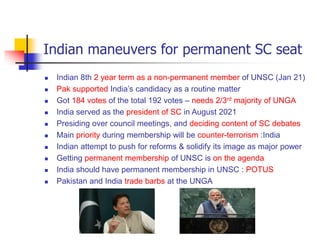
 Indian 8th 2 year term as a non-permanent member of UNSC (Jan 21)
 Pak supported India’s candidacy as a routine matter
 Got 184 votes of the total 192 votes – needs 2/3rd majority of UNGA
 India served as the president of SC in August 2021
 Presiding over council meetings, and deciding content of SC debates
 Main priority during membership will be counter-terrorism :India
 Indian attempt to push for reforms & solidify its image as major power
 Getting permanent membership of UNSC is on the agenda
 India should have permanent membership in UNSC : POTUS
 Pakistan and India trade barbs at the UNGA
Reforming the UN
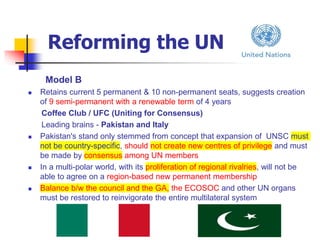
Model B
 Retains current 5 permanent & 10 non-permanent seats, suggests creation
of 9 semi-permanent with a renewable term of 4 years
Coffee Club / UFC (Uniting for Consensus)
Leading brains - Pakistan and Italy
 Pakistan's stand only stemmed from concept that expansion of UNSC must
not be country-specific, should not create new centres of privilege and must
be made by consensus among UN members
 In a multi-polar world, with its proliferation of regional rivalries, will not be
able to agree on a region-based new permanent membership
 Balance b/w the council and the GA, the ECOSOC and other UN organs
must be restored to reinvigorate the entire multilateral system
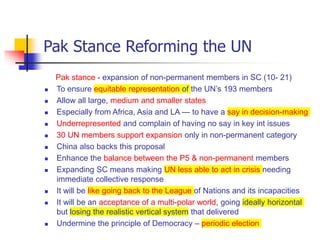
Pak Stance Reforming the UN
Pak stance - expansion of non-permanent members in SC (10- 21)
 To ensure equitable representation of the UN’s 193 members
 Allow all large, medium and smaller states
 Especially from Africa, Asia and LA — to have a say in decision-making
 Underrepresented and complain of having no say in key int issues
 30 UN members support expansion only in non-permanent category
 China also backs this proposal
 Enhance the balance between the P5 & non-permanent members
 Expanding SC means making UN less able to act in crisis needing
immediate collective response
 It will be like going back to the League of Nations and its incapacities
 It will be an acceptance of a multi-polar world, going ideally horizontal
but losing the realistic vertical system that delivered
 Undermine the principle of Democracy – periodic election
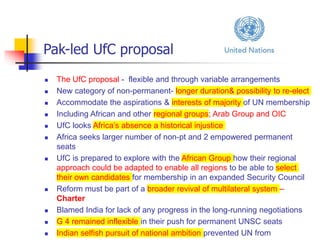
Pak-led UfC proposal
 The UfC proposal - flexible and through variable arrangements
 New category of non-permanent- longer duration& possibility to re-elect
 Accommodate the aspirations & interests of majority of UN membership
 Including African and other regional groups; Arab Group and OIC
 UfC looks Africa’s absence a historical injustice
 Africa seeks larger number of non-pt and 2 empowered permanent
seats
 UfC is prepared to explore with the African Group how their regional
approach could be adapted to enable all regions to be able to select
their own candidates for membership in an expanded Security Council
 Reform must be part of a broader revival of multilateral system –
Charter
 Blamed India for lack of any progress in the long-running negotiations
 G 4 remained inflexible in their push for permanent UNSC seats
 Indian selfish pursuit of national ambition prevented UN from
The UN Peace and Security Architecture
 UN Peace and Security Architecture is under severe stress
 More than 100,000 armed personnel deployed in 14 Missions (Africa)
 This accounts to less than 0.5% of the world military expenditures
 Western leaders protest over core costs of UN and its Peace Operations
 The US$8 billion UN Peace-Keeping budget
 Pale against billions of $ in weapons transactions from Western democracies to
totalitarian KSA and the Gulf states
 Mediations, shuttle diplomacy, cease-fires and observer missions
 Peacekeeping evolved into peace enforcement and robust protection of civilian in
armed conflicts; from being mere unarmed or non-combatant forces, the UN and/or
regional organizations, authorized by the SC, at times are mandated to use robust
force to challenge armed groups, as in Congo and Mali
The UN Peace and Security Architecture
 Impoverished UN tries to do is secure a tiny safe area to ensure that humanitarian
supplies reaching the war torn country
 Failures and betrayals when realpolitik and narrowly defined nat interests paralyzed
the UN
 UN – an org with human beings with virtues and flaws, even when individually
equipped with exceptional qualifications and wisdom, was not always capable to
anticipate, prevent, mediate and end conflicts
 Afghanistan, Somalia, South Sudan, Syria, Yemen are crying examples
Pakistan’s Blue Helmets
 Takes its inspiration from policy statement of Jinah - Pakistan
wants peace with all nations of the world
 Pak contribution to UN peacekeeping duties -cornerstone of FP
 For a small nation in terms of power potential, participation in
UN peacekeeping missions provides a suitable presence on the
int arena
 A soft way of portraying country’s image as a responsible UN
member
 It provided Army a useful way to showcase skills in positive
manner
 Missions provide great international exposure
 Work with multinational forces and staffs and learn latest skills in
conflict management and post conflict stabilisation operations
 Pakistan -longest-serving and largest contributors to UN
Pakistan’s Blue Helmets
 Participation in peacekeeping duties- positive impact on regional
level
 Pak & India amicably operated together on UN peacekeeping
missions
 Pak, as a nation, have a strong urge to help other nations in
times of crisis, irrespective of religion and creed
 Countries that provide peacekeepers receive remuneration from
UN
 Pakistan always relied on her own equipment and assets
 Even in times of crisis, when we were fighting terrorism and
rooting out insurgency on our Western border while engaged
with India on the East, we have fulfilled our peacekeeping
obligations
 Kinds of operations - peace enforcement & stability operations,
Pak Peacekeeping Efforts
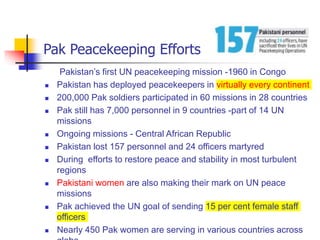
Pakistan’s first UN peacekeeping mission -1960 in Congo
 Pakistan has deployed peacekeepers in virtually every continent
 200,000 Pak soldiers participated in 60 missions in 28 countries
 Pak still has 7,000 personnel in 9 countries -part of 14 UN
missions
 Ongoing missions - Central African Republic
 Pakistan lost 157 personnel and 24 officers martyred
 During efforts to restore peace and stability in most turbulent
regions
 Pakistani women are also making their mark on UN peace
missions
 Pak achieved the UN goal of sending 15 per cent female staff
officers
 Nearly 450 Pak women are serving in various countries across
Reform Agenda of UN
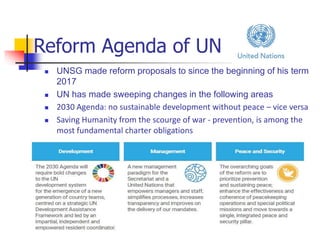
 UNSG made reform proposals to since the beginning of his term
2017
 UN has made sweeping changes in the following areas
 2030 Agenda: no sustainable development without peace – vice versa
 Saving Humanity from the scourge of war - prevention, is among the
most fundamental charter obligations
 It resides in the raison d’être of the organization
UN– Only hope and refuge for many
 Coronavirus; a failure of global governance - needs radical transformation
 Vision of a world at peace based on active int partnership and
solidarity (Antonio Guterres and Donald Trump case)
 Trump’s beliefs and policies: to deconstruct UN & multilateral regimes
 Europe, anchor of multilateralism is in disarray
 Best leader Merkel, is on the way out, a victim of the refugee crisis
 UK: deeply divided & distracted by a colossal mess of its own making
 Macron is confronted with serious domestic political challenges
 Racism, anti-semitism and fascism are on the rise across Europe
 BRICS - once viewed as a counterweight to the old US-dominated
Western alliance has had to scale down its global ambitions
UN– Only hope and refuge for many
 The United Nations stands at a crossroads
 UN is sidelined but remains indispensable
 May not have been able to prevent & resolve man-made catastrophes
 But in some situations it saved hundreds of thousands of lives
 In this time of upheaval (pandemic & climate change) debate over
how to reform and strengthen UN is more relevant than ever
 Unlike its predecessor, LN - it endured, and in its 75yrs as the largest
and most representative global multilateral institution, it recorded
many successes
 UN is bedeviled by a numerous challenges - gross underfunding,
bloated bureaucracy, disunity, and geopolitical rivalry among the
permanent members of the Security Council
 These issues weaken its effectiveness and undermine its relevance
UN 2023 World Summit - Inclusive Global Governance
 https://www.un.org/pga/75/wp-content/uploads/sites/100/2021/03/Letter-PGA-
VS.pdf
 https://www.stimson.org/2021/beyond-un75-a-roadmap-for-inclusive-
networked-effective-global-governance/
 https://www.un.org/sg/en/content/sg/statement/2020-07-18/secretary-
generals-nelson-mandela-lecture-%E2%80%9Ctackling-the-inequality-
pandemic-new-social-contract-for-new-era%E2%80%9D-delivered
 https://www.passblue.com/2021/06/21/making-the-un-more-relevant-in-the-
next-25-years-is-within-our-reach/
 https://www.cfr.org/councilofcouncils/global-memos/un-turns-seventy-
five-heres-how-make-it-relevant-again
 https://www.foreignaffairs.com/articles/world/2021-03-18/world-still-
needs-un
 https://www.theguardian.com/commentisfree/2013/sep/08/dont-
sideline-un-security-council
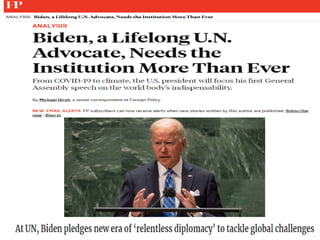
 https://foreignpolicy.com/2021/09/17/biden-us-united-nations-
relations-general-assembly-security-council-speech/
 https://news.cgtn.com/news/2020-09-03/UN-reform-What-to-change-
and-what-to-keep--SXkY62EUoM/index.html
 https://theconversation.com/coronavirus-is-a-failure-of-global-
governance-now-the-world-needs-a-radical-transformation-136535

UN.ppt

  • 2.
    Historical Retrospect  Kant’svision of ‘perpetual peace, a philosophical sketch’ (1795)  Idea of a league to promote peace between states  Republican constitutions  Argued for the establishment of a peaceful world community  No secret treaty of peace having seeds of future war  Reduce the prospects of war  No independent states, large/small, shall come under dominion of another state  Standing armies shall in time be totally abolished The Concert of Europe (1814-15) - The Geneva Convention- 1864 General consensus to maintain European balance of power  Roosevelt was the first to call for an international league  G.L. Dickinson, coined the term "League of Nations" in 1914  W. Wilson - US joined WW-I with a moto ‘a war to end all wars’
  • 4.
    League of Nations Firstworldwide intergovernmental organization Established by Part I of ’Treaty of Versailles’ -28 June 1919  Came into force on 10 January 1920 - Post WW-I  44 states signed the Covenant  Raison d’etre : Provides a forum for resolving int. disputes  Member states were expected to  Ensure territorial integrity of other members  Promote peace as against external aggression  Disarm "to the lowest point consistent with domestic safety
  • 5.
    Structure & Functions Submitcomplaints for arbitration/judicial inquiry before going to war  The Executive Council created a Permanent Court of Int. Justice  1 Nov 1920, headquarters was moved from London to Geneva  The League’s main organs  Gen. Assembly (representing all member states with 1 vote)  Executive Council ( 4 permanent (Britain, France, Italy and Japan) plus 4 rotating members – later 11)  Council’s membership limited to major powers  Permanent Secretariat  Int. Court of Justice  Guarantee territorial integrity & pol independence of states
  • 6.
    League of Nations(Mandate) Principal mission was to maintain world peace  Its primary goals, as stated in its Covenant  Preventing wars  Collective security  Disarmament  Settling int disputes through negotiation and arbitration  The Covenant authorized the League to  take any action to safeguard the peace  establish procedures for arbitration  create the mechanisms for eco and military sanctions
  • 7.
    League of Nations(Mandate)  Other issues in the treaties included  labor conditions  human and drug trafficking and arms trade  global health  prisoners of war  protection of minorities  At its greatest extent from 1934 to 1935, it had 58 members  Soviet Union was expelled in 1939, following its invasion of Finland  Germany and Japan voluntarily withdrew in 1933, Italy left in 1937  Sep 1931 – Japan assault on Chinese Garrison  Japan rejected LN Commission's findings and withdrew in 1933
  • 8.
    The Idea ofCollective Security  Article 16 of the Covenant of the League  The members agreed to leave other states alone  In a dispute,2 sides were to refrain from war for3 months while the League looked for a solution  If one party turned out to be the aggressor, all League members were required to break all ties  If that could not work, Council could recommend military actions  The notion of collective security failed due to; 1. Defining what the ‘Aggression’ is 2. Forcing members to be with Council for applying sanctions 3. Contribution for finances and military
  • 9.
    Analysis – Stumblingblocks Wilson’s insistence to link covenant with treaty of Versailles - blunder  Discredited treaty : unenforceable, parochial, too extreme provisions  The League failed either to enforce or revise it  The Treaty of Versailles contained the seeds of war in it  Absence of Big Powers  Domination Of France and England  Hyper-nationalism at the end of the WW1  Period of Extraordinary eco turbulence and turmoil – Great Depression  Rise of Dictatorship, Populism and authoritarian strongmen  Unanimity for decisions made it really hard for the League to do anything
  • 10.
    Stumbling blocks  Lossof Faith In League  Lack of Mutual Co-Operation  Policy of appeasement  The League lacked its own armed force  Depended on the victorious Great Powers of World War I  to enforce its resolutions  keep to its economic sanctions  provide an army when needed  The Great Powers were often reluctant to do so  Ineffective Sanction regime could hurt League members, so they were reluctant to comply with them  https://www.bbc.co.uk/bitesize/guides/zbg4t39/revision/9
  • 11.
    Accomplishments Honeymoon Period -Genuine desire for peace after the horrors of WW1  First time a bunch of sovereign nations got together  Modest successes - particularly dealing with certain territorial disputes  Sweden & Finland (Aaland Islands 1921)  Split Upper Silesia between Germany and Poland (1921)  1923, Bloody war in Turkey – Humanitarian crisis (1.4mn refugees)  In 1925, helped to resolve a dispute between Greece and Bulgaria  League extended considerable aid to refugees  It helped to suppress white slave and opium traffic  Pioneering work in surveys of health ------------ It extended financial aid to needy states  League furthered international cooperation in labor relations  Several agencies & Commissions – ILO, Disarmament Commission, The Health Org (precursor to WHO), Permanent Central Opium Board, Commission for Refugees, Slavery Commission, Int- Commission on intellectual cooperation (Today’s UNESCO) ,
  • 13.
    United Nations The Riseof the UN  Roosevelt influenced by Wilson’s idealism - Eager to rectify the failures of League  Got Churchill and Stalin on his side - Truman continues campaign for UN during WW-II  This time America was the most enthusiastic supporter  The UN is the largest, most familiar, most internationally represented and most powerful intergovernmental organization  Oct 1945- established with aim of preventing future wars with Charter  At its founding, UN had 51 member states; there are now 193  Idea of liberal institutionalism -multilateral institutions are to facilitate inter-state co-op  The United Nations has four purposes  To maintain international peace and security --To develop friendly relations among nations  To cooperate in solving international problems  Promoting respect for human rights; and to be a centre for harmonizing actions of nations
  • 14.
  • 16.
    General Assembly –Powers & Functions All nations have one vote  Deliberative powers : take up, discuss, recommendation, resolution  Can not intervene directly into the domestic matters of a state  Can’t discuss a matter under discussion in the SC at same time  Significant role in the codification of international law  Empowered to make recommendations to States on int. issues  It has power to recommend only  Financial powers - Finalizes the budget of the entire UN – 2yrs  Compulsory contribution + Voluntary Contribution  General Assembly meets every fall  Induction of new states is done by GA (expulsion with SC Nod)  SC & ICJ submit annual reports to the GA  ECOSOC & Trusteeship council under the supervision of GA  Authorize to constitute new organ, and specialized agency  Power to amend charters: 111 articles
  • 17.
    UNSC  Security Council;can meet any time to preserve peace  Primary responsibility for maintenance of int. peace & security  It has 15 Members (5 permanent and 10 non-permanent members)  Non- Permanent members :5 Afro+Asia , 2W. Europe & others, 2 Latin. America +Caribbean Islands, 1 from eastern Europe  Each Member has one vote  9 votes needed for a resolution to be passed out of 15 votes  Each of the five can veto any of the resolution  10 non-permanent members are elected by GA for two-year term  All member States to comply with Council decisions  Takes lead in determining existence of a threat or act of aggression A Secretariat to run the organization  A SG is elected by the GA for renewable 5-year term  The bureaucratic administration of day to day affairs of the UN
  • 18.
    UNSC Powers &Functions  The establishment of peacekeeping and special political missions  Authorization of military enforcement action  The imposition of international sanctions on member states  The ability to refer matters to the International Criminal Court • To maintain international peace and security • To investigate dispute or situation which might lead to international friction • To recommend methods of adjusting such disputes or the terms of settlement • To formulate plans for the establishment of a system to regulate armaments • To determine the existence of a threat to the peace or act of aggression and to recommend what action should be taken • Chapter VII - Threats to the Peace, Breaches, and Acts of Aggression • To call on Members to apply economic sanctions and other measures not involving the use of force to prevent or stop aggression • To recommend the admission of new Members
  • 19.
    UN Specialized agencies Specialized Agencies are mentioned in the Charter in • Chapter IX, International Economic and Social Co-operation • Chapter X, The Economic and Social Council  There are 17* Specialized Agencies: • FAO: Food and Agriculture Organization of the United Nations • ICAO: International Civil Aviation Organization • IFAD: International Fund for Agricultural Development • ILO: International Labour Organization • IMF: International Monetary Fund • IMO: International Maritime Organization • ITU: International Telecommunication Union • UNESCO: United Nations Educational, Scientific and Cultural Organization
  • 20.
    UN Specialized agencies •UNIDO: United Nations Industrial Development Organization • UNWTO: World Tourism Organization • UPU: Universal Postal Union • WHO: World Health Organization • WIPO: World Intellectual Property Organization • WMO: World Meteorological Organization • World Bank Group • IBRD: International Bank for Reconstruction and Development • IDA: International Development Association • IFC: International Finance Corporation  Article 58 of the Charter states that the UN will make "recommendations for the co-ordination of the policies and activities of the specialized agencies  Coordination is facilitated through ECOSOC and the Chief Executives Board
  • 21.
    UN accomplishment Its supremegoal was to end war, but by the end of the 20th century the organization had expanded its mandate to cover a varied agenda that included such issues as human rights, world poverty, public health, and environmental concerns. Membership was eventually extended to almost every country on Earth, growing from the initial 51 member nations in 1945 to 191 by 2002  In human development during 20th century ,the UN and its agencies certainly helped the world become a more hospitable and livable place for millions  Evaluating the first 50 years of the UN's history, the author Stanley Meisler writes that "the United Nations never fulfilled the hopes of its founders, but it accomplished a great deal nevertheless" citing its role in decolonization and its many successful peacekeeping efforts  British historian Paul Kennedy states that while the organization has suffered some major setbacks,"when all its aspects are considered, UN
  • 22.
    UN Success strokes Decolonization Idea of racial equality and of a people’s right to self-determination was discussed in the wake of World War I and rejected  After World War II, those principles were endorsed within the UN system, and the Trusteeship Council, which monitored the process of decolonization, was one of the initial bodies of the UN  Although many national independence movements only won liberation through bloody conflicts, the UN has overseen a process of decolonisation that has transformed international politics  1945, around 1/3rd of the world’s population lived under colonial rule
  • 23.
    UN Success strokes Acease-fire in the Iran-Iraq War (1980-90)  The independence of Namibia (from SA, 1990)  The end of the civil wars in Angola, Cambodia and El Salvador  MDGs and SDGs  Climate change - Human rights protection - Refugees management  Scientific, cultural and human development  Law of the Sea (Negotiated between 1973 and 1982)  Peacekeeping - soldiers as a catalyst for peace rather war instruments  UN Convention on the Law of the Sea (UNCLOS) set up the current international law of the seas) - states’ rights and creates concepts such as exclusive economic zones, procedures for the settling of disputes, new arrangements for governing deep sea bed mining, new provisions for the protection of marine resources and ocean conservation
  • 24.
    Dilemma with theUN The Kashmir Issue- 1947 to date  The Palestine Issue-1947 to date  The Korean War- 1950-54 and Korean Peninsula today  Rwanda massacres  Somalia Famine and civil war  First Iraq War  Bosnia-Herzegovina massacre and the Serbs  The Responsibility to Protect is a global political commitment  Endorsed by all states of United Nations at the 2005 World Summit  To address its four key concerns - prevent genocide, war crimes, ethnic cleansing and crimes against humanity
  • 25.
    Analysis Are these fivereally most important or powerful countries in world?  Germany & Japan have overtaken UK and France in terms of economy  India; rising power demanded permanent seat  Russia and China are struggling to stand firmly  Latin America, and Africa, have no permanent membership  Who is to decide which nations can keep the peace?  Why any major country should have a veto power over the will of the majority?  The veto could render the SC toothless but would keep the big powers talking instead of leaving  The veto system has kept the UN alive but the price for holding the system together is its powerlessness to resolve many disputes  Problem - No mechanism for adding new permanent SC members
  • 26.
    Reforming the UN Cold War - US and USSR accused UN of favoring the other  Unilateral actions were preferred over multilateral solutions  UN charter continues to preserve primacy of the major powers  It tramples on legitimate aspirations of the weak  Bureaucratic inefficiency, waste of money and time, corruption  Demands for System-wide reform and Security Council reform  Restructuring SC - Comprehensive and meaningful reforms  Democratic, transparent & accountable structure & functioning
  • 27.
    Reforming the UN Process of institutional change and transformation  Strengthen GA -reflects common conscience of Int. Community  Little consensus on how to do so  Some want UN to play more effective role in world affairs  Others want its role reduced to humanitarian work  Calls for UN Security Council's membership to be increased  Intergovernmental Negotiations Framework  Full-scale negotiations to reform SC began in GA in Feb 2009  Areas - veto, regional representation, membership, working methods of council & relationship with GA
  • 28.
    Reforming the UNNeeds Rebirth  Underserved by global financial architecture  Reforms needed for democratization of global eco governance  Chance to re-imagine global financing frameworks  Reform of macroeconomic and financing mechanisms –SDG  Kofi Annan - Razali Plan (2004) proposed enlarging the SC  2 stage plan to reform the SC by increasing membership from 15 to 24  Adding 5 new permanent members (without veto power)  Four new non-permanent member  New SC will have to be endorsed by a two-thirds majority from over 190 members of the UN  Veto-bearing permanent members of SC will have to pass the plan
  • 30.
    Reforming the UN To respond extremely complex and multidimensional challenges  By 2030 - 9 billion people inhabiting a crowded and tired Planet  Weapons manufacturers continue to profit from the business of death  We are facing implosions of fragile States - mass atrocities  Reinvent working methods for agile, responsive & accountable UN  75 yro old System does not fully deliver on purpose of Charter  Past SG’s and the current one launched ground breaking initiatives at reform, improve and perfect doctrines and operational capabilities  UN is undercut by realpolitik, super powers and regional powers relationships - UN Senior Leadership is blameless
  • 31.
    Reforming UN Model A Increase in permanent seats 5 -11 non-permanent seats 10-13 G 4 States (Equitable representation)  Brazil, Germany, India and Japan lobby for Model A as it serves their long-standing aspirations and attempts to secure permanent membership and consequently to play a bigger role in world affairs If either one is rejected, the other 3 won’t accept the offer
  • 32.
    Indian maneuvers forpermanent SC seat  Indian 8th 2 year term as a non-permanent member of UNSC (Jan 21)  Pak supported India’s candidacy as a routine matter  Got 184 votes of the total 192 votes – needs 2/3rd majority of UNGA  India served as the president of SC in August 2021  Presiding over council meetings, and deciding content of SC debates  Main priority during membership will be counter-terrorism :India  Indian attempt to push for reforms & solidify its image as major power  Getting permanent membership of UNSC is on the agenda  India should have permanent membership in UNSC : POTUS  Pakistan and India trade barbs at the UNGA
  • 34.
    Reforming the UN ModelB  Retains current 5 permanent & 10 non-permanent seats, suggests creation of 9 semi-permanent with a renewable term of 4 years Coffee Club / UFC (Uniting for Consensus) Leading brains - Pakistan and Italy  Pakistan's stand only stemmed from concept that expansion of UNSC must not be country-specific, should not create new centres of privilege and must be made by consensus among UN members  In a multi-polar world, with its proliferation of regional rivalries, will not be able to agree on a region-based new permanent membership  Balance b/w the council and the GA, the ECOSOC and other UN organs must be restored to reinvigorate the entire multilateral system
  • 35.
    Pak Stance Reformingthe UN Pak stance - expansion of non-permanent members in SC (10- 21)  To ensure equitable representation of the UN’s 193 members  Allow all large, medium and smaller states  Especially from Africa, Asia and LA — to have a say in decision-making  Underrepresented and complain of having no say in key int issues  30 UN members support expansion only in non-permanent category  China also backs this proposal  Enhance the balance between the P5 & non-permanent members  Expanding SC means making UN less able to act in crisis needing immediate collective response  It will be like going back to the League of Nations and its incapacities  It will be an acceptance of a multi-polar world, going ideally horizontal but losing the realistic vertical system that delivered  Undermine the principle of Democracy – periodic election
  • 36.
    Pak-led UfC proposal The UfC proposal - flexible and through variable arrangements  New category of non-permanent- longer duration& possibility to re-elect  Accommodate the aspirations & interests of majority of UN membership  Including African and other regional groups; Arab Group and OIC  UfC looks Africa’s absence a historical injustice  Africa seeks larger number of non-pt and 2 empowered permanent seats  UfC is prepared to explore with the African Group how their regional approach could be adapted to enable all regions to be able to select their own candidates for membership in an expanded Security Council  Reform must be part of a broader revival of multilateral system – Charter  Blamed India for lack of any progress in the long-running negotiations  G 4 remained inflexible in their push for permanent UNSC seats  Indian selfish pursuit of national ambition prevented UN from
  • 37.
    The UN Peaceand Security Architecture  UN Peace and Security Architecture is under severe stress  More than 100,000 armed personnel deployed in 14 Missions (Africa)  This accounts to less than 0.5% of the world military expenditures  Western leaders protest over core costs of UN and its Peace Operations  The US$8 billion UN Peace-Keeping budget  Pale against billions of $ in weapons transactions from Western democracies to totalitarian KSA and the Gulf states  Mediations, shuttle diplomacy, cease-fires and observer missions  Peacekeeping evolved into peace enforcement and robust protection of civilian in armed conflicts; from being mere unarmed or non-combatant forces, the UN and/or regional organizations, authorized by the SC, at times are mandated to use robust force to challenge armed groups, as in Congo and Mali
  • 38.
    The UN Peaceand Security Architecture  Impoverished UN tries to do is secure a tiny safe area to ensure that humanitarian supplies reaching the war torn country  Failures and betrayals when realpolitik and narrowly defined nat interests paralyzed the UN  UN – an org with human beings with virtues and flaws, even when individually equipped with exceptional qualifications and wisdom, was not always capable to anticipate, prevent, mediate and end conflicts  Afghanistan, Somalia, South Sudan, Syria, Yemen are crying examples
  • 39.
    Pakistan’s Blue Helmets Takes its inspiration from policy statement of Jinah - Pakistan wants peace with all nations of the world  Pak contribution to UN peacekeeping duties -cornerstone of FP  For a small nation in terms of power potential, participation in UN peacekeeping missions provides a suitable presence on the int arena  A soft way of portraying country’s image as a responsible UN member  It provided Army a useful way to showcase skills in positive manner  Missions provide great international exposure  Work with multinational forces and staffs and learn latest skills in conflict management and post conflict stabilisation operations  Pakistan -longest-serving and largest contributors to UN
  • 40.
    Pakistan’s Blue Helmets Participation in peacekeeping duties- positive impact on regional level  Pak & India amicably operated together on UN peacekeeping missions  Pak, as a nation, have a strong urge to help other nations in times of crisis, irrespective of religion and creed  Countries that provide peacekeepers receive remuneration from UN  Pakistan always relied on her own equipment and assets  Even in times of crisis, when we were fighting terrorism and rooting out insurgency on our Western border while engaged with India on the East, we have fulfilled our peacekeeping obligations  Kinds of operations - peace enforcement & stability operations,
  • 41.
    Pak Peacekeeping Efforts Pakistan’sfirst UN peacekeeping mission -1960 in Congo  Pakistan has deployed peacekeepers in virtually every continent  200,000 Pak soldiers participated in 60 missions in 28 countries  Pak still has 7,000 personnel in 9 countries -part of 14 UN missions  Ongoing missions - Central African Republic  Pakistan lost 157 personnel and 24 officers martyred  During efforts to restore peace and stability in most turbulent regions  Pakistani women are also making their mark on UN peace missions  Pak achieved the UN goal of sending 15 per cent female staff officers  Nearly 450 Pak women are serving in various countries across
  • 42.
    Reform Agenda ofUN  UNSG made reform proposals to since the beginning of his term 2017  UN has made sweeping changes in the following areas  2030 Agenda: no sustainable development without peace – vice versa  Saving Humanity from the scourge of war - prevention, is among the most fundamental charter obligations  It resides in the raison d’être of the organization
  • 43.
    UN– Only hopeand refuge for many  Coronavirus; a failure of global governance - needs radical transformation  Vision of a world at peace based on active int partnership and solidarity (Antonio Guterres and Donald Trump case)  Trump’s beliefs and policies: to deconstruct UN & multilateral regimes  Europe, anchor of multilateralism is in disarray  Best leader Merkel, is on the way out, a victim of the refugee crisis  UK: deeply divided & distracted by a colossal mess of its own making  Macron is confronted with serious domestic political challenges  Racism, anti-semitism and fascism are on the rise across Europe  BRICS - once viewed as a counterweight to the old US-dominated Western alliance has had to scale down its global ambitions
  • 45.
    UN– Only hopeand refuge for many  The United Nations stands at a crossroads  UN is sidelined but remains indispensable  May not have been able to prevent & resolve man-made catastrophes  But in some situations it saved hundreds of thousands of lives  In this time of upheaval (pandemic & climate change) debate over how to reform and strengthen UN is more relevant than ever  Unlike its predecessor, LN - it endured, and in its 75yrs as the largest and most representative global multilateral institution, it recorded many successes  UN is bedeviled by a numerous challenges - gross underfunding, bloated bureaucracy, disunity, and geopolitical rivalry among the permanent members of the Security Council  These issues weaken its effectiveness and undermine its relevance
  • 47.
    UN 2023 WorldSummit - Inclusive Global Governance  https://www.un.org/pga/75/wp-content/uploads/sites/100/2021/03/Letter-PGA- VS.pdf  https://www.stimson.org/2021/beyond-un75-a-roadmap-for-inclusive- networked-effective-global-governance/  https://www.un.org/sg/en/content/sg/statement/2020-07-18/secretary- generals-nelson-mandela-lecture-%E2%80%9Ctackling-the-inequality- pandemic-new-social-contract-for-new-era%E2%80%9D-delivered  https://www.passblue.com/2021/06/21/making-the-un-more-relevant-in-the- next-25-years-is-within-our-reach/
  • 48.
     https://www.cfr.org/councilofcouncils/global-memos/un-turns-seventy- five-heres-how-make-it-relevant-again  https://www.foreignaffairs.com/articles/world/2021-03-18/world-still- needs-un https://www.theguardian.com/commentisfree/2013/sep/08/dont- sideline-un-security-council  https://foreignpolicy.com/2021/09/17/biden-us-united-nations- relations-general-assembly-security-council-speech/  https://news.cgtn.com/news/2020-09-03/UN-reform-What-to-change- and-what-to-keep--SXkY62EUoM/index.html  https://theconversation.com/coronavirus-is-a-failure-of-global- governance-now-the-world-needs-a-radical-transformation-136535