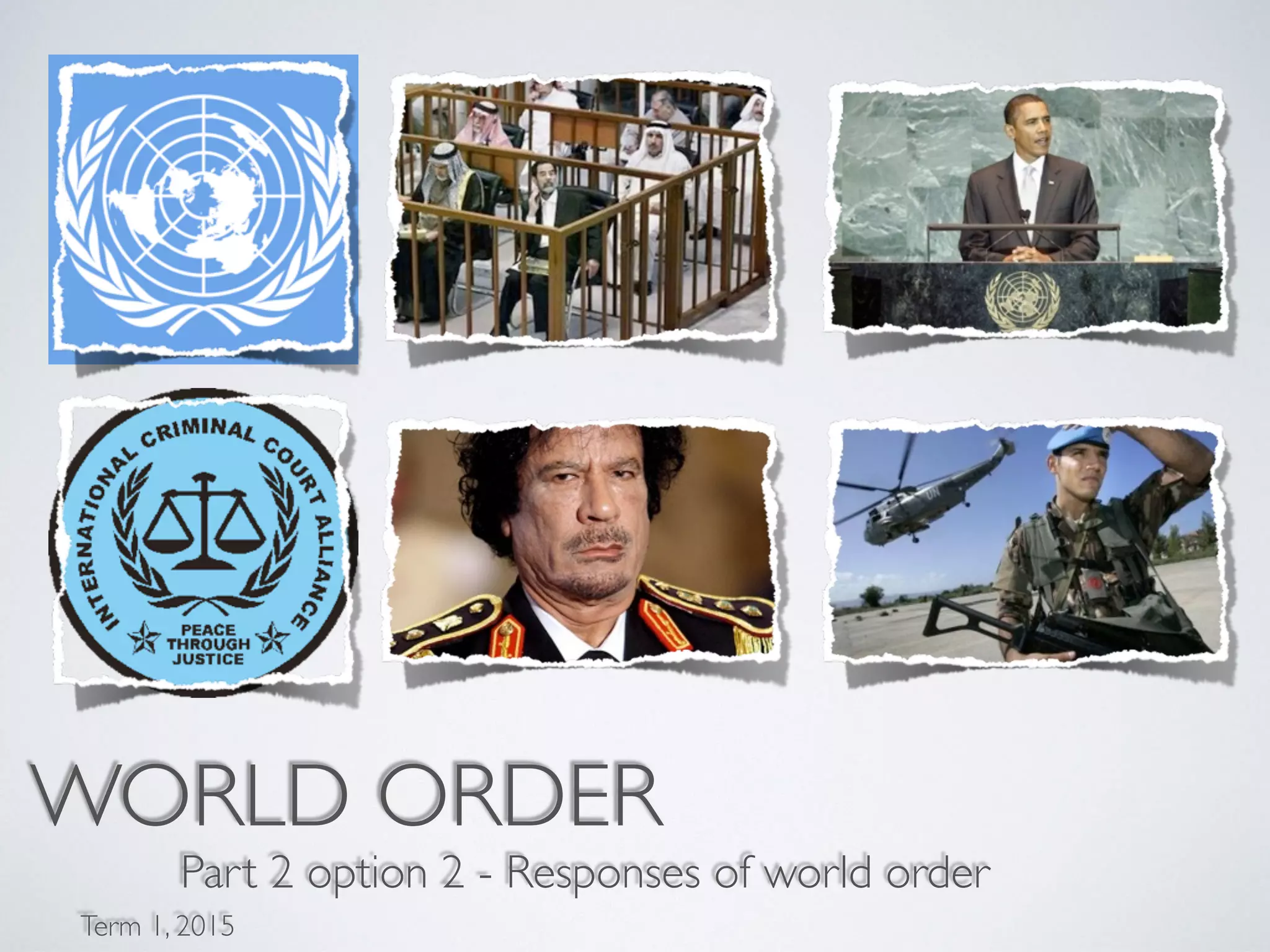
WORLD ORDER
Part 2 option 2 - Responses of world order
Term 1, 2015
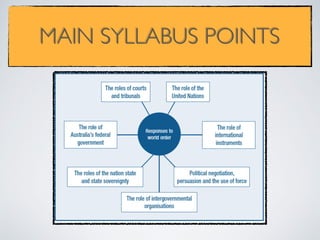
MAIN SYLLABUS POINTS
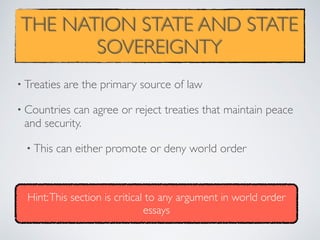
THE NATION STATE AND STATE
SOVEREIGNTY
• Treaties are the primary source of law
• Countries can agree or reject treaties that maintain peace
and security.
• This can either promote or deny world order
Hint:This section is critical to any argument in world order
essays
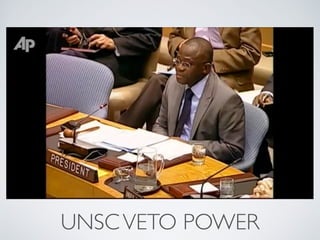
•However, the UNSC can intervene if there is a
‘threat to peace’
•The UNSC can deliver a humanitarian
intervention. It can be difficult to get the
‘Permanent Five’ to agree (China and the Darfur
region)
•Theme: the effectiveness of legal and non-legal
responses in promoting and maintaining world order
•The Permanent Five are often unwilling to carry out the
intervention (military force)
•Asking other nations to supply military force is often denied
(supporting USA in Iraq, national armies used to guard civilians)
•Peacekeeping forces can be used but only after internal fighting has
stopped
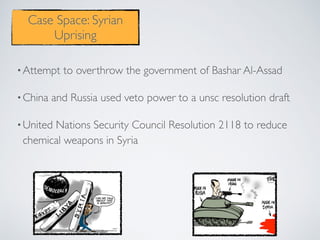
•Attempt to overthrow the government of Bashar Al-Assad
•China and Russia used veto power to a unsc resolution draft
•United Nations Security Council Resolution 2118 to reduce
chemical weapons in Syria
Case Space: Syrian
Uprising
UNSCVETO POWER
ARAB LEAGUE SUSPENDS SYRIA
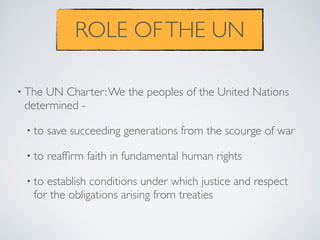
ROLE OFTHE UN
• The UN Charter:We the peoples of the United Nations
determined -
• to save succeeding generations from the scourge of war
• to reaffirm faith in fundamental human rights
• to establish conditions under which justice and respect
for the obligations arising from treaties
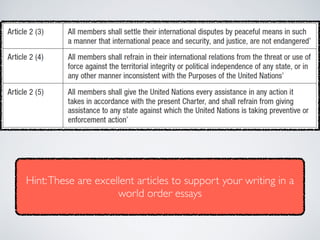
Hint:These are excellent articles to support your writing in a
world order essays
STRUCTURE OFTHE UN
• 193 members, 5 major
organs, Main International
Organisation to discuss
resolving disputes
• UNGA has equal vote of its
members
Hint:The UN is also considered an IGO as its members
are many nation states
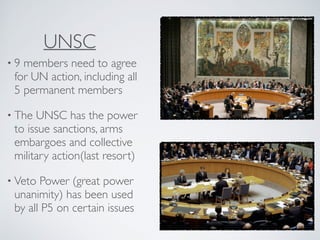
UNSC
• 9 members need to agree
for UN action, including all
5 permanent members
• The UNSC has the power
to issue sanctions, arms
embargoes and collective
military action(last resort)
• Veto Power (great power
unanimity) has been used
by all P5 on certain issues
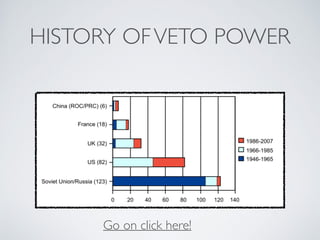
HISTORY OFVETO POWER
Go on click here!
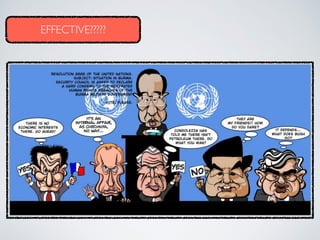
EFFECTIVE?????
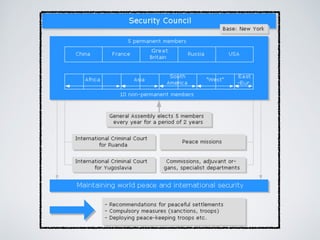
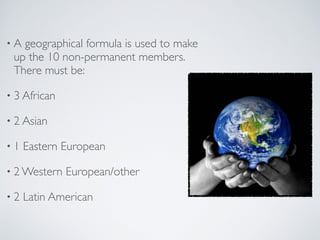
• A geographical formula is used to make
up the 10 non-permanent members.
There must be:
• 3 African
• 2 Asian
• 1 Eastern European
• 2 Western European/other
• 2 Latin American
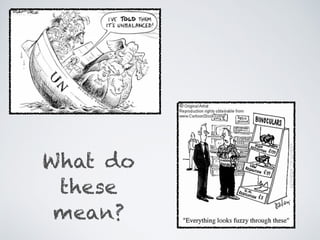
What do
these
mean?
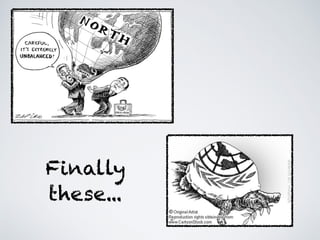
Finally
these...
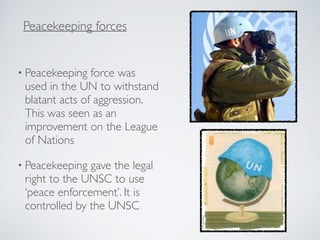
• Peacekeeping force was
used in the UN to withstand
blatant acts of aggression.
This was seen as an
improvement on the League
of Nations
• Peacekeeping gave the legal
right to the UNSC to use
‘peace enforcement’. It is
controlled by the UNSC
Peacekeeping forces
PEACE KEEPING
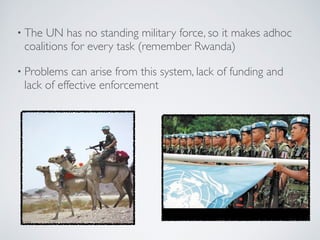
• The UN has no standing military force, so it makes adhoc
coalitions for every task (remember Rwanda)
• Problems can arise from this system, lack of funding and
lack of effective enforcement
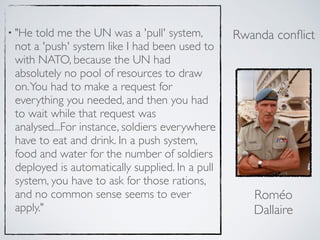
• "He told me the UN was a 'pull' system,
not a 'push' system like I had been used to
with NATO, because the UN had
absolutely no pool of resources to draw
on.You had to make a request for
everything you needed, and then you had
to wait while that request was
analysed...For instance, soldiers everywhere
have to eat and drink. In a push system,
food and water for the number of soldiers
deployed is automatically supplied. In a pull
system, you have to ask for those rations,
and no common sense seems to ever
apply."
Roméo
Dallaire
Rwanda conflict
UN 2013 REVIEW
INTERNATIONAL INSTRUMENTS
• Treaties and customary law are the main sources of
international law
• Treaties are legally binding and are freely entered into.
There are two types Bilateral and multilateral
• Declarations are not legally binding and therefore only
show principle support from a nation state
Hint: Using this terminology in a world order essay is very
important
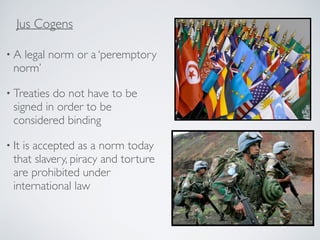
• A legal norm or a ‘peremptory
norm’
• Treaties do not have to be
signed in order to be
considered binding
• It is accepted as a norm today
that slavery, piracy and torture
are prohibited under
international law
Jus Cogens
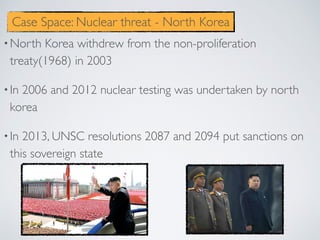
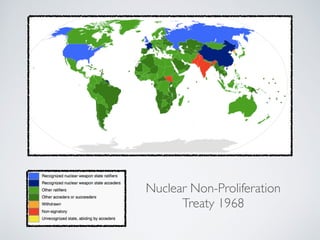
•North Korea withdrew from the non-proliferation
treaty(1968) in 2003
•In 2006 and 2012 nuclear testing was undertaken by north
korea
•In 2013, UNSC resolutions 2087 and 2094 put sanctions on
this sovereign state
Case Space: Nuclear threat - North Korea
•How is this case concerning North Korea linked
to the issues, themes and the effectiveness
criteria?
Discussion time
Hint:This is the secret HSC Legal
Studies
Nuclear Non-Proliferation
Treaty 1968
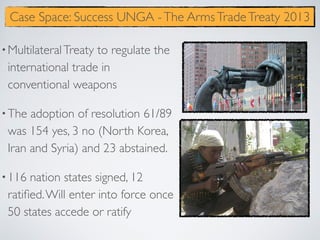
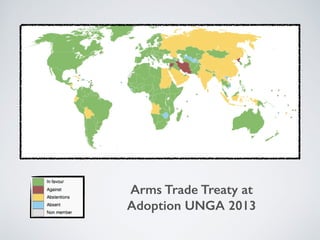
•MultilateralTreaty to regulate the
international trade in
conventional weapons
•The adoption of resolution 61/89
was 154 yes, 3 no (North Korea,
Iran and Syria) and 23 abstained.
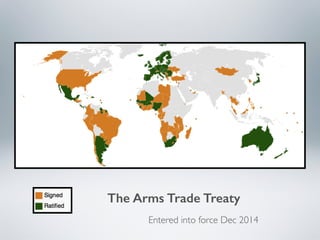
•116 nation states signed, 12
ratified.Will enter into force once
50 states accede or ratify
Case Space: Success UNGA -The ArmsTradeTreaty 2013
ARMSTRADETREATY 2013
Arms Trade Treaty at
Adoption UNGA 2013
The Arms Trade Treaty
Entered into force Dec 2014
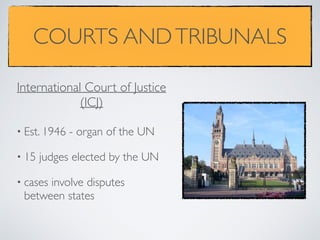
COURTS ANDTRIBUNALS
• Est. 1946 - organ of the UN
• 15 judges elected by the UN
• cases involve disputes
between states
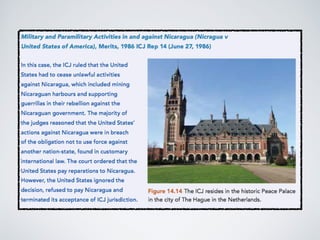
International Court of Justice
(ICJ)
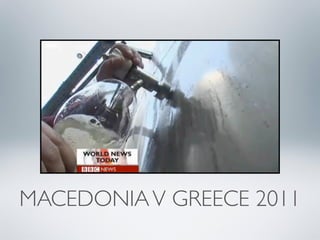
MACEDONIAV GREECE 2011
ICJ RULING MACEDONIA
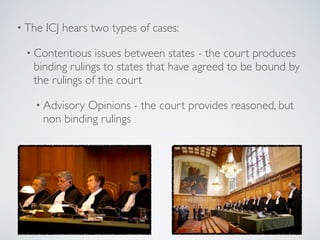
• The ICJ hears two types of cases:
• Contentious issues between states - the court produces
binding rulings to states that have agreed to be bound by
the rulings of the court
• Advisory Opinions - the court provides reasoned, but
non binding rulings
•The Rome Statute of the International Criminal
CourtTreaty signed 1998 by 123 (Palestine 123rd)
nation states
•The ICC est. in the Hague, 2002
•Given jurisdiction over acts of genocide, war crimes
and crimes against humanity
International Criminal Court
(ICC)
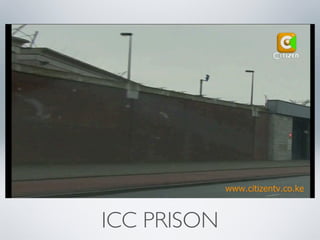
ICC PRISON
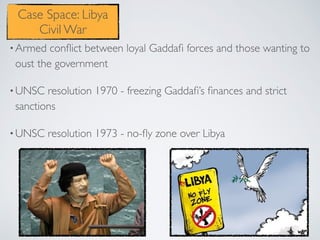
•Armed conflict between loyal Gaddafi forces and those wanting to
oust the government
•UNSC resolution 1970 - freezing Gaddafi’s finances and strict
sanctions
•UNSC resolution 1973 - no-fly zone over Libya
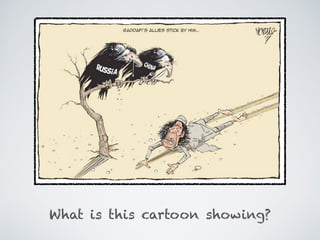
Case Space: Libya
Civil War
UNSC RESOLUTION 1973
NATO AND LIBYA
What is this cartoon showing?
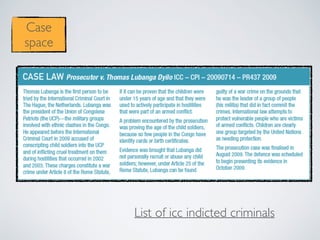
Case
space
List of icc indicted criminals
THOMAS LUBANGAVERDICT
GERMAIN KATANGA CONVICTION
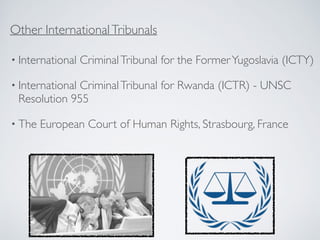
• International CriminalTribunal for the FormerYugoslavia (ICTY)
• International CriminalTribunal for Rwanda (ICTR) - UNSC
Resolution 955
• The European Court of Human Rights, Strasbourg, France
Other InternationalTribunals
INTERGOVERNMENTAL
ORGANISATIONS (IGO’S)
• These regional/strategic organisation have been established
for mutual benefits (Trade, regional cooperation etc)
• examples include the African Union (AU), the
Commonwealth,ASEAN, BRICS, the Arab League and
APEC
Hint: It is important to understand the links with the United
Nations and IGO’s
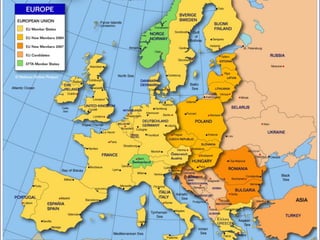
• Has been successful at making war impossible over the
European continent
• Its a Supranation (decisions made by majority vote)
• It improves issues of peace and security by tackling
organised crime, improving human rights and agreeing not
to attack each other
European Union
(EU)
Hint: Due to recent economic impacts, the EU has declined in
value in some member states
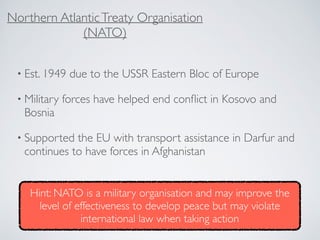
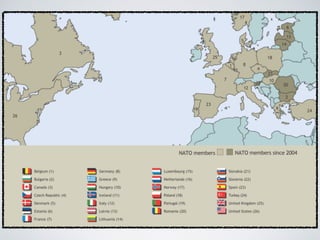
• Est. 1949 due to the USSR Eastern Bloc of Europe
• Military forces have helped end conflict in Kosovo and
Bosnia
• Supported the EU with transport assistance in Darfur and
continues to have forces in Afghanistan
Northern AtlanticTreaty Organisation
(NATO)
Hint: NATO is a military organisation and may improve the
level of effectiveness to develop peace but may violate
international law when taking action
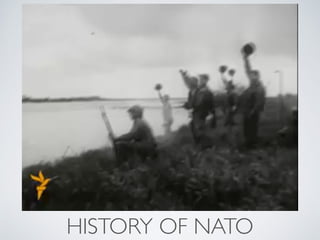
HISTORY OF NATO
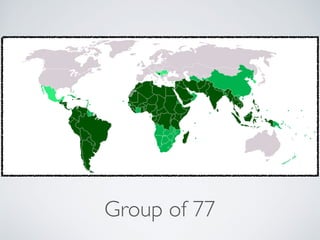
• Loose coalition of developing countries in the UN General
Assembly. CHINA
• 77 founding members which have expanded to 132
Group of 77
Hint:This IGO was developed due to imbalance of developing country
issues in the general assembly
Group of 77
CHINA’STERRITORIAL DISPUTES
Case Space: Ukraine
Crisis 2014
Click here for a full rundown
• Tension between EU, NATO and the Eurasian Economic
Union
• The EU and Ukraine have signed an Association Deal
March 2014
• IGO’s intentions can often lead to ongoing conflict
between nations. NATO and Russia.
• Economic interests are the main factors for
governments decisions
NON-GOVERNMENT
ORGANISATIONS (NGO’S)
• NGO’s provide the balance to issues involved with
improving peace and security around the world
• Close to 25000 NGO’s around the world
• NGO’s apply pressure to the UN and IGO’s, large influence
on the UN Charter and champion the continued struggles
involving humanitarian issues
Hint:The UN will use statistics gathered by NGO’s. E.G. Human
Rights Watch
• Founded in 1995 due to ineffective measures taken on
Somalia, Rwanda and Bosnia
• Provides behind the scenes assistance to peace negotiations
• Highly active in troublesome areas of the world. Focuses on
conflict resolution
International Crisis
Group (ICG)
Hint: Most world order essays will ask you to include non-legal
responses
INTERNATIONAL CRISIS GROUP
AUSTRALIA’S FEDERAL
GOVERNMENT
• Under Section 51 of the Constitution only the federal
government can make decisions on external affairs (World
Order issues)
• All signed treaties and agreements have to be established
by the federal government
• Australia is largely seen to be involved in positive and
peaceful global affairs
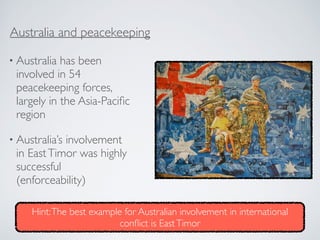
• Australia has been
involved in 54
peacekeeping forces,
largely in the Asia-Pacific
region
• Australia’s involvement
in EastTimor was highly
successful
(enforceability)
Australia and peacekeeping
Hint:The best example for Australian involvement in international
conflict is EastTimor
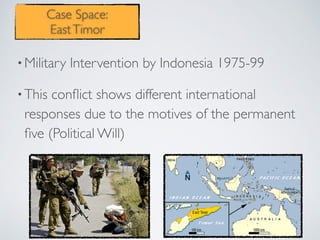
•Military Intervention by Indonesia 1975-99
•This conflict shows different international
responses due to the motives of the permanent
five (Political Will)
Case Space:
EastTimor
THE MEDIA
• A free and unbiased media is the essential ingredient for
rule of law in the global sphere
• The media is effective in raising awareness for world issues
but at times can be criticised for only providing
entertainment and not the full facts to the issue
Hint: Rwanda is a great example of the lack of media’s
response to the conflict
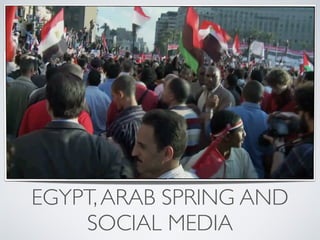
EGYPT,ARAB SPRING AND
SOCIAL MEDIA
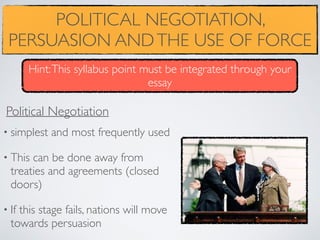
POLITICAL NEGOTIATION,
PERSUASION ANDTHE USE OF FORCE
• simplest and most frequently used
• This can be done away from
treaties and agreements (closed
doors)
• If this stage fails, nations will move
towards persuasion
Political Negotiation
Hint:This syllabus point must be integrated through your
essay
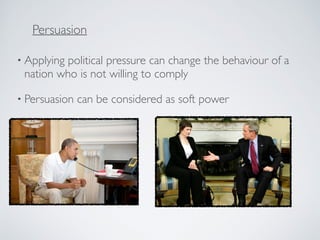
• Applying political pressure can change the behaviour of a
nation who is not willing to comply
• Persuasion can be considered as soft power
Persuasion
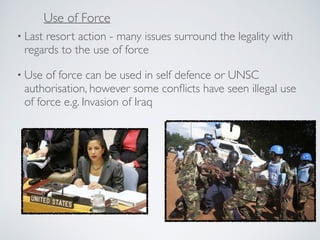
• Last resort action - many issues surround the legality with
regards to the use of force
• Use of force can be used in self defence or UNSC
authorisation, however some conflicts have seen illegal use
of force e.g. Invasion of Iraq
Use of Force
International law exists but only when
nation states wish to act upon it
Ban-Ki Moon
Hint:This dot point of the
syllabus can be considered as
a non-legal response
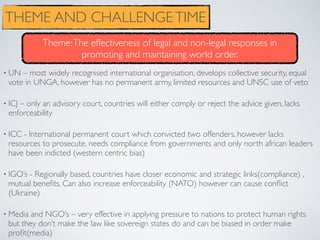
• UN – most widely recognised international organisation, develops collective security, equal
vote in UNGA, however has no permanent army, limited resources and UNSC use of veto
• ICJ – only an advisory court, countries will either comply or reject the advice given, lacks
enforceability
• ICC - International permanent court which convicted two offenders, however lacks
resources to prosecute, needs compliance from governments and only north african leaders
have been indicted (western centric bias)
• IGO’s - Regionally based, countries have closer economic and strategic links(compliance) ,
mutual benefits. Can also increase enforceability (NATO) however can cause conflict
(Ukraine)
• Media and NGO’s – very effective in applying pressure to nations to protect human rights
but they don’t make the law like sovereign states do and can be biased in order make
profit(media)
THEME AND CHALLENGETIME
Theme:The effectiveness of legal and non-legal responses in
promoting and maintaining world order.

Responses to World Order

  • 1.
    WORLD ORDER Part 2option 2 - Responses of world order Term 1, 2015
  • 2.
  • 3.
    THE NATION STATEAND STATE SOVEREIGNTY • Treaties are the primary source of law • Countries can agree or reject treaties that maintain peace and security. • This can either promote or deny world order Hint:This section is critical to any argument in world order essays
  • 5.
    •However, the UNSCcan intervene if there is a ‘threat to peace’ •The UNSC can deliver a humanitarian intervention. It can be difficult to get the ‘Permanent Five’ to agree (China and the Darfur region)
  • 7.
    •Theme: the effectivenessof legal and non-legal responses in promoting and maintaining world order •The Permanent Five are often unwilling to carry out the intervention (military force) •Asking other nations to supply military force is often denied (supporting USA in Iraq, national armies used to guard civilians) •Peacekeeping forces can be used but only after internal fighting has stopped
  • 8.
    •Attempt to overthrowthe government of Bashar Al-Assad •China and Russia used veto power to a unsc resolution draft •United Nations Security Council Resolution 2118 to reduce chemical weapons in Syria Case Space: Syrian Uprising
  • 9.
  • 10.
  • 11.
    ROLE OFTHE UN •The UN Charter:We the peoples of the United Nations determined - • to save succeeding generations from the scourge of war • to reaffirm faith in fundamental human rights • to establish conditions under which justice and respect for the obligations arising from treaties
  • 12.
    Hint:These are excellentarticles to support your writing in a world order essays
  • 13.
    STRUCTURE OFTHE UN •193 members, 5 major organs, Main International Organisation to discuss resolving disputes • UNGA has equal vote of its members Hint:The UN is also considered an IGO as its members are many nation states
  • 14.
    UNSC • 9 membersneed to agree for UN action, including all 5 permanent members • The UNSC has the power to issue sanctions, arms embargoes and collective military action(last resort) • Veto Power (great power unanimity) has been used by all P5 on certain issues
  • 15.
  • 17.
  • 18.
    • A geographicalformula is used to make up the 10 non-permanent members. There must be: • 3 African • 2 Asian • 1 Eastern European • 2 Western European/other • 2 Latin American
  • 19.
  • 20.
  • 21.
    • Peacekeeping forcewas used in the UN to withstand blatant acts of aggression. This was seen as an improvement on the League of Nations • Peacekeeping gave the legal right to the UNSC to use ‘peace enforcement’. It is controlled by the UNSC Peacekeeping forces
  • 22.
  • 23.
    • The UNhas no standing military force, so it makes adhoc coalitions for every task (remember Rwanda) • Problems can arise from this system, lack of funding and lack of effective enforcement
  • 24.
    • "He toldme the UN was a 'pull' system, not a 'push' system like I had been used to with NATO, because the UN had absolutely no pool of resources to draw on.You had to make a request for everything you needed, and then you had to wait while that request was analysed...For instance, soldiers everywhere have to eat and drink. In a push system, food and water for the number of soldiers deployed is automatically supplied. In a pull system, you have to ask for those rations, and no common sense seems to ever apply." Roméo Dallaire Rwanda conflict
  • 25.
  • 26.
    INTERNATIONAL INSTRUMENTS • Treatiesand customary law are the main sources of international law • Treaties are legally binding and are freely entered into. There are two types Bilateral and multilateral • Declarations are not legally binding and therefore only show principle support from a nation state Hint: Using this terminology in a world order essay is very important
  • 27.
    • A legalnorm or a ‘peremptory norm’ • Treaties do not have to be signed in order to be considered binding • It is accepted as a norm today that slavery, piracy and torture are prohibited under international law Jus Cogens
  • 28.
    •North Korea withdrewfrom the non-proliferation treaty(1968) in 2003 •In 2006 and 2012 nuclear testing was undertaken by north korea •In 2013, UNSC resolutions 2087 and 2094 put sanctions on this sovereign state Case Space: Nuclear threat - North Korea
  • 29.
    •How is thiscase concerning North Korea linked to the issues, themes and the effectiveness criteria? Discussion time Hint:This is the secret HSC Legal Studies
  • 30.
  • 31.
    •MultilateralTreaty to regulatethe international trade in conventional weapons •The adoption of resolution 61/89 was 154 yes, 3 no (North Korea, Iran and Syria) and 23 abstained. •116 nation states signed, 12 ratified.Will enter into force once 50 states accede or ratify Case Space: Success UNGA -The ArmsTradeTreaty 2013
  • 32.
  • 33.
    Arms Trade Treatyat Adoption UNGA 2013
  • 34.
    The Arms TradeTreaty Entered into force Dec 2014
  • 35.
    COURTS ANDTRIBUNALS • Est.1946 - organ of the UN • 15 judges elected by the UN • cases involve disputes between states International Court of Justice (ICJ)
  • 36.
  • 37.
  • 38.
    • The ICJhears two types of cases: • Contentious issues between states - the court produces binding rulings to states that have agreed to be bound by the rulings of the court • Advisory Opinions - the court provides reasoned, but non binding rulings
  • 40.
    •The Rome Statuteof the International Criminal CourtTreaty signed 1998 by 123 (Palestine 123rd) nation states •The ICC est. in the Hague, 2002 •Given jurisdiction over acts of genocide, war crimes and crimes against humanity International Criminal Court (ICC)
  • 41.
  • 42.
    •Armed conflict betweenloyal Gaddafi forces and those wanting to oust the government •UNSC resolution 1970 - freezing Gaddafi’s finances and strict sanctions •UNSC resolution 1973 - no-fly zone over Libya Case Space: Libya Civil War
  • 43.
  • 44.
  • 45.
    What is thiscartoon showing?
  • 46.
    Case space List of iccindicted criminals
  • 47.
  • 48.
  • 49.
    • International CriminalTribunalfor the FormerYugoslavia (ICTY) • International CriminalTribunal for Rwanda (ICTR) - UNSC Resolution 955 • The European Court of Human Rights, Strasbourg, France Other InternationalTribunals
  • 50.
    INTERGOVERNMENTAL ORGANISATIONS (IGO’S) • Theseregional/strategic organisation have been established for mutual benefits (Trade, regional cooperation etc) • examples include the African Union (AU), the Commonwealth,ASEAN, BRICS, the Arab League and APEC Hint: It is important to understand the links with the United Nations and IGO’s
  • 51.
    • Has beensuccessful at making war impossible over the European continent • Its a Supranation (decisions made by majority vote) • It improves issues of peace and security by tackling organised crime, improving human rights and agreeing not to attack each other European Union (EU) Hint: Due to recent economic impacts, the EU has declined in value in some member states
  • 53.
    • Est. 1949due to the USSR Eastern Bloc of Europe • Military forces have helped end conflict in Kosovo and Bosnia • Supported the EU with transport assistance in Darfur and continues to have forces in Afghanistan Northern AtlanticTreaty Organisation (NATO) Hint: NATO is a military organisation and may improve the level of effectiveness to develop peace but may violate international law when taking action
  • 55.
  • 56.
    • Loose coalitionof developing countries in the UN General Assembly. CHINA • 77 founding members which have expanded to 132 Group of 77 Hint:This IGO was developed due to imbalance of developing country issues in the general assembly
  • 57.
  • 58.
  • 59.
    Case Space: Ukraine Crisis2014 Click here for a full rundown • Tension between EU, NATO and the Eurasian Economic Union • The EU and Ukraine have signed an Association Deal March 2014 • IGO’s intentions can often lead to ongoing conflict between nations. NATO and Russia. • Economic interests are the main factors for governments decisions
  • 60.
    NON-GOVERNMENT ORGANISATIONS (NGO’S) • NGO’sprovide the balance to issues involved with improving peace and security around the world • Close to 25000 NGO’s around the world • NGO’s apply pressure to the UN and IGO’s, large influence on the UN Charter and champion the continued struggles involving humanitarian issues Hint:The UN will use statistics gathered by NGO’s. E.G. Human Rights Watch
  • 61.
    • Founded in1995 due to ineffective measures taken on Somalia, Rwanda and Bosnia • Provides behind the scenes assistance to peace negotiations • Highly active in troublesome areas of the world. Focuses on conflict resolution International Crisis Group (ICG) Hint: Most world order essays will ask you to include non-legal responses
  • 62.
  • 63.
    AUSTRALIA’S FEDERAL GOVERNMENT • UnderSection 51 of the Constitution only the federal government can make decisions on external affairs (World Order issues) • All signed treaties and agreements have to be established by the federal government • Australia is largely seen to be involved in positive and peaceful global affairs
  • 64.
    • Australia hasbeen involved in 54 peacekeeping forces, largely in the Asia-Pacific region • Australia’s involvement in EastTimor was highly successful (enforceability) Australia and peacekeeping Hint:The best example for Australian involvement in international conflict is EastTimor
  • 65.
    •Military Intervention byIndonesia 1975-99 •This conflict shows different international responses due to the motives of the permanent five (Political Will) Case Space: EastTimor
  • 66.
    THE MEDIA • Afree and unbiased media is the essential ingredient for rule of law in the global sphere • The media is effective in raising awareness for world issues but at times can be criticised for only providing entertainment and not the full facts to the issue Hint: Rwanda is a great example of the lack of media’s response to the conflict
  • 67.
  • 68.
    POLITICAL NEGOTIATION, PERSUASION ANDTHEUSE OF FORCE • simplest and most frequently used • This can be done away from treaties and agreements (closed doors) • If this stage fails, nations will move towards persuasion Political Negotiation Hint:This syllabus point must be integrated through your essay
  • 69.
    • Applying politicalpressure can change the behaviour of a nation who is not willing to comply • Persuasion can be considered as soft power Persuasion
  • 70.
    • Last resortaction - many issues surround the legality with regards to the use of force • Use of force can be used in self defence or UNSC authorisation, however some conflicts have seen illegal use of force e.g. Invasion of Iraq Use of Force
  • 71.
    International law existsbut only when nation states wish to act upon it Ban-Ki Moon Hint:This dot point of the syllabus can be considered as a non-legal response
  • 72.
    • UN –most widely recognised international organisation, develops collective security, equal vote in UNGA, however has no permanent army, limited resources and UNSC use of veto • ICJ – only an advisory court, countries will either comply or reject the advice given, lacks enforceability • ICC - International permanent court which convicted two offenders, however lacks resources to prosecute, needs compliance from governments and only north african leaders have been indicted (western centric bias) • IGO’s - Regionally based, countries have closer economic and strategic links(compliance) , mutual benefits. Can also increase enforceability (NATO) however can cause conflict (Ukraine) • Media and NGO’s – very effective in applying pressure to nations to protect human rights but they don’t make the law like sovereign states do and can be biased in order make profit(media) THEME AND CHALLENGETIME Theme:The effectiveness of legal and non-legal responses in promoting and maintaining world order.