
MONETARYMONETARY
SYSTEMSYSTEM
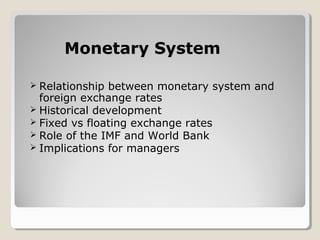
Monetary SystemMonetary System
 Relationship between monetary system and
foreign exchange rates
 Historical development
 Fixed vs floating exchange rates
 Role of the IMF and World Bank
 Implications for managers
International Monetary SystemInternational Monetary System
Currency exchange rates depend on the
structure of the international monetary
system
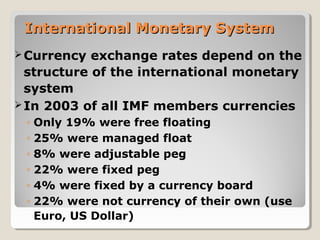
In 2003 of all IMF members currencies
◦ Only 19% were free floating
◦ 25% were managed float
◦ 8% were adjustable peg
◦ 22% were fixed peg
◦ 4% were fixed by a currency board
◦ 22% were not currency of their own (use
Euro, US Dollar)
Evolution of the InternationalEvolution of the International
Monetary SystemMonetary System
Gold Standard: currencies pegged to
gold value
◦ Convertibility guaranteed
◦ By 1880 most on gold standard
◦ Balance of trade equilibrium for all
countries
 Value of exports should equal value of
imports
 Flow of gold used to make up differences
◦ Abandoned in 1914
 Failed resumption after WWI
 Great Depression
Bretton Woods (1944 - 1973)Bretton Woods (1944 - 1973)
 44 countries met to design a new
system in 1944
 Established:
International Monetary Fund (IMF) and
World Bank
◦ IMF: maintain order in monetary system
◦ World Bank: promote general economic
development
◦ Fixed exchange rates pegged to the US
Dollar
◦ US Dollar pegged to gold at $35 per ounce
◦ Countries maintained their currencies ±
1% of the fixed rate; buy/sell own
currency to maintain level
The Role of the IMFThe Role of the IMF
 IMF maintained exchange rate
◦ discipline
 National governments had to manage inflation
through their money supply
◦ flexibility
 Provides loans to help members states with
temporary balance-of-payment deficit;
◦ Allows time to bring down inflation
◦ Relieves pressures to devalue
 Excessive drawing from IMF funds came with
IMF supervision of monetary and fiscal policies
◦ Allowed to 10% devaluations and more with
IMF approval
 187 members by 2003
The Role of the World BankThe Role of the World Bank
World Bank (IBRD) role
(International Bank for Reconstruction
& Development)
◦ Refinanced post-WWII reconstruction and
development
◦ Provides low-interest long term loans to
developing economies
The International Development Agency
(IDA), an arm of the bank created in
1960
◦ Raises funds from member states
◦ Loans only to poorest countries
◦ 50 year repayment at 1% per year interest
Collapse of Bretton WoodsCollapse of Bretton Woods
Devaluation pressures on US dollar
after 20 years
◦ Lyndon Johnson policies
 Vietnam war financing
 Welfare program financing
◦ Nixon ended gold convertibility of US
dollar in 1971
◦ US dollar was devalued and dealers
started speculating against it for
further devaluation
◦ Bretton Woods fixed exchange rates
abandoned in January 1972
Jamaica Agreement 1976Jamaica Agreement 1976
Floating rates declared acceptable
Gold abandoned as reserve asset;
◦ IMF returned gold reserves to members at
current prices
◦ Proceeds placed in trust fund to help poor
nations
◦ IMF quotas – member country
contributions – increased; membership
now 182 countries
◦ Less-develop, non-oil exporting countries
given more access to IMF
 IMF continued its role of helping countries
cope with macroeconomic and exchange rate
problems
◦ Monetary policy autonomy
◦ Trade balance adjustments helped
The Case for FixedThe Case for Fixed
Exchange RatesExchange Rates
◦ Monetary discipline
◦ Speculation limited
◦ Uncertainty reduced
◦ Trade balance adjustment effects on
inflation controlled
Who is right?
Case for Floating Exchange RatesCase for Floating Exchange Rates
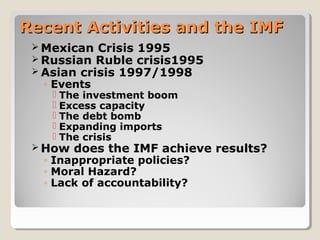
Recent Activities and the IMFRecent Activities and the IMF
 Mexican Crisis 1995
 Russian Ruble crisis1995
 Asian crisis 1997/1998
◦ Events
 The investment boom
 Excess capacity
 The debt bomb
 Expanding imports
 The crisis
 How does the IMF achieve results?
◦ Inappropriate policies?
◦ Moral Hazard?
◦ Lack of accountability?
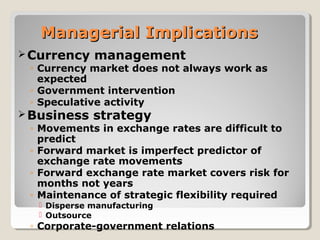
Managerial ImplicationsManagerial Implications
Currency management
◦ Currency market does not always work as
expected
◦ Government intervention
◦ Speculative activity
Business strategy
◦ Movements in exchange rates are difficult to
predict
◦ Forward market is imperfect predictor of
exchange rate movements
◦ Forward exchange rate market covers risk for
months not years
◦ Maintenance of strategic flexibility required
 Disperse manufacturing
 Outsource
◦ Corporate-government relations

Intl monetary system ch. 10

  • 1.
  • 3.
    Monetary SystemMonetary System Relationship between monetary system and foreign exchange rates  Historical development  Fixed vs floating exchange rates  Role of the IMF and World Bank  Implications for managers
  • 4.
    International Monetary SystemInternationalMonetary System Currency exchange rates depend on the structure of the international monetary system In 2003 of all IMF members currencies ◦ Only 19% were free floating ◦ 25% were managed float ◦ 8% were adjustable peg ◦ 22% were fixed peg ◦ 4% were fixed by a currency board ◦ 22% were not currency of their own (use Euro, US Dollar)
  • 6.
    Evolution of theInternationalEvolution of the International Monetary SystemMonetary System Gold Standard: currencies pegged to gold value ◦ Convertibility guaranteed ◦ By 1880 most on gold standard ◦ Balance of trade equilibrium for all countries  Value of exports should equal value of imports  Flow of gold used to make up differences ◦ Abandoned in 1914  Failed resumption after WWI  Great Depression
  • 7.
    Bretton Woods (1944- 1973)Bretton Woods (1944 - 1973)  44 countries met to design a new system in 1944  Established: International Monetary Fund (IMF) and World Bank ◦ IMF: maintain order in monetary system ◦ World Bank: promote general economic development ◦ Fixed exchange rates pegged to the US Dollar ◦ US Dollar pegged to gold at $35 per ounce ◦ Countries maintained their currencies ± 1% of the fixed rate; buy/sell own currency to maintain level
  • 8.
    The Role ofthe IMFThe Role of the IMF  IMF maintained exchange rate ◦ discipline  National governments had to manage inflation through their money supply ◦ flexibility  Provides loans to help members states with temporary balance-of-payment deficit; ◦ Allows time to bring down inflation ◦ Relieves pressures to devalue  Excessive drawing from IMF funds came with IMF supervision of monetary and fiscal policies ◦ Allowed to 10% devaluations and more with IMF approval  187 members by 2003
  • 9.
    The Role ofthe World BankThe Role of the World Bank World Bank (IBRD) role (International Bank for Reconstruction & Development) ◦ Refinanced post-WWII reconstruction and development ◦ Provides low-interest long term loans to developing economies The International Development Agency (IDA), an arm of the bank created in 1960 ◦ Raises funds from member states ◦ Loans only to poorest countries ◦ 50 year repayment at 1% per year interest
  • 10.
    Collapse of BrettonWoodsCollapse of Bretton Woods Devaluation pressures on US dollar after 20 years ◦ Lyndon Johnson policies  Vietnam war financing  Welfare program financing ◦ Nixon ended gold convertibility of US dollar in 1971 ◦ US dollar was devalued and dealers started speculating against it for further devaluation ◦ Bretton Woods fixed exchange rates abandoned in January 1972
  • 11.
    Jamaica Agreement 1976JamaicaAgreement 1976 Floating rates declared acceptable Gold abandoned as reserve asset; ◦ IMF returned gold reserves to members at current prices ◦ Proceeds placed in trust fund to help poor nations ◦ IMF quotas – member country contributions – increased; membership now 182 countries ◦ Less-develop, non-oil exporting countries given more access to IMF  IMF continued its role of helping countries cope with macroeconomic and exchange rate problems
  • 12.
    ◦ Monetary policyautonomy ◦ Trade balance adjustments helped The Case for FixedThe Case for Fixed Exchange RatesExchange Rates ◦ Monetary discipline ◦ Speculation limited ◦ Uncertainty reduced ◦ Trade balance adjustment effects on inflation controlled Who is right? Case for Floating Exchange RatesCase for Floating Exchange Rates
  • 13.
    Recent Activities andthe IMFRecent Activities and the IMF  Mexican Crisis 1995  Russian Ruble crisis1995  Asian crisis 1997/1998 ◦ Events  The investment boom  Excess capacity  The debt bomb  Expanding imports  The crisis  How does the IMF achieve results? ◦ Inappropriate policies? ◦ Moral Hazard? ◦ Lack of accountability?
  • 14.
    Managerial ImplicationsManagerial Implications Currencymanagement ◦ Currency market does not always work as expected ◦ Government intervention ◦ Speculative activity Business strategy ◦ Movements in exchange rates are difficult to predict ◦ Forward market is imperfect predictor of exchange rate movements ◦ Forward exchange rate market covers risk for months not years ◦ Maintenance of strategic flexibility required  Disperse manufacturing  Outsource ◦ Corporate-government relations

Editor's Notes