International Monetary
System


PRESENTED BY:
Gaurav Sharma
Preface
   Increased Volatility of currency affects the earnings of
    MNC’s, Banks and Cross Border investor’s

   There are large and unexpected fluctuations in the
    value of currency hence a setup called Bretton Woods
    was formed in 1944 to reduce this riskiness of
    international business

   The main feature of Bretton Woods was the relatively
    fixed exchange rate of individual currency in the terms
    of USD $ and convertibility of $ into gold

   In 1971 Bretton Woods fell prey to international financial
    turmoil and was replaced by the present regime of
    rapidly fluctuating exchange rates which resulted in
    both problems and opportunities for MNC’s
INTERNATIONAL MONETARY
SYSTEM
 The International Monetary System refers to set
  of policies, institutions, practices, regulations &
  mechanism that determine the rate at which one
  currency would be exchange for another.
 There are primarily 5 market mechanisms to
  establish exchange rate with each having its
  share of merits & demerits –

   Free float
   Managed float
   Target zone arrangement
   Fixed rate system
   Hybrid system
 All  countries like to have economic stability &
  prefer a stable exchange rate, however fixing
  exchange rate often leads to currency crises
  if the monetary policy is inconsistent with it

 Countries   are less vulnerable to economic
  shocks if they allow their currency to float
  freely but that may exhibit excessive volatility
  which hurts trade & economic growth

 The  trade off between different mechanism
  depend upon the importance of the
  underlying benefits & trade offs associated
  with them
Free Float

 Free market exchange rates are determined
 by interaction of currency supply & demand
 which is in turn influenced by price level
 changes interest differential & economic
 growth

 The exchange rate fluctuates randomly as
 market participants arises & react to new
 information, for example – Government
 policies or acts of God & nature

 This
     is also called clean float as the
 exchange rates are free flowing without any
 manipulation
Managed float

   Intervention by Government’s in the foreign
    change market in order to reduce economic
    uncertainty associated with free/ clean float

   This is triggered by the fear that a sudden
    change in the currency appreciates or inflation of
    it depreciates

   Central banks of countries intervene to smooth
    as out exchange rate fluctuations & determine
    the rate that is why it is called Managed/ dirty
    float

   Crawling peg – unofficial pegging
Target zone arrangement


 Underthis system, countries adjust their
 national economic policies to maintain there
 exchange rates within a specific margin


 Members  of the arrangement adjust their
 national economic policies to maintain the
 target range
Fixed rate


   Bretton wood was also a fixed rate mechanism, in this
    type of regime, Governments are committed to maintain
    a target exchange rate

   Central banks buy/ sell currency actively if the
    exchange rate is threatened

   For this system to work, all member nations must
    accept the groups joint inflation rate as its own.

   These controls are major source of imperfection for
    MNC’s which provide both risk & opportunities to them
The current hybrid system


 Thecurrency system is the one where major
 currencies float on a managed basis, some
 currencies are freely floating while other
 currencies follow various types of pegged
 exchange rates


 Examples  – another currency as legal tender
 – Equador, el Salvador (US dollar) – pegged
 against a single currency, Malaysia, Maldives,
 Nepal, Iraq, Jordan
Brief history of International
monetary system

   Why Gold – Gold has a certain desirable
    properties like durability, ease of storage, easy
    recognition, standardization

   Short term changes in its stock are limited by
    high production cost, making it expensive to
    manipulate

   It ensures price stability in long run

   This is the reason why most currencies fairly
    recent recently followed gold standard which
    defined their exchange rates
The Gold standard

   The gold standard essentially involved a commitment
    by the participating countries to fix the price of their
    currencies in terms of a specific amount of gold

   The price was maintained by buying/ selling gold at that
    price

   The value of gold relative to other goods does not
    change much over long period of time, that helps in
    maintaining monetary discipline & ensures long run
    price stability

   Concept of fat money – gold standard
The gold standard from 1925 -
1944

   The gold standard broke down during World War
    I, and was briefly re-instated between 1925-31 as
    gold exchange standard

   Under this system, only US & Britain were
    allowed to hold gold reserves while other could
    hold both gold, dollars &/ or pound reserves

   1931 – Britain departed from Gold standard due
    to high influx of gold & capital, this led to
    devaluation of many currencies which in turn led
    to trade wars, some economists even blame the
    protectionist regimes of triggering the great
    depression
Bretton woods (1946 – 1971 )

   To avoid destructive monetary economic policies to be
    formulated allied nations agreed to form a new postwar
    system

   The conference held in New hampshire also created
    institutions, IMF & World Bank to promote international
    financial stability

   World bank had the primary function of lending to
    nations devastated by the world war

   The IMF had agenda to foster global growth and
    economic stability
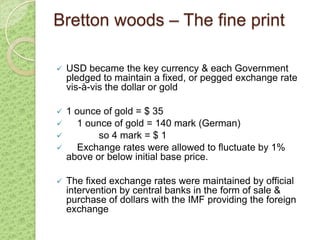
Bretton woods – The fine print

   USD became the key currency & each Government
    pledged to maintain a fixed, or pegged exchange rate
    vis-à-vis the dollar or gold

 1 ounce of gold = $ 35
    1 ounce of gold = 140 mark (German)
         so 4 mark = $ 1
    Exchange rates were allowed to fluctuate by 1%
  above or below initial base price.

   The fixed exchange rates were maintained by official
    intervention by central banks in the form of sale &
    purchase of dollars with the IMF providing the foreign
    exchange
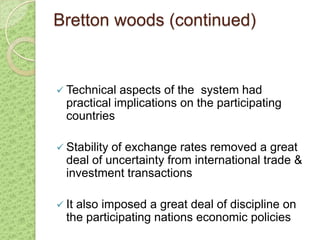
Bretton woods (continued)


 Technical  aspects of the system had
  practical implications on the participating
  countries

 Stabilityof exchange rates removed a great
  deal of uncertainty from international trade &
  investment transactions

 Italso imposed a great deal of discipline on
  the participating nations economic policies
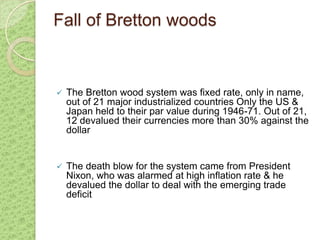
Fall of Bretton woods


   The Bretton wood system was fixed rate, only in name,
    out of 21 major industrialized countries Only the US &
    Japan held to their par value during 1946-71. Out of 21,
    12 devalued their currencies more than 30% against the
    dollar


   The death blow for the system came from President
    Nixon, who was alarmed at high inflation rate & he
    devalued the dollar to deal with the emerging trade
    deficit
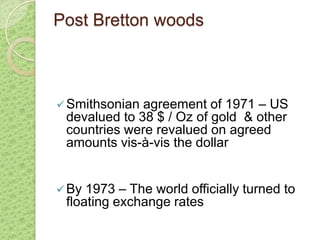
Post Bretton woods


 Smithsonian agreement of 1971 – US
 devalued to 38 $ / Oz of gold & other
 countries were revalued on agreed
 amounts vis-à-vis the dollar


 By 1973 – The world officially turned to
 floating exchange rates
Role of International Monetary
       Fund
   The IMF works to foster global growth and economic stability. It provides
    policy advice and financing to members in economic difficulties and also
    works with developing nations to help them achieve macroeconomic
    stability and reduce poverty.

   Its main works are –

   policy advice to governments and central banks based on analysis of
    economic trends and cross-country experiences

   research, statistics, forecasts, and analysis based on tracking of global,
    regional, and individual economies and markets

   loans to help countries overcome economic difficulties

 concessional loans to help fight poverty in developing countries
 It is having 188 member countries till date
Special Drawing Right
 (SDR)
   The IMF supplemented its foreign exchange by
    creating a new reserve asset, (named SDR).

   It serves as the IMF’s unit of account

   It is a weighted average of the currencies of five
    nations (US, Germany, France, Japan & Great
    Britain)

   The weights, which are based on the relative
    importance of each country in international trade
    are updated periodically
Role of World bank

The world bank is an internationally supported bank that
  provides financial and technical assistance to developing
  countries for development programs (e.g. bridges, roads,
  schools)with the stated goal of reducing poverty.


Role of Bank of International
 Settlements
   Acts as the “Central Bank“ for Industrial Countries’ Central
    Bank

   Helps in managing FOREIGN EXCHANGE RESERVES

   BIS also holds deposits of Central Banks
Floating Rate system - 1973


 Proponents       of the new system said that
    this system would reduce economic
    volatility & facilitate free trade, floating
    exchange rates would offset the
    differences in inflation rate

    High inflation countries would have their
    currencies depreciate, allowing their
    firms to stay competitive without having
    to act wages & unemployment
Assessment of Floating Rate
system


 Currency   volatility has increased – The
 experience till date from the system has been
 disappointing. The dollars ups & down has
 little to do with inflation & a lot to do with
 expectations of future government policies &
 economic conditions

 Theinstability reflects the non monetary
 shocks to the world economy, such as
 changing oil prices & competitiveness
 amongst countries
Jamaica Agreement 1976

    Floating rates declared acceptable

  Gold abandoned as reserve asset;
1.  IMF returned gold reserves to members at
    current prices
2. Proceeds placed in trust fund to help poor
    nations
3. IMF quotas – member country contributions –
    increased; membership now 188 countries
4. Less-develop, non-oil exporting countries given
    more access to IMF
  IMF continued its role of helping countries cope
   with macroeconomic and exchange rate
   problems
Major events after 1973
   OPEC and the Oil Crisis (1973-74)

1. OPEC raised oil prices four fold
2. Exchange rate turmoil resulted
3. Caused OPEC nations to earn large surplus B-O-P.
  Surpluses recycled to debtor nations which set up debt
  crisis of 1980’s.

   Dollar Crisis (1977-78)

1. U.S. B-O-P difficulties
2. Result of inconsistent monetary policy in U.S.
3. Dollar value falls as confidence shrinks.
   The Rising Dollar (1980-85)

   1. U.S. inflation subsides as the Fed raises interest rates

 2. Rising rates attracts global capital to U.S.
 3. Result: Dollar value rises.


   The Sinking Dollar:(1985-87)

 1. Dollar revaluated slowly downward;
 2. Plaza Agreement (1985) G-5 agree to depress US $
  further.
 3. Louvre Agreement (1987) G-7 agree to support the falling
  US $

   Recent History (1988-2005)

 1988 US$ stabilized
 Post-1991 Confidence resulted in stronger dollar
 1993-1995 Dollar value falls
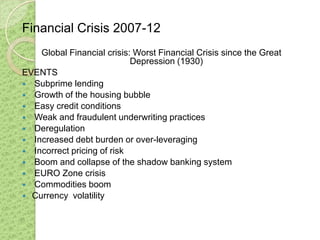
Financial Crisis 2007-12
    Global Financial crisis: Worst Financial Crisis since the Great
                            Depression (1930)
EVENTS
 Subprime lending
 Growth of the housing bubble
 Easy credit conditions
 Weak and fraudulent underwriting practices
 Deregulation
 Increased debt burden or over-leveraging
 Incorrect pricing of risk
 Boom and collapse of the shadow banking system
 EURO Zone crisis
 Commodities boom
 Currency volatility
THANK YOU

International monetary system

  • 1.
  • 2.
    Preface  Increased Volatility of currency affects the earnings of MNC’s, Banks and Cross Border investor’s  There are large and unexpected fluctuations in the value of currency hence a setup called Bretton Woods was formed in 1944 to reduce this riskiness of international business  The main feature of Bretton Woods was the relatively fixed exchange rate of individual currency in the terms of USD $ and convertibility of $ into gold  In 1971 Bretton Woods fell prey to international financial turmoil and was replaced by the present regime of rapidly fluctuating exchange rates which resulted in both problems and opportunities for MNC’s
  • 3.
    INTERNATIONAL MONETARY SYSTEM  TheInternational Monetary System refers to set of policies, institutions, practices, regulations & mechanism that determine the rate at which one currency would be exchange for another.  There are primarily 5 market mechanisms to establish exchange rate with each having its share of merits & demerits –  Free float  Managed float  Target zone arrangement  Fixed rate system  Hybrid system
  • 4.
     All countries like to have economic stability & prefer a stable exchange rate, however fixing exchange rate often leads to currency crises if the monetary policy is inconsistent with it  Countries are less vulnerable to economic shocks if they allow their currency to float freely but that may exhibit excessive volatility which hurts trade & economic growth  The trade off between different mechanism depend upon the importance of the underlying benefits & trade offs associated with them
  • 5.
    Free Float  Freemarket exchange rates are determined by interaction of currency supply & demand which is in turn influenced by price level changes interest differential & economic growth  The exchange rate fluctuates randomly as market participants arises & react to new information, for example – Government policies or acts of God & nature  This is also called clean float as the exchange rates are free flowing without any manipulation
  • 6.
    Managed float  Intervention by Government’s in the foreign change market in order to reduce economic uncertainty associated with free/ clean float  This is triggered by the fear that a sudden change in the currency appreciates or inflation of it depreciates  Central banks of countries intervene to smooth as out exchange rate fluctuations & determine the rate that is why it is called Managed/ dirty float  Crawling peg – unofficial pegging
  • 7.
    Target zone arrangement Underthis system, countries adjust their national economic policies to maintain there exchange rates within a specific margin  Members of the arrangement adjust their national economic policies to maintain the target range
  • 8.
    Fixed rate  Bretton wood was also a fixed rate mechanism, in this type of regime, Governments are committed to maintain a target exchange rate  Central banks buy/ sell currency actively if the exchange rate is threatened  For this system to work, all member nations must accept the groups joint inflation rate as its own.  These controls are major source of imperfection for MNC’s which provide both risk & opportunities to them
  • 9.
    The current hybridsystem  Thecurrency system is the one where major currencies float on a managed basis, some currencies are freely floating while other currencies follow various types of pegged exchange rates  Examples – another currency as legal tender – Equador, el Salvador (US dollar) – pegged against a single currency, Malaysia, Maldives, Nepal, Iraq, Jordan
  • 10.
    Brief history ofInternational monetary system  Why Gold – Gold has a certain desirable properties like durability, ease of storage, easy recognition, standardization  Short term changes in its stock are limited by high production cost, making it expensive to manipulate  It ensures price stability in long run  This is the reason why most currencies fairly recent recently followed gold standard which defined their exchange rates
  • 11.
    The Gold standard  The gold standard essentially involved a commitment by the participating countries to fix the price of their currencies in terms of a specific amount of gold  The price was maintained by buying/ selling gold at that price  The value of gold relative to other goods does not change much over long period of time, that helps in maintaining monetary discipline & ensures long run price stability  Concept of fat money – gold standard
  • 12.
    The gold standardfrom 1925 - 1944  The gold standard broke down during World War I, and was briefly re-instated between 1925-31 as gold exchange standard  Under this system, only US & Britain were allowed to hold gold reserves while other could hold both gold, dollars &/ or pound reserves  1931 – Britain departed from Gold standard due to high influx of gold & capital, this led to devaluation of many currencies which in turn led to trade wars, some economists even blame the protectionist regimes of triggering the great depression
  • 13.
    Bretton woods (1946– 1971 )  To avoid destructive monetary economic policies to be formulated allied nations agreed to form a new postwar system  The conference held in New hampshire also created institutions, IMF & World Bank to promote international financial stability  World bank had the primary function of lending to nations devastated by the world war  The IMF had agenda to foster global growth and economic stability
  • 14.
    Bretton woods –The fine print  USD became the key currency & each Government pledged to maintain a fixed, or pegged exchange rate vis-à-vis the dollar or gold  1 ounce of gold = $ 35  1 ounce of gold = 140 mark (German)  so 4 mark = $ 1  Exchange rates were allowed to fluctuate by 1% above or below initial base price.  The fixed exchange rates were maintained by official intervention by central banks in the form of sale & purchase of dollars with the IMF providing the foreign exchange
  • 15.
    Bretton woods (continued) Technical aspects of the system had practical implications on the participating countries  Stabilityof exchange rates removed a great deal of uncertainty from international trade & investment transactions  Italso imposed a great deal of discipline on the participating nations economic policies
  • 16.
    Fall of Brettonwoods  The Bretton wood system was fixed rate, only in name, out of 21 major industrialized countries Only the US & Japan held to their par value during 1946-71. Out of 21, 12 devalued their currencies more than 30% against the dollar  The death blow for the system came from President Nixon, who was alarmed at high inflation rate & he devalued the dollar to deal with the emerging trade deficit
  • 17.
    Post Bretton woods Smithsonian agreement of 1971 – US devalued to 38 $ / Oz of gold & other countries were revalued on agreed amounts vis-à-vis the dollar  By 1973 – The world officially turned to floating exchange rates
  • 18.
    Role of InternationalMonetary Fund  The IMF works to foster global growth and economic stability. It provides policy advice and financing to members in economic difficulties and also works with developing nations to help them achieve macroeconomic stability and reduce poverty.  Its main works are –  policy advice to governments and central banks based on analysis of economic trends and cross-country experiences  research, statistics, forecasts, and analysis based on tracking of global, regional, and individual economies and markets  loans to help countries overcome economic difficulties  concessional loans to help fight poverty in developing countries  It is having 188 member countries till date
  • 19.
    Special Drawing Right (SDR)  The IMF supplemented its foreign exchange by creating a new reserve asset, (named SDR).  It serves as the IMF’s unit of account  It is a weighted average of the currencies of five nations (US, Germany, France, Japan & Great Britain)  The weights, which are based on the relative importance of each country in international trade are updated periodically
  • 20.
    Role of Worldbank The world bank is an internationally supported bank that provides financial and technical assistance to developing countries for development programs (e.g. bridges, roads, schools)with the stated goal of reducing poverty. Role of Bank of International Settlements  Acts as the “Central Bank“ for Industrial Countries’ Central Bank  Helps in managing FOREIGN EXCHANGE RESERVES  BIS also holds deposits of Central Banks
  • 21.
    Floating Rate system- 1973  Proponents of the new system said that this system would reduce economic volatility & facilitate free trade, floating exchange rates would offset the differences in inflation rate  High inflation countries would have their currencies depreciate, allowing their firms to stay competitive without having to act wages & unemployment
  • 22.
    Assessment of FloatingRate system  Currency volatility has increased – The experience till date from the system has been disappointing. The dollars ups & down has little to do with inflation & a lot to do with expectations of future government policies & economic conditions  Theinstability reflects the non monetary shocks to the world economy, such as changing oil prices & competitiveness amongst countries
  • 23.
    Jamaica Agreement 1976  Floating rates declared acceptable  Gold abandoned as reserve asset; 1. IMF returned gold reserves to members at current prices 2. Proceeds placed in trust fund to help poor nations 3. IMF quotas – member country contributions – increased; membership now 188 countries 4. Less-develop, non-oil exporting countries given more access to IMF  IMF continued its role of helping countries cope with macroeconomic and exchange rate problems
  • 24.
    Major events after1973  OPEC and the Oil Crisis (1973-74) 1. OPEC raised oil prices four fold 2. Exchange rate turmoil resulted 3. Caused OPEC nations to earn large surplus B-O-P. Surpluses recycled to debtor nations which set up debt crisis of 1980’s.  Dollar Crisis (1977-78) 1. U.S. B-O-P difficulties 2. Result of inconsistent monetary policy in U.S. 3. Dollar value falls as confidence shrinks.
  • 25.
    The Rising Dollar (1980-85)  1. U.S. inflation subsides as the Fed raises interest rates  2. Rising rates attracts global capital to U.S.  3. Result: Dollar value rises.  The Sinking Dollar:(1985-87)  1. Dollar revaluated slowly downward;  2. Plaza Agreement (1985) G-5 agree to depress US $ further.  3. Louvre Agreement (1987) G-7 agree to support the falling US $  Recent History (1988-2005)  1988 US$ stabilized  Post-1991 Confidence resulted in stronger dollar  1993-1995 Dollar value falls
  • 26.
    Financial Crisis 2007-12 Global Financial crisis: Worst Financial Crisis since the Great Depression (1930) EVENTS  Subprime lending  Growth of the housing bubble  Easy credit conditions  Weak and fraudulent underwriting practices  Deregulation  Increased debt burden or over-leveraging  Incorrect pricing of risk  Boom and collapse of the shadow banking system  EURO Zone crisis  Commodities boom  Currency volatility
  • 27.