Exchange Rate
Regimes
Submitted By :-
Anshu Sindhu
Jayalaxmi Desai
What is exchange-rate regime
• the way an authority manages its currency in
relation to other currencies and the foreign
exchange market
• An exchange rate change is simply the price of
one currency in terms of another
Different types of Regimes
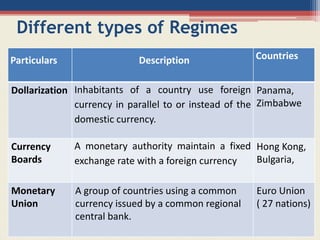
Particulars Description Countries
Dollarization Inhabitants of a country use foreign
currency in parallel to or instead of the
domestic currency.
Panama,
Zimbabwe
Currency
Boards
A monetary authority maintain a fixed
exchange rate with a foreign currency
Hong Kong,
Bulgaria,
Monetary
Union
A group of countries using a common
currency issued by a common regional
central bank.
Euro Union
( 27 nations)
Float with
discretionary
intervention
Exchange rates are determined in
the foreign exchange market,
However authorities can and do
intervene
India,
Bangladesh,
Sri Lanka
Pure Float /
Independent
floating
The exchange rate is determined in
the market without public sector
intervention.
Japan,
New Zealand,
The United
States
Traditional
Peg/Fixed
exchange
rate system
Crawling Pegs Crawling
Bands
Importance of Foreign exchange
regime
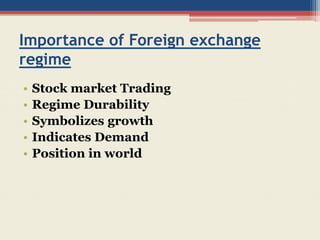
• Stock market Trading
• Regime Durability
• Symbolizes growth
• Indicates Demand
• Position in world
Economics of the Foreign Exchange
Market
• Depends on : forces of Demand and Supply
• Echo the international trade and financial
transactions that are summarized in the Balance
Of Payments (BOP)
• BOP
▫ Current A/c – Import and export of goods and
services
▫ Capital A/c - Capital Inflow and Capital Outflow
Economics of the Foreign Exchange
Market
• Floating ERR :
 Automatic equilibrium in the balance of
payments without government intervention
 Shock absorber that helps to insulate against
overseas disturbances
 Increases the effectiveness of monetary policy
(diminishing the Fiscal Policy)
 In India, fiscal policy has come to be
overshadowed by an increased reliance on
monetary policy as the primary instrument of
macroeconomic stabilization
How do countries choose Exchange
Rate Regimes (ERR)?
• Socio – Economic Variables Affecting choice of
ERR’s are :
1. Openness, size, trade concentration and
economic volatility indicators
 A country is less likely to adopt a fixed exchange
rate if it is relatively large and closed, if its
external trade is concentrated, and if the
business cycle is more volatile. This suggests that
what matters for the choice of the exchange rate
regime is the exposure to external shocks
Variables Affecting Choice of
Exchange Rate regimes
2. Financial depth indicators
 Deeper the financial markets – prone to
adopting Floating Exchange rates
3. Inflation
 Not a very influential parameter
 Socio-economic scenario
 The inflation rate is endogenous to the
institutional and political environment
Variables Affecting Choice of
Exchange Rate regimes
4. Political variables
 Expected government turnover and socio-
political unrest reduce the likelihood of adopting
a de facto peg
 Use of monetary policy to raise consensus in the
elections
 fragmented policymaking calls for a Float
probably because greater discretion makes it
easier to settle conflicts among agents involved
in the decision-making process
Exchange rate regimes

Exchange rate regimes

  • 1.
    Exchange Rate Regimes Submitted By:- Anshu Sindhu Jayalaxmi Desai
  • 2.
    What is exchange-rateregime • the way an authority manages its currency in relation to other currencies and the foreign exchange market • An exchange rate change is simply the price of one currency in terms of another
  • 3.
    Different types ofRegimes Particulars Description Countries Dollarization Inhabitants of a country use foreign currency in parallel to or instead of the domestic currency. Panama, Zimbabwe Currency Boards A monetary authority maintain a fixed exchange rate with a foreign currency Hong Kong, Bulgaria, Monetary Union A group of countries using a common currency issued by a common regional central bank. Euro Union ( 27 nations)
  • 4.
    Float with discretionary intervention Exchange ratesare determined in the foreign exchange market, However authorities can and do intervene India, Bangladesh, Sri Lanka Pure Float / Independent floating The exchange rate is determined in the market without public sector intervention. Japan, New Zealand, The United States Traditional Peg/Fixed exchange rate system Crawling Pegs Crawling Bands
  • 5.
    Importance of Foreignexchange regime • Stock market Trading • Regime Durability • Symbolizes growth • Indicates Demand • Position in world
  • 6.
    Economics of theForeign Exchange Market • Depends on : forces of Demand and Supply • Echo the international trade and financial transactions that are summarized in the Balance Of Payments (BOP) • BOP ▫ Current A/c – Import and export of goods and services ▫ Capital A/c - Capital Inflow and Capital Outflow
  • 7.
    Economics of theForeign Exchange Market • Floating ERR :  Automatic equilibrium in the balance of payments without government intervention  Shock absorber that helps to insulate against overseas disturbances  Increases the effectiveness of monetary policy (diminishing the Fiscal Policy)  In India, fiscal policy has come to be overshadowed by an increased reliance on monetary policy as the primary instrument of macroeconomic stabilization
  • 8.
    How do countrieschoose Exchange Rate Regimes (ERR)? • Socio – Economic Variables Affecting choice of ERR’s are : 1. Openness, size, trade concentration and economic volatility indicators  A country is less likely to adopt a fixed exchange rate if it is relatively large and closed, if its external trade is concentrated, and if the business cycle is more volatile. This suggests that what matters for the choice of the exchange rate regime is the exposure to external shocks
  • 9.
    Variables Affecting Choiceof Exchange Rate regimes 2. Financial depth indicators  Deeper the financial markets – prone to adopting Floating Exchange rates 3. Inflation  Not a very influential parameter  Socio-economic scenario  The inflation rate is endogenous to the institutional and political environment
  • 10.
    Variables Affecting Choiceof Exchange Rate regimes 4. Political variables  Expected government turnover and socio- political unrest reduce the likelihood of adopting a de facto peg  Use of monetary policy to raise consensus in the elections  fragmented policymaking calls for a Float probably because greater discretion makes it easier to settle conflicts among agents involved in the decision-making process