Downloaded 39 times
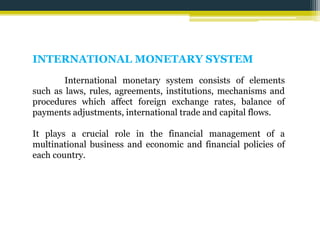
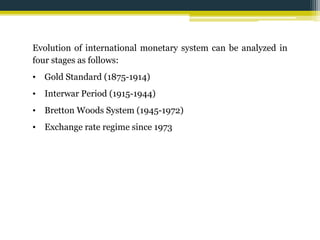
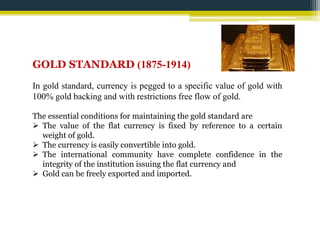
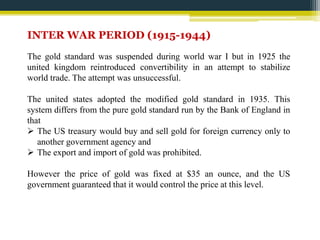
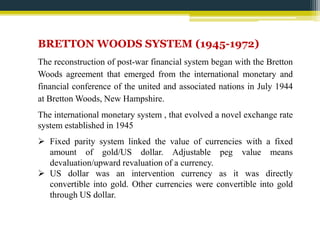
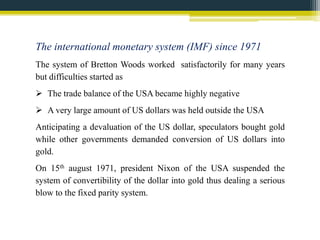
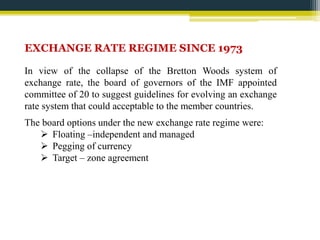


The international monetary system consists of rules and institutions that govern foreign exchange rates, trade, and capital flows between countries. It has evolved over four stages: the gold standard (1875-1914), the interwar period (1915-1944), the Bretton Woods system (1945-1972), and the floating exchange rate regime since 1973. Under the Bretton Woods system, currencies were pegged to the US dollar, which was convertible to gold, establishing a fixed exchange rate system. However, the system collapsed in 1971 when the US suspended gold convertibility, leading to the current floating rate regime.


![02[1].international monetary system](https://cdn.slidesharecdn.com/ss_thumbnails/021-internationalmonetarysystem-110209011238-phpapp01-thumbnail.jpg?width=640&height=640&fit=bounds)


![Lecture_Chapter_2_accessible4PPT[1].pptx](https://cdn.slidesharecdn.com/ss_thumbnails/lecturechapter2accessibleppt1-250126110253-8a97dbce-thumbnail.jpg?width=640&height=640&fit=bounds)


![Cells and Organs of immune system [Autosaved].pptx](https://cdn.slidesharecdn.com/ss_thumbnails/cellsandorgansofimmunesystemautosaved-260123152717-ea0cb261-thumbnail.jpg?width=640&height=640&fit=bounds)


