International Monetary System

 ALTERNATIVE EXCHANGE RATE SYSTEMS
 A BRIEF HISTORY OF THE INTERNATIONAL MONETARY SYSTEM
 THE EUROPEAN MONETARY SYSTEM
 Costs and benefits of a single currency
Alternative Exchange Rate Systems (Obvious but
important point)

 People trade currencies for two primary reasons



To buy and sell goods and services
To buy and sell financial assets
There are an enormous number of exchange rate
systems, but generally they can be sorted into one of these
categories

 Freely Floating
 Managed Float
 Target Zone
 Fixed Rate
Important Note:

 Even though we may call it “free float” in fact the government can

still control the exchange rate by manipulating the factors that affect
the exchange rate (i.e., monetary policy)
Under a floating rate system, exchange rates are
set by demand and supply.

 price levels
 interest rates
 economic growth
Alternate exchange rate systems: Managed Float
(“Dirty Float”)
 Market forces set rates unless excess volatility occurs, then,

central bank determines rate by buying or selling currency.
Managed float isn’t really a single system, but describes a
continuum of systems
 Smoothing daily fluctuations
 “Leaning against the wind” slowing the change to a different
rate
 Unofficial pegging: actually fixing the rate without saying so.
 Target-Zone Arrangement: countries agree to maintain
exchange rates within a certain bound What makes target
zone arrangements special is the understanding that
countries will adjust real economic policies to maintain the
zone.
A Brief History of the International Monetary System
 Pre 1875 Bimetalism
 1875-1914: Classical Gold Standard
 1915-1944: Interwar Period
 1945-1972: Bretton Woods System
 1973-Present: Flexible (Hybrid) System
The Intrinsic Value of Money and Exchange Rates

 At present the money of most countries has no intrinsic value (if you

melt a quarter, you don’t get $.25 worth of metal). But historically
many countries have backed their currency with valuable
commodities (usually gold or silver)—if the U.S. treasury were to mint
gold coins that had 1/35th ounces of gold and sold these for $1.00,
then a dollar bill would have an intrinsic value.
 When a country’s currency has some intrinsic value, then the
exchange rate between the two countries is fixed. For example, if
the U.S. mints $1.00 coins that contain 1/35th ounces of gold and
Great Britain mints £1.00 coins that contain 4/35th ounces of gold,
then it must be the case that £1 = $4 (if not, people could make an
unlimited profit buying gold in one country and selling it in another)
The Classical Gold Standard(1875-1914) had two
essential features

 Nations fixed the value of the currency in terms of
 Gold is freely transferable between countries
 Essentially a fixed rate system (Suppose the US announces a

willingness to buy gold for $200/oz and Great Britain announces a
willingness to buy gold for £100. Then £1=$2)
Advantage of Gold System



Disturbances in Price Levels Would be offset by the price-specieflow mechanism. When a balance of payments surplus led to a gold
inflow Gold inflow (country with surplus) led to higher prices which
reduced surplus Gold outflow led to lower prices and increased
surplus.
Interwar Period

 Periods of serious chaos such as German hyperinflation and the use

of exchange rates as a way to gain trade advantage.
 Britain and US adopt a kind of gold standard (but tried to prevent the
species adjustment mechanism from working).
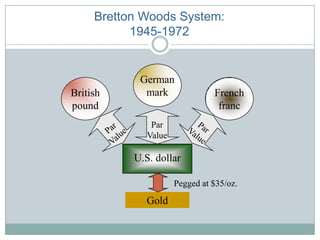
The Bretton Woods System (1946-1971)

 U.S.$ was key currency valued at $1 = 1/35 oz. of gold
 All currencies linked to that price in a fixed rate system.
 In effect, rather than hold gold as a reserve asset, other countries

hold US dollars (which are backed by gold)
Bretton Woods System:
1945-1972

British
pound

German
mark

French
franc

Par
Value

U.S. dollar
Pegged at $35/oz.

Gold
Collapse of Bretton Woods (1971)

 U.S. high inflation rate
 U.S.$ depreciated sharply.
 Smithsonian Agreement (1971) US$ devalued to 1/38 oz. of gold.

1973 The US dollar is under heavy pressure, European and Japanese
currencies are allowed to float
 1976 Jamaica Agreement
 Flexible exchange rates declared acceptable
 Gold abandoned as an international reserve

Current Exchange Rate Arrangements

 The largest number of countries, about 49, allow market forces to

determine their currency’s value.
 Managed Float. About 25 countries combine government intervention
with market forces to set exchange rates.
 Pegged to another currency such as the U.S. dollar or euro (through
franc or mark). About 45 countries.
 No national currency and simply uses another currency, such as the
dollar or euro as their own.

International monetary system

  • 1.
    International Monetary System ALTERNATIVE EXCHANGE RATE SYSTEMS  A BRIEF HISTORY OF THE INTERNATIONAL MONETARY SYSTEM  THE EUROPEAN MONETARY SYSTEM  Costs and benefits of a single currency
  • 2.
    Alternative Exchange RateSystems (Obvious but important point)  People trade currencies for two primary reasons   To buy and sell goods and services To buy and sell financial assets
  • 3.
    There are anenormous number of exchange rate systems, but generally they can be sorted into one of these categories  Freely Floating  Managed Float  Target Zone  Fixed Rate
  • 4.
    Important Note:  Eventhough we may call it “free float” in fact the government can still control the exchange rate by manipulating the factors that affect the exchange rate (i.e., monetary policy)
  • 5.
    Under a floatingrate system, exchange rates are set by demand and supply.  price levels  interest rates  economic growth
  • 6.
    Alternate exchange ratesystems: Managed Float (“Dirty Float”)  Market forces set rates unless excess volatility occurs, then, central bank determines rate by buying or selling currency. Managed float isn’t really a single system, but describes a continuum of systems  Smoothing daily fluctuations  “Leaning against the wind” slowing the change to a different rate  Unofficial pegging: actually fixing the rate without saying so.  Target-Zone Arrangement: countries agree to maintain exchange rates within a certain bound What makes target zone arrangements special is the understanding that countries will adjust real economic policies to maintain the zone.
  • 7.
    A Brief Historyof the International Monetary System  Pre 1875 Bimetalism  1875-1914: Classical Gold Standard  1915-1944: Interwar Period  1945-1972: Bretton Woods System  1973-Present: Flexible (Hybrid) System
  • 8.
    The Intrinsic Valueof Money and Exchange Rates  At present the money of most countries has no intrinsic value (if you melt a quarter, you don’t get $.25 worth of metal). But historically many countries have backed their currency with valuable commodities (usually gold or silver)—if the U.S. treasury were to mint gold coins that had 1/35th ounces of gold and sold these for $1.00, then a dollar bill would have an intrinsic value.  When a country’s currency has some intrinsic value, then the exchange rate between the two countries is fixed. For example, if the U.S. mints $1.00 coins that contain 1/35th ounces of gold and Great Britain mints £1.00 coins that contain 4/35th ounces of gold, then it must be the case that £1 = $4 (if not, people could make an unlimited profit buying gold in one country and selling it in another)
  • 9.
    The Classical GoldStandard(1875-1914) had two essential features  Nations fixed the value of the currency in terms of  Gold is freely transferable between countries  Essentially a fixed rate system (Suppose the US announces a willingness to buy gold for $200/oz and Great Britain announces a willingness to buy gold for £100. Then £1=$2)
  • 10.
    Advantage of GoldSystem  Disturbances in Price Levels Would be offset by the price-specieflow mechanism. When a balance of payments surplus led to a gold inflow Gold inflow (country with surplus) led to higher prices which reduced surplus Gold outflow led to lower prices and increased surplus.
  • 11.
    Interwar Period  Periodsof serious chaos such as German hyperinflation and the use of exchange rates as a way to gain trade advantage.  Britain and US adopt a kind of gold standard (but tried to prevent the species adjustment mechanism from working).
  • 12.
    The Bretton WoodsSystem (1946-1971)  U.S.$ was key currency valued at $1 = 1/35 oz. of gold  All currencies linked to that price in a fixed rate system.  In effect, rather than hold gold as a reserve asset, other countries hold US dollars (which are backed by gold)
  • 13.
  • 14.
    Collapse of BrettonWoods (1971)  U.S. high inflation rate  U.S.$ depreciated sharply.  Smithsonian Agreement (1971) US$ devalued to 1/38 oz. of gold. 1973 The US dollar is under heavy pressure, European and Japanese currencies are allowed to float  1976 Jamaica Agreement  Flexible exchange rates declared acceptable  Gold abandoned as an international reserve 
  • 15.
    Current Exchange RateArrangements  The largest number of countries, about 49, allow market forces to determine their currency’s value.  Managed Float. About 25 countries combine government intervention with market forces to set exchange rates.  Pegged to another currency such as the U.S. dollar or euro (through franc or mark). About 45 countries.  No national currency and simply uses another currency, such as the dollar or euro as their own.