Types of
Exchange Rate
Regimes/Systems
Prepared by Sandrea Butcher
Examples of exchange rates in the past
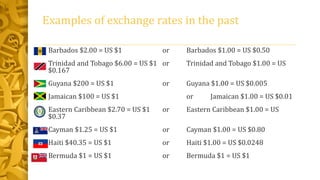
• Barbados $2.00 = US $1 or Barbados $1.00 = US $0.50
• Trinidad and Tobago $6.00 = US $1 or Trinidad and Tobago $1.00 = US
$0.167
• Guyana $200 = US $1 or Guyana $1.00 = US $0.005
• Jamaican $100 = US $1 or Jamaican $1.00 = US $0.01
• Eastern Caribbean $2.70 = US $1 or Eastern Caribbean $1.00 = US
$0.37
• Cayman $1.25 = US $1 or Cayman $1.00 = US $0.80
• Haiti $40.35 = US $1 or Haiti $1.00 = US $0.0248
• Bermuda $1 = US $1 or Bermuda $1 = US $1
What is an exchange rate Regime?
• This is a system that determines
the value of a domestic currency
in terms of foreign currencies.
• There are THREE types of
regimes.
Shall we
dance?
Floating
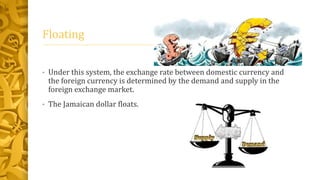
• Under this system, the exchange rate between domestic currency and
the foreign currency is determined by the demand and supply in the
foreign exchange market.
• The Jamaican dollar floats.
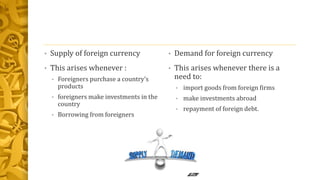
• Demand for foreign currency
• This arises whenever there is a
need to:
• import goods from foreign firms
• make investments abroad
• repayment of foreign debt.
• Supply of foreign currency
• This arises whenever :
• Foreigners purchase a country’s
products
• foreigners make investments in the
country
• Borrowing from foreigners
Fixed (or pegged)
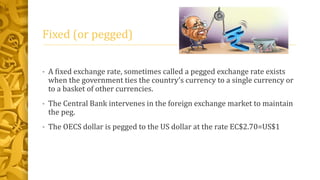
• A fixed exchange rate, sometimes called a pegged exchange rate exists
when the government ties the country’s currency to a single currency or
to a basket of other currencies.
• The Central Bank intervenes in the foreign exchange market to maintain
the peg.
• The OECS dollar is pegged to the US dollar at the rate EC$2.70=US$1
Managed float
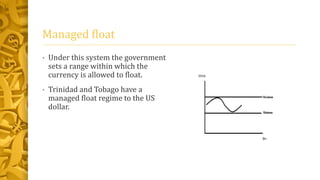
• Under this system the government
sets a range within which the
currency is allowed to float.
• Trinidad and Tobago have a
managed float regime to the US
dollar.
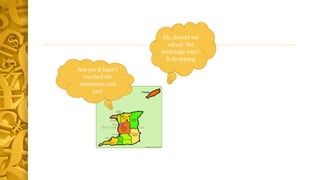
Eh, should we
adjust the
exchange rate?
It dropping
Not yet it hasn’t
reached the
minimum rate
yet!

Exchange rate regimes

  • 1.
  • 2.
    Examples of exchangerates in the past • Barbados $2.00 = US $1 or Barbados $1.00 = US $0.50 • Trinidad and Tobago $6.00 = US $1 or Trinidad and Tobago $1.00 = US $0.167 • Guyana $200 = US $1 or Guyana $1.00 = US $0.005 • Jamaican $100 = US $1 or Jamaican $1.00 = US $0.01 • Eastern Caribbean $2.70 = US $1 or Eastern Caribbean $1.00 = US $0.37 • Cayman $1.25 = US $1 or Cayman $1.00 = US $0.80 • Haiti $40.35 = US $1 or Haiti $1.00 = US $0.0248 • Bermuda $1 = US $1 or Bermuda $1 = US $1
  • 3.
    What is anexchange rate Regime? • This is a system that determines the value of a domestic currency in terms of foreign currencies. • There are THREE types of regimes. Shall we dance?
  • 4.
    Floating • Under thissystem, the exchange rate between domestic currency and the foreign currency is determined by the demand and supply in the foreign exchange market. • The Jamaican dollar floats.
  • 5.
    • Demand forforeign currency • This arises whenever there is a need to: • import goods from foreign firms • make investments abroad • repayment of foreign debt. • Supply of foreign currency • This arises whenever : • Foreigners purchase a country’s products • foreigners make investments in the country • Borrowing from foreigners
  • 6.
    Fixed (or pegged) •A fixed exchange rate, sometimes called a pegged exchange rate exists when the government ties the country’s currency to a single currency or to a basket of other currencies. • The Central Bank intervenes in the foreign exchange market to maintain the peg. • The OECS dollar is pegged to the US dollar at the rate EC$2.70=US$1
  • 7.
    Managed float • Underthis system the government sets a range within which the currency is allowed to float. • Trinidad and Tobago have a managed float regime to the US dollar.
  • 8.
    Eh, should we adjustthe exchange rate? It dropping Not yet it hasn’t reached the minimum rate yet!

Editor's Notes

  • #4 http://4.bp.blogspot.com/-9ML5YHyrVLw/VLsc8pZkDEI/AAAAAAAAB1A/_uZTYjjGcMU/s1600/vectorstock-20418-yuan-and-dollar-dance-vector.jpg
  • #5 Top http://4.bp.blogspot.com/-VttPV_tV3eA/VBVJgAXtgNI/AAAAAAAAEjM/tpktoyBlCQw/s1600/Floating%2BExchange%2BRate.png Bottom http://i.investopedia.com/dimages/graphics/floating_exchange_rate.png