IFS Presentation Stephan Tromp IFS Managing Director NRA Conference,  Atlanta, 22.10.2008
Content Introduction & IFS Organisation Position of IFS in the Supply Chain IFS Content IFS eTools Next Steps
Introduction & IFS Organisation
Goals of the IFS A common food safety standard with an uniform evaluation system Cost reduction for both retailers (wholesalers) and suppliers Reduction of the amount of audits per year -> one audit done by an approved IFS auditor -> accepted by everybody Accreditation of qualified certification bodies and approval of competent auditors Strong enforcement of food law (Traceability/ GMO/ Allergene e.g.)
Who we are IFS Board Responsible for the strategic development of the IFS Standards IFS Working Group Responsible for the content development of the IFS Standards and the IFS Auditor examination processes   IFS Management Responsible for the continuous development and the international recognition of the Standards 4.   IFS Offices Berlin, Paris, Mailand
IFS - A retailer network Germany France Italy IFS 2004 IFS  2007 IFS 2003 Poland Austria Switzerland Spain Half of retailers working with IFS  Others supporting auditor  qualification  process 140 retailer have access to the IFS database
Retailers German, French and Italian retailers and wholesalers Furthermore a lot of other retailers accept IFS: Migros ( Switzerland),  COOP ( Switzerland)  Spar ( Austria and Hungary),  Billa ( Austria) Members of POHID (Polish Retail Organisation) Eroski (Spain), Woolworth ( South Africa),  Superunie ( The Netherlands), AHOLD (The Netherlands), Wal-Mart (USA), Tesco (UK), Delhaize (Belgium) etc. 9 of the 10 biggest European retailers are present in the IFS working groups and support the IFS!
> 9.500 IFS certificates through 65 CB’s and over 730 approved auditors. North America 50 South America 400 Africa 100 Asia 800 Europe 8.500 Status 02/2008 France 1250 Germany 3000 Italy 1250 IFS is based in Europe but used worldwide
IFS more than a food safety standard Match completely   concerning food safety and quality customer satisfaction assessment, research and development, good manufacturing, hygienic aspects, traceability, GMO, allergen,  packaging material Describes a specific level which is to fulfil  Implement EU-food-legislation – one of the strongest food law worldwide Standard is designed to fit the customers demands
IFS is a managed standard Contract with every IFS certification body Checking the qualification of every auditor every two years Uniform report saves time and money Quick adoption of new regulation and customer requirements possible World wide audits in the native language most available eTools (Database, Software, eLearning)
2. Position of IFS in the Supply Chain
Work flow at the supply chain PRE- FARM GATE POST FARM GATE Growers Farmers Food Packing and Processing Retail Stores Consumers REQUIREMENTS
Quality Assurance System Safety is only one part in the definition of quality, fulfillment of fitness for use criteria, sustainable and ethical aspects are requested by customer A vertical integrated Quality Assurance System - from farm to fork -  is the backbone of any efficient QA network International (horizontal) comparability must be secured by an International Audit Standard Traceability „from the table to the stable“ is needed for transparency
IFS in the supply chain IFS Food:  Post-Farm     Food-Production GlobalG.A.P.: Pre-Farm Farm Production Packaging IFS Logistics:    Transport / Storage Logistic Outlets IFS Food Guideline Wholesale:    C&C-markets Quelle: METRO Group
Current Situation Horizontal Food Safety-Standards  GlobalG.A.P. (PreFarm),  IFS, BRC, SQF (PostFarm) etc. Vertical QS-Systems  QS, KAT/GGE etc.  Interests and main goals are the same  Ensure food safety Adopting retail requirements (no competition area) Double efforts Checks and audits Development and meetings
Horizontal  &  vertical qualitysystems Meat Fruit and vegetables Egg Poultry and   rabbit Prozess 1 Prozess 2 Prozess 3 Prozess 4 Production Retail TRANSPORT Post-Farm Gate Pre-Farm Gate Quelle: METRO Group
3. IFS Standard
IFS Standard Part 1: Audit Protocol Type of audits, Certification process, Scoring of requirements, Major, KO, Audit frequency, IFS Food versus IFS Logistic, Product categories Part 2: Requirements 251 requirements diveded in five chapters Part 3:  Requirements for accreditation bodies,    certification bodies and auditors Part 4: Layout auditreport and action plan
Number of requirements IFS 5 251 Only one checklist  no subdivision   in  foundation level,  higher level  or recommendations
Scoring of requirements The auditor shall explain all scorings with B, C and D in the audit report. When the auditor decides that a requirement is not applicable, then: N/A: Not applicable, with a short explanation Only one level of requirements :  no different checklists for foundation, higher or recommendation levels Result  Explanation  Points A  Full compliance  20 points B (deviation) Almost full compliance  15 points C (deviation)  Small part of the requirement has been implemented  5 points D (deviation) Requirement has not been implemented  0 points
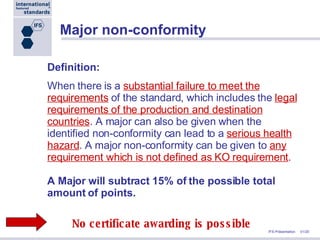
Major non-conformity Definition: When there is a  substantial failure to meet the requirements  of the standard, which includes the  legal requirements of the production and destination countries . A major can also be given when the identified non-conformity can lead to a  serious health hazard . A major non-conformity can be given to  any requirement which is not defined as KO requirement . A Major will subtract 15% of the possible total amount of points. No certificate awarding is possible
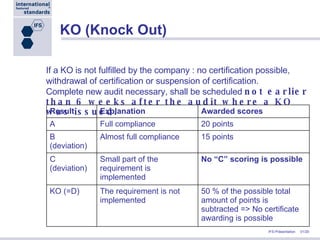
KO (Knock Out) If a KO is not fulfilled by the company : no certification possible, withdrawal of certification or suspension of certification.  Complete new audit necessary, shall be scheduled  not earlier than 6 weeks after the audit where a KO was issued.   Result  Explanation  Awarded scores A  Full compliance  20 points  B (deviation) Almost full compliance  15 points  C (deviation) Small part of the requirement is implemented  No “C” scoring is possible KO (=D) The requirement is not implemented  50 % of the possible total amount of points is subtracted => No certificate awarding is possible
KO (Knock Out) KO-Requirements in the IFS Food, Version 5 1.2.4 Corporate structure and processes – responsibility of the senior management 2.1.3.8 HACCP analyse – monitoring system of each CCP 3.2.1.2 Personnel hygiene 4.2.2 Raw material specifications 4.2.3 Finished products (recipe) specifications 4.9.1 Foreign bodies management 4.16.1 Traceability (including GMO and allergens) – Traceability system  5.1.1 Internal audit 5.9.2 Crisis management procedure (recall/withdrawal) 5.11.2 Corrective actions
Handling of non conformities Non conformities : KOs (no certification possible) Majors non conformities (no certification possible / if only one to be solved before certification) All others deviations : to be solved till next IFS audit latest  action plan (with corrective actions, deadlines and responsibilities) to be approved by CB (on IFS database)
Scoring, Conditions for issuing audit report and certificate Non conformities  Status Action company Report form Certificate Total score is  ≥  75 and < 95% of total amount of points Approved at Foundation IFS Food level after reception of the action plans Send action plan within 2 weeks of receiving the preliminarily report. Report including action plan gives status Yes, certificate at foundation level,  12 months validity Total score is ≥ 95% of total amount of points Approved at higher IFS Food level after reception of the action plan Send action plan within 2 weeks of receiving the preliminarily report. Report including action plan gives status Yes, certificate at higher level,  12 months validity
Part 2: Requirements IFS 5 1. Senior management responsibility 2. Quality management system  3. Resource management 4. Production process 5. Measures, analysis, improvements Food safety I F S
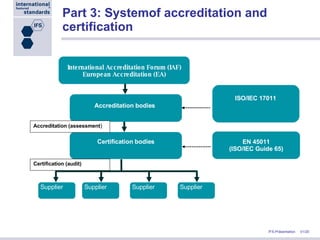
International Accreditation Forum (IAF) European Accreditation (EA) Part 3: Systemof accreditation and certification Accreditation bodies ISO/IEC 17011 EN 45011 (ISO/IEC Guide 65) Certification bodies Supplier Supplier Supplier Supplier Accreditation (assessment ) Certification (audit)
Requirements for auditors by application Requirements Explanations/remarks Education and min. experience 4 possibilities General audit experience ≥ 10 complete audits in the food processing industry in different companies / past 2 years Food hygiene training Qualified  training on the basis of the Codex General Principles for Food Hygiene (including HACCP) Quality assurance and quality management knowledge Practical experience (during job experience) and/or theoretical skills (recognised training, part of the university degree, etc.) Specific and practical knowledge for each applied product scope 10 audits under 45011 accreditation and/or second party audits for retailers per scope  or  2 years professional experience for the scope Language Native language and other language(s) (details of experience shall be provided In-house training Participation at an IFS in-house training provided by the certification body
4. IFS eTools
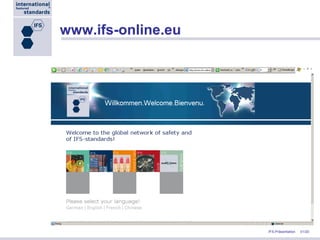
www.ifs-online.eu
IFS eTools IFS-Auditportal Industry Sector CB Sector Retail Sector Industry AuditXpress with additional checklists QS/GGE/GlobalGap CB Version Industry Version CB Retailer XML-Interface KAT QS Others Research check status of their suppliers and reports  (my audit) statistics online available responsible for company data and audit report  Data exchange between IFS and different standards  I nternal audits are analysed by AuditXpress industry AuditXpress CB-file could use as benchmark but not change CB use Auditxpress-CB to made auditreport Final audit report has to be uploaded into the database as PDF and as AuditXpress CB-file only by CB Verification of their own certification status Own management tool to check the certification status / report of their subcontractors Can upload certificates from other standards Direct link with other standards and their data Retailer can ask for access to the full audit report Industry decides to give or give not  Reports available as PDF or original AuditXpress CB-file Auditors
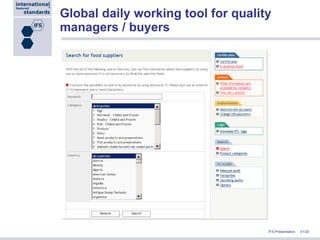
Global daily working tool for quality managers / buyers
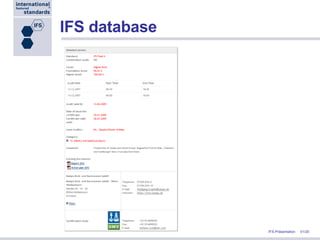
IFS database
IFS software Uniform audit reports and data Software Update IFS Food Version 5 Software Update IFS Logistic
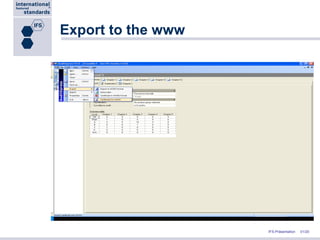
Export to the www
5. Next steps
Next steps Development of guidelines for wholesalers (C&C) Separate IFS standard for brokers Review of the IFS Logistic Standard Further expansion of the IFS retailer network Cooperation with further countries and their retailer  federations Cooperation with the European Egg Consortium Development of IFS “House and personal care  products”
Thank you for your attention !   Contact: Mr. Stephan Tromp General Manager IFS Phone: 0049-(0)30-726-250-70 Fax: 0049-(0)30-726-250-79 E-Mail:  [email_address] www.ifs-online.eu

International Featured Standards Presentation

  • 1.
    IFS Presentation StephanTromp IFS Managing Director NRA Conference, Atlanta, 22.10.2008
  • 2.
    Content Introduction &IFS Organisation Position of IFS in the Supply Chain IFS Content IFS eTools Next Steps
  • 3.
    Introduction & IFSOrganisation
  • 4.
    Goals of theIFS A common food safety standard with an uniform evaluation system Cost reduction for both retailers (wholesalers) and suppliers Reduction of the amount of audits per year -> one audit done by an approved IFS auditor -> accepted by everybody Accreditation of qualified certification bodies and approval of competent auditors Strong enforcement of food law (Traceability/ GMO/ Allergene e.g.)
  • 5.
    Who we areIFS Board Responsible for the strategic development of the IFS Standards IFS Working Group Responsible for the content development of the IFS Standards and the IFS Auditor examination processes IFS Management Responsible for the continuous development and the international recognition of the Standards 4. IFS Offices Berlin, Paris, Mailand
  • 6.
    IFS - Aretailer network Germany France Italy IFS 2004 IFS 2007 IFS 2003 Poland Austria Switzerland Spain Half of retailers working with IFS Others supporting auditor qualification process 140 retailer have access to the IFS database
  • 7.
    Retailers German, Frenchand Italian retailers and wholesalers Furthermore a lot of other retailers accept IFS: Migros ( Switzerland), COOP ( Switzerland) Spar ( Austria and Hungary), Billa ( Austria) Members of POHID (Polish Retail Organisation) Eroski (Spain), Woolworth ( South Africa), Superunie ( The Netherlands), AHOLD (The Netherlands), Wal-Mart (USA), Tesco (UK), Delhaize (Belgium) etc. 9 of the 10 biggest European retailers are present in the IFS working groups and support the IFS!
  • 8.
    > 9.500 IFScertificates through 65 CB’s and over 730 approved auditors. North America 50 South America 400 Africa 100 Asia 800 Europe 8.500 Status 02/2008 France 1250 Germany 3000 Italy 1250 IFS is based in Europe but used worldwide
  • 9.
    IFS more thana food safety standard Match completely concerning food safety and quality customer satisfaction assessment, research and development, good manufacturing, hygienic aspects, traceability, GMO, allergen, packaging material Describes a specific level which is to fulfil Implement EU-food-legislation – one of the strongest food law worldwide Standard is designed to fit the customers demands
  • 10.
    IFS is amanaged standard Contract with every IFS certification body Checking the qualification of every auditor every two years Uniform report saves time and money Quick adoption of new regulation and customer requirements possible World wide audits in the native language most available eTools (Database, Software, eLearning)
  • 11.
    2. Position ofIFS in the Supply Chain
  • 12.
    Work flow atthe supply chain PRE- FARM GATE POST FARM GATE Growers Farmers Food Packing and Processing Retail Stores Consumers REQUIREMENTS
  • 13.
    Quality Assurance SystemSafety is only one part in the definition of quality, fulfillment of fitness for use criteria, sustainable and ethical aspects are requested by customer A vertical integrated Quality Assurance System - from farm to fork - is the backbone of any efficient QA network International (horizontal) comparability must be secured by an International Audit Standard Traceability „from the table to the stable“ is needed for transparency
  • 14.
    IFS in thesupply chain IFS Food: Post-Farm  Food-Production GlobalG.A.P.: Pre-Farm Farm Production Packaging IFS Logistics:  Transport / Storage Logistic Outlets IFS Food Guideline Wholesale:  C&C-markets Quelle: METRO Group
  • 15.
    Current Situation HorizontalFood Safety-Standards GlobalG.A.P. (PreFarm), IFS, BRC, SQF (PostFarm) etc. Vertical QS-Systems QS, KAT/GGE etc. Interests and main goals are the same Ensure food safety Adopting retail requirements (no competition area) Double efforts Checks and audits Development and meetings
  • 16.
    Horizontal & vertical qualitysystems Meat Fruit and vegetables Egg Poultry and rabbit Prozess 1 Prozess 2 Prozess 3 Prozess 4 Production Retail TRANSPORT Post-Farm Gate Pre-Farm Gate Quelle: METRO Group
  • 17.
  • 18.
    IFS Standard Part1: Audit Protocol Type of audits, Certification process, Scoring of requirements, Major, KO, Audit frequency, IFS Food versus IFS Logistic, Product categories Part 2: Requirements 251 requirements diveded in five chapters Part 3: Requirements for accreditation bodies, certification bodies and auditors Part 4: Layout auditreport and action plan
  • 19.
    Number of requirementsIFS 5 251 Only one checklist no subdivision in foundation level, higher level or recommendations
  • 20.
    Scoring of requirementsThe auditor shall explain all scorings with B, C and D in the audit report. When the auditor decides that a requirement is not applicable, then: N/A: Not applicable, with a short explanation Only one level of requirements : no different checklists for foundation, higher or recommendation levels Result Explanation Points A Full compliance 20 points B (deviation) Almost full compliance 15 points C (deviation) Small part of the requirement has been implemented 5 points D (deviation) Requirement has not been implemented 0 points
  • 21.
    Major non-conformity Definition:When there is a substantial failure to meet the requirements of the standard, which includes the legal requirements of the production and destination countries . A major can also be given when the identified non-conformity can lead to a serious health hazard . A major non-conformity can be given to any requirement which is not defined as KO requirement . A Major will subtract 15% of the possible total amount of points. No certificate awarding is possible
  • 22.
    KO (Knock Out)If a KO is not fulfilled by the company : no certification possible, withdrawal of certification or suspension of certification. Complete new audit necessary, shall be scheduled not earlier than 6 weeks after the audit where a KO was issued. Result Explanation Awarded scores A Full compliance 20 points B (deviation) Almost full compliance 15 points C (deviation) Small part of the requirement is implemented No “C” scoring is possible KO (=D) The requirement is not implemented 50 % of the possible total amount of points is subtracted => No certificate awarding is possible
  • 23.
    KO (Knock Out)KO-Requirements in the IFS Food, Version 5 1.2.4 Corporate structure and processes – responsibility of the senior management 2.1.3.8 HACCP analyse – monitoring system of each CCP 3.2.1.2 Personnel hygiene 4.2.2 Raw material specifications 4.2.3 Finished products (recipe) specifications 4.9.1 Foreign bodies management 4.16.1 Traceability (including GMO and allergens) – Traceability system 5.1.1 Internal audit 5.9.2 Crisis management procedure (recall/withdrawal) 5.11.2 Corrective actions
  • 24.
    Handling of nonconformities Non conformities : KOs (no certification possible) Majors non conformities (no certification possible / if only one to be solved before certification) All others deviations : to be solved till next IFS audit latest action plan (with corrective actions, deadlines and responsibilities) to be approved by CB (on IFS database)
  • 25.
    Scoring, Conditions forissuing audit report and certificate Non conformities Status Action company Report form Certificate Total score is ≥ 75 and < 95% of total amount of points Approved at Foundation IFS Food level after reception of the action plans Send action plan within 2 weeks of receiving the preliminarily report. Report including action plan gives status Yes, certificate at foundation level, 12 months validity Total score is ≥ 95% of total amount of points Approved at higher IFS Food level after reception of the action plan Send action plan within 2 weeks of receiving the preliminarily report. Report including action plan gives status Yes, certificate at higher level, 12 months validity
  • 26.
    Part 2: RequirementsIFS 5 1. Senior management responsibility 2. Quality management system 3. Resource management 4. Production process 5. Measures, analysis, improvements Food safety I F S
  • 27.
    International Accreditation Forum(IAF) European Accreditation (EA) Part 3: Systemof accreditation and certification Accreditation bodies ISO/IEC 17011 EN 45011 (ISO/IEC Guide 65) Certification bodies Supplier Supplier Supplier Supplier Accreditation (assessment ) Certification (audit)
  • 28.
    Requirements for auditorsby application Requirements Explanations/remarks Education and min. experience 4 possibilities General audit experience ≥ 10 complete audits in the food processing industry in different companies / past 2 years Food hygiene training Qualified training on the basis of the Codex General Principles for Food Hygiene (including HACCP) Quality assurance and quality management knowledge Practical experience (during job experience) and/or theoretical skills (recognised training, part of the university degree, etc.) Specific and practical knowledge for each applied product scope 10 audits under 45011 accreditation and/or second party audits for retailers per scope or 2 years professional experience for the scope Language Native language and other language(s) (details of experience shall be provided In-house training Participation at an IFS in-house training provided by the certification body
  • 29.
  • 30.
  • 31.
    IFS eTools IFS-AuditportalIndustry Sector CB Sector Retail Sector Industry AuditXpress with additional checklists QS/GGE/GlobalGap CB Version Industry Version CB Retailer XML-Interface KAT QS Others Research check status of their suppliers and reports (my audit) statistics online available responsible for company data and audit report Data exchange between IFS and different standards I nternal audits are analysed by AuditXpress industry AuditXpress CB-file could use as benchmark but not change CB use Auditxpress-CB to made auditreport Final audit report has to be uploaded into the database as PDF and as AuditXpress CB-file only by CB Verification of their own certification status Own management tool to check the certification status / report of their subcontractors Can upload certificates from other standards Direct link with other standards and their data Retailer can ask for access to the full audit report Industry decides to give or give not Reports available as PDF or original AuditXpress CB-file Auditors
  • 32.
    Global daily workingtool for quality managers / buyers
  • 33.
  • 34.
    IFS software Uniformaudit reports and data Software Update IFS Food Version 5 Software Update IFS Logistic
  • 35.
  • 36.
  • 37.
    Next steps Developmentof guidelines for wholesalers (C&C) Separate IFS standard for brokers Review of the IFS Logistic Standard Further expansion of the IFS retailer network Cooperation with further countries and their retailer federations Cooperation with the European Egg Consortium Development of IFS “House and personal care products”
  • 38.
    Thank you foryour attention ! Contact: Mr. Stephan Tromp General Manager IFS Phone: 0049-(0)30-726-250-70 Fax: 0049-(0)30-726-250-79 E-Mail: [email_address] www.ifs-online.eu