Tips and Traps for SQF 7.1: Understanding
NonTop 10 Non-conformances
Bill McBride
13 November, 2013
General Disclaimer
Opinions expressed by or on behalf of SAI Global published through MyTutor or
presented during MyTutor live webinars is provided as general guidance only
and does not amount to formal legal or other professional advice. SAI Global
does not warrant the accuracy or completeness of information given or its
fitness for any particular purpose. To the extent permitted by law SAI Global
accepts no liability for any claims for loss or damage whether caused by its
negligence (or that of any of its agents or employees) or otherwise. For full
terms and conditions of use, please visit www.saiglobal.com/terms
Introductions
• Based in Sydney, Australia
• Asia Pacific Representative for SQF
program
• Chairman of the GFSI Auditor Competence
Scheme Committee
• CEO of Foodlink Management Services
since 1998
• Forty years experience in food and
beverage manufacturing, quality
management, food safety systems.
3
Agenda
• Welcome and Introductions
• The relationship between SQFI and GFSI
• The difference between the SQF Code, edition 7 and
earlier versions
• Top Non-conformances (NCRs), module 2 and module 11
• Common themes in NCRs:
• Management Responsibility
• Business Continuity Planning
• Food Safety Plan
• Internal Audits
• Corrective and Preventative Action

• Tips for Compliance
• Q&A
GFSI Mission and Objectives
Provide continuous improvement in food safety
management systems to ensure confidence in the
delivery of safe food to consumers worldwide
Reduce Food Safety
Risks

Manage Cost in the
Supply Chain

Develop
Competencies and
Capacity Building

Knowledge
Exchange and
Networking
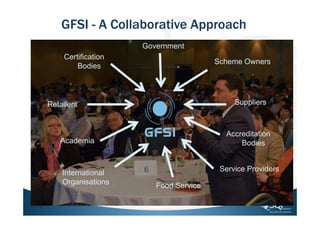
GFSI - A Collaborative Approach
Government
Certification
Bodies

Scheme Owners

Suppliers

Retailers

Accreditation
Bodies

Academia

International
Organisations

Service Providers
Food Service
The GFSI Guidance Document
multiA multi-stakeholder document that:

›

Sets out the requirements for food
safety management schemes and the
key elements for the production of
food, feed, packaging, etc

›

Provides guidance to schemes seeking
compliance with the GFSI Guidance
Document and recognition by the GFSI

›

Defines the requirements for the
effective management and control of
conforming schemes

›

Puts in place transparent procedures
for the GFSI benchmarking process
SQF Code Revision
The publication of edition
6 of the GFSI Guidance
Documented presented
SQFI with a challenge,
and an opportunity to
review the SQF 2000 and
SQF 1000 Codes and
revise as necessary
before resubmission
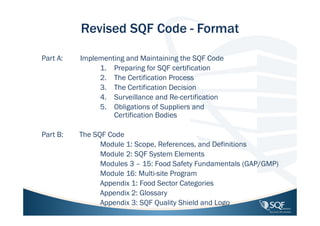
Revised SQF Code - Format
Part A:

Implementing and Maintaining the SQF Code
1. Preparing for SQF certification
2. The Certification Process
3. The Certification Decision
4. Surveillance and Re-certification
5. Obligations of Suppliers and
Certification Bodies

Part B:

The SQF Code
Module 1: Scope, References, and Definitions
Module 2: SQF System Elements
Modules 3 – 15: Food Safety Fundamentals (GAP/GMP)
Module 16: Multi-site Program
Appendix 1: Food Sector Categories
Appendix 2: Glossary
Appendix 3: SQF Quality Shield and Logo
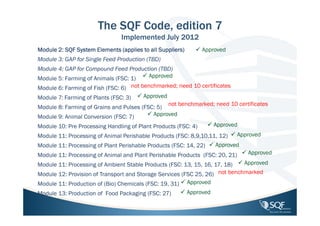
The SQF Code, edition 7
Implemented July 2012
Module 2: SQF System Elements (applies to all Suppliers)

Approved

Module 3: GAP for Single Feed Production (TBD)
Module 4: GAP for Compound Feed Production (TBD)
Approved
Module 5: Farming of Animals (FSC: 1)
Module 6: Farming of Fish (FSC: 6) not benchmarked; need 10 certificates
Approved
Module 7: Farming of Plants (FSC: 3)
not benchmarked; need 10 certificates
Module 8: Farming of Grains and Pulses (FSC: 5)
Approved
Module 9: Animal Conversion (FSC: 7)
Module 10: Pre Processing Handling of Plant Products (FSC: 4)

Approved

Approved
Module 11: Processing of Animal Perishable Products (FSC: 8,9,10,11, 12)
Approved
Module 11: Processing of Plant Perishable Products (FSC: 14, 22)
Approved
Module 11: Processing of Animal and Plant Perishable Products (FSC: 20, 21)
Approved
Module 11: Processing of Ambient Stable Products (FSC: 13, 15, 16, 17, 18)
Module 12: Provision of Transport and Storage Services (FSC 25, 26) not benchmarked
Module 11: Production of (Bio) Chemicals (FSC: 19, 31)

Approved

Module 13: Production of Food Packaging (FSC: 27)

Approved
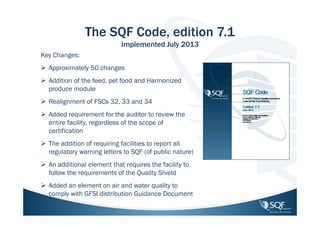
The SQF Code, edition 7.1
Implemented July 2013
Key Changes:
Approximately 50 changes
Addition of the feed, pet food and Harmonized
produce module
Realignment of FSCs 32, 33 and 34
Added requirement for the auditor to review the
entire facility, regardless of the scope of
certification
The addition of requiring facilities to report all
regulatory warning letters to SQF (of public nature)
An additional element that requires the facility to
follow the requirements of the Quality Shield
Added an element on air and water quality to
comply with GFSI distribution Guidance Document
The SQF Code, edition 7.1
Implemented July 2013
Module 2: SQF System Elements (applies to all Suppliers)
Module 3: GMP for Animal Feed Production(FSC: 34)

Submitted to GFSI for benchmarking

Module 4: GMP for Processing of Pet Food (FSC: 32)

Submitted to GFSI for benchmarking

Module 5: Farming of Animals (FSC: 1)
Module 6: Farming of Fish (FSC: 6)
Module 7: Farming of Plants (FSC: 3)
Module 7H: Farming of Plants (FSC: 3)

Preparing to submit to GFSI

Module 8: Farming of Grains and Pulses (FSC: 5)
Module 9: Animal Conversion (FSC: 7)
Module 10: Pre Processing Handling of Plant Products (FSC: 4)
Module 11: Processing of Animal Perishable Products (FSC: 8,9,10,11, 12)
Module 11: Processing of Plant Perishable Products (FSC: 14, 22)
Module 11: Processing of Animal and Plant Perishable Products (FSC: 20, 21)
Module 11: Processing of Ambient Stable Products (FSC: 13, 15, 16, 17, 18)
Module 12: Provision of Transport and Storage Services (FSC 25, 26)
Module 11: Production of (Bio) Chemicals (FSC: 19, 31)
Module 13: Production of Food Packaging (FSC: 27)

Preparing to submit to GFSI
Modules in Development
• Module 14 GMP for Food Brokers (FSC 35)*
• Module 15 GMP for Retail (FSC 24)*
• * GFSI recognition will only apply once GFSI Guidance is
available for these sectors, and SQFI has requested an
extension
Top Non-Conformances
Certification Audits
Module 2
2.1.6.1 Business Continuity Planning
2.3.2.1 Raw and Packaging
Materials
2.1.2.1 Management Responsibility
2.3.3.1 Contract Service Providers
2.5.7.1 Internal Audits
2.5.2.1 Validation and Effectiveness
2.3.1.4 Specification and Product
Development
2.8.2.1 Allergen Management
2.1.2.5 SQF Practitioner
2.4.5.4 Incoming Goods and Service

Module 11
11.2.13 Cleaning and sanitation
11.7.5. Control of Foreign Matter
Contamination
11.2.3 Walls, Partitions, Doors and
Ceilings
11.2.12 Equipment, Utensils and
Protective Clothing
11.2.9 Premises and Equipment
Maintenance
11.6.1. Cold Storage, Freezing and
Chilling of Foods

15
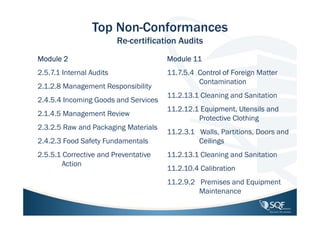
Top Non-Conformances
Re-certification Audits
Module 2

Module 11

2.5.7.1 Internal Audits

11.7.5.4 Control of Foreign Matter
Contamination

2.1.2.8 Management Responsibility
2.4.5.4 Incoming Goods and Services
2.1.4.5 Management Review
2.3.2.5 Raw and Packaging Materials
2.4.2.3 Food Safety Fundamentals
2.5.5.1 Corrective and Preventative
Action

11.2.13.1 Cleaning and Sanitation
11.2.12.1 Equipment, Utensils and
Protective Clothing
11.2.3.1 Walls, Partitions, Doors and
Ceilings
11.2.13.1 Cleaning and Sanitation
11.2.10.4 Calibration
11.2.9.2 Premises and Equipment
Maintenance
16
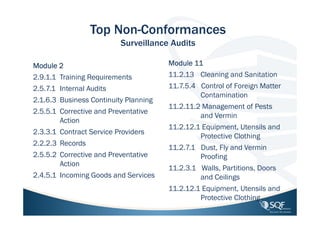
Top Non-Conformances
Surveillance Audits
Module 2
2.9.1.1 Training Requirements
2.5.7.1 Internal Audits
2.1.6.3 Business Continuity Planning
2.5.5.1 Corrective and Preventative
Action
2.3.3.1 Contract Service Providers
2.2.2.3 Records
2.5.5.2 Corrective and Preventative
Action
2.4.5.1 Incoming Goods and Services

Module 11
11.2.13 Cleaning and Sanitation
11.7.5.4 Control of Foreign Matter
Contamination
11.2.11.2 Management of Pests
and Vermin
11.2.12.1 Equipment, Utensils and
Protective Clothing
11.2.7.1 Dust, Fly and Vermin
Proofing
11.2.3.1 Walls, Partitions, Doors
and Ceilings
11.2.12.1 Equipment, Utensils and
Protective Clothing
17
Common Themes– All Audit Types
Module 2

Module 11

• Management Responsibility

• Cleaning and Sanitation

• Business Continuity Planning

• Control of Foreign Matter
Contamination

• Food Safety Plan
• Internal Audits

• Equipment, Utensils and
Protective Clothing

• Corrective and Preventative
Action

• Walls, Partitions, Doors and
Ceilings

18
Management Responsibility and SQF
Certification
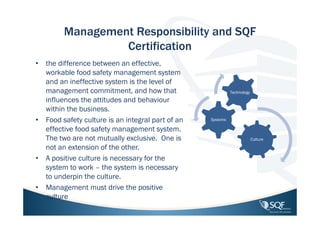
• the difference between an effective,
workable food safety management system
and an ineffective system is the level of
management commitment, and how that
influences the attitudes and behaviour
within the business.
• Food safety culture is an integral part of an
effective food safety management system.
The two are not mutually exclusive. One is
not an extension of the other.
• A positive culture is necessary for the
system to work – the system is necessary
to underpin the culture.
• Management must drive the positive
culture

Technology

Systems

Culture
2.1.2 Management Responsibility
•

……. organisational structure describing those with
responsibility for food safety ……..

•

……. ensure fundamental food safety practices are adopted
and maintained ……

•

……. ensure adequate resources are available ……

•

……. designate an SQF Practitioner ……..

•

……. establish (food safety) training needs …….

•

……. continuous improvement …….

20
2.1.6 Business Continuity Planning
2.1.6.1 A business continuity plan based on the
understanding of known threats to a business shall be
prepared by senior management outlining the methods and
responsibility the organization will implement to cope with a
business crisis that may impact on the ability of the supplier to
deliver safe, quality food.
2.4 Attaining Food Safety
2.4.1 Food Legislation
• The organization shall ensure that, at the time of delivery to its customer,
the food supplied shall comply with the legislation that applies to the food
and its production in the country of its origin and destination……

2.4.2 Food Safety Fundamentals
• The supplier shall ensure the food safety fundamentals described in the
relevant subsequent modules of this Code (eg module 11) are applied, or
excluded according to a detailed risk analysis outlining the justification
for exclusion or evidence of the effectiveness of alternative control
measures to ensure that food safety is not compromised.

2.4.3 Food Safety Plan (Level 2)
• A food safety plan shall be developed, effectively implemented, and
maintained and outline the means by which the organization controls and
assures food safety.

2.4.4 Food Quality Plan (Level 3)
• A food quality plan shall be developed, effectively implemented, and
maintained in accordance with the HACCP method.
2.5.7 Internal Audits
• Methods and responsibilities for scheduling and conducting
internal audits to verify the effectiveness of the SQF system
including facility and equipment inspections, PRPs, food
safety plans, food quality plans, and regulation controls shall
be documented and implemented
o An internal audit schedule with scope and frequency
o Corrections and corrective actions of deficiencies
o Audit results are communicated to relevant management and staff
o Records of internal audits and corrective actions

• Staff conducting internal audits shall be trained in internal
audit procedures
Benefits of a Strong Internal Audit Program
• Drives continuous
improvement
• Promotes ownership of the
entire SQF system
• Promotes a food safety
culture within your
organization
• Adds credibility to the audit
results
• Improves the audit score!
Challenges to an Internal Audit Program
• Management commitment – if leaders do
not take your results seriously, no one else
will
• Time management- letting issues pull you
away from audit schedule or issuance of
report
• Conflict resolution – you and the plant
manager can never seem to see eye to
eye…
• Bias – who audits you? Who can review the
quality programs?
• Ignoring previous issues for information –
findings should be what is found during the
audit only, not what was observed earlier
5 Keys to Successful Internal Audit Programs
1. Define objectives of the Internal Audit Program
with management to facilitate management
commitment
2. Formalize the audit process
3. Communicate well
4. Manage Internal Audits as its own program
5. Use correction action management program
(2.5.5) to manage and resolve internal audit
findings
Tips for Compliance
• How can a facility improve their audit performance?
– Implement effective training programs
– Know the standard and any updates
– Conduct validation activities
– Review facility condition
– Maintain records
– Conduct internal audits
Summary
Ensure you have knowledge of the SQF Code. Edition 7.1,
and how to implement it.
Keep it simple. Don’t drown in paperwork.
Have a strong internal audit program. Take it seriously.
System implementation and maintenance must be a team
approach.
Success can be achieved through diligence, awareness
and commitment from all levels of the organization.
SQF Technical Contacts
North America
LeAnn Chuboff
Senior Technical Director
lchuboff@sqfi.com
Kristie A. Grzywinski
Technical Manager
kgrzywinski@sqfi.com
Melody Ge
Compliance Specialist
mge@sqfi.com

Australia, Asia
Bill McBride
Asia Pacific Representative
bmcbride@sqfi.com.au

General Info
info@sqfi.com
Questions and discussion
Upcoming “SQF Implementation” dates
2013
Melbourne - 25 & 26 November
2014
Parramatta – 10 & 11 March
Melbourne – 24 & 25 March
Call 1300 727 444 for further information
Thank you for attending

A recording of this webinar and unanswered questions
will be available on the SAI Global ‘MyTutor’ portal
• Visit saiglobal-mytutor.com
• Call 1300 727 444
• Email training@saiglobal.com

Tips and Traps for SQF 7.1: Understanding Top 10 Non-conformances

  • 1.
    Tips and Trapsfor SQF 7.1: Understanding NonTop 10 Non-conformances Bill McBride 13 November, 2013
  • 2.
    General Disclaimer Opinions expressedby or on behalf of SAI Global published through MyTutor or presented during MyTutor live webinars is provided as general guidance only and does not amount to formal legal or other professional advice. SAI Global does not warrant the accuracy or completeness of information given or its fitness for any particular purpose. To the extent permitted by law SAI Global accepts no liability for any claims for loss or damage whether caused by its negligence (or that of any of its agents or employees) or otherwise. For full terms and conditions of use, please visit www.saiglobal.com/terms
  • 3.
    Introductions • Based inSydney, Australia • Asia Pacific Representative for SQF program • Chairman of the GFSI Auditor Competence Scheme Committee • CEO of Foodlink Management Services since 1998 • Forty years experience in food and beverage manufacturing, quality management, food safety systems. 3
  • 4.
    Agenda • Welcome andIntroductions • The relationship between SQFI and GFSI • The difference between the SQF Code, edition 7 and earlier versions • Top Non-conformances (NCRs), module 2 and module 11 • Common themes in NCRs: • Management Responsibility • Business Continuity Planning • Food Safety Plan • Internal Audits • Corrective and Preventative Action • Tips for Compliance • Q&A
  • 5.
    GFSI Mission andObjectives Provide continuous improvement in food safety management systems to ensure confidence in the delivery of safe food to consumers worldwide Reduce Food Safety Risks Manage Cost in the Supply Chain Develop Competencies and Capacity Building Knowledge Exchange and Networking
  • 6.
    GFSI - ACollaborative Approach Government Certification Bodies Scheme Owners Suppliers Retailers Accreditation Bodies Academia International Organisations Service Providers Food Service
  • 7.
    The GFSI GuidanceDocument multiA multi-stakeholder document that: › Sets out the requirements for food safety management schemes and the key elements for the production of food, feed, packaging, etc › Provides guidance to schemes seeking compliance with the GFSI Guidance Document and recognition by the GFSI › Defines the requirements for the effective management and control of conforming schemes › Puts in place transparent procedures for the GFSI benchmarking process
  • 9.
    SQF Code Revision Thepublication of edition 6 of the GFSI Guidance Documented presented SQFI with a challenge, and an opportunity to review the SQF 2000 and SQF 1000 Codes and revise as necessary before resubmission
  • 10.
    Revised SQF Code- Format Part A: Implementing and Maintaining the SQF Code 1. Preparing for SQF certification 2. The Certification Process 3. The Certification Decision 4. Surveillance and Re-certification 5. Obligations of Suppliers and Certification Bodies Part B: The SQF Code Module 1: Scope, References, and Definitions Module 2: SQF System Elements Modules 3 – 15: Food Safety Fundamentals (GAP/GMP) Module 16: Multi-site Program Appendix 1: Food Sector Categories Appendix 2: Glossary Appendix 3: SQF Quality Shield and Logo
  • 11.
    The SQF Code,edition 7 Implemented July 2012 Module 2: SQF System Elements (applies to all Suppliers) Approved Module 3: GAP for Single Feed Production (TBD) Module 4: GAP for Compound Feed Production (TBD) Approved Module 5: Farming of Animals (FSC: 1) Module 6: Farming of Fish (FSC: 6) not benchmarked; need 10 certificates Approved Module 7: Farming of Plants (FSC: 3) not benchmarked; need 10 certificates Module 8: Farming of Grains and Pulses (FSC: 5) Approved Module 9: Animal Conversion (FSC: 7) Module 10: Pre Processing Handling of Plant Products (FSC: 4) Approved Approved Module 11: Processing of Animal Perishable Products (FSC: 8,9,10,11, 12) Approved Module 11: Processing of Plant Perishable Products (FSC: 14, 22) Approved Module 11: Processing of Animal and Plant Perishable Products (FSC: 20, 21) Approved Module 11: Processing of Ambient Stable Products (FSC: 13, 15, 16, 17, 18) Module 12: Provision of Transport and Storage Services (FSC 25, 26) not benchmarked Module 11: Production of (Bio) Chemicals (FSC: 19, 31) Approved Module 13: Production of Food Packaging (FSC: 27) Approved
  • 12.
    The SQF Code,edition 7.1 Implemented July 2013 Key Changes: Approximately 50 changes Addition of the feed, pet food and Harmonized produce module Realignment of FSCs 32, 33 and 34 Added requirement for the auditor to review the entire facility, regardless of the scope of certification The addition of requiring facilities to report all regulatory warning letters to SQF (of public nature) An additional element that requires the facility to follow the requirements of the Quality Shield Added an element on air and water quality to comply with GFSI distribution Guidance Document
  • 13.
    The SQF Code,edition 7.1 Implemented July 2013 Module 2: SQF System Elements (applies to all Suppliers) Module 3: GMP for Animal Feed Production(FSC: 34) Submitted to GFSI for benchmarking Module 4: GMP for Processing of Pet Food (FSC: 32) Submitted to GFSI for benchmarking Module 5: Farming of Animals (FSC: 1) Module 6: Farming of Fish (FSC: 6) Module 7: Farming of Plants (FSC: 3) Module 7H: Farming of Plants (FSC: 3) Preparing to submit to GFSI Module 8: Farming of Grains and Pulses (FSC: 5) Module 9: Animal Conversion (FSC: 7) Module 10: Pre Processing Handling of Plant Products (FSC: 4) Module 11: Processing of Animal Perishable Products (FSC: 8,9,10,11, 12) Module 11: Processing of Plant Perishable Products (FSC: 14, 22) Module 11: Processing of Animal and Plant Perishable Products (FSC: 20, 21) Module 11: Processing of Ambient Stable Products (FSC: 13, 15, 16, 17, 18) Module 12: Provision of Transport and Storage Services (FSC 25, 26) Module 11: Production of (Bio) Chemicals (FSC: 19, 31) Module 13: Production of Food Packaging (FSC: 27) Preparing to submit to GFSI
  • 14.
    Modules in Development •Module 14 GMP for Food Brokers (FSC 35)* • Module 15 GMP for Retail (FSC 24)* • * GFSI recognition will only apply once GFSI Guidance is available for these sectors, and SQFI has requested an extension
  • 15.
    Top Non-Conformances Certification Audits Module2 2.1.6.1 Business Continuity Planning 2.3.2.1 Raw and Packaging Materials 2.1.2.1 Management Responsibility 2.3.3.1 Contract Service Providers 2.5.7.1 Internal Audits 2.5.2.1 Validation and Effectiveness 2.3.1.4 Specification and Product Development 2.8.2.1 Allergen Management 2.1.2.5 SQF Practitioner 2.4.5.4 Incoming Goods and Service Module 11 11.2.13 Cleaning and sanitation 11.7.5. Control of Foreign Matter Contamination 11.2.3 Walls, Partitions, Doors and Ceilings 11.2.12 Equipment, Utensils and Protective Clothing 11.2.9 Premises and Equipment Maintenance 11.6.1. Cold Storage, Freezing and Chilling of Foods 15
  • 16.
    Top Non-Conformances Re-certification Audits Module2 Module 11 2.5.7.1 Internal Audits 11.7.5.4 Control of Foreign Matter Contamination 2.1.2.8 Management Responsibility 2.4.5.4 Incoming Goods and Services 2.1.4.5 Management Review 2.3.2.5 Raw and Packaging Materials 2.4.2.3 Food Safety Fundamentals 2.5.5.1 Corrective and Preventative Action 11.2.13.1 Cleaning and Sanitation 11.2.12.1 Equipment, Utensils and Protective Clothing 11.2.3.1 Walls, Partitions, Doors and Ceilings 11.2.13.1 Cleaning and Sanitation 11.2.10.4 Calibration 11.2.9.2 Premises and Equipment Maintenance 16
  • 17.
    Top Non-Conformances Surveillance Audits Module2 2.9.1.1 Training Requirements 2.5.7.1 Internal Audits 2.1.6.3 Business Continuity Planning 2.5.5.1 Corrective and Preventative Action 2.3.3.1 Contract Service Providers 2.2.2.3 Records 2.5.5.2 Corrective and Preventative Action 2.4.5.1 Incoming Goods and Services Module 11 11.2.13 Cleaning and Sanitation 11.7.5.4 Control of Foreign Matter Contamination 11.2.11.2 Management of Pests and Vermin 11.2.12.1 Equipment, Utensils and Protective Clothing 11.2.7.1 Dust, Fly and Vermin Proofing 11.2.3.1 Walls, Partitions, Doors and Ceilings 11.2.12.1 Equipment, Utensils and Protective Clothing 17
  • 18.
    Common Themes– AllAudit Types Module 2 Module 11 • Management Responsibility • Cleaning and Sanitation • Business Continuity Planning • Control of Foreign Matter Contamination • Food Safety Plan • Internal Audits • Equipment, Utensils and Protective Clothing • Corrective and Preventative Action • Walls, Partitions, Doors and Ceilings 18
  • 19.
    Management Responsibility andSQF Certification • the difference between an effective, workable food safety management system and an ineffective system is the level of management commitment, and how that influences the attitudes and behaviour within the business. • Food safety culture is an integral part of an effective food safety management system. The two are not mutually exclusive. One is not an extension of the other. • A positive culture is necessary for the system to work – the system is necessary to underpin the culture. • Management must drive the positive culture Technology Systems Culture
  • 20.
    2.1.2 Management Responsibility • …….organisational structure describing those with responsibility for food safety …….. • ……. ensure fundamental food safety practices are adopted and maintained …… • ……. ensure adequate resources are available …… • ……. designate an SQF Practitioner …….. • ……. establish (food safety) training needs ……. • ……. continuous improvement ……. 20
  • 21.
    2.1.6 Business ContinuityPlanning 2.1.6.1 A business continuity plan based on the understanding of known threats to a business shall be prepared by senior management outlining the methods and responsibility the organization will implement to cope with a business crisis that may impact on the ability of the supplier to deliver safe, quality food.
  • 22.
    2.4 Attaining FoodSafety 2.4.1 Food Legislation • The organization shall ensure that, at the time of delivery to its customer, the food supplied shall comply with the legislation that applies to the food and its production in the country of its origin and destination…… 2.4.2 Food Safety Fundamentals • The supplier shall ensure the food safety fundamentals described in the relevant subsequent modules of this Code (eg module 11) are applied, or excluded according to a detailed risk analysis outlining the justification for exclusion or evidence of the effectiveness of alternative control measures to ensure that food safety is not compromised. 2.4.3 Food Safety Plan (Level 2) • A food safety plan shall be developed, effectively implemented, and maintained and outline the means by which the organization controls and assures food safety. 2.4.4 Food Quality Plan (Level 3) • A food quality plan shall be developed, effectively implemented, and maintained in accordance with the HACCP method.
  • 23.
    2.5.7 Internal Audits •Methods and responsibilities for scheduling and conducting internal audits to verify the effectiveness of the SQF system including facility and equipment inspections, PRPs, food safety plans, food quality plans, and regulation controls shall be documented and implemented o An internal audit schedule with scope and frequency o Corrections and corrective actions of deficiencies o Audit results are communicated to relevant management and staff o Records of internal audits and corrective actions • Staff conducting internal audits shall be trained in internal audit procedures
  • 24.
    Benefits of aStrong Internal Audit Program • Drives continuous improvement • Promotes ownership of the entire SQF system • Promotes a food safety culture within your organization • Adds credibility to the audit results • Improves the audit score!
  • 25.
    Challenges to anInternal Audit Program • Management commitment – if leaders do not take your results seriously, no one else will • Time management- letting issues pull you away from audit schedule or issuance of report • Conflict resolution – you and the plant manager can never seem to see eye to eye… • Bias – who audits you? Who can review the quality programs? • Ignoring previous issues for information – findings should be what is found during the audit only, not what was observed earlier
  • 26.
    5 Keys toSuccessful Internal Audit Programs 1. Define objectives of the Internal Audit Program with management to facilitate management commitment 2. Formalize the audit process 3. Communicate well 4. Manage Internal Audits as its own program 5. Use correction action management program (2.5.5) to manage and resolve internal audit findings
  • 27.
    Tips for Compliance •How can a facility improve their audit performance? – Implement effective training programs – Know the standard and any updates – Conduct validation activities – Review facility condition – Maintain records – Conduct internal audits
  • 28.
    Summary Ensure you haveknowledge of the SQF Code. Edition 7.1, and how to implement it. Keep it simple. Don’t drown in paperwork. Have a strong internal audit program. Take it seriously. System implementation and maintenance must be a team approach. Success can be achieved through diligence, awareness and commitment from all levels of the organization.
  • 29.
    SQF Technical Contacts NorthAmerica LeAnn Chuboff Senior Technical Director lchuboff@sqfi.com Kristie A. Grzywinski Technical Manager kgrzywinski@sqfi.com Melody Ge Compliance Specialist mge@sqfi.com Australia, Asia Bill McBride Asia Pacific Representative bmcbride@sqfi.com.au General Info info@sqfi.com
  • 30.
  • 31.
    Upcoming “SQF Implementation”dates 2013 Melbourne - 25 & 26 November 2014 Parramatta – 10 & 11 March Melbourne – 24 & 25 March Call 1300 727 444 for further information
  • 32.
    Thank you forattending A recording of this webinar and unanswered questions will be available on the SAI Global ‘MyTutor’ portal • Visit saiglobal-mytutor.com • Call 1300 727 444 • Email training@saiglobal.com