Food Safety  in the 21 st  Century National Restaurant Association Doubletree Hotel Atlanta, GA October 23, 2008
Supply-Chain Hurdles:  Meat and Poultry Gale Prince [email_address]
Consumer Expectation Safe Dining Experience
Under Magnifying Glass
What is on the consumer’s mind?
Consumer Research
Consumer Research Source:  FMI Trends 2008
Top Food Stories 2007 Rankings Pet Food Recalls 21 Million pound Ground Beef Recall Peanut Butter Recall Nutrition Labeling NYC FDA restrictions on importing farm raised fish from China Nutrient fortified sodas, juice, teas and flavored waters Country of Origin Labeling Source: Hunter Public Relations Year End 2007
Congressional Hearings
Recent Food Safety Problems 2006 Produce Safety was the top news story Spinach Carrot Juice 2007 Product safety was the top news stories Peanut Butter Pet Food Canned Chili 2008 Ground Beef Tomatoes and Peppers
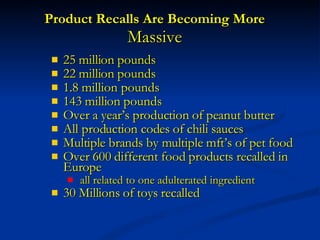
Product Recalls Are Becoming More  Massive 25 million pounds  22 million pounds  1.8 million pounds 143 million pounds Over a year’s production of peanut butter All production codes of chili sauces Multiple brands by multiple mft’s of pet food Over 600 different food products recalled in Europe all related to one adulterated ingredient  30 Millions of toys recalled
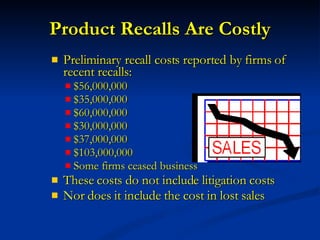
Product Recalls Are Costly Preliminary recall costs reported by firms of recent recalls: $56,000,000 $35,000,000 $60,000,000 $30,000,000 $37,000,000 $103,000,000 Some firms ceased business These costs do not include litigation costs Nor does it include the cost in lost sales
Legal Impact $15.6 Million in one case Jack in the Box $12.0 Million Odwalla apple juice $4.6  Million for eleven children and E. coli $6.25 Million for hepatitis A Green Onions Food Borne Illness Pending Lawsuits: Pot Pies, Spinach, Peanut Butter, Pizza, Canned Chili, Ground Beef, Tomatoes, Peppers, Lettuce, restaurants, supermarkets, etc
20 Year Trends in Product Recalls
Do Recalls Always Happen Late Friday Afternoon?
Consumer Reaction To Product Recalls
 
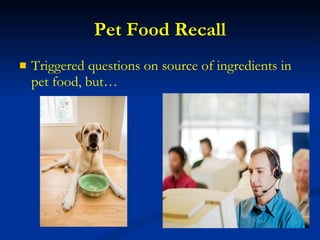
Pet Food Recall Triggered questions on source of ingredients in pet food, but…
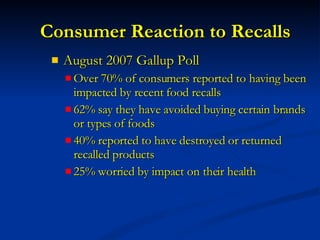
Consumer Reaction to Recalls August 2007 Gallup Poll Over 70% of consumers reported to having been impacted by recent food recalls 62% say they have avoided buying certain brands or types of foods  40% reported to have destroyed or returned recalled products 25% worried by impact on their health Gallup Poll taken prior to Chili Sauce Recall
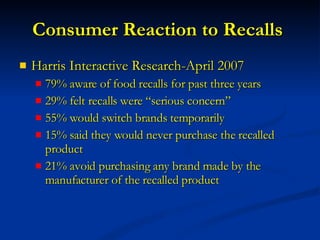
Consumer Reaction to Recalls  Harris Interactive Research-April 2007 79% aware of food recalls for past three years 29% felt recalls were “serious concern” 55% would switch brands temporarily 15% said they would never purchase the recalled product 21% avoid purchasing any brand made by the manufacturer of the recalled product
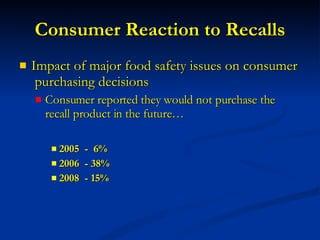
Consumer Reaction to Recalls Impact of major food safety issues on consumer  purchasing decisions Consumer reported they would not purchase the recall product in the future… 2005  -  6% 2006  - 38% 2008  - 15% FMI Trends 2008
Consumer Reaction to Recalls Harris Interactive Research-April 2007 News media 24 hour format Story Repeated every 15 minutes  Proliferation of blogs Consumers have access to more information about a brand’s  not –so– shining moments Once on the internet your story is there forever Internet  reinvents recalls months and years later
Consumer Satisfaction Blogs Consumer Generated Media CGM
Recall Challenges Ahead I do not expect recalls to decrease Can expect more massive recalls  Foodborne disease investigative skills keep improving Media found food safety information sells Consumers becoming more sensitive
Why the increase in food safety concerns and recalls?
Why the Change Concentration of food production Increased batch size Product changes Changes in food distribution Consumer changes Medical services New science Epidemiology Lawyers
FOOD NET SITES Represents about 15% of US population
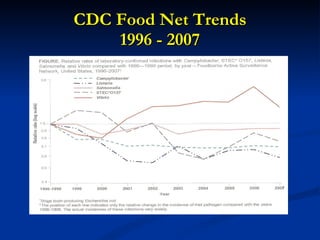
CDC Food Net Trends 1996 - 2007 Updated March 2008
Center of Disease Control Pulse Net
Electronic Communications
CDC Outbreak Response and Surveillance Team (ORST)


What does this tell us? The foodborne disease detectives have become very good! The science and electronic capabilities of epidemiology will continue to grow rapidly Electronic communications links all of this together with instant messaging.
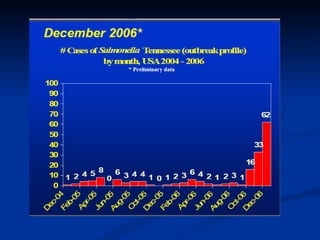
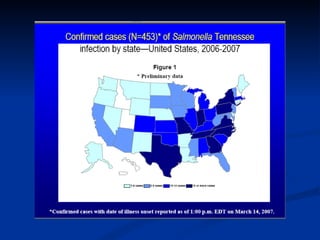
What does this tell us? Now “ LITTLE PROBLEMS”  in the past can now become major events! Failures of basic food safety elements can get your facility into the spotlight. What do customer complaints really say? Do not take unusual events lightly! PREVENTION IS THE KEY TO FOOD SAFETY
Preventing  Food Safety Problems Protecting Your Guests  And The Bottom-line
Preventing Food Safety Problems Starts with knowing your product and process Vulnerability of your product to food safety issues  The microbiological risks of your product  Where are the Critical Control Points  Potential impact of post preparation handling The kitchen environment The impact of employee practices
Preventing Food Safety Problems Historical issues  Staphylococcus Salmonella E. coli O157:H7 Norovirus Chemical contamination
Preventing Food Safety Problems Common Sources Employees Employee practices Temperature Control Cooling  Cooking Cross Contamination
Preventing Food Safety Problems Know your supply source Ask about the suppliers food safety controls  Expect there maybe contamination on raw unprocessed products Design your food safety programs to isolate and prevent cross contamination Temperature control Cooling Cooking
Developing a Food Safety Culture In Your Kitchen
Culture Management must demonstrate the culture by Setting the example Provide and maintain your facility to promote good food safety practices Provide employee training and re-enforcement Monitor performance Don’t miss a teachable moment! Being proactive and provide leadership
Preventing Food Safety Problems Employee Training Follow up… Facility Inspections Self Third party Inspections can serve as a training tool
Preventing Food Safety Problems Regulatory inspections Regulatory inspection reports Have you addressed items on the reports Regulatory inspection is not the tell all You need to go beyond  You cannot delegate your responsibility to the HD It is YOUR facility and YOU are responsible for FOOD SAFETY!!!
Preventing Food Safety Problems Two hot topics for 2009 Product Recalls Do you monitor? WWW.Recall.Gov Are you responsive? Traceability How well can you trace your supply chain? How quick can you identify the source of an item? Practice
Preventing Food Safety Problems To do 1. 2. 3. October 23, 2008 Today you have an opportunity…
Responsibilities
Our Responsibilities Moral To do what is right for your guests  Legal To meet regulatory requirements Both as a Corporation and  You Personally
Complacency Is a self-satisfaction especially when accompanied by unawareness of actual dangers or deficiencies Merriam-Webster Dictionary
Complacency “ We have been in business for 67 years and  we have never had a problem.”  “ We have always done it like that and it has never been a problem.” “ The inspector didn’t say anything about that being a problem”
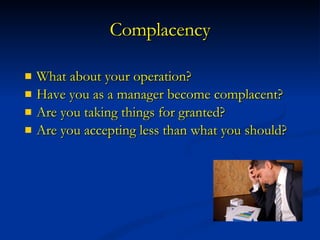
Complacency What about your operation? Have you as a manager become complacent? Are you taking things for granted? Are you accepting less than what you should?
Complacency YOU Cannot Accept A Complacent Attitude With FOOD SAFETY
Food Safety is a Journey  Not a Destination! You must continue to strive for improvements each and every day  in protecting the consumer
Meeting Guest Expectations
Thank you for your attention [email_address]
 

Gale Prince Presentation

  • 1.
    Food Safety in the 21 st Century National Restaurant Association Doubletree Hotel Atlanta, GA October 23, 2008
  • 2.
    Supply-Chain Hurdles: Meat and Poultry Gale Prince [email_address]
  • 3.
    Consumer Expectation SafeDining Experience
  • 4.
  • 5.
    What is onthe consumer’s mind?
  • 6.
  • 7.
    Consumer Research Source: FMI Trends 2008
  • 8.
    Consumer Research Source: FMI Trends 2008
  • 9.
    Consumer Research Source: FMI Trends 2008
  • 10.
    Consumer Research Source: FMI Trends 2008
  • 11.
    Top Food Stories2007 Rankings Pet Food Recalls 21 Million pound Ground Beef Recall Peanut Butter Recall Nutrition Labeling NYC FDA restrictions on importing farm raised fish from China Nutrient fortified sodas, juice, teas and flavored waters Country of Origin Labeling Source: Hunter Public Relations Year End 2007
  • 12.
  • 13.
    Recent Food SafetyProblems 2006 Produce Safety was the top news story Spinach Carrot Juice 2007 Product safety was the top news stories Peanut Butter Pet Food Canned Chili 2008 Ground Beef Tomatoes and Peppers
  • 14.
    Product Recalls AreBecoming More Massive 25 million pounds 22 million pounds 1.8 million pounds 143 million pounds Over a year’s production of peanut butter All production codes of chili sauces Multiple brands by multiple mft’s of pet food Over 600 different food products recalled in Europe all related to one adulterated ingredient 30 Millions of toys recalled
  • 15.
    Product Recalls AreCostly Preliminary recall costs reported by firms of recent recalls: $56,000,000 $35,000,000 $60,000,000 $30,000,000 $37,000,000 $103,000,000 Some firms ceased business These costs do not include litigation costs Nor does it include the cost in lost sales
  • 16.
    Legal Impact $15.6Million in one case Jack in the Box $12.0 Million Odwalla apple juice $4.6 Million for eleven children and E. coli $6.25 Million for hepatitis A Green Onions Food Borne Illness Pending Lawsuits: Pot Pies, Spinach, Peanut Butter, Pizza, Canned Chili, Ground Beef, Tomatoes, Peppers, Lettuce, restaurants, supermarkets, etc
  • 17.
    20 Year Trendsin Product Recalls
  • 18.
    Do Recalls AlwaysHappen Late Friday Afternoon?
  • 19.
    Consumer Reaction ToProduct Recalls
  • 20.
  • 21.
    Pet Food RecallTriggered questions on source of ingredients in pet food, but…
  • 22.
    Consumer Reaction toRecalls August 2007 Gallup Poll Over 70% of consumers reported to having been impacted by recent food recalls 62% say they have avoided buying certain brands or types of foods 40% reported to have destroyed or returned recalled products 25% worried by impact on their health Gallup Poll taken prior to Chili Sauce Recall
  • 23.
    Consumer Reaction toRecalls Harris Interactive Research-April 2007 79% aware of food recalls for past three years 29% felt recalls were “serious concern” 55% would switch brands temporarily 15% said they would never purchase the recalled product 21% avoid purchasing any brand made by the manufacturer of the recalled product
  • 24.
    Consumer Reaction toRecalls Impact of major food safety issues on consumer purchasing decisions Consumer reported they would not purchase the recall product in the future… 2005 - 6% 2006 - 38% 2008 - 15% FMI Trends 2008
  • 25.
    Consumer Reaction toRecalls Harris Interactive Research-April 2007 News media 24 hour format Story Repeated every 15 minutes Proliferation of blogs Consumers have access to more information about a brand’s not –so– shining moments Once on the internet your story is there forever Internet reinvents recalls months and years later
  • 26.
    Consumer Satisfaction BlogsConsumer Generated Media CGM
  • 27.
    Recall Challenges AheadI do not expect recalls to decrease Can expect more massive recalls Foodborne disease investigative skills keep improving Media found food safety information sells Consumers becoming more sensitive
  • 28.
    Why the increasein food safety concerns and recalls?
  • 29.
    Why the ChangeConcentration of food production Increased batch size Product changes Changes in food distribution Consumer changes Medical services New science Epidemiology Lawyers
  • 30.
    FOOD NET SITESRepresents about 15% of US population
  • 31.
    CDC Food NetTrends 1996 - 2007 Updated March 2008
  • 32.
    Center of DiseaseControl Pulse Net
  • 33.
  • 34.
    CDC Outbreak Responseand Surveillance Team (ORST)
  • 35.
  • 36.
  • 37.
  • 38.
  • 39.
  • 40.
  • 41.
  • 42.
  • 43.
  • 44.
  • 45.
  • 46.
    What does thistell us? The foodborne disease detectives have become very good! The science and electronic capabilities of epidemiology will continue to grow rapidly Electronic communications links all of this together with instant messaging.
  • 47.
    What does thistell us? Now “ LITTLE PROBLEMS” in the past can now become major events! Failures of basic food safety elements can get your facility into the spotlight. What do customer complaints really say? Do not take unusual events lightly! PREVENTION IS THE KEY TO FOOD SAFETY
  • 48.
    Preventing FoodSafety Problems Protecting Your Guests And The Bottom-line
  • 49.
    Preventing Food SafetyProblems Starts with knowing your product and process Vulnerability of your product to food safety issues The microbiological risks of your product Where are the Critical Control Points Potential impact of post preparation handling The kitchen environment The impact of employee practices
  • 50.
    Preventing Food SafetyProblems Historical issues Staphylococcus Salmonella E. coli O157:H7 Norovirus Chemical contamination
  • 51.
    Preventing Food SafetyProblems Common Sources Employees Employee practices Temperature Control Cooling Cooking Cross Contamination
  • 52.
    Preventing Food SafetyProblems Know your supply source Ask about the suppliers food safety controls Expect there maybe contamination on raw unprocessed products Design your food safety programs to isolate and prevent cross contamination Temperature control Cooling Cooking
  • 53.
    Developing a FoodSafety Culture In Your Kitchen
  • 54.
    Culture Management mustdemonstrate the culture by Setting the example Provide and maintain your facility to promote good food safety practices Provide employee training and re-enforcement Monitor performance Don’t miss a teachable moment! Being proactive and provide leadership
  • 55.
    Preventing Food SafetyProblems Employee Training Follow up… Facility Inspections Self Third party Inspections can serve as a training tool
  • 56.
    Preventing Food SafetyProblems Regulatory inspections Regulatory inspection reports Have you addressed items on the reports Regulatory inspection is not the tell all You need to go beyond You cannot delegate your responsibility to the HD It is YOUR facility and YOU are responsible for FOOD SAFETY!!!
  • 57.
    Preventing Food SafetyProblems Two hot topics for 2009 Product Recalls Do you monitor? WWW.Recall.Gov Are you responsive? Traceability How well can you trace your supply chain? How quick can you identify the source of an item? Practice
  • 58.
    Preventing Food SafetyProblems To do 1. 2. 3. October 23, 2008 Today you have an opportunity…
  • 59.
  • 60.
    Our Responsibilities MoralTo do what is right for your guests Legal To meet regulatory requirements Both as a Corporation and You Personally
  • 61.
    Complacency Is aself-satisfaction especially when accompanied by unawareness of actual dangers or deficiencies Merriam-Webster Dictionary
  • 62.
    Complacency “ Wehave been in business for 67 years and we have never had a problem.” “ We have always done it like that and it has never been a problem.” “ The inspector didn’t say anything about that being a problem”
  • 63.
    Complacency What aboutyour operation? Have you as a manager become complacent? Are you taking things for granted? Are you accepting less than what you should?
  • 64.
    Complacency YOU CannotAccept A Complacent Attitude With FOOD SAFETY
  • 65.
    Food Safety isa Journey Not a Destination! You must continue to strive for improvements each and every day in protecting the consumer
  • 66.
  • 67.
    Thank you foryour attention [email_address]
  • 68.