The Hazard Analysis Critical Control Point (haccp)
    The Hazard Analysis Critical     	Control Point systemIs a prevention based safety    program that identifies and monitors the hazards associated with food productionis designed to anticipate and control problems before they happened It provides the most effective and sufficient way to ensure that food products are safe
 2 benefits offered1. The HCCP system enables food managers to identify the foods and processes that are most likely to cause foodborne illnesses 2. HCCP system more accurately describes the overall condition of the establishments
THE SEVEN PRICIPLES in a HACCP System
Principle 1- Hazard Analysisthis involves identifying hazard that might be introduced to food by certain food production practices or the intended use of a product            hazards- (biological, chemical, and physical) are conditions which may pose an unacceptable health risk to the consumer
Exaples of hazardous foodsMeat
Dairy products
Poultry, eggs
Cooked foods (beans, pasta, potatoes)
Cut cantaloupe and raw seeds sproutsClassifications of HazardsBiological- an organism, or substance derived     	from an organism, that poses a threat to 			(primarily) human health. -this includes viruses, parasites and   		fungiChemical- are toxin substances that may occur 	naturally or may be added during the 			processing of foods.
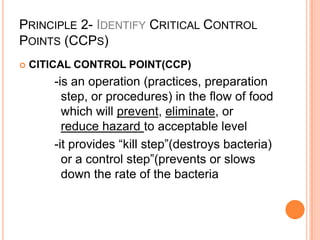
Physical-are hard or soft objects in food that can  			contaminate the food(metal, 				jewelry, hair pins)Principle 2-IdentifyCritical Control Points (CCPs)CITICAL CONTROL POINT(CCP)-is an operation (practices, preparation step, or procedures) in the flow of food which will prevent, eliminate, or reduce hazard to acceptable level-it provides “kill step”(destroys bacteria) or a control step”(prevents or slows down the rate of the bacteria
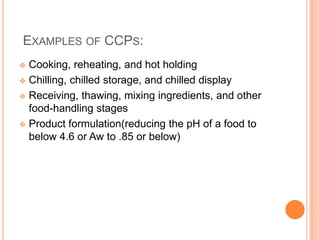
 Examples of CCPs:Cooking, reheating, and hot holding
Chilling, chilled storage, and chilled display
Receiving, thawing, mixing ingredients, and other food-handling stages
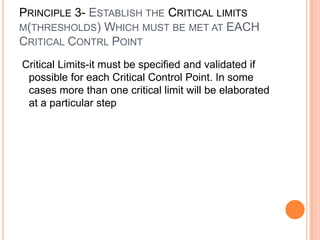
Product formulation(reducing the pH of a food to below 4.6 or Aw to .85 or below)Principle 3- Establish the Critical limits m(thresholds) Which must be met at EACH Critical Contrl Point Critical Limits-it must be specified and validated if possible for each Critical Control Point. In some cases more than one critical limit will be elaborated at a particular step
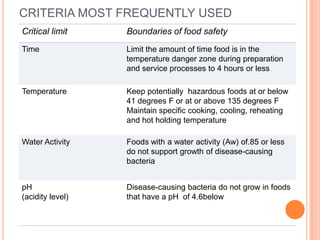
CRITERIA MOST FREQUENTLY USED
Each CCP has one or more critical limits to monitor to assure that hazards are:PreventedEliminatedReduce to acceptable level

The Hazard Analysis Critical Control Point (Haccp

  • 1.
    The Hazard AnalysisCritical Control Point (haccp)
  • 2.
    The Hazard Analysis Critical Control Point systemIs a prevention based safety program that identifies and monitors the hazards associated with food productionis designed to anticipate and control problems before they happened It provides the most effective and sufficient way to ensure that food products are safe
  • 3.
    2 benefitsoffered1. The HCCP system enables food managers to identify the foods and processes that are most likely to cause foodborne illnesses 2. HCCP system more accurately describes the overall condition of the establishments
  • 4.
    THE SEVEN PRICIPLESin a HACCP System
  • 5.
    Principle 1- HazardAnalysisthis involves identifying hazard that might be introduced to food by certain food production practices or the intended use of a product hazards- (biological, chemical, and physical) are conditions which may pose an unacceptable health risk to the consumer
  • 6.
  • 7.
  • 8.
  • 9.
    Cooked foods (beans,pasta, potatoes)
  • 10.
    Cut cantaloupe andraw seeds sproutsClassifications of HazardsBiological- an organism, or substance derived from an organism, that poses a threat to (primarily) human health. -this includes viruses, parasites and fungiChemical- are toxin substances that may occur naturally or may be added during the processing of foods.
  • 11.
    Physical-are hard orsoft objects in food that can contaminate the food(metal, jewelry, hair pins)Principle 2-IdentifyCritical Control Points (CCPs)CITICAL CONTROL POINT(CCP)-is an operation (practices, preparation step, or procedures) in the flow of food which will prevent, eliminate, or reduce hazard to acceptable level-it provides “kill step”(destroys bacteria) or a control step”(prevents or slows down the rate of the bacteria
  • 12.
    Examples ofCCPs:Cooking, reheating, and hot holding
  • 13.
    Chilling, chilled storage,and chilled display
  • 14.
    Receiving, thawing, mixingingredients, and other food-handling stages
  • 15.
    Product formulation(reducing thepH of a food to below 4.6 or Aw to .85 or below)Principle 3- Establish the Critical limits m(thresholds) Which must be met at EACH Critical Contrl Point Critical Limits-it must be specified and validated if possible for each Critical Control Point. In some cases more than one critical limit will be elaborated at a particular step
  • 16.
  • 17.
    Each CCP hasone or more critical limits to monitor to assure that hazards are:PreventedEliminatedReduce to acceptable level
  • 19.
    Principle 4-Establish Proceduresto Monitor CCPsMonitoringIs a critical part of the HACCP system and provides written documentation that can be used to verify that the HACCP system is working properly
  • 20.
    is a plannedsequence of measurements or observations to ensure the product or process is in control (critical limits are being met).
  • 21.
    Is necessary toensure that the process is under control at each critical control pointPrinciple 5- Establish the Corrective Action to Be Taken When Monitoring Shows That a Critical Limit Has Been Exceeded1st. Determine what went wrong2nd. Choose and apply the appropriate corrective4 action
  • 22.
    Principle #6 RecordkeepingThe HACCP system requires the preparation and maintenance of a written HACCP plan together with other documentation. This must include all records generated during the monitoring of each CCP and notations of corrective actions taken. Usually, the simplest record keeping system possible to ensure effectiveness is the most desirable.
  • 23.
    Principle #7 VerificationVerificationhas several steps. The scientific or technical validity of the hazard analysis and the adequacy of the CCP's should be documented. Verification of the effectiveness of the HACCP