HACCP IMPLEMENTATION
IN MEAT INDUSTRY
Nandhu Lal A.M.
Krishnaprabha
KCAET, Tavanur
Kerala Agricultral University
HACCP
 HACCP is a management system in
which food safety is addressed through
the analysis and control of biological,
chemical, physical hazards from raw
materials production and handling to
manufacture, distribution and
consumption of the finished products.
7 HACCP PRINCIPLES
1) Identify the potential hazards
2) Identify the critical control points(CCP)
3) Establish critical limits
4) Establish and implement effective monitoring
procedures at CCPs
5) Establish corrective actions
6) Establish procedures to verify that the measures
outlined above are working effectively
7)Establish documents and records
Basic elements of HACCP in
Meat Processing Plants
 Every single meat product with product specific
technology requires a specifically designed
individual HACCP scheme.
 As a precondition for implementing HACCP
concepts, hazard analysis and risk assessment
referring to meat plant specific processing
methods or products, have to be carried out.
 Critical control points (CCPs) have to be
identified, critical limits be established and
monitoring systems properly implemented.
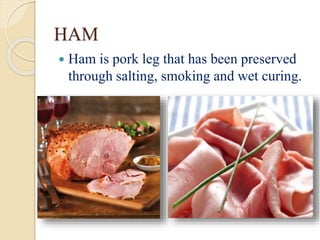
HAM
 Ham is pork leg that has been preserved
through salting, smoking and wet curing.
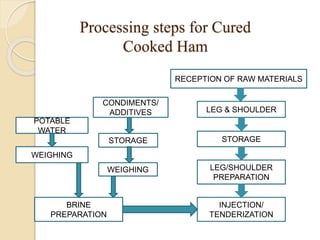
Processing steps for Cured
Cooked Ham
RECEPTION OF RAW MATERIALS
LEG & SHOULDER
INJECTION/
TENDERIZATION
STORAGE
LEG/SHOULDER
PREPARATION
BRINE
PREPARATION
WEIGHING
WEIGHING
POTABLE
WATER
STORAGE
CONDIMENTS/
ADDITIVES
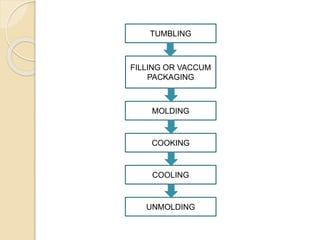
TUMBLING
FILLING OR VACCUM
PACKAGING
MOLDING
COOKING
COOLING
UNMOLDING
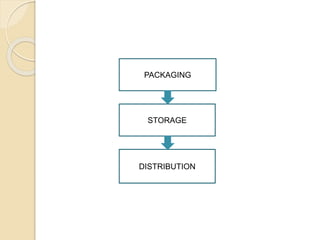
PACKAGING
STORAGE
DISTRIBUTION
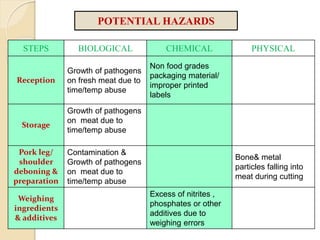
STEPS BIOLOGICAL CHEMICAL PHYSICAL
Reception
Growth of pathogens
on fresh meat due to
time/temp abuse
Non food grades
packaging material/
improper printed
labels
Storage
Growth of pathogens
on meat due to
time/temp abuse
Pork leg/
shoulder
deboning &
preparation
Contamination &
Growth of pathogens
on meat due to
time/temp abuse
Bone& metal
particles falling into
meat during cutting
Weighing
ingredients
& additives
Excess of nitrites ,
phosphates or other
additives due to
weighing errors
POTENTIAL HAZARDS
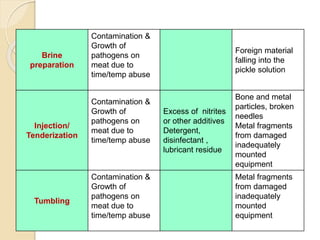
Brine
preparation
Contamination &
Growth of
pathogens on
meat due to
time/temp abuse
Foreign material
falling into the
pickle solution
Injection/
Tenderization
Contamination &
Growth of
pathogens on
meat due to
time/temp abuse
Excess of nitrites
or other additives
Detergent,
disinfectant ,
lubricant residue
Bone and metal
particles, broken
needles
Metal fragments
from damaged
inadequately
mounted
equipment
Tumbling
Contamination &
Growth of
pathogens on
meat due to
time/temp abuse
Metal fragments
from damaged
inadequately
mounted
equipment
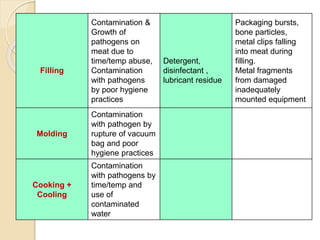
Filling
Contamination &
Growth of
pathogens on
meat due to
time/temp abuse,
Contamination
with pathogens
by poor hygiene
practices
Detergent,
disinfectant ,
lubricant residue
Packaging bursts,
bone particles,
metal clips falling
into meat during
filling.
Metal fragments
from damaged
inadequately
mounted equipment
Molding
Contamination
with pathogen by
rupture of vacuum
bag and poor
hygiene practices
Cooking +
Cooling
Contamination
with pathogens by
time/temp and
use of
contaminated
water
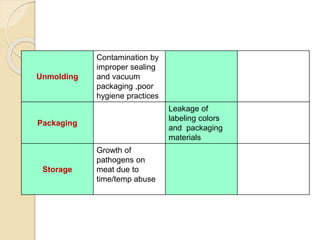
Unmolding
Contamination by
improper sealing
and vacuum
packaging ,poor
hygiene practices
Packaging
Leakage of
labeling colors
and packaging
materials
Storage
Growth of
pathogens on
meat due to
time/temp abuse
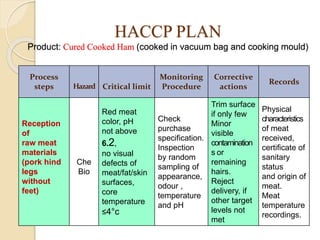
HACCP PLAN
Product: Cured Cooked Ham (cooked in vacuum bag and cooking mould)
Process
steps Hazard Critical limit
Monitoring
Procedure
Corrective
actions
Records
Reception
of
raw meat
materials
(pork hind
legs
without
feet)
Che
Bio
Red meat
color, pH
not above
6.2,
no visual
defects of
meat/fat/skin
surfaces,
core
temperature
≤4°c
Check
purchase
specification.
Inspection
by random
sampling of
appearance,
odour ,
temperature
and pH
Trim surface
if only few
Minor
visible
contamination
s or
remaining
hairs.
Reject
delivery, if
other target
levels not
met
Physical
characteristics
of meat
received,
certificate of
sanitary
status
and origin of
meat.
Meat
temperature
recordings.
Storage in
reception
chiller
Bio
Chiller
temperature
≤4°c
Periodic
temperature
control
Minor temp
deviation:
Adjust
temperature
Major
temperature
deviation:
Reject meat
Temperature/
time
recordings
Cutting,
deboning,
Trimming
Bio
Room
temperature
+10°c, meat
temperature
≤+7°c.
Absence of
alterations
in meat such as
abscesses,
blood
infiltrations
Meat
temperature
control.
Check for
meat
alterations
and
abnormal
tissues
Further
cooling if meat
temperature
too high.
Reject /
discard entire
meat parts
with
alterations
such as
abscesses,
blood
infiltrations
Record meat
temperature.
Record
accidental
findings
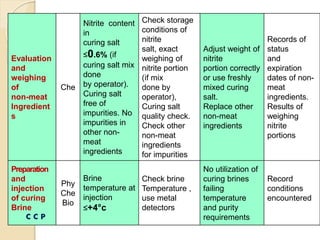
Evaluation
and
weighing
of
non-meat
Ingredient
s
Che
Nitrite content
in
curing salt
≤0.6% (if
curing salt mix
done
by operator).
Curing salt
free of
impurities. No
impurities in
other non-
meat
ingredients
Check storage
conditions of
nitrite
salt, exact
weighing of
nitrite portion
(if mix
done by
operator),
Curing salt
quality check.
Check other
non-meat
ingredients
for impurities
Adjust weight of
nitrite
portion correctly
or use freshly
mixed curing
salt.
Replace other
non-meat
ingredients
Records of
status
and
expiration
dates of non-
meat
ingredients.
Results of
weighing
nitrite
portions
Preparation
and
injection
of curing
Brine
C C P
Phy
Che
Bio
Brine
temperature at
injection
≤+4°c
Check brine
Temperature ,
use metal
detectors
No utilization of
curing brines
failing
temperature
and purity
requirements
Record
conditions
encountered
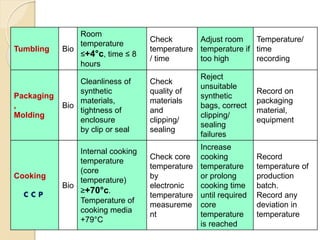
Tumbling Bio
Room
temperature
≤+4°c, time ≤ 8
hours
Check
temperature
/ time
Adjust room
temperature if
too high
Temperature/
time
recording
Packaging
,
Molding
Bio
Cleanliness of
synthetic
materials,
tightness of
enclosure
by clip or seal
Check
quality of
materials
and
clipping/
sealing
Reject
unsuitable
synthetic
bags, correct
clipping/
sealing
failures
Record on
packaging
material,
equipment
Cooking
C C P
Bio
Internal cooking
temperature
(core
temperature)
≥+70°c.
Temperature of
cooking media
+79°C
Check core
temperature
by
electronic
temperature
measureme
nt
Increase
cooking
temperature
or prolong
cooking time
until required
core
temperature
is reached
Record
temperature of
production
batch.
Record any
deviation in
temperature
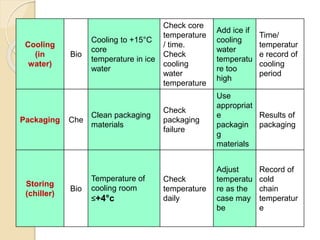
Cooling
(in
water)
Bio
Cooling to +15°C
core
temperature in ice
water
Check core
temperature
/ time.
Check
cooling
water
temperature
Add ice if
cooling
water
temperatu
re too
high
Time/
temperatur
e record of
cooling
period
Packaging Che
Clean packaging
materials
Check
packaging
failure
Use
appropriat
e
packagin
g
materials
Results of
packaging
Storing
(chiller)
Bio
Temperature of
cooling room
≤+4°c
Check
temperature
daily
Adjust
temperatu
re as the
case may
be
Record of
cold
chain
temperatur
e
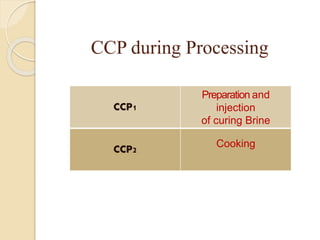
CCP during Processing
CCP1
Preparation and
injection
of curing Brine
CCP2
Cooking
Recommended microbiological criteria for fresh
meat
Good
microbiological
standard
Critical
microbiological
condition
Not
acceptable
Total plate
count per
square cm
Less than
10,000
Between
10,000 and
1,00,000
More than
1,00,000
Enterobacteri
acae
per square
cm
<100 >100 - <1000 >1000
THANK YOU…

HACCP Plan in Meat Industry

  • 1.
    HACCP IMPLEMENTATION IN MEATINDUSTRY Nandhu Lal A.M. Krishnaprabha KCAET, Tavanur Kerala Agricultral University
  • 2.
    HACCP  HACCP isa management system in which food safety is addressed through the analysis and control of biological, chemical, physical hazards from raw materials production and handling to manufacture, distribution and consumption of the finished products.
  • 3.
    7 HACCP PRINCIPLES 1)Identify the potential hazards 2) Identify the critical control points(CCP) 3) Establish critical limits 4) Establish and implement effective monitoring procedures at CCPs 5) Establish corrective actions 6) Establish procedures to verify that the measures outlined above are working effectively 7)Establish documents and records
  • 4.
    Basic elements ofHACCP in Meat Processing Plants  Every single meat product with product specific technology requires a specifically designed individual HACCP scheme.  As a precondition for implementing HACCP concepts, hazard analysis and risk assessment referring to meat plant specific processing methods or products, have to be carried out.  Critical control points (CCPs) have to be identified, critical limits be established and monitoring systems properly implemented.
  • 5.
    HAM  Ham ispork leg that has been preserved through salting, smoking and wet curing.
  • 6.
    Processing steps forCured Cooked Ham RECEPTION OF RAW MATERIALS LEG & SHOULDER INJECTION/ TENDERIZATION STORAGE LEG/SHOULDER PREPARATION BRINE PREPARATION WEIGHING WEIGHING POTABLE WATER STORAGE CONDIMENTS/ ADDITIVES
  • 7.
  • 8.
  • 9.
    STEPS BIOLOGICAL CHEMICALPHYSICAL Reception Growth of pathogens on fresh meat due to time/temp abuse Non food grades packaging material/ improper printed labels Storage Growth of pathogens on meat due to time/temp abuse Pork leg/ shoulder deboning & preparation Contamination & Growth of pathogens on meat due to time/temp abuse Bone& metal particles falling into meat during cutting Weighing ingredients & additives Excess of nitrites , phosphates or other additives due to weighing errors POTENTIAL HAZARDS
  • 10.
    Brine preparation Contamination & Growth of pathogenson meat due to time/temp abuse Foreign material falling into the pickle solution Injection/ Tenderization Contamination & Growth of pathogens on meat due to time/temp abuse Excess of nitrites or other additives Detergent, disinfectant , lubricant residue Bone and metal particles, broken needles Metal fragments from damaged inadequately mounted equipment Tumbling Contamination & Growth of pathogens on meat due to time/temp abuse Metal fragments from damaged inadequately mounted equipment
  • 11.
    Filling Contamination & Growth of pathogenson meat due to time/temp abuse, Contamination with pathogens by poor hygiene practices Detergent, disinfectant , lubricant residue Packaging bursts, bone particles, metal clips falling into meat during filling. Metal fragments from damaged inadequately mounted equipment Molding Contamination with pathogen by rupture of vacuum bag and poor hygiene practices Cooking + Cooling Contamination with pathogens by time/temp and use of contaminated water
  • 12.
    Unmolding Contamination by improper sealing andvacuum packaging ,poor hygiene practices Packaging Leakage of labeling colors and packaging materials Storage Growth of pathogens on meat due to time/temp abuse
  • 13.
    HACCP PLAN Product: CuredCooked Ham (cooked in vacuum bag and cooking mould) Process steps Hazard Critical limit Monitoring Procedure Corrective actions Records Reception of raw meat materials (pork hind legs without feet) Che Bio Red meat color, pH not above 6.2, no visual defects of meat/fat/skin surfaces, core temperature ≤4°c Check purchase specification. Inspection by random sampling of appearance, odour , temperature and pH Trim surface if only few Minor visible contamination s or remaining hairs. Reject delivery, if other target levels not met Physical characteristics of meat received, certificate of sanitary status and origin of meat. Meat temperature recordings.
  • 14.
    Storage in reception chiller Bio Chiller temperature ≤4°c Periodic temperature control Minor temp deviation: Adjust temperature Major temperature deviation: Rejectmeat Temperature/ time recordings Cutting, deboning, Trimming Bio Room temperature +10°c, meat temperature ≤+7°c. Absence of alterations in meat such as abscesses, blood infiltrations Meat temperature control. Check for meat alterations and abnormal tissues Further cooling if meat temperature too high. Reject / discard entire meat parts with alterations such as abscesses, blood infiltrations Record meat temperature. Record accidental findings
  • 15.
    Evaluation and weighing of non-meat Ingredient s Che Nitrite content in curing salt ≤0.6%(if curing salt mix done by operator). Curing salt free of impurities. No impurities in other non- meat ingredients Check storage conditions of nitrite salt, exact weighing of nitrite portion (if mix done by operator), Curing salt quality check. Check other non-meat ingredients for impurities Adjust weight of nitrite portion correctly or use freshly mixed curing salt. Replace other non-meat ingredients Records of status and expiration dates of non- meat ingredients. Results of weighing nitrite portions Preparation and injection of curing Brine C C P Phy Che Bio Brine temperature at injection ≤+4°c Check brine Temperature , use metal detectors No utilization of curing brines failing temperature and purity requirements Record conditions encountered
  • 16.
    Tumbling Bio Room temperature ≤+4°c, time≤ 8 hours Check temperature / time Adjust room temperature if too high Temperature/ time recording Packaging , Molding Bio Cleanliness of synthetic materials, tightness of enclosure by clip or seal Check quality of materials and clipping/ sealing Reject unsuitable synthetic bags, correct clipping/ sealing failures Record on packaging material, equipment Cooking C C P Bio Internal cooking temperature (core temperature) ≥+70°c. Temperature of cooking media +79°C Check core temperature by electronic temperature measureme nt Increase cooking temperature or prolong cooking time until required core temperature is reached Record temperature of production batch. Record any deviation in temperature
  • 17.
    Cooling (in water) Bio Cooling to +15°C core temperaturein ice water Check core temperature / time. Check cooling water temperature Add ice if cooling water temperatu re too high Time/ temperatur e record of cooling period Packaging Che Clean packaging materials Check packaging failure Use appropriat e packagin g materials Results of packaging Storing (chiller) Bio Temperature of cooling room ≤+4°c Check temperature daily Adjust temperatu re as the case may be Record of cold chain temperatur e
  • 18.
    CCP during Processing CCP1 Preparationand injection of curing Brine CCP2 Cooking
  • 19.
    Recommended microbiological criteriafor fresh meat Good microbiological standard Critical microbiological condition Not acceptable Total plate count per square cm Less than 10,000 Between 10,000 and 1,00,000 More than 1,00,000 Enterobacteri acae per square cm <100 >100 - <1000 >1000
  • 20.