Presentation to National Restaurant Association October 22, 2008 Scott Cooper ANSI Vice President Government Relations and Public Policy
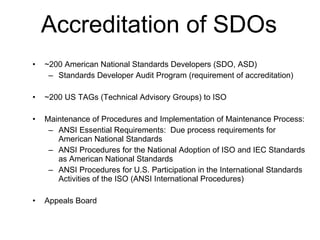
Accreditation of SDOs ~200 American National Standards Developers (SDO, ASD) Standards Developer Audit Program (requirement of accreditation) ~200 US TAGs (Technical Advisory Groups) to ISO Maintenance of Procedures and Implementation of Maintenance Process: ANSI Essential Requirements:  Due process requirements for American National Standards ANSI Procedures for the National Adoption of ISO and IEC Standards as American National Standards ANSI Procedures for U.S. Participation in the International Standards Activities of the ISO (ANSI International Procedures) Appeals Board
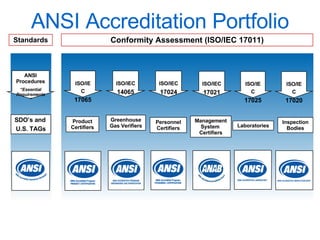
ANSI Accreditation Portfolio Conformity Assessment (ISO/IEC 17011) Product Certifiers Personnel Certifiers SDO’s and  U.S. TAGs ANSI Procedures “ Essential Requirements” Standards Laboratories Inspection Bodies ISO/IEC 14065 ISO/IEC 17021 ISO/IEC  17024 ISO/IEC  17025 ISO/IEC  17020 Management System  Certifiers ISO/IEC 17065 Greenhouse Gas Verifiers
“ ANSI’s Role in Conformity Assessment ” ( ANSI Policy : BoD 412; ExCo 329) In conformity assessment areas, ANSI is committed to  2 related but distinct efforts : 1. ANSI  Conformity Assessment Policy Committee   (CAPC)   addresses conformity assessment policy issues. develops consensus among all stakeholders and advocates policy nationally, regionally, and internationally. coordinates U.S. positions via the ANSI International Conformity Assessment Committee  (ICAC)  and  ISO CASCO (Committee on Conformity Assessment). promotes widespread education and understanding of conformity assessment. 2. ANSI  Accreditation Programs  provide conformity assessment body accreditation. serve the needs of the market; open, flexible and efficient; technical rigor; highest level of integrity. strengthen relationships with government agencies; enhance recognition; for regulatory needs. operate in conformance to relevant international standards. support mutual recognition programs; promote the interests and competitiveness of U.S. industry.
National Conformity Assessment Principles (NCAP) Articulates principles for conformity assessment activities in the U.S. Guidance document to be considered along with the  U.S. National Standards Strategy   Improves the ability of the marketplace to understand and have confidence in conformity assessment processes Approved by ANSI Board in 2002
IAF  INTERNATIONAL ACCREDITATION FORUM IAAC INTERAMERICAN ACCREDITATION COOPERATION PAC   PACIFIC ACCREDITATION COOPERATION APLAC ASIA-PACIFIC LABORATORY ACCREDITATION COOPERATION EA EUROPEAN ACCREDITATION COOPERATION ILAC INTERNATIONAL LABORATORY ACCREDITATION COOPERATION Recognition Bodies
Product Certification FCC TCB Program (NIST NVCASE) Food Marketing Institute – SQF American Forest & Paper Association – SFI Personnel Certification FDA/CDC - Conference for Food Protection Department of Defense – InfoSec professionals Systems Certification Telecommunications – TL 9000 Aerospace – AS 9100 American Chemical Council – RC 14000
The ANSI-Conference for Food Protection Accreditation Partnership
ANSI/CFP  Accreditation Partnership History of Partnership CFP/ANSI enter into a formal agreement May 2002 Agreement creates accreditation program for bodies that certify Food Protection Managers in accordance the CFP Standards Delineates Roles and Responsibilities between CFP and ANSI Creates ANSI/CFP Personnel Certification Accreditation Committee
Goals of the ANSI/CFP Accreditation Program Ensure all Food Protection Manager Certification Programs meet CFP Standards Facilitate a self-assessment process that increases the quality of the program Increase recognition and confidence in the quality of Food Protection Manager certification programs
ANSI/CFP  Accreditation = Quality Verifies the quality of a certification program for State regulatory bodies responsible for licensing Ensures consistent quality of food protection managers for employers Increases consumer confidence regarding food safety  Verifies the use of valid and reliable processes that increases legal defensibility of certification programs
  Accreditation   Benefits Facilitates a High Level of Technical Competence and Reliability through a Self Assessment Process Consistency of Competencies across all jurisdictions Verification of Quality by an Independent Objective Review Agency Opportunity for Peer Review and Dialogue with National Experts Facilitates Continuous Quality Improvement
Accreditation   Benefits Marketing tool to employers – Consistent known product Mobility of Personnel Improved Consumer Confidence regarding food safety Potential Prevention of Lawsuits Lessens State/Local regulatory costs No certification cost Can facilitate reciprocity agreements
    ANSI/CFP Accredited    Organizations National Restaurant Association Solutions  National Registry of Food Safety Professionals Prometric
Accreditation Mark
SQF Background The SQF Program is owned by the Food Marketing Institute (FMI).  SQF means Safe Quality Food. The SQF Program is a fully integrated food safety and quality management protocol designed specifically for the food sector. It has been the culmination of 10 years development and is designed specifically for the food industry with application at all links in the food supply chain. SQF Certification provides an independent and external validation that a product, process or service complies with international, regulatory and other specified standard(s) and enables a food supplier to give assurances that food has been produced, prepared and handled according to the highest possible standards.
SQF Standards Standards: SQF 1000 CODE: 5th Ed. Nov 2005  A HACCP Based Supplier Assurance Code for the Primary Producer SQF 2000 CODE: 6th Ed. Aug 2008  A HACCP Based Supplier Assurance Code for the Food Industry
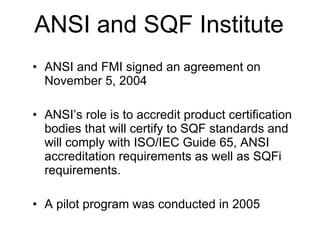
ANSI and SQF Institute ANSI and FMI signed an agreement on November 5, 2004 ANSI’s role is to accredit product certification bodies that will certify to SQF standards and will comply with ISO/IEC Guide 65, ANSI accreditation requirements as well as SQFi requirements. A pilot program was conducted in 2005
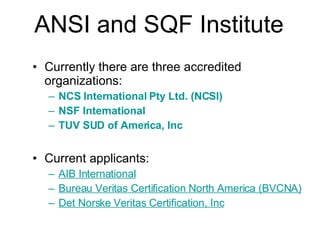
ANSI and SQF Institute Currently there are three accredited organizations: NCS International Pty Ltd. (NCSI) NSF International TUV SUD of America, Inc Current applicants: AIB International   Bureau Veritas Certification North America (BVCNA)   Det Norske Veritas Certification, Inc
    ANSI/CFP Accredited    Organizations National Restaurant Association Solutions  National Registry of Food Safety Professionals Prometric

American National Standards Institute Presentation

  • 1.
    Presentation to NationalRestaurant Association October 22, 2008 Scott Cooper ANSI Vice President Government Relations and Public Policy
  • 2.
    Accreditation of SDOs~200 American National Standards Developers (SDO, ASD) Standards Developer Audit Program (requirement of accreditation) ~200 US TAGs (Technical Advisory Groups) to ISO Maintenance of Procedures and Implementation of Maintenance Process: ANSI Essential Requirements: Due process requirements for American National Standards ANSI Procedures for the National Adoption of ISO and IEC Standards as American National Standards ANSI Procedures for U.S. Participation in the International Standards Activities of the ISO (ANSI International Procedures) Appeals Board
  • 3.
    ANSI Accreditation PortfolioConformity Assessment (ISO/IEC 17011) Product Certifiers Personnel Certifiers SDO’s and U.S. TAGs ANSI Procedures “ Essential Requirements” Standards Laboratories Inspection Bodies ISO/IEC 14065 ISO/IEC 17021 ISO/IEC 17024 ISO/IEC 17025 ISO/IEC 17020 Management System Certifiers ISO/IEC 17065 Greenhouse Gas Verifiers
  • 4.
    “ ANSI’s Rolein Conformity Assessment ” ( ANSI Policy : BoD 412; ExCo 329) In conformity assessment areas, ANSI is committed to 2 related but distinct efforts : 1. ANSI Conformity Assessment Policy Committee (CAPC) addresses conformity assessment policy issues. develops consensus among all stakeholders and advocates policy nationally, regionally, and internationally. coordinates U.S. positions via the ANSI International Conformity Assessment Committee (ICAC) and ISO CASCO (Committee on Conformity Assessment). promotes widespread education and understanding of conformity assessment. 2. ANSI Accreditation Programs provide conformity assessment body accreditation. serve the needs of the market; open, flexible and efficient; technical rigor; highest level of integrity. strengthen relationships with government agencies; enhance recognition; for regulatory needs. operate in conformance to relevant international standards. support mutual recognition programs; promote the interests and competitiveness of U.S. industry.
  • 5.
    National Conformity AssessmentPrinciples (NCAP) Articulates principles for conformity assessment activities in the U.S. Guidance document to be considered along with the U.S. National Standards Strategy Improves the ability of the marketplace to understand and have confidence in conformity assessment processes Approved by ANSI Board in 2002
  • 6.
    IAF INTERNATIONALACCREDITATION FORUM IAAC INTERAMERICAN ACCREDITATION COOPERATION PAC PACIFIC ACCREDITATION COOPERATION APLAC ASIA-PACIFIC LABORATORY ACCREDITATION COOPERATION EA EUROPEAN ACCREDITATION COOPERATION ILAC INTERNATIONAL LABORATORY ACCREDITATION COOPERATION Recognition Bodies
  • 7.
    Product Certification FCCTCB Program (NIST NVCASE) Food Marketing Institute – SQF American Forest & Paper Association – SFI Personnel Certification FDA/CDC - Conference for Food Protection Department of Defense – InfoSec professionals Systems Certification Telecommunications – TL 9000 Aerospace – AS 9100 American Chemical Council – RC 14000
  • 8.
    The ANSI-Conference forFood Protection Accreditation Partnership
  • 9.
    ANSI/CFP AccreditationPartnership History of Partnership CFP/ANSI enter into a formal agreement May 2002 Agreement creates accreditation program for bodies that certify Food Protection Managers in accordance the CFP Standards Delineates Roles and Responsibilities between CFP and ANSI Creates ANSI/CFP Personnel Certification Accreditation Committee
  • 10.
    Goals of theANSI/CFP Accreditation Program Ensure all Food Protection Manager Certification Programs meet CFP Standards Facilitate a self-assessment process that increases the quality of the program Increase recognition and confidence in the quality of Food Protection Manager certification programs
  • 11.
    ANSI/CFP Accreditation= Quality Verifies the quality of a certification program for State regulatory bodies responsible for licensing Ensures consistent quality of food protection managers for employers Increases consumer confidence regarding food safety Verifies the use of valid and reliable processes that increases legal defensibility of certification programs
  • 12.
    Accreditation Benefits Facilitates a High Level of Technical Competence and Reliability through a Self Assessment Process Consistency of Competencies across all jurisdictions Verification of Quality by an Independent Objective Review Agency Opportunity for Peer Review and Dialogue with National Experts Facilitates Continuous Quality Improvement
  • 13.
    Accreditation Benefits Marketing tool to employers – Consistent known product Mobility of Personnel Improved Consumer Confidence regarding food safety Potential Prevention of Lawsuits Lessens State/Local regulatory costs No certification cost Can facilitate reciprocity agreements
  • 14.
    ANSI/CFP Accredited Organizations National Restaurant Association Solutions National Registry of Food Safety Professionals Prometric
  • 15.
  • 16.
    SQF Background TheSQF Program is owned by the Food Marketing Institute (FMI). SQF means Safe Quality Food. The SQF Program is a fully integrated food safety and quality management protocol designed specifically for the food sector. It has been the culmination of 10 years development and is designed specifically for the food industry with application at all links in the food supply chain. SQF Certification provides an independent and external validation that a product, process or service complies with international, regulatory and other specified standard(s) and enables a food supplier to give assurances that food has been produced, prepared and handled according to the highest possible standards.
  • 17.
    SQF Standards Standards:SQF 1000 CODE: 5th Ed. Nov 2005 A HACCP Based Supplier Assurance Code for the Primary Producer SQF 2000 CODE: 6th Ed. Aug 2008 A HACCP Based Supplier Assurance Code for the Food Industry
  • 18.
    ANSI and SQFInstitute ANSI and FMI signed an agreement on November 5, 2004 ANSI’s role is to accredit product certification bodies that will certify to SQF standards and will comply with ISO/IEC Guide 65, ANSI accreditation requirements as well as SQFi requirements. A pilot program was conducted in 2005
  • 19.
    ANSI and SQFInstitute Currently there are three accredited organizations: NCS International Pty Ltd. (NCSI) NSF International TUV SUD of America, Inc Current applicants: AIB International Bureau Veritas Certification North America (BVCNA) Det Norske Veritas Certification, Inc
  • 20.
    ANSI/CFP Accredited Organizations National Restaurant Association Solutions National Registry of Food Safety Professionals Prometric