
www.iso.org
International Organization
for Standardization
BY- Surbhi Chauhan
International Organization
for Standardization
 International Standardization Organization
 Non-governmental
 A network of national standards bodies (148 countries)
 A bridge between public and private sectors
 An ISO Standard
 Voluntary (no legal authority)
 Purpose:
 To facilitates exchanges (trade) – hamonizing national standards
 Meet a real need (market driven)
 Work of Experts – outcome is achieved by consensus
 Specific Auditable Requirement
 the organization today known as ISO began in
1926 as the International Federation of the
National Standardizing Associations (ISA).
 It was suspended in 1942 during World War II, but
after the war ISA was approached by the
recently formed United Nations Standards
Coordinating Committee (UNSCC) with a proposal
to form a new global standards body.
 In October 1946, ISA and UNSCC delegates from
25 countries met in London and agreed to join
forces to create the new International
Organization for Standardization; the new
organization officially began operations in
February 1947.
ISO 9000 - Quality management
ISO 14000 - Environmental management
ISO 26000 - Social responsibility
ISO 50001 - Energy management
ISO 31000 - Risk management
ISO 20121 - Sustainable events
 ISO 22000 -Food safety management systems -
Requirements for any organization in the food chain.
 ISO 22001 - Guidelines on the application of ISO
9001:2000 for the food and drink industry .
 ISO 22002- Prerequisite programmes on food safety—
Food manufacturing
 ISO 22003 - Food safety management systems for bodies
providing audit and certification of food safety
management systems.
 ISO 22004 - Food safety management systems - Guidance
on the application of ISO 22000:2005.
 ISO 22006 - Quality management systems - Guidance on
the application of ISO 9002:2000 for crop production.
1-Good manufacturing practices (GMP) –
are the practices required in order to conform to
guidelines recommended by agencies that control
authorization and licensing for manufacture and sale of
food, drug products, and active pharmaceutical
products
2-Good laboratory practices(GLP)-
for laboratories conducting non-clinica lstudies
(toxicology and pharmacology studies in animals);
3-Good Clinical practices(GCP)-for hospitals and
clinicians conducting clinical studies on new drugs in
humans;
4-Good regulatory practices(GRP)- for the
management of regulatory commitments,
procedures and documentation
5-Good Distribution Practices (GDP) –
deals with the guidelines for the proper
distribution of medicinal products for
human use
6-Good transportation practices(GTP)-
deals with the guidelines for the proper
domestic and international transportation of
medicinal products for human use
7-Good hygiene practices(GHP
measures for maintaing hygiene and sanitation and
including personal hygiene and employe health
condition.maintance of plant and equipment
hygiene including food contact surfaces,pest
control waste disposal water quality,toilet and
hand wash facilities prevention of cross
contamination.
ISO 22000 is a standard developed by the
International Organization for Standardization
dealing with food safety.
The ISO 22000 international standard specifies the
requirements for a food safety management
system that involves the following elements:
 interactive communication
 system management
 prerequisite programs
 HACCP principles
 ISO 22000 has been aligned with ISO 9001 in
order to enhance the compatibility of the
two standards.
 ISO 22000 integrates the principles of the
Hazard Analysis and Critical Control Point
(HACCP) system
 Haccp is a systematic preventive approach to
food safety from biological,chemical,and
physical hazards in production process that
can cause the finish product to be
unsafe,and design measurements to reduce
this risk to a safe level.
 The haccap system can be used at all stages
of a food chain,from food production and
preparation,processes including
packaging,distribution etc.
 Global market place
 Increasing incidents of food-borne pathogens
 New pathogens emerging
 Need to protect Brands, control risks
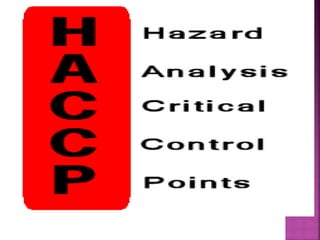
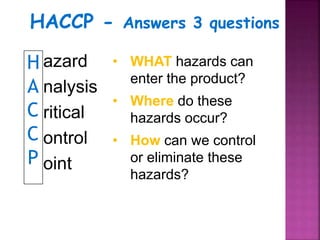
H
A
C
C
P
azard
nalysis
ritical
ontrol
oint
• WHAT hazards can
enter the product?
• Where do these
hazards occur?
• How can we control
or eliminate these
hazards?
HACCP - Answers 3 questions
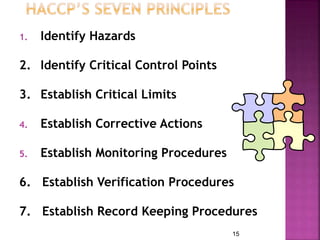
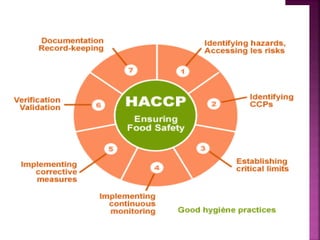
1. Identify Hazards
2. Identify Critical Control Points
3. Establish Critical Limits
4. Establish Corrective Actions
5. Establish Monitoring Procedures
6. Establish Verification Procedures
7. Establish Record Keeping Procedures
15
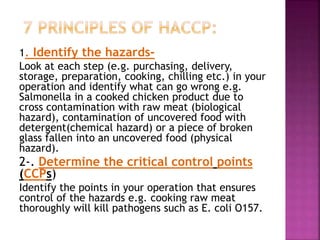
1. Identify the hazards-
Look at each step (e.g. purchasing, delivery,
storage, preparation, cooking, chilling etc.) in your
operation and identify what can go wrong e.g.
Salmonella in a cooked chicken product due to
cross contamination with raw meat (biological
hazard), contamination of uncovered food with
detergent(chemical hazard) or a piece of broken
glass fallen into an uncovered food (physical
hazard).
2-. Determine the critical control points
(CCPs)
Identify the points in your operation that ensures
control of the hazards e.g. cooking raw meat
thoroughly will kill pathogens such as E. coli O157.
3-. Establish critical limit(s)
 Set limits to enable you to identify when a
CCP is out of control e.g. when cooking beef
burgers, the centre of the burger must reach
a minimum temperature of 75°C (or an
equivalent time temperature combination
e.g. 70°C for 2 minutes) to ensure pathogens
are destroyed.
4. Establish a system to monitor
control of the CCP
When CCPs and critical limits have been identified
it is important to have a way to monitor and
record what is happening at each CCP. Typically
monitoring will involve measuring parameters such
as temperature and time.
You will establish what actions need to be taken if a
critical limit is not met. This will be identified ahead of
time for each CCP. The action must make sure that no
unsafe product is released. There must also be an
evaluation of the process to determine the cause of the
problem and an elimination of the cause.
The action or actions taken have two purposes, to
control any nonconforming product resulting from the
loss of control, and to identify the cause, eliminate it
and prevent the situation from reoccurring. By
identifying the corrective action before an out of
control situation occurs, you are prepared to take
action quickly if and when it does occur.
6. Establish procedures for
verification to confirm the HACCP
system is working effectively
Review and correct the system periodically and
whenever you make changes to your operation e.g.
when replacing an oven verify that the
time/temperature settings in the new oven achieves
the minimum safe cooking temperature for a particular
dish by probing the food.
7. Establish documentation concerning all
procedures and records appropriate to these principles
and their application
For the successful implementation of HACCP,
appropriate documentation and records must be kept
and be readily available. It is unrealistic to operate
HACCP or to demonstrate compliance with the current
legislation without providing evidence such as written
records.
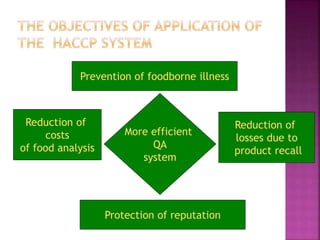
Reduction of
costs
of food analysis
Reduction of
losses due to
product recall
More efficient
QA
system
Protection of reputation
Prevention of foodborne illness
A food safety program based on HACCP
Principles helps to reduce or eliminate
potential food safety hazards and:
 Protects your customers
 Improves control of food processes
22
 Provides a defense against complaints and
legal action
 Complies with the law for Child Nutrition
Programs
 Provides a process for continuous self-
inspection and self-improvement
23
 Increased confidence in your products
 Ability to reach markets and customers that
require a HACCP based system
 Reduced Liability
 Effective process management
 Improved quality and consistency
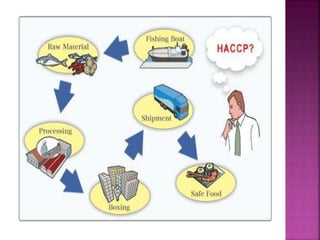
EVERY STEP, FROM PROCUREMENT TO
CLEAN – UP, MUST BE EVALUATED TO
ENSURE THE FOOD SUPPLY FOR
YOUR CUSTOMERS IS SAFE.
26
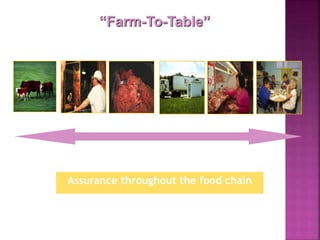
“Farm-To-Table”
Assurance throughout the food chain
 INTRODUCTION
ISO 9001 is one of series of three international
standards dealing with quality systems that can
be used for external quality assurance purpose
in contractual situations.
 ISO 9001 is for quality management.
 Quality refers to all those features of a product
(or service) which are required by the customer.
 Quality management means what the
organization does to
 ensure that its products or services satisfy the
customer's quality requirements and
 comply with any regulations applicable to those
products or services.
 Quality management also means what the
organization does to
 enhance customer satisfaction, and
 achieve continual improvement of its
performance.
 There are 20 elements of ISO 9001 quality
system which are to be established and
maintained for compliance of this standard.
 The elements are:-
 1)management responsibility
 2)quality system
 3)contract review
 4)design control
 5)document control
 6)purchasing
 7)purchaser supplied product
 8)product identification & traceability
 9)process control
 10) inspection & testing
 11) inspection measuring and test
equipment's
 12)inspection & test status
 13)control of non-conforming product
 14)corrective action
 15)handling ,storage , packaging & delivery
 16)quality records
 17)internal quality audits
 18)training
 19)servicing
 20)statistical techniques..
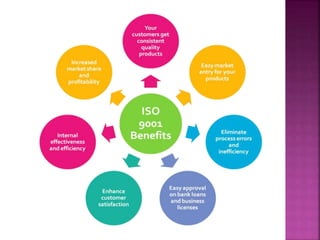
 Model for satisfying customers and other
stakeholders.
 Build quality into products and services from
design onwards.
 Address environmental concerns of
customers and public, and comply with
government regulations.
 Integrate with global economy.
 Sustainable business
 Unifying base for industry sectors
 Qualify suppliers for global supply chains
 Technical support for regulations
 The Quality Management Standard, ISO 9001
was used in the development of ISO 22000.
Both are standards based on a management
systems approach, and they share many
requirements. The key difference is that ISO
9001 is a Quality Management System with
the emphasis on achieving product quality
and customer satisfaction, while ISO 22000 is
a Food Safety Management System
emphasizing safe product.

Haccp,iso 9001 22000

Haccp,iso 9001 22000

  • 1.
    www.iso.org International Organization for Standardization BY-Surbhi Chauhan International Organization for Standardization
  • 2.
     International StandardizationOrganization  Non-governmental  A network of national standards bodies (148 countries)  A bridge between public and private sectors  An ISO Standard  Voluntary (no legal authority)  Purpose:  To facilitates exchanges (trade) – hamonizing national standards  Meet a real need (market driven)  Work of Experts – outcome is achieved by consensus  Specific Auditable Requirement
  • 3.
     the organizationtoday known as ISO began in 1926 as the International Federation of the National Standardizing Associations (ISA).  It was suspended in 1942 during World War II, but after the war ISA was approached by the recently formed United Nations Standards Coordinating Committee (UNSCC) with a proposal to form a new global standards body.  In October 1946, ISA and UNSCC delegates from 25 countries met in London and agreed to join forces to create the new International Organization for Standardization; the new organization officially began operations in February 1947.
  • 4.
    ISO 9000 -Quality management ISO 14000 - Environmental management ISO 26000 - Social responsibility ISO 50001 - Energy management ISO 31000 - Risk management ISO 20121 - Sustainable events
  • 5.
     ISO 22000-Food safety management systems - Requirements for any organization in the food chain.  ISO 22001 - Guidelines on the application of ISO 9001:2000 for the food and drink industry .  ISO 22002- Prerequisite programmes on food safety— Food manufacturing  ISO 22003 - Food safety management systems for bodies providing audit and certification of food safety management systems.  ISO 22004 - Food safety management systems - Guidance on the application of ISO 22000:2005.  ISO 22006 - Quality management systems - Guidance on the application of ISO 9002:2000 for crop production.
  • 6.
    1-Good manufacturing practices(GMP) – are the practices required in order to conform to guidelines recommended by agencies that control authorization and licensing for manufacture and sale of food, drug products, and active pharmaceutical products 2-Good laboratory practices(GLP)- for laboratories conducting non-clinica lstudies (toxicology and pharmacology studies in animals); 3-Good Clinical practices(GCP)-for hospitals and clinicians conducting clinical studies on new drugs in humans;
  • 7.
    4-Good regulatory practices(GRP)-for the management of regulatory commitments, procedures and documentation 5-Good Distribution Practices (GDP) – deals with the guidelines for the proper distribution of medicinal products for human use
  • 8.
    6-Good transportation practices(GTP)- dealswith the guidelines for the proper domestic and international transportation of medicinal products for human use 7-Good hygiene practices(GHP measures for maintaing hygiene and sanitation and including personal hygiene and employe health condition.maintance of plant and equipment hygiene including food contact surfaces,pest control waste disposal water quality,toilet and hand wash facilities prevention of cross contamination.
  • 9.
    ISO 22000 isa standard developed by the International Organization for Standardization dealing with food safety. The ISO 22000 international standard specifies the requirements for a food safety management system that involves the following elements:  interactive communication  system management  prerequisite programs  HACCP principles
  • 10.
     ISO 22000has been aligned with ISO 9001 in order to enhance the compatibility of the two standards.  ISO 22000 integrates the principles of the Hazard Analysis and Critical Control Point (HACCP) system
  • 12.
     Haccp isa systematic preventive approach to food safety from biological,chemical,and physical hazards in production process that can cause the finish product to be unsafe,and design measurements to reduce this risk to a safe level.  The haccap system can be used at all stages of a food chain,from food production and preparation,processes including packaging,distribution etc.
  • 13.
     Global marketplace  Increasing incidents of food-borne pathogens  New pathogens emerging  Need to protect Brands, control risks
  • 14.
    H A C C P azard nalysis ritical ontrol oint • WHAT hazardscan enter the product? • Where do these hazards occur? • How can we control or eliminate these hazards? HACCP - Answers 3 questions
  • 15.
    1. Identify Hazards 2.Identify Critical Control Points 3. Establish Critical Limits 4. Establish Corrective Actions 5. Establish Monitoring Procedures 6. Establish Verification Procedures 7. Establish Record Keeping Procedures 15
  • 17.
    1. Identify thehazards- Look at each step (e.g. purchasing, delivery, storage, preparation, cooking, chilling etc.) in your operation and identify what can go wrong e.g. Salmonella in a cooked chicken product due to cross contamination with raw meat (biological hazard), contamination of uncovered food with detergent(chemical hazard) or a piece of broken glass fallen into an uncovered food (physical hazard). 2-. Determine the critical control points (CCPs) Identify the points in your operation that ensures control of the hazards e.g. cooking raw meat thoroughly will kill pathogens such as E. coli O157.
  • 18.
    3-. Establish criticallimit(s)  Set limits to enable you to identify when a CCP is out of control e.g. when cooking beef burgers, the centre of the burger must reach a minimum temperature of 75°C (or an equivalent time temperature combination e.g. 70°C for 2 minutes) to ensure pathogens are destroyed. 4. Establish a system to monitor control of the CCP When CCPs and critical limits have been identified it is important to have a way to monitor and record what is happening at each CCP. Typically monitoring will involve measuring parameters such as temperature and time.
  • 19.
    You will establishwhat actions need to be taken if a critical limit is not met. This will be identified ahead of time for each CCP. The action must make sure that no unsafe product is released. There must also be an evaluation of the process to determine the cause of the problem and an elimination of the cause. The action or actions taken have two purposes, to control any nonconforming product resulting from the loss of control, and to identify the cause, eliminate it and prevent the situation from reoccurring. By identifying the corrective action before an out of control situation occurs, you are prepared to take action quickly if and when it does occur.
  • 20.
    6. Establish proceduresfor verification to confirm the HACCP system is working effectively Review and correct the system periodically and whenever you make changes to your operation e.g. when replacing an oven verify that the time/temperature settings in the new oven achieves the minimum safe cooking temperature for a particular dish by probing the food. 7. Establish documentation concerning all procedures and records appropriate to these principles and their application For the successful implementation of HACCP, appropriate documentation and records must be kept and be readily available. It is unrealistic to operate HACCP or to demonstrate compliance with the current legislation without providing evidence such as written records.
  • 21.
    Reduction of costs of foodanalysis Reduction of losses due to product recall More efficient QA system Protection of reputation Prevention of foodborne illness
  • 22.
    A food safetyprogram based on HACCP Principles helps to reduce or eliminate potential food safety hazards and:  Protects your customers  Improves control of food processes 22
  • 23.
     Provides adefense against complaints and legal action  Complies with the law for Child Nutrition Programs  Provides a process for continuous self- inspection and self-improvement 23
  • 24.
     Increased confidencein your products  Ability to reach markets and customers that require a HACCP based system  Reduced Liability  Effective process management  Improved quality and consistency
  • 26.
    EVERY STEP, FROMPROCUREMENT TO CLEAN – UP, MUST BE EVALUATED TO ENSURE THE FOOD SUPPLY FOR YOUR CUSTOMERS IS SAFE. 26
  • 27.
  • 28.
     INTRODUCTION ISO 9001is one of series of three international standards dealing with quality systems that can be used for external quality assurance purpose in contractual situations.
  • 29.
     ISO 9001is for quality management.  Quality refers to all those features of a product (or service) which are required by the customer.  Quality management means what the organization does to  ensure that its products or services satisfy the customer's quality requirements and  comply with any regulations applicable to those products or services.
  • 30.
     Quality managementalso means what the organization does to  enhance customer satisfaction, and  achieve continual improvement of its performance.
  • 32.
     There are20 elements of ISO 9001 quality system which are to be established and maintained for compliance of this standard.  The elements are:-  1)management responsibility  2)quality system  3)contract review  4)design control  5)document control
  • 33.
     6)purchasing  7)purchasersupplied product  8)product identification & traceability  9)process control  10) inspection & testing  11) inspection measuring and test equipment's  12)inspection & test status  13)control of non-conforming product
  • 34.
     14)corrective action 15)handling ,storage , packaging & delivery  16)quality records  17)internal quality audits  18)training  19)servicing  20)statistical techniques..
  • 35.
     Model forsatisfying customers and other stakeholders.  Build quality into products and services from design onwards.  Address environmental concerns of customers and public, and comply with government regulations.  Integrate with global economy.
  • 36.
     Sustainable business Unifying base for industry sectors  Qualify suppliers for global supply chains  Technical support for regulations
  • 38.
     The QualityManagement Standard, ISO 9001 was used in the development of ISO 22000. Both are standards based on a management systems approach, and they share many requirements. The key difference is that ISO 9001 is a Quality Management System with the emphasis on achieving product quality and customer satisfaction, while ISO 22000 is a Food Safety Management System emphasizing safe product. 

Editor's Notes

  • #15 So what is HACCP? HACCP stands for Hazard Analyses Critical Control point and simply put answers three questions: read bullets.