Inter cultur al Communication and
        Under standing 101


       By Paul Raymond Doyon
        Utsunomiya University
      Honors English Camp 2010
What is Culture?
• Culture with a Big C: (“Formal Culture”)
     – (“The Best in Human Life”)
     – The History, Fine Arts
• Culture with a Little c: (“Deep Culture”)
     – (“Everything in Human Life)
•   (Patterns of Daily Living; Value Systems)

     – The Society:
          •   Behavior
          •   Attitudes
          •   Beliefs
          •   Values
“Commitment to the Teaching of Foreign Cultures” by Genelle Morain from The Modern Language Journal, University of
Wisconsin Press, 1983
What is Cross-Cultural Awareness?
• Does Contact lead to Understanding?
      – Not necessarily.
• What else is needed?
      – RESPECT
      – PARTICIPATION
      – EMPATHY (Ability to imagine oneself in another role)
      – Individual Plasticity
      – Tolerance for Ambiguity

“Cross-Cultural Awareness” by Robert G. Hanvey, from Toward Internationalism: Readings in Cross-Cultural Communication, by Louise
Fiber Luce and Elise C. Smith (eds). Newbury House, 1986
Does Cross-Cultural
                                    Awareness Matter?
• “Yes, cross-cultural awareness does matter, for the
  following major reason if for no other. Several
  million years of evolution seem to have produced in
  us a creature that does not easily recognize the
  members of its own species. That is stated in rather
  exaggerated form, but it refers to the fact that
  human groups commonly have difficulty in accepting
  the humanness of other human groups.”
“Cross-Cultural Awareness” by Robert G. Hanvey, from Toward Internationalism: Readings in Cross-Cultural Communication, by Louise
Fiber Luce and Elise C. Smith (eds). Newbury House, 1986
Does Cross-Cultural
                                Awareness Matter?
• “For example, we need to discover the extent to which our thinking is
  bound by a culture. Cultures are good in many ways. But, to the extent
  that they lock us in to one way of looking at the world, we need to
  transcend them. We need to think beyond them. Why is this important?
  It’s important because we, as creatures, are deeply determined -- in our
  life, and in our behavior, and in our character, and in other ways – are
  determined by our thinking. We have no choice but to be governed by
  thought. The question is, do we govern the thought that governs us?
  Ideas control us ... Do we control them? ”
• “Critical Thinking in Every Domain of Knowledge and Belief” The 27th Annual International Conference on Critical
  Thinking -- July 23 -- 26, 2007 Keynote Address -- July 23, 2007
  Richard Paul, Director of Research and Professional Development at the Center for Critical Thinking, Chair of the
  National Council for Excellence in Critical Thinking
Does Cross-Cultural
                                       Awareness Matter?
• “We call a group of primitives in northern North America,
  Eskimos; this name, originated by certain Indians to the
  south of the Eskimos, means ‘Eaters of Raw Flesh.’
  However, the Eskimos’ own name for themselves is not
  Eskimos but Inupik, meaning ‘Real People.’ By their name
  they provide a contrast between themselves and other
  groups; the latter might be ‘people’ but are never ‘real’.”
“Cross-Cultural Awareness” by Robert G. Hanvey, from Toward Internationalism: Readings in Cross-Cultural Communication, by Louise Fiber Luce and
Elise C. Smith (eds). Newbury House, 1986
Does Cross-Cultural
                                                                   Awareness Matter?
  “Consider the phenomenon -- which is worldwide -- of patriotic history. Patriotic history -- at least in my conception of patriotic
history -- consists in telling the story of our past in such ways as to make us look much better than we are and to take those who have
come into conflict with us and represent them as worse than they were and are. In other words, patriotic history is dishonest history
that makes us, unjustifiably, feel good about ourselves. This is what most societies want of their historians. Tell us about the past so we
can see how heroic we are. Fine and good, but what does that imply about others. If we are the chosen people, then everyone else is
not chosen. If we're number one, then everyone else is below us. If we're the most important, then others are unimportant or of lesser
importance. And so, to penetrate history critically -- to see its dangers, and to see its values, and to be able to think with a different sort
of framework -- is certainly crucial to our well being. “
“Critical Thinking in Every Domain of Knowledge and Belief” The 27th Annual International Conference on Critical Thinking -- July 23 -- 26, 2007 Keynote Address -- July 23, 2007
Richard Paul, Director of Research and Professional Development at the Center for Critical Thinking, Chair of the National Council for Excellence in Critical Thinking
Achieving Understanding!
                 Initial Willingness to
                 Respect Local Ways &
                 Viewpoints
                                                                   Rewards: Internal
                                                                   And Community
                                                                   Approval
                             Participation (which is a
                             concrete demonstration
                             of respect.)


                                       Advanced Participation:
“Cross-Cultural                        Living the Culture
Awareness” by Robert G.
Hanvey, from Toward
Internationalism: Readings
in Cross-Cultural
Communication, by Louise
Fiber Luce and Elise C.                          Depth Understanding:
Smith (eds). Newbury                             “Inside the Head” of the Host Society
House, 1986
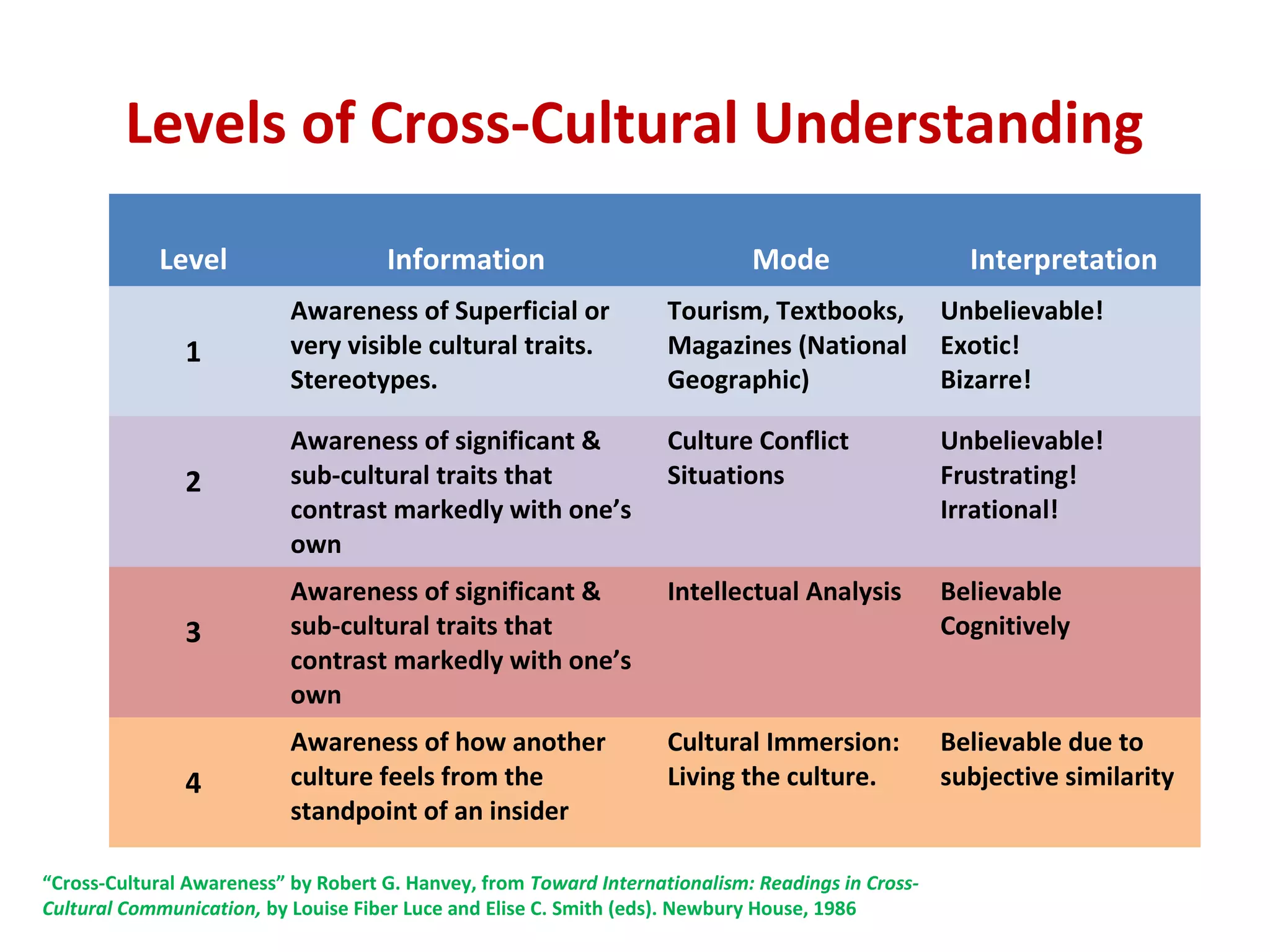
Levels of Cross-Cultural Understanding
            Level                    Information                             Mode                    Interpretation
                           Awareness of Superficial or              Tourism, Textbooks,            Unbelievable!
               1           very visible cultural traits.            Magazines (National            Exotic!
                           Stereotypes.                             Geographic)                    Bizarre!

                           Awareness of significant &               Culture Conflict               Unbelievable!
               2           sub-cultural traits that                 Situations                     Frustrating!
                           contrast markedly with one’s                                            Irrational!
                           own
                           Awareness of significant &               Intellectual Analysis          Believable
               3           sub-cultural traits that                                                Cognitively
                           contrast markedly with one’s
                           own
                           Awareness of how another                 Cultural Immersion:            Believable due to
               4           culture feels from the                   Living the culture.            subjective similarity
                           standpoint of an insider

“Cross-Cultural Awareness” by Robert G. Hanvey, from Toward Internationalism: Readings in Cross-
Cultural Communication, by Louise Fiber Luce and Elise C. Smith (eds). Newbury House, 1986
Seven Dimensions of Intercultural
            Competence
1.The capacity to be flexible
2.The capacity to be non-judgmental
3.Tolerance for ambiguity
4.The capacity to communicate respect
5.The capacity to personalize one’s
  knowledge and perceptions
6.The capacity to display empathy
7.The capacity for turn taking
“Guidelines for Cross-Cultural Communication Effectiveness” by Brent D. Ruben, from
Toward Internationalism: Readings in Cross-Cultural Communication, by Louise Fiber Luce
and Elise C. Smith (eds). Newbury House, 1986
Seven Steps in Intercultural Interactions
  1. Establishing contact and communication
  2. Establishing Bona Fide friends and being
     accepted into the community
  3. Observing what is going on around oneself
     and making meaning from those experiences
  4. Establishing a role in the host society
  5. Gaining consciousness of oneself as a
     cultural being and taking responsibility
  6. Developing needed skills and traits
  7. Developing meaningful relationships
  “Seven Concepts in Cross-Cultural Interaction” by Theodore Gochenour and Anne Janeway, from Beyond
  CultureS. Experiment Press, 1973
Culture Bump
Occurs when an individual from one culture finds him/herself in a different,
strange , or uncomfortable situation when interacting with persons of a
different culture. This phenomenon results from a difference in the way
people from one culture behave in a particular situation from people in
another culture. Can be

   • Negative
   • Positive
   • Neutral

Unlike Culture Shock, which extends over an extended period of time,
culture bumps are instantaneous, usually over within minutes or seconds,
though the effect may be long-lasting, and can occur anytime one is in
contact with members of a different culture.
“Culture Bump and Beyond” by Carol M. Archer, from Culture Bound: Bridging the Cultural Gap in Language Teaching, by
Joyce M. Valdes (Ed.). Cambridge University Press, 1986
Recognizing a Culture Bump
1. Pinpoint some time when I have felt “different” or
   noticed something different when I was with
   someone from a different culture.
2. Define the situation
3. List the behaviors of the other person
4. List my own behavior
5. List my feelings in the situation
6. List the behaviors I expect from people in my own
   culture in the same situation
7. Reflect on the underlying value in my own culture
   that prompts that behavior expectation.
“Culture Bump and Beyond” by Carol M. Archer, from Culture Bound: Bridging the Cultural Gap in Language Teaching, by
Joyce M. Valdes (Ed.). Cambridge University Press, 1986
Multicultural Man
“It suggests a human being whose
identifications and loyalties transcend
the boundaries of nationalism and whose
commitments are pinned to a vision of
the world as a global community.”


“Beyond Cultural Identity: Reflections on Cultural and Multicultural Man” by Peter
S. Adler, from Intercultural Communication: A Reader (3rd Edition), by Larry A.
Samovar and Richard E. Porter. Wadsworth Publishing, 1982
Multicultural Man
“Nation, culture, and society exert tremendous
influence on each of our lives, structuring our values,
engineering our view of the world, and patterning our
responses to experience. No human being can hold
himself apart from some form of cultural influence.
No one is culture free. Yet the conditions of
contemporary history are such that we may now be
on the threshold of a new kind of person, a person
who is socially and psychologically a product of the
interweaving of cultures in the twentieth century.”
“Beyond Cultural Identity: Reflections on Cultural and Multicultural Man” by Peter
S. Adler, from Intercultural Communication: A Reader (3rd Edition), by Larry A.
Samovar and Richard E. Porter. Wadsworth Publishing, 1982
Multicultural Man
“What is universal about the multicultural person is
his abiding commitment to essential similarities
between people everywhere, while paradoxically
maintaining an equally strong commitment to their
differences. The universal person, suggests Walsh,
‘does not at all eliminate culture differences.’ Rather,
he ‘seeks to preserve whatever is most valid,
significant, and valuable in each culture as a way of
enriching and helping to form the whole.’ ”
“Beyond Cultural Identity: Reflections on Cultural and Multicultural Man” by Peter
S. Adler, from Intercultural Communication: A Reader (3rd Edition), by Larry A.
Samovar and Richard E. Porter. Wadsworth Publishing, 1982
The Marginal Person
“A marginal person is thought of as one whose actions do not reflect well
any one culture.”

“Marginal persons can be tragic or they can be advantaged. They may fall
as well as they may rise.”

“Marginal people who fall may be rootless or alienated; those who rise
may be synthesizers. They do not have to act entirely like members of any
particular group, majority or minority. Therefore, they can transcend
boundaries, see new patterns, and attempt to bridge gaps…. Marginal
people are generally broadminded and unchauvinistic.”

“Marginality is an essential component in a healthy social system.”


“Marginality and Multiculturalism: Another Look at Bilingual/Bicultural Education” by John Lum, from Intercultural
Communication: A Reader (3rd Edition), by Larry A. Samovar and Richard E. Porter. Wadsworth Publishing, 1982
Cultural Identity
      “Why are race and ethnic identity so powerful?”
“They think they are maximizing their identities when they
relate primarily to similar persons. In reality, however, they
are limiting the range of their identity.”

“It must be contended, however, that emphasizing one’s own
cultural and linguistic heritage does not of itself lead that one
to be multicultural or pluralistic. If anything, without balance,
such emphasis might even lead one to mono-ethnic
chauvinism or ethnocentrism.”

“Marginality and Multiculturalism: Another Look at Bilingual/Bicultural Education” by John Lum, from Intercultural
Communication: A Reader (3rd Edition), by Larry A. Samovar and Richard E. Porter. Wadsworth Publishing, 1982
Kinesics: Non-Verbal Communication
• Postural differences
• Movement: e.g. Styles of walking
  • French perceive American walk as “bouncing” and
    “uncivilized.”
  • Spanish Americans perceive it as “Authoritarian.”
• Gestures
• Facial Expressions
• Eye management
• Proxemics (distancing)
“Kinesics and Cross Cultural Communication” by Gennelle G. Morain, from Intercultural Communication: A Reader (3rd
Edition), by Larry A. Samovar and Richard E. Porter. Wadsworth Publishing, 1982
Research Methodology: Exploration

1. Observation
  – Watching
  – Noticing
  – Perceiving
                      2. Inquiry
                      Asking Questions
Observation Versus Interpretation
       • Observation – Perception
      • Interpretation – Conception
T he Experiential Lear ning
                  Cycle
                        Concrete Experience


Testing Implications                                   Observation
of Concepts in New                                    and Reflection
Situations
(Experimentation)


                          Formation of Abstract
                       Concepts and Generalizations
T he Experiential Lear ning Cycle
                             Concrete
                             Experience

                  Teachers           Artists,
                                     Musicians,
                                     Psychologists
           Businesspeople


    Active
                                                 Reflective
Experimentation
                                                Observation
                                            Sociologists
                                            Anthropologists

                   Engineers              Scientists

                      Formations of
                     Abstract Concepts
                     & Generalizations
Feeling
  Perception
 Apprehensio
       n
 (observation)


    -prehension


   Thinking
  Conception
Comprehension
(Interpretation)
Two Ways of Knowing:
         A pprehension & Compr ehension

The prehension dimension refers to the way in which the individual
grasps experience. This dimension can be seen as two modes of
knowing, ranging from what Kolb calls grasping via “apprehension”
to what he calls grasping via “comprehension.” Apprehension is
instant intuitive knowledge without a need for rational inquiry or
analytical confirmation. The other end of the dimension,
grasping via comprehension, on the other hand, emphasizes the
role of conscious learning, whereby comprehension introduces
order and predictability to the flow of unconscious sensations. This
dimension is thus concerned with the ways of grasping reality
through the varying degrees of emphasis on unconscious and
conscious learning.
(Kohonen, Experiential language lear ning: second language
lear ning as cooperative lear ner education . 1992, p. 16)
Praxis
             “reflection and action upon the world in
                      order to transform it.”
                                            Paulo Freire


Action                       Praxis                        Reflection
(Activism)                                                 (Verbalism)
Models of Teaching & Learning


One "way in" to this distinction which I have found helpful is to define it in terms of Wallace's
(1991) three models of teacher learning: the applied science, craft, and reflective models.
According to the applied science model, teachers learn to be teachers by being taught research-
based theories, and then applying them in practice: The implication is that the most important
professional knowledge is generalizable theory. The craft model means learning teaching in the
way apprentices learn crafts like shoemaking or carpentry: The novice watches and imitates a
master teacher, and obeys the latter's directions for improvement. Here the implication is that
teaching is mainly a practical skill. Finally we have the reflection model, according to which
teachers learn by reflecting on their own experience and applying what they have learned in
order to develop their professional abilities further.

Penny Ur 1997 “Teacher Training and Teacher Development: A Useful Dichotomy?” The Language
Teacher.
The Outside World
              Expert Practice              Ur’s Optimal Teaching &
              Anecdote, etc.                   Learning Model

                                  Concrete
                                  Experience
                                                                Critical
                                                                Observation


                        The Learner
           Active                                    Reflective
       Experimentation                              Observation


 Research,
 Experiment

                                   Abstract
                                Conceptualization
                                                         Theories,
                                                         Abstract Concepts
Optimal Learning
…to learn only from oneself is limited: One needs also to take
advantage of the enormous amount of … knowledge and expertise
“out there” waiting to be tapped. Your own experience can be
enriched by hearing, seeing, or reading about the experiences of
others: your reflections on your own or other’s performance can be
enriched by other people’s critical observations; you can discover
some beautiful theories through reading the literature or listening to
lecturers that help you understand what you are doing; you can
supplement your own experimentation by finding out about the
experiments of researchers. Such knowledge cannot be taken on
board simply through reading or hearing about it. In order for it to
function as real knowledge and not just as inert items of information,
you need to process it through your own experience, reflection,
conceptualization, and experimentation and to construct your own
understanding of it.
Penny Ur 1997 “Teacher Training and Teacher Development: A
Useful Dichotomy?” The Language Teacher.
The End

Thank You Very Much

Intercultural communication and understanding 101

  • 1.
    Inter cultur alCommunication and Under standing 101 By Paul Raymond Doyon Utsunomiya University Honors English Camp 2010
  • 2.
    What is Culture? •Culture with a Big C: (“Formal Culture”) – (“The Best in Human Life”) – The History, Fine Arts • Culture with a Little c: (“Deep Culture”) – (“Everything in Human Life) • (Patterns of Daily Living; Value Systems) – The Society: • Behavior • Attitudes • Beliefs • Values “Commitment to the Teaching of Foreign Cultures” by Genelle Morain from The Modern Language Journal, University of Wisconsin Press, 1983
  • 3.
    What is Cross-CulturalAwareness? • Does Contact lead to Understanding? – Not necessarily. • What else is needed? – RESPECT – PARTICIPATION – EMPATHY (Ability to imagine oneself in another role) – Individual Plasticity – Tolerance for Ambiguity “Cross-Cultural Awareness” by Robert G. Hanvey, from Toward Internationalism: Readings in Cross-Cultural Communication, by Louise Fiber Luce and Elise C. Smith (eds). Newbury House, 1986
  • 4.
    Does Cross-Cultural Awareness Matter? • “Yes, cross-cultural awareness does matter, for the following major reason if for no other. Several million years of evolution seem to have produced in us a creature that does not easily recognize the members of its own species. That is stated in rather exaggerated form, but it refers to the fact that human groups commonly have difficulty in accepting the humanness of other human groups.” “Cross-Cultural Awareness” by Robert G. Hanvey, from Toward Internationalism: Readings in Cross-Cultural Communication, by Louise Fiber Luce and Elise C. Smith (eds). Newbury House, 1986
  • 5.
    Does Cross-Cultural Awareness Matter? • “For example, we need to discover the extent to which our thinking is bound by a culture. Cultures are good in many ways. But, to the extent that they lock us in to one way of looking at the world, we need to transcend them. We need to think beyond them. Why is this important? It’s important because we, as creatures, are deeply determined -- in our life, and in our behavior, and in our character, and in other ways – are determined by our thinking. We have no choice but to be governed by thought. The question is, do we govern the thought that governs us? Ideas control us ... Do we control them? ” • “Critical Thinking in Every Domain of Knowledge and Belief” The 27th Annual International Conference on Critical Thinking -- July 23 -- 26, 2007 Keynote Address -- July 23, 2007 Richard Paul, Director of Research and Professional Development at the Center for Critical Thinking, Chair of the National Council for Excellence in Critical Thinking
  • 6.
    Does Cross-Cultural Awareness Matter? • “We call a group of primitives in northern North America, Eskimos; this name, originated by certain Indians to the south of the Eskimos, means ‘Eaters of Raw Flesh.’ However, the Eskimos’ own name for themselves is not Eskimos but Inupik, meaning ‘Real People.’ By their name they provide a contrast between themselves and other groups; the latter might be ‘people’ but are never ‘real’.” “Cross-Cultural Awareness” by Robert G. Hanvey, from Toward Internationalism: Readings in Cross-Cultural Communication, by Louise Fiber Luce and Elise C. Smith (eds). Newbury House, 1986
  • 7.
    Does Cross-Cultural Awareness Matter? “Consider the phenomenon -- which is worldwide -- of patriotic history. Patriotic history -- at least in my conception of patriotic history -- consists in telling the story of our past in such ways as to make us look much better than we are and to take those who have come into conflict with us and represent them as worse than they were and are. In other words, patriotic history is dishonest history that makes us, unjustifiably, feel good about ourselves. This is what most societies want of their historians. Tell us about the past so we can see how heroic we are. Fine and good, but what does that imply about others. If we are the chosen people, then everyone else is not chosen. If we're number one, then everyone else is below us. If we're the most important, then others are unimportant or of lesser importance. And so, to penetrate history critically -- to see its dangers, and to see its values, and to be able to think with a different sort of framework -- is certainly crucial to our well being. “ “Critical Thinking in Every Domain of Knowledge and Belief” The 27th Annual International Conference on Critical Thinking -- July 23 -- 26, 2007 Keynote Address -- July 23, 2007 Richard Paul, Director of Research and Professional Development at the Center for Critical Thinking, Chair of the National Council for Excellence in Critical Thinking
  • 8.
    Achieving Understanding! Initial Willingness to Respect Local Ways & Viewpoints Rewards: Internal And Community Approval Participation (which is a concrete demonstration of respect.) Advanced Participation: “Cross-Cultural Living the Culture Awareness” by Robert G. Hanvey, from Toward Internationalism: Readings in Cross-Cultural Communication, by Louise Fiber Luce and Elise C. Depth Understanding: Smith (eds). Newbury “Inside the Head” of the Host Society House, 1986
  • 9.
    Levels of Cross-CulturalUnderstanding Level Information Mode Interpretation Awareness of Superficial or Tourism, Textbooks, Unbelievable! 1 very visible cultural traits. Magazines (National Exotic! Stereotypes. Geographic) Bizarre! Awareness of significant & Culture Conflict Unbelievable! 2 sub-cultural traits that Situations Frustrating! contrast markedly with one’s Irrational! own Awareness of significant & Intellectual Analysis Believable 3 sub-cultural traits that Cognitively contrast markedly with one’s own Awareness of how another Cultural Immersion: Believable due to 4 culture feels from the Living the culture. subjective similarity standpoint of an insider “Cross-Cultural Awareness” by Robert G. Hanvey, from Toward Internationalism: Readings in Cross- Cultural Communication, by Louise Fiber Luce and Elise C. Smith (eds). Newbury House, 1986
  • 10.
    Seven Dimensions ofIntercultural Competence 1.The capacity to be flexible 2.The capacity to be non-judgmental 3.Tolerance for ambiguity 4.The capacity to communicate respect 5.The capacity to personalize one’s knowledge and perceptions 6.The capacity to display empathy 7.The capacity for turn taking “Guidelines for Cross-Cultural Communication Effectiveness” by Brent D. Ruben, from Toward Internationalism: Readings in Cross-Cultural Communication, by Louise Fiber Luce and Elise C. Smith (eds). Newbury House, 1986
  • 11.
    Seven Steps inIntercultural Interactions 1. Establishing contact and communication 2. Establishing Bona Fide friends and being accepted into the community 3. Observing what is going on around oneself and making meaning from those experiences 4. Establishing a role in the host society 5. Gaining consciousness of oneself as a cultural being and taking responsibility 6. Developing needed skills and traits 7. Developing meaningful relationships “Seven Concepts in Cross-Cultural Interaction” by Theodore Gochenour and Anne Janeway, from Beyond CultureS. Experiment Press, 1973
  • 12.
    Culture Bump Occurs whenan individual from one culture finds him/herself in a different, strange , or uncomfortable situation when interacting with persons of a different culture. This phenomenon results from a difference in the way people from one culture behave in a particular situation from people in another culture. Can be • Negative • Positive • Neutral Unlike Culture Shock, which extends over an extended period of time, culture bumps are instantaneous, usually over within minutes or seconds, though the effect may be long-lasting, and can occur anytime one is in contact with members of a different culture. “Culture Bump and Beyond” by Carol M. Archer, from Culture Bound: Bridging the Cultural Gap in Language Teaching, by Joyce M. Valdes (Ed.). Cambridge University Press, 1986
  • 13.
    Recognizing a CultureBump 1. Pinpoint some time when I have felt “different” or noticed something different when I was with someone from a different culture. 2. Define the situation 3. List the behaviors of the other person 4. List my own behavior 5. List my feelings in the situation 6. List the behaviors I expect from people in my own culture in the same situation 7. Reflect on the underlying value in my own culture that prompts that behavior expectation. “Culture Bump and Beyond” by Carol M. Archer, from Culture Bound: Bridging the Cultural Gap in Language Teaching, by Joyce M. Valdes (Ed.). Cambridge University Press, 1986
  • 14.
    Multicultural Man “It suggestsa human being whose identifications and loyalties transcend the boundaries of nationalism and whose commitments are pinned to a vision of the world as a global community.” “Beyond Cultural Identity: Reflections on Cultural and Multicultural Man” by Peter S. Adler, from Intercultural Communication: A Reader (3rd Edition), by Larry A. Samovar and Richard E. Porter. Wadsworth Publishing, 1982
  • 15.
    Multicultural Man “Nation, culture,and society exert tremendous influence on each of our lives, structuring our values, engineering our view of the world, and patterning our responses to experience. No human being can hold himself apart from some form of cultural influence. No one is culture free. Yet the conditions of contemporary history are such that we may now be on the threshold of a new kind of person, a person who is socially and psychologically a product of the interweaving of cultures in the twentieth century.” “Beyond Cultural Identity: Reflections on Cultural and Multicultural Man” by Peter S. Adler, from Intercultural Communication: A Reader (3rd Edition), by Larry A. Samovar and Richard E. Porter. Wadsworth Publishing, 1982
  • 16.
    Multicultural Man “What isuniversal about the multicultural person is his abiding commitment to essential similarities between people everywhere, while paradoxically maintaining an equally strong commitment to their differences. The universal person, suggests Walsh, ‘does not at all eliminate culture differences.’ Rather, he ‘seeks to preserve whatever is most valid, significant, and valuable in each culture as a way of enriching and helping to form the whole.’ ” “Beyond Cultural Identity: Reflections on Cultural and Multicultural Man” by Peter S. Adler, from Intercultural Communication: A Reader (3rd Edition), by Larry A. Samovar and Richard E. Porter. Wadsworth Publishing, 1982
  • 17.
    The Marginal Person “Amarginal person is thought of as one whose actions do not reflect well any one culture.” “Marginal persons can be tragic or they can be advantaged. They may fall as well as they may rise.” “Marginal people who fall may be rootless or alienated; those who rise may be synthesizers. They do not have to act entirely like members of any particular group, majority or minority. Therefore, they can transcend boundaries, see new patterns, and attempt to bridge gaps…. Marginal people are generally broadminded and unchauvinistic.” “Marginality is an essential component in a healthy social system.” “Marginality and Multiculturalism: Another Look at Bilingual/Bicultural Education” by John Lum, from Intercultural Communication: A Reader (3rd Edition), by Larry A. Samovar and Richard E. Porter. Wadsworth Publishing, 1982
  • 18.
    Cultural Identity “Why are race and ethnic identity so powerful?” “They think they are maximizing their identities when they relate primarily to similar persons. In reality, however, they are limiting the range of their identity.” “It must be contended, however, that emphasizing one’s own cultural and linguistic heritage does not of itself lead that one to be multicultural or pluralistic. If anything, without balance, such emphasis might even lead one to mono-ethnic chauvinism or ethnocentrism.” “Marginality and Multiculturalism: Another Look at Bilingual/Bicultural Education” by John Lum, from Intercultural Communication: A Reader (3rd Edition), by Larry A. Samovar and Richard E. Porter. Wadsworth Publishing, 1982
  • 19.
    Kinesics: Non-Verbal Communication •Postural differences • Movement: e.g. Styles of walking • French perceive American walk as “bouncing” and “uncivilized.” • Spanish Americans perceive it as “Authoritarian.” • Gestures • Facial Expressions • Eye management • Proxemics (distancing) “Kinesics and Cross Cultural Communication” by Gennelle G. Morain, from Intercultural Communication: A Reader (3rd Edition), by Larry A. Samovar and Richard E. Porter. Wadsworth Publishing, 1982
  • 20.
    Research Methodology: Exploration 1.Observation – Watching – Noticing – Perceiving 2. Inquiry Asking Questions
  • 21.
    Observation Versus Interpretation • Observation – Perception • Interpretation – Conception
  • 22.
    T he ExperientialLear ning Cycle Concrete Experience Testing Implications Observation of Concepts in New and Reflection Situations (Experimentation) Formation of Abstract Concepts and Generalizations
  • 23.
    T he ExperientialLear ning Cycle Concrete Experience Teachers Artists, Musicians, Psychologists Businesspeople Active Reflective Experimentation Observation Sociologists Anthropologists Engineers Scientists Formations of Abstract Concepts & Generalizations
  • 24.
    Feeling Perception Apprehensio n (observation) -prehension Thinking Conception Comprehension (Interpretation)
  • 25.
    Two Ways ofKnowing: A pprehension & Compr ehension The prehension dimension refers to the way in which the individual grasps experience. This dimension can be seen as two modes of knowing, ranging from what Kolb calls grasping via “apprehension” to what he calls grasping via “comprehension.” Apprehension is instant intuitive knowledge without a need for rational inquiry or analytical confirmation. The other end of the dimension, grasping via comprehension, on the other hand, emphasizes the role of conscious learning, whereby comprehension introduces order and predictability to the flow of unconscious sensations. This dimension is thus concerned with the ways of grasping reality through the varying degrees of emphasis on unconscious and conscious learning. (Kohonen, Experiential language lear ning: second language lear ning as cooperative lear ner education . 1992, p. 16)
  • 26.
    Praxis “reflection and action upon the world in order to transform it.” Paulo Freire Action Praxis Reflection (Activism) (Verbalism)
  • 27.
    Models of Teaching& Learning One "way in" to this distinction which I have found helpful is to define it in terms of Wallace's (1991) three models of teacher learning: the applied science, craft, and reflective models. According to the applied science model, teachers learn to be teachers by being taught research- based theories, and then applying them in practice: The implication is that the most important professional knowledge is generalizable theory. The craft model means learning teaching in the way apprentices learn crafts like shoemaking or carpentry: The novice watches and imitates a master teacher, and obeys the latter's directions for improvement. Here the implication is that teaching is mainly a practical skill. Finally we have the reflection model, according to which teachers learn by reflecting on their own experience and applying what they have learned in order to develop their professional abilities further. Penny Ur 1997 “Teacher Training and Teacher Development: A Useful Dichotomy?” The Language Teacher.
  • 28.
    The Outside World Expert Practice Ur’s Optimal Teaching & Anecdote, etc. Learning Model Concrete Experience Critical Observation The Learner Active Reflective Experimentation Observation Research, Experiment Abstract Conceptualization Theories, Abstract Concepts
  • 29.
    Optimal Learning …to learnonly from oneself is limited: One needs also to take advantage of the enormous amount of … knowledge and expertise “out there” waiting to be tapped. Your own experience can be enriched by hearing, seeing, or reading about the experiences of others: your reflections on your own or other’s performance can be enriched by other people’s critical observations; you can discover some beautiful theories through reading the literature or listening to lecturers that help you understand what you are doing; you can supplement your own experimentation by finding out about the experiments of researchers. Such knowledge cannot be taken on board simply through reading or hearing about it. In order for it to function as real knowledge and not just as inert items of information, you need to process it through your own experience, reflection, conceptualization, and experimentation and to construct your own understanding of it. Penny Ur 1997 “Teacher Training and Teacher Development: A Useful Dichotomy?” The Language Teacher.
  • 30.