Making Maths
Accessible to All:
STEMReader
project
Accessible to all…
but what does “Accessible”
mean?
When something is accessible, it means it’s usable by
everyone (UK Government Digital Inclusion Strategy, 2014)
1. able to be reached or entered.
2. able to be easily obtained or used.
3. easily understood or appreciated.
4. able to be reached, entered, or used by people who
have a disability
“Assistive technology” = in this case technology that
allows users to access content in different formats
sometimes known as alternative/multiple formats.
Potential barriers to success
• Visually impaired students – 23,500 in FE
• Specific learning difficulties – 161,300 in FE
• Students with English as a second language
How large is the problem?
– Apprenticeship success rate 4.4% lower for
dyslexia/dyscalculia; 5.1% for VI – differential
increasing
– 61% of apprenticeships in business, health and
engineering sectors
– Estimate 132 000 print disabled post-16 students
studying STEM subjects
Do difficulties with reading
impact maths learning?
• Maths is a visual subject…. Learners with impaired
sight need additional support
• But other students impacted by difficulties with
reading, with 10% of population estimated to be
impacted by a SpLD
– 55 000 GCSE candidates a year require reading
support; 100 000+ receive extra time
– 161 000 students in FE with SpLD
– 4% of HE student population receives support
for SpLD
Access Arrangements for
qualifications
“Computer readers” (text to speech) are
– allowed in all GCSEs, including English
– candidates who qualify for a reader & it is their
usual way of working.
Potential impact (Runshaw College, Learning Futures
Project):
“Being offered a computer reader takes away the
embarrassment, or the stigma, of requiring someone to sit with
you in the exam to read the question.”
“Using the software improved my mark. I got a grade C (in the
mock exam) and I’ve never had a C on a paper before.”
“Becoming an adult, I feel it has helped me to become more
independent, preparing me for getting a job”
Runshaw College project
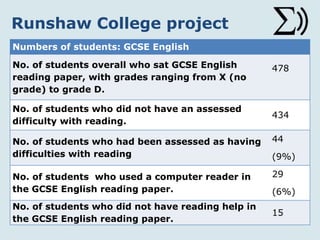
Numbers of students: GCSE English
No. of students overall who sat GCSE English
reading paper, with grades ranging from X (no
grade) to grade D.
478
No. of students who did not have an assessed
difficulty with reading.
434
No. of students who had been assessed as having
difficulties with reading
44
(9%)
No. of students who used a computer reader in
the GCSE English reading paper.
29
(6%)
No. of students who did not have reading help in
the GCSE English reading paper.
15
Runshaw College project
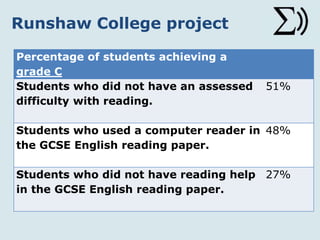
Percentage of students achieving a
grade C
Students who did not have an assessed
difficulty with reading.
51%
Students who used a computer reader in
the GCSE English reading paper.
48%
Students who did not have reading help
in the GCSE English reading paper.
27%
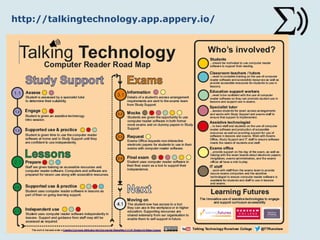
http://talkingtechnology.app.appery.io/
But reading assistance in
maths is limited, why?
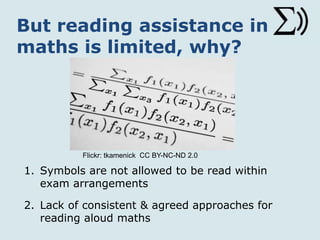
1. Symbols are not allowed to be read within
exam arrangements
2. Lack of consistent & agreed approaches for
reading aloud maths
Flickr: tkamenick CC BY-NC-ND 2.0
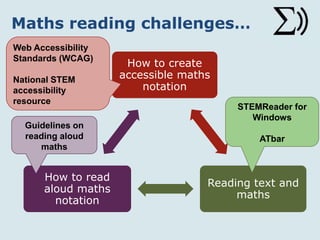
Maths reading challenges…
How to create
accessible maths
notation
Reading text and
maths
How to read
aloud maths
notation
STEMReader for
Windows
ATbar
Guidelines on
reading aloud
maths
Web Accessibility
Standards (WCAG)
National STEM
accessibility
resource
STEMReader project
Develop a usable, sustainable tool for reading aloud maths
notation to use alongside their current support strategies.
Goals:
• Improve solutions for reading aloud maths notation for
students studying from functional skills through to degree
level maths and science
• Platform independent tool for rendering & speaking MathML
with definitions and suitable reading rules
• User-centred design throughout user trials throughout
development
• Due to launch May 2016
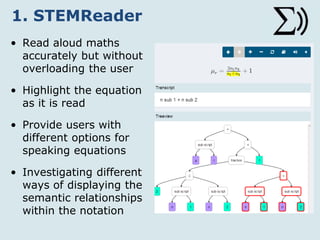
1. STEMReader
• Read aloud maths
accurately but without
overloading the user
• Highlight the equation
as it is read
• Provide users with
different options for
speaking equations
• Investigating different
ways of displaying the
semantic relationships
within the notation
2. Reading guidance on
maths equations
• Currently no guidance on reading aloud maths to
support learners in the UK (rules available for the
US)
• Reading aloud tests and exams - must consider
assessment criteria. Access arrangements state:
“reader must not decode any symbols and unit
abbreviations, e.g. 22 should not be read as two
squared, but the function simply pointed to by the
reader. Part of the assessment is recognising
what the superscript 2 means”
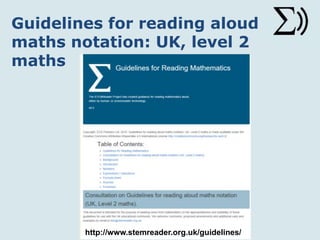
Guidelines for reading aloud
maths notation: UK, level 2
maths
http://www.stemreader.org.uk/guidelines/
3. ATBar for reading
assistance
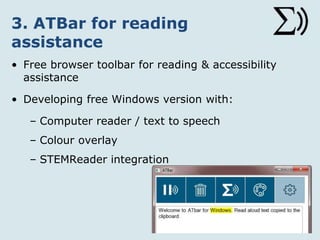
• Free browser toolbar for reading & accessibility
assistance
• Developing free Windows version with:
– Computer reader / text to speech
– Colour overlay
– STEMReader integration
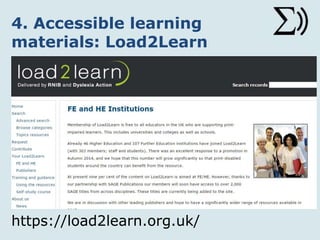
4. Accessible learning
materials: Load2Learn
https://load2learn.org.uk/
Interested in trialling
STEMReader & ATbar?
www.stemreader.org.uk
info@stemreader.co.uk
Abi James, Teresa Binks and E.A. Draffan
University of Southampton
http://www.slideshare.net/eadraffan/collaboration-to-
enhance-digital-accessibility

Making maths accessible to all

  • 1.
    Making Maths Accessible toAll: STEMReader project
  • 2.
    Accessible to all… butwhat does “Accessible” mean? When something is accessible, it means it’s usable by everyone (UK Government Digital Inclusion Strategy, 2014) 1. able to be reached or entered. 2. able to be easily obtained or used. 3. easily understood or appreciated. 4. able to be reached, entered, or used by people who have a disability “Assistive technology” = in this case technology that allows users to access content in different formats sometimes known as alternative/multiple formats.
  • 3.
    Potential barriers tosuccess • Visually impaired students – 23,500 in FE • Specific learning difficulties – 161,300 in FE • Students with English as a second language How large is the problem? – Apprenticeship success rate 4.4% lower for dyslexia/dyscalculia; 5.1% for VI – differential increasing – 61% of apprenticeships in business, health and engineering sectors – Estimate 132 000 print disabled post-16 students studying STEM subjects
  • 4.
    Do difficulties withreading impact maths learning? • Maths is a visual subject…. Learners with impaired sight need additional support • But other students impacted by difficulties with reading, with 10% of population estimated to be impacted by a SpLD – 55 000 GCSE candidates a year require reading support; 100 000+ receive extra time – 161 000 students in FE with SpLD – 4% of HE student population receives support for SpLD
  • 5.
    Access Arrangements for qualifications “Computerreaders” (text to speech) are – allowed in all GCSEs, including English – candidates who qualify for a reader & it is their usual way of working. Potential impact (Runshaw College, Learning Futures Project): “Being offered a computer reader takes away the embarrassment, or the stigma, of requiring someone to sit with you in the exam to read the question.” “Using the software improved my mark. I got a grade C (in the mock exam) and I’ve never had a C on a paper before.” “Becoming an adult, I feel it has helped me to become more independent, preparing me for getting a job”
  • 6.
    Runshaw College project Numbersof students: GCSE English No. of students overall who sat GCSE English reading paper, with grades ranging from X (no grade) to grade D. 478 No. of students who did not have an assessed difficulty with reading. 434 No. of students who had been assessed as having difficulties with reading 44 (9%) No. of students who used a computer reader in the GCSE English reading paper. 29 (6%) No. of students who did not have reading help in the GCSE English reading paper. 15
  • 7.
    Runshaw College project Percentageof students achieving a grade C Students who did not have an assessed difficulty with reading. 51% Students who used a computer reader in the GCSE English reading paper. 48% Students who did not have reading help in the GCSE English reading paper. 27%
  • 8.
  • 9.
    But reading assistancein maths is limited, why? 1. Symbols are not allowed to be read within exam arrangements 2. Lack of consistent & agreed approaches for reading aloud maths Flickr: tkamenick CC BY-NC-ND 2.0
  • 10.
    Maths reading challenges… Howto create accessible maths notation Reading text and maths How to read aloud maths notation STEMReader for Windows ATbar Guidelines on reading aloud maths Web Accessibility Standards (WCAG) National STEM accessibility resource
  • 11.
    STEMReader project Develop ausable, sustainable tool for reading aloud maths notation to use alongside their current support strategies. Goals: • Improve solutions for reading aloud maths notation for students studying from functional skills through to degree level maths and science • Platform independent tool for rendering & speaking MathML with definitions and suitable reading rules • User-centred design throughout user trials throughout development • Due to launch May 2016
  • 12.
    1. STEMReader • Readaloud maths accurately but without overloading the user • Highlight the equation as it is read • Provide users with different options for speaking equations • Investigating different ways of displaying the semantic relationships within the notation
  • 13.
    2. Reading guidanceon maths equations • Currently no guidance on reading aloud maths to support learners in the UK (rules available for the US) • Reading aloud tests and exams - must consider assessment criteria. Access arrangements state: “reader must not decode any symbols and unit abbreviations, e.g. 22 should not be read as two squared, but the function simply pointed to by the reader. Part of the assessment is recognising what the superscript 2 means”
  • 14.
    Guidelines for readingaloud maths notation: UK, level 2 maths http://www.stemreader.org.uk/guidelines/
  • 15.
    3. ATBar forreading assistance • Free browser toolbar for reading & accessibility assistance • Developing free Windows version with: – Computer reader / text to speech – Colour overlay – STEMReader integration
  • 16.
    4. Accessible learning materials:Load2Learn https://load2learn.org.uk/
  • 17.
    Interested in trialling STEMReader& ATbar? www.stemreader.org.uk info@stemreader.co.uk Abi James, Teresa Binks and E.A. Draffan University of Southampton http://www.slideshare.net/eadraffan/collaboration-to- enhance-digital-accessibility

Editor's Notes

  • #4 Visually impaired students – 23,500 in FE Specific learning difficulties – dyslexia & dyscalculia – 161,300 in FE Students with English as a second language How large is the problem? Apprenticeship success rate 4.4% lower for dyslexia/dyscalculia; 5.1% for VI – differential increasing 61% of apprenticeships in business, health and engineering sectors Students studying degrees in STEM – disabled students 3.3% less achieve 1st/2:1 than non-disabled students 4% of FE students have dyslexia, dyscalculia or VI - 184 800 est 50% on STEM – 92 400 students 81 000 disabled HE students studying STEM subjects – 48.5% SpLD and VI = 39 300 students ~ 131 700 STEM print disabled post -16 students If every print disabled STEM students needs 2 hours of reader support @ £20 per hour a year = £5.3M p.a.
  • #5 Apprenticeship success rate 4.4% lower for dyslexia/dyscalculia; 5.1% for VI – differential increasing
  • #7 Difficulties with reading = qualify for reader support = (i.e. standardised score of less than 85 on a nationally standardised test of either single word reading, reading comprehension or reading speed). Numbers of students: GCSE English   No. of students overall who sat GCSE English reading paper, with grades ranging from X (no grade) to grade D. 478   No. of students who did not have an assessed difficulty with reading. 434 No. of students who had been assessed as having difficulties with reading 44 (9%) No. of students who used a computer reader in the GCSE English reading paper. 29 (6%) No. of students who did not have reading help in the GCSE English reading paper. 15
  • #8 Percentage of students achieving a grade C   Students who did not have an assessed difficulty with reading.   51% Students who used a computer reader in the GCSE English reading paper.   48% Students who did not have reading help in the GCSE English reading paper. 27%