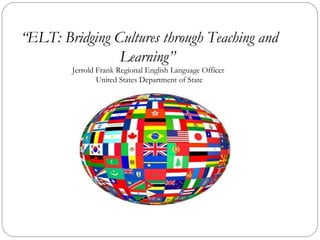
“ELT: Bridging Cultures through Teaching and
                Learning”
        Jerrold Frank Regional English Language Officer
                United States Department of State
What is Culture?
Culture is a set of common beliefs and
 values that is shared by a group of people
 that binds them together into a society. All
 people are members of at least one culture.
 The norms of a culture define roles and
 provide a framework that makes people’s
 behavior predictable and understandable to
 one another.
John Bodley (1994): Diverse
                         Definitions
              Culture consists of everything on a list of topics, or categories, such as
Topical:
              social organization, religion, or economy
              Culture is social heritage, or tradition, that is passed on to future
Historical:
              generations
Behavioral:   Culture is shared, learned human behavior, a way of life
Normative:    Culture is ideals, values, or rules for living
              Culture is the way humans solve problems of adapting to the
Functional:
              environment or living together
              Culture is a complex of ideas, or learned habits, that inhibit impulses
Mental:
              and distinguish people from animals
              Culture consists of patterned and interrelated ideas, symbols, or
Structural:
              behaviors
              Culture is based on arbitrarily assigned meanings that are shared by a
Symbolic:
              society
Sapir-Whorf Hypothesis
Sapir (1921): “Human beings do not
 live in the objective world alone, nor
 alone in the world of social activity as
 ordinarily understood, but are very
 much at the mercy of the particular
 language which has become the
 medium of expression in that society.”
As a result of differences in language, people
 in different cultures will think about, perceive,
 and behave toward the world differently.
Reality itself is already embedded in language
 and therefore comes preformed.
Language determines, enabling and
 constraining, what is perceived and attended
 to in a culture, as well as the upper limits of
 knowledge.
Culture Shapes…
The way we think
The way we interact
The way we communicate
The way we transmit knowledge to
 the next generation
Culture Affects…
The organization of learning
Pedagogical practices
Evaluation procedures
Rules of schools
Instructional activities and curriculum
First Step in Cultural Awareness
Understanding the values and rules for
 behavior of our own culture that are so
 ingrained that we feel they are “normal” or
 the “right” way of doing things.
The Iceberg Model of Culture
Surface Culture
Above the Surface


 Deep Culture
 Unspoken Rules
 Just Below the Surface
 Behavior-Based


  Unconscious Rules
  Far Below Surface
  Value-Based
Surface Culture
         Above the Surface
         Emotional Load: Relatively Low


 Food * Dress * Music * Visual
    Arts * Drama * Crafts *
     Dance * Literature *
   Language * Celebrations *
            Games
 The kind of VISUAL elements of culture
that are easily identifiable, easily shared, and
                easily accessed.
Surface-Culture Rules Example
                                         It is the third
                                          Thursday in
                                         November.
                                      What are you going to
                                             eat?
                                      In the United States,
                                            that date is
                                         Thanksgiving.
                                       Depending on your
                                       family, you may be
                                      eating Turkey, Ham,
                                      or nothing special at
                                         all. Even if you
“Everybody does it differently”       don’t celebrate, you
                                      may wish somebody
                                              “Happy
                                        Thanksgiving”.
Courtesy * Contextual
 Conversational Patterns * Concept
of Time * Personal Space * Rules of
  Conduct * Facial Expressions *
Non-Verbal Communication * Body
Language * Touching * Eye-Contact
 * Patterns of Handling Emotions

   Deep Culture

       Unspoken Rules
       Just Below the Surface
       Emotional Load: High


 Elements of culture that are perhaps not as
   easily pointed out, more ingrained into
                   society.
              Behavior-based.
        “What are you DOING?”
Deep Culture

Unspoken Rules Example


You are in a major chain grocery
store (Target, Kmart, etc),
standing in line at the checkout.
How do you know what to pay for your
items?


In that culture - we don’t haggle
over low-cost, pre-priced items.
You just pay as is marked.


     BEHAVIOR-BASED


   “What are you DOING?”
Notions of Modesty * Concept of Beauty *
                                                 Courtship Practices * Relationships to
                                               Animals * Notions of Leadership * Tempo
                                                of Work * Concepts of Food * Ideals of
                                                Childrearing * Theory of Disease * Social
                                               Interaction Rate * Nature of Friendships *
                                              Tone of Voice * Attitudes Towards Elders *
                                                  Concept of Cleanliness * Notions of
                                               Adolescence * Patterns of Group Decision-
                                              Making * Definition of Insanity * Preference
                                              for Competition or Cooperation * Tolerance
                                                  of Physical Pain * Concept of “self” *
                                               Concept of Past and Future * Definition of
The things that don’t get talked about, and
                                              Obscenity * Attitudes toward Dependents *
     often times aren’t even realized.
                                               Problem-Solving Roles in Relation to Age,
              Value-Based.                      Sex, Class, Occupation, Kinship, and so
                                                                   forth
        “You just don’t DO that!”

                                              Deep Culture

                                                      Unconscious Rules
                                                      Far Below Surface
                                                      Emotional Load: INTENSE
Deep Culture

  Unconscious Rules Example

It is summer and your air conditioning
 has broken. Your family is lounging
around the house and your children are
playing in the family room. It is getting
               quite hot.
           How do you cool off?


In the United States, you don’t take your
   clothing off around your children. It
would be considered highly offensive for
a father to walk around home completely
        naked, no matter how hot.


           VALUE-BASED
       “You just don’t DO that!”
Questions to Consider…
Everyone has a culture. It shapes how we see the world,
ourselves, and others.
How does my culture shape me?
How does culture shape the way we see ourselves, others,
and the world?
Why is it important to understand culture?
As an activity – sit down and try to describe as many of the
elements of your own culture as you can – including all three
levels.
How does Culture Influence Peoples’ Lives?

Do now: Identify one thing that represents your culture.
Example: American culture - baseball


 HW – Pick five artifacts in your home, describe the item, and
 describe why it is important to your culture?
Acculturation
Acculturation is the process of
 adapting to a new culture. All people
 experience the acculturation process
 when the move from one culture to
 another.
In the Acculturation Process, we must
                adapt to:
New Languages
Different Cultures
Values and Beliefs
Communication Systems
Non-verbal/body language
Conversational styles
Stages of Acculturation
Stage One          Euphoria        Excitement over the
                                   newness of being in a
                                   new country.


Stage Two          Culture Shock   Engenders feelings of anger,
                                   hostility, and frustration


Stage Three        Recovery        Individual starts to feel
                                   comfortable in new culture


Stage Four         Acceptance      Acceptance of new culture
Cross-Cultural Values
    Americans                Japanese
 Freedom                   Belonging
 Independence              Group harmony
 Self-reliance             Collectiveness
 Equality                  Age/seniority
 Individualism             Group consciousness
 Competition               Cooperation
 Efficiency                Quality
 Time                      Patience
 Directness                Indirectness
 Openness                  Go-between            Elashmawi &
                                                   Harris 1993
Edward T. Hall's Model
  High-context cultures             Low-context cultures
Long-lasting relationships       Shorter relationships
Exploiting context               Less dependent on context
Spoken agreements                Written agreements
Insiders and outsiders clearly   Insiders and outsiders less
 distinguished                     clearly distinguished
Cultural patterns ingrained,     Cultural patterns change
 slow change                       faster
Cultural Classification--Hall
Low-Context Cultures - What is Said is more Important
 than How or Where it is Said
  U.S.
  Germany
High-Context cultures - What is Said and How or
 Where it is Said are Significant
  Asia
  Latin America
  Middle East
High and Low Context Cultural Values
Factors/Dimensions     High Context             Low Context

Lawyers                Less important           Very important

A person’s word        Is his or her bond       Get it in writing

Responsibility for     Taken by the top level   Pushed to the lowest level
organizational error


Negotiations           Lengthy                  Proceed quickly

Examples:              Japan, Middle East       U.S.A. Northern Europe
Tips on Teaching Culture in the Classroom
 Provide a wide array of cultural information in different formats,
  including DVD’s, music, online programs, guest speakers,
  literature and newspapers.
 Ask your students to point out the things they notice about
  cultural information they learn in class. Have them mention the
  differences they observe.
 Assign students a new culture and have them teach it to the class.
 Add fun activities to your culture curriculum such as games, short
  plays, debates, songs, holiday celebrations from other cultures,
  etc.
 Encourage students to find penpals or keypals from different
  cultures.
 Incorporate activities that help students reflect on their own
  cultures and have them think how they would teach their culture
  to someone from another country.

03culture

  • 1.
    “ELT: Bridging Culturesthrough Teaching and Learning” Jerrold Frank Regional English Language Officer United States Department of State
  • 2.
    What is Culture? Cultureis a set of common beliefs and values that is shared by a group of people that binds them together into a society. All people are members of at least one culture. The norms of a culture define roles and provide a framework that makes people’s behavior predictable and understandable to one another.
  • 3.
    John Bodley (1994):Diverse Definitions Culture consists of everything on a list of topics, or categories, such as Topical: social organization, religion, or economy Culture is social heritage, or tradition, that is passed on to future Historical: generations Behavioral: Culture is shared, learned human behavior, a way of life Normative: Culture is ideals, values, or rules for living Culture is the way humans solve problems of adapting to the Functional: environment or living together Culture is a complex of ideas, or learned habits, that inhibit impulses Mental: and distinguish people from animals Culture consists of patterned and interrelated ideas, symbols, or Structural: behaviors Culture is based on arbitrarily assigned meanings that are shared by a Symbolic: society
  • 4.
    Sapir-Whorf Hypothesis Sapir (1921):“Human beings do not live in the objective world alone, nor alone in the world of social activity as ordinarily understood, but are very much at the mercy of the particular language which has become the medium of expression in that society.”
  • 5.
    As a resultof differences in language, people in different cultures will think about, perceive, and behave toward the world differently. Reality itself is already embedded in language and therefore comes preformed. Language determines, enabling and constraining, what is perceived and attended to in a culture, as well as the upper limits of knowledge.
  • 6.
    Culture Shapes… The waywe think The way we interact The way we communicate The way we transmit knowledge to the next generation
  • 7.
    Culture Affects… The organizationof learning Pedagogical practices Evaluation procedures Rules of schools Instructional activities and curriculum
  • 8.
    First Step inCultural Awareness Understanding the values and rules for behavior of our own culture that are so ingrained that we feel they are “normal” or the “right” way of doing things.
  • 9.
  • 10.
    Surface Culture Above theSurface Deep Culture Unspoken Rules Just Below the Surface Behavior-Based Unconscious Rules Far Below Surface Value-Based
  • 11.
    Surface Culture Above the Surface Emotional Load: Relatively Low Food * Dress * Music * Visual Arts * Drama * Crafts * Dance * Literature * Language * Celebrations * Games The kind of VISUAL elements of culture that are easily identifiable, easily shared, and easily accessed.
  • 12.
    Surface-Culture Rules Example It is the third Thursday in November. What are you going to eat? In the United States, that date is Thanksgiving. Depending on your family, you may be eating Turkey, Ham, or nothing special at all. Even if you “Everybody does it differently” don’t celebrate, you may wish somebody “Happy Thanksgiving”.
  • 13.
    Courtesy * Contextual Conversational Patterns * Concept of Time * Personal Space * Rules of Conduct * Facial Expressions * Non-Verbal Communication * Body Language * Touching * Eye-Contact * Patterns of Handling Emotions Deep Culture Unspoken Rules Just Below the Surface Emotional Load: High Elements of culture that are perhaps not as easily pointed out, more ingrained into society. Behavior-based. “What are you DOING?”
  • 14.
    Deep Culture Unspoken RulesExample You are in a major chain grocery store (Target, Kmart, etc), standing in line at the checkout. How do you know what to pay for your items? In that culture - we don’t haggle over low-cost, pre-priced items. You just pay as is marked. BEHAVIOR-BASED “What are you DOING?”
  • 15.
    Notions of Modesty* Concept of Beauty * Courtship Practices * Relationships to Animals * Notions of Leadership * Tempo of Work * Concepts of Food * Ideals of Childrearing * Theory of Disease * Social Interaction Rate * Nature of Friendships * Tone of Voice * Attitudes Towards Elders * Concept of Cleanliness * Notions of Adolescence * Patterns of Group Decision- Making * Definition of Insanity * Preference for Competition or Cooperation * Tolerance of Physical Pain * Concept of “self” * Concept of Past and Future * Definition of The things that don’t get talked about, and Obscenity * Attitudes toward Dependents * often times aren’t even realized. Problem-Solving Roles in Relation to Age, Value-Based. Sex, Class, Occupation, Kinship, and so forth “You just don’t DO that!” Deep Culture Unconscious Rules Far Below Surface Emotional Load: INTENSE
  • 16.
    Deep Culture Unconscious Rules Example It is summer and your air conditioning has broken. Your family is lounging around the house and your children are playing in the family room. It is getting quite hot. How do you cool off? In the United States, you don’t take your clothing off around your children. It would be considered highly offensive for a father to walk around home completely naked, no matter how hot. VALUE-BASED “You just don’t DO that!”
  • 17.
    Questions to Consider… Everyonehas a culture. It shapes how we see the world, ourselves, and others. How does my culture shape me? How does culture shape the way we see ourselves, others, and the world? Why is it important to understand culture? As an activity – sit down and try to describe as many of the elements of your own culture as you can – including all three levels.
  • 18.
    How does CultureInfluence Peoples’ Lives? Do now: Identify one thing that represents your culture. Example: American culture - baseball HW – Pick five artifacts in your home, describe the item, and describe why it is important to your culture?
  • 19.
    Acculturation Acculturation is theprocess of adapting to a new culture. All people experience the acculturation process when the move from one culture to another.
  • 20.
    In the AcculturationProcess, we must adapt to: New Languages Different Cultures Values and Beliefs Communication Systems Non-verbal/body language Conversational styles
  • 21.
    Stages of Acculturation StageOne Euphoria Excitement over the newness of being in a new country. Stage Two Culture Shock Engenders feelings of anger, hostility, and frustration Stage Three Recovery Individual starts to feel comfortable in new culture Stage Four Acceptance Acceptance of new culture
  • 22.
    Cross-Cultural Values Americans Japanese  Freedom  Belonging  Independence  Group harmony  Self-reliance  Collectiveness  Equality  Age/seniority  Individualism  Group consciousness  Competition  Cooperation  Efficiency  Quality  Time  Patience  Directness  Indirectness  Openness  Go-between Elashmawi & Harris 1993
  • 23.
    Edward T. Hall'sModel High-context cultures Low-context cultures Long-lasting relationships Shorter relationships Exploiting context Less dependent on context Spoken agreements Written agreements Insiders and outsiders clearly Insiders and outsiders less distinguished clearly distinguished Cultural patterns ingrained, Cultural patterns change slow change faster
  • 24.
    Cultural Classification--Hall Low-Context Cultures- What is Said is more Important than How or Where it is Said U.S. Germany High-Context cultures - What is Said and How or Where it is Said are Significant Asia Latin America Middle East
  • 25.
    High and LowContext Cultural Values Factors/Dimensions High Context Low Context Lawyers Less important Very important A person’s word Is his or her bond Get it in writing Responsibility for Taken by the top level Pushed to the lowest level organizational error Negotiations Lengthy Proceed quickly Examples: Japan, Middle East U.S.A. Northern Europe
  • 26.
    Tips on TeachingCulture in the Classroom  Provide a wide array of cultural information in different formats, including DVD’s, music, online programs, guest speakers, literature and newspapers.  Ask your students to point out the things they notice about cultural information they learn in class. Have them mention the differences they observe.  Assign students a new culture and have them teach it to the class.  Add fun activities to your culture curriculum such as games, short plays, debates, songs, holiday celebrations from other cultures, etc.  Encourage students to find penpals or keypals from different cultures.  Incorporate activities that help students reflect on their own cultures and have them think how they would teach their culture to someone from another country.