
Welcome
Interactive Learning for the Interactive Generation
Presenter: Terri Stice, Director of InstructionalTechnology,ADE; GCT
Green River Regional EducationalCooperative
Fundamental Questions
Does technology fundamentally change good
instructional practice?
Is good instruction just good instruction and technology
just an add on?
Guiding Questions
•What does teaching & learning look like when
technology is being effectively used?
•What are the challenges of the classroom?
•How do we engage the interactive generation?
 “Technology integration
is the future of
education.”
 “Technology has a way to
get every student
involved – we simply
can’t overlook it.”
 “It’s not about the
technology. It’s about the
interactions we get
because of the
technology.”
Rule # 10 –
Vision trumps all other senses
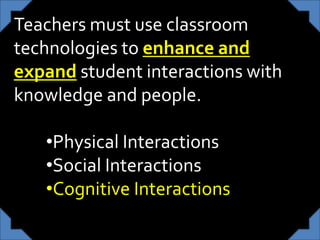
Teachers must use classroom
technologies to enhance and
expand student interactions with
knowledge and people.
•Physical Interactions
•Social Interactions
•Cognitive Interactions
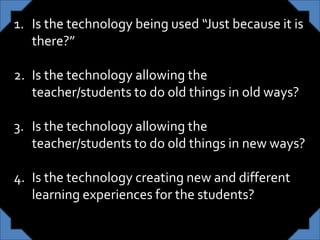
1. Is the technology being used “Just because it is
there?”
2. Is the technology allowing the
teacher/students to do old things in old ways?
3. Is the technology allowing the
teacher/students to do old things in new ways?
4. Is the technology creating new and different
learning experiences for the students?
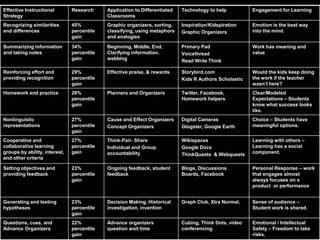
Effective Instructional
Strategy
Research Application to Differentiated
Classrooms
Technology to help Engagement for Learning
Recognizing similarities
and differences
45%
percentile
gain
Graphic organizers, sorting,
classifying, using metaphors
and analogies
Inspiration/Kidspiration
Graphic Organizers
Emotion is the best way
into the mind.
Summarizing information
and taking notes
34%
percentile
gain
Beginning, Middle, End,
Clarifying information,
webbing
Primary Pad
Voicethread
Read Write Think
Work has meaning and
value
Reinforcing effort and
providing recognition
29%
percentile
gain
Effective praise, & rewards Storybird.com
Kids R Authors Scholastic
Would the kids keep doing
the work if the teacher
wasn’t here?
Homework and practice 28%
percentile
gain
Planners and Organizers Twitter, Facebook,
Homework helpers
Clear/Modeled
Expectations – Students
know what success looks
like.
Nonlinguistic
representations
27%
percentile
gain
Cause and Effect Organizers
Concept Organizers
Digital Cameras
Glogster, Google Earth
Choice – Students have
meaningful options.
Cooperative and
collaborative learning
groups by ability, interest,
and other criteria
27%
percentile
gain
Think-Pair- Share
Individual and Group
accountability
Wikispaces
Google Docs
ThinkQuests & Webquests
Learning with others –
Learning has a social
component.
Setting objectives and
providing feedback
23%
percentile
gain
Ongoing feedback, student
feedback
Blogs, Discussions
Boards, Facebook
Personal Response – work
that engages almost
always focuses on a
product or performance
Generating and testing
hypotheses
23%
percentile
gain
Decision Making, Historical
investigation, invention
Graph Club, Xtra Normal, Sense of audience –
Student work is shared.
Questions, cues, and
Advance Organizers
22%
percentile
gain
Advance organizers
question wait time
Cubing, Think Dots, video
conferencing
Emotional / Intellectual
Safety – Freedom to take
risks.
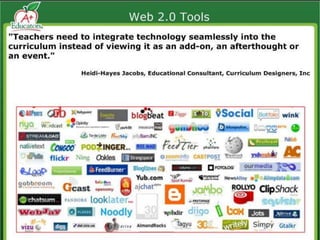
 Software Selections
 What are the interactions it provides? (physical,
social, cognitive) Is it meeting the need? (FREE)
 Kids touching the board/laptop does not mean
you have cognitive interaction.
 Get away from the “UndeniableWow” and ask
why?
 Work to design, not to decorate lessons and
resources
 What’s the task?
Terri Stice, Director of InstructionalTechnology
Green River Regional Education
Terri.stice@grrec.ky.gov

Interactive learning

  • 1.
    Welcome Interactive Learning forthe Interactive Generation Presenter: Terri Stice, Director of InstructionalTechnology,ADE; GCT Green River Regional EducationalCooperative
  • 2.
    Fundamental Questions Does technologyfundamentally change good instructional practice? Is good instruction just good instruction and technology just an add on? Guiding Questions •What does teaching & learning look like when technology is being effectively used? •What are the challenges of the classroom? •How do we engage the interactive generation?
  • 3.
     “Technology integration isthe future of education.”  “Technology has a way to get every student involved – we simply can’t overlook it.”  “It’s not about the technology. It’s about the interactions we get because of the technology.”
  • 4.
    Rule # 10– Vision trumps all other senses
  • 5.
    Teachers must useclassroom technologies to enhance and expand student interactions with knowledge and people. •Physical Interactions •Social Interactions •Cognitive Interactions
  • 6.
    1. Is thetechnology being used “Just because it is there?” 2. Is the technology allowing the teacher/students to do old things in old ways? 3. Is the technology allowing the teacher/students to do old things in new ways? 4. Is the technology creating new and different learning experiences for the students?
  • 8.
    Effective Instructional Strategy Research Applicationto Differentiated Classrooms Technology to help Engagement for Learning Recognizing similarities and differences 45% percentile gain Graphic organizers, sorting, classifying, using metaphors and analogies Inspiration/Kidspiration Graphic Organizers Emotion is the best way into the mind. Summarizing information and taking notes 34% percentile gain Beginning, Middle, End, Clarifying information, webbing Primary Pad Voicethread Read Write Think Work has meaning and value Reinforcing effort and providing recognition 29% percentile gain Effective praise, & rewards Storybird.com Kids R Authors Scholastic Would the kids keep doing the work if the teacher wasn’t here? Homework and practice 28% percentile gain Planners and Organizers Twitter, Facebook, Homework helpers Clear/Modeled Expectations – Students know what success looks like. Nonlinguistic representations 27% percentile gain Cause and Effect Organizers Concept Organizers Digital Cameras Glogster, Google Earth Choice – Students have meaningful options. Cooperative and collaborative learning groups by ability, interest, and other criteria 27% percentile gain Think-Pair- Share Individual and Group accountability Wikispaces Google Docs ThinkQuests & Webquests Learning with others – Learning has a social component. Setting objectives and providing feedback 23% percentile gain Ongoing feedback, student feedback Blogs, Discussions Boards, Facebook Personal Response – work that engages almost always focuses on a product or performance Generating and testing hypotheses 23% percentile gain Decision Making, Historical investigation, invention Graph Club, Xtra Normal, Sense of audience – Student work is shared. Questions, cues, and Advance Organizers 22% percentile gain Advance organizers question wait time Cubing, Think Dots, video conferencing Emotional / Intellectual Safety – Freedom to take risks.
  • 22.
     Software Selections What are the interactions it provides? (physical, social, cognitive) Is it meeting the need? (FREE)  Kids touching the board/laptop does not mean you have cognitive interaction.  Get away from the “UndeniableWow” and ask why?  Work to design, not to decorate lessons and resources  What’s the task?
  • 23.
    Terri Stice, Directorof InstructionalTechnology Green River Regional Education Terri.stice@grrec.ky.gov

Editor's Notes

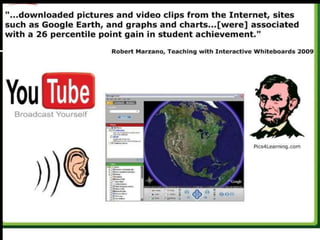
  • #5 We don’t see with our eyes, we see with our brains!Vision is by far our most dominant sense, taking up half of our brain’s resources.
  • #6 Kids touching the board does not mean you have cognitive interaction. – Tommy G. principal – “What does it look like? What am I suppose to see.”
  • #7 Learning Goal posted but nothing every said about it. Using Word to publish a piece of writing rather than hand writing it; using the interactive board as a chalkboard; using the Internet for research as opposed to encyclopedia. Watching Obama’s inaugural speech as opposed to reading his speech. (things we have done for years in education) Is the technology use pushing the both the teacher and the students to new heights, new learning, and new knowledge? Does the technology allow kids to learn from people they never would have been able to without it? Does the technology allow students to interact with information in a way that is meaningful and could not have happened otherwise? Does the technology allow students to create and share their knowledge with an audience they never would have had access to without the technology?