NATIONAL POPULATION POLICY
2000
Presented by:
Palka Mittal
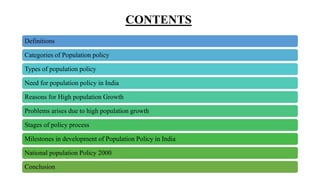
CONTENTS
Definitions
Categories of Population policy
Types of population policy
Need for population policy in India
Reasons for High population Growth
Problems arises due to high population growth
Stages of policy process
Milestones in development of Population Policy in India
National population Policy 2000
Conclusion
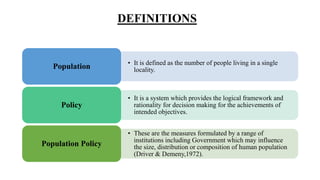
DEFINITIONS
• It is defined as the number of people living in a single
locality.
Population
• It is a system which provides the logical framework and
rationality for decision making for the achievements of
intended objectives.
Policy
• These are the measures formulated by a range of
institutions including Government which may influence
the size, distribution or composition of human population
(Driver & Demeny,1972).
Population Policy
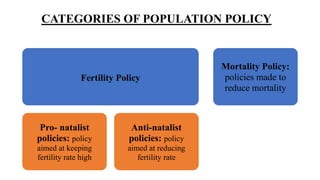
CATEGORIES OF POPULATION POLICY
Fertility Policy
Pro- natalist
policies: policy
aimed at keeping
fertility rate high
Anti-natalist
policies: policy
aimed at reducing
fertility rate
Mortality Policy:
policies made to
reduce mortality
TYPES OF POPULATION POLICY
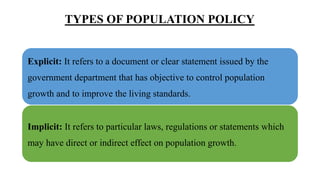
Explicit: It refers to a document or clear statement issued by the
government department that has objective to control population
growth and to improve the living standards.
Implicit: It refers to particular laws, regulations or statements which
may have direct or indirect effect on population growth.
NEED FOR POPULATION POLICY IN INDIA
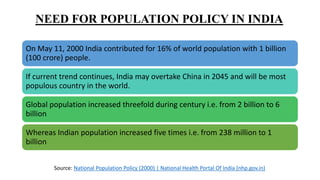
On May 11, 2000 India contributed for 16% of world population with 1 billion
(100 crore) people.
If current trend continues, India may overtake China in 2045 and will be most
populous country in the world.
Global population increased threefold during century i.e. from 2 billion to 6
billion
Whereas Indian population increased five times i.e. from 238 million to 1
billion
Source: National Population Policy (2000) | National Health Portal Of India (nhp.gov.in)
REASONS FOR HIGH POPULATION GROWTH
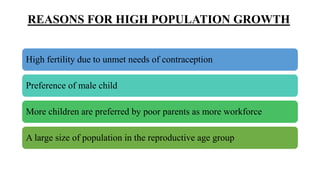
High fertility due to unmet needs of contraception
Preference of male child
More children are preferred by poor parents as more workforce
A large size of population in the reproductive age group
PROBLEMS ARISES DUE TO HIGH
POPULATION GROWTH
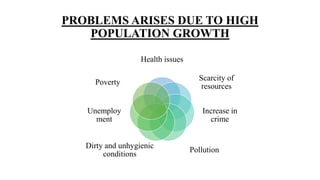
Health issues
Scarcity of
resources
Increase in
crime
Pollution
Dirty and unhygienic
conditions
Unemploy
ment
Poverty
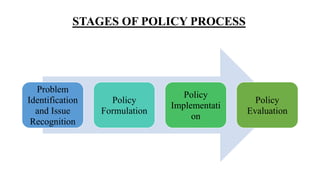
STAGES OF POLICY PROCESS
Problem
Identification
and Issue
Recognition
Policy
Formulation
Policy
Implementati
on
Policy
Evaluation
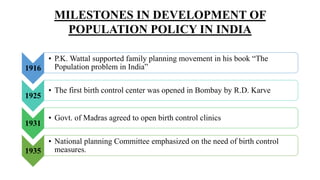
MILESTONES IN DEVELOPMENT OF
POPULATION POLICY IN INDIA
1916
• P.K. Wattal supported family planning movement in his book “The
Population problem in India”
1925
• The first birth control center was opened in Bombay by R.D. Karve
1931
• Govt. of Madras agreed to open birth control clinics
1935
• National planning Committee emphasized on the need of birth control
measures.
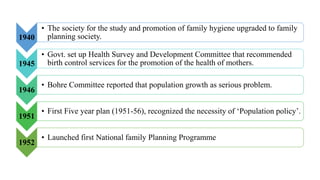
1940
• The society for the study and promotion of family hygiene upgraded to family
planning society.
1945
• Govt. set up Health Survey and Development Committee that recommended
birth control services for the promotion of the health of mothers.
1946
• Bohre Committee reported that population growth as serious problem.
1951
• First Five year plan (1951-56), recognized the necessity of ‘Population policy’.
1952
• Launched first National family Planning Programme
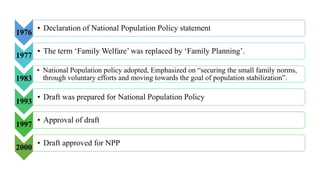
1976
• Declaration of National Population Policy statement
1977
• The term ‘Family Welfare’ was replaced by ‘Family Planning’.
1983
• National Population policy adopted, Emphasized on “securing the small family norms,
through voluntary efforts and moving towards the goal of population stabilization”.
1993
• Draft was prepared for National Population Policy
1997
• Approval of draft
2000
• Draft approved for NPP
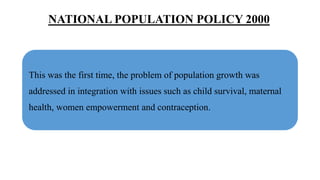
NATIONAL POPULATION POLICY 2000
This was the first time, the problem of population growth was
addressed in integration with issues such as child survival, maternal
health, women empowerment and contraception.
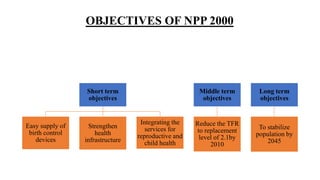
OBJECTIVES OF NPP 2000
Short term
objectives
Easy supply of
birth control
devices
Strengthen
health
infrastructure
Integrating the
services for
reproductive and
child health
Middle term
objectives
Reduce the TFR
to replacement
level of 2.1by
2010
Long term
objectives
To stabilize
population by
2045
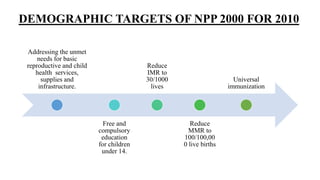
DEMOGRAPHIC TARGETS OF NPP 2000 FOR 2010
Addressing the unmet
needs for basic
reproductive and child
health services,
supplies and
infrastructure.
Free and
compulsory
education
for children
under 14.
Reduce
IMR to
30/1000
lives
Reduce
MMR to
100/100,00
0 live births
Universal
immunization
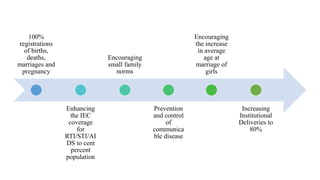
100%
registrations
of births,
deaths,
marriages and
pregnancy
Enhancing
the IEC
coverage
for
RTI/STI/AI
DS to cent
percent
population
Encouraging
small family
norms
Prevention
and control
of
communica
ble disease
Encouraging
the increase
in average
age at
marriage of
girls
Increasing
Institutional
Deliveries to
80%
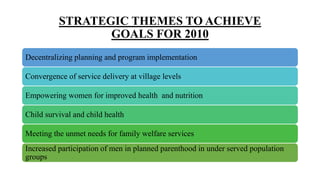
STRATEGIC THEMES TO ACHIEVE
GOALS FOR 2010
Decentralizing planning and program implementation
Convergence of service delivery at village levels
Empowering women for improved health and nutrition
Child survival and child health
Meeting the unmet needs for family welfare services
Increased participation of men in planned parenthood in under served population
groups
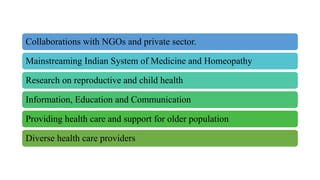
Collaborations with NGOs and private sector.
Mainstreaming Indian System of Medicine and Homeopathy
Research on reproductive and child health
Information, Education and Communication
Providing health care and support for older population
Diverse health care providers
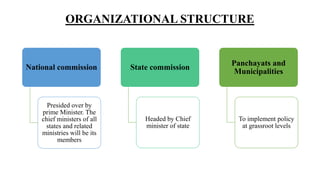
ORGANIZATIONAL STRUCTURE
National commission
Presided over by
prime Minister. The
chief ministers of all
states and related
ministries will be its
members
State commission
Headed by Chief
minister of state
Panchayats and
Municipalities
To implement policy
at grassroot levels
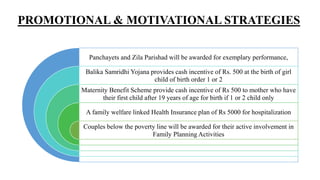
PROMOTIONAL & MOTIVATIONAL STRATEGIES
Panchayets and Zila Parishad will be awarded for exemplary performance,
Balika Samridhi Yojana provides cash incentive of Rs. 500 at the birth of girl
child of birth order 1 or 2
Maternity Benefit Scheme provide cash incentive of Rs 500 to mother who have
their first child after 19 years of age for birth if 1 or 2 child only
A family welfare linked Health Insurance plan of Rs 5000 for hospitalization
Couples below the poverty line will be awarded for their active involvement in
Family Planning Activities
LEGISLATION
79th Amendment Bill of 1992 disqualify a person for being a
member of either house of legislature of a state, if he/she has
more than 2 children.
PUBLIC SUPPORT
Strong support of political, community, professionals,
religious leaders, media, sports personalities and opinion
makers has been sought for small family norms.
FUNDING
NPP expressed that the programme, projects and schemes
promised on the goals and objectives of the policy 2000 will
be adequately funded.
CONCLUSION
Success will be achieved if the Action Plan contained in the
NPP is pursued as a national movement.
National Population Policy.pptx

National Population Policy.pptx

  • 1.
  • 2.
    CONTENTS Definitions Categories of Populationpolicy Types of population policy Need for population policy in India Reasons for High population Growth Problems arises due to high population growth Stages of policy process Milestones in development of Population Policy in India National population Policy 2000 Conclusion
  • 3.
    DEFINITIONS • It isdefined as the number of people living in a single locality. Population • It is a system which provides the logical framework and rationality for decision making for the achievements of intended objectives. Policy • These are the measures formulated by a range of institutions including Government which may influence the size, distribution or composition of human population (Driver & Demeny,1972). Population Policy
  • 4.
    CATEGORIES OF POPULATIONPOLICY Fertility Policy Pro- natalist policies: policy aimed at keeping fertility rate high Anti-natalist policies: policy aimed at reducing fertility rate Mortality Policy: policies made to reduce mortality
  • 5.
    TYPES OF POPULATIONPOLICY Explicit: It refers to a document or clear statement issued by the government department that has objective to control population growth and to improve the living standards. Implicit: It refers to particular laws, regulations or statements which may have direct or indirect effect on population growth.
  • 6.
    NEED FOR POPULATIONPOLICY IN INDIA On May 11, 2000 India contributed for 16% of world population with 1 billion (100 crore) people. If current trend continues, India may overtake China in 2045 and will be most populous country in the world. Global population increased threefold during century i.e. from 2 billion to 6 billion Whereas Indian population increased five times i.e. from 238 million to 1 billion Source: National Population Policy (2000) | National Health Portal Of India (nhp.gov.in)
  • 7.
    REASONS FOR HIGHPOPULATION GROWTH High fertility due to unmet needs of contraception Preference of male child More children are preferred by poor parents as more workforce A large size of population in the reproductive age group
  • 8.
    PROBLEMS ARISES DUETO HIGH POPULATION GROWTH Health issues Scarcity of resources Increase in crime Pollution Dirty and unhygienic conditions Unemploy ment Poverty
  • 9.
    STAGES OF POLICYPROCESS Problem Identification and Issue Recognition Policy Formulation Policy Implementati on Policy Evaluation
  • 10.
    MILESTONES IN DEVELOPMENTOF POPULATION POLICY IN INDIA 1916 • P.K. Wattal supported family planning movement in his book “The Population problem in India” 1925 • The first birth control center was opened in Bombay by R.D. Karve 1931 • Govt. of Madras agreed to open birth control clinics 1935 • National planning Committee emphasized on the need of birth control measures.
  • 11.
    1940 • The societyfor the study and promotion of family hygiene upgraded to family planning society. 1945 • Govt. set up Health Survey and Development Committee that recommended birth control services for the promotion of the health of mothers. 1946 • Bohre Committee reported that population growth as serious problem. 1951 • First Five year plan (1951-56), recognized the necessity of ‘Population policy’. 1952 • Launched first National family Planning Programme
  • 12.
    1976 • Declaration ofNational Population Policy statement 1977 • The term ‘Family Welfare’ was replaced by ‘Family Planning’. 1983 • National Population policy adopted, Emphasized on “securing the small family norms, through voluntary efforts and moving towards the goal of population stabilization”. 1993 • Draft was prepared for National Population Policy 1997 • Approval of draft 2000 • Draft approved for NPP
  • 13.
    NATIONAL POPULATION POLICY2000 This was the first time, the problem of population growth was addressed in integration with issues such as child survival, maternal health, women empowerment and contraception.
  • 14.
    OBJECTIVES OF NPP2000 Short term objectives Easy supply of birth control devices Strengthen health infrastructure Integrating the services for reproductive and child health Middle term objectives Reduce the TFR to replacement level of 2.1by 2010 Long term objectives To stabilize population by 2045
  • 15.
    DEMOGRAPHIC TARGETS OFNPP 2000 FOR 2010 Addressing the unmet needs for basic reproductive and child health services, supplies and infrastructure. Free and compulsory education for children under 14. Reduce IMR to 30/1000 lives Reduce MMR to 100/100,00 0 live births Universal immunization
  • 16.
    100% registrations of births, deaths, marriages and pregnancy Enhancing theIEC coverage for RTI/STI/AI DS to cent percent population Encouraging small family norms Prevention and control of communica ble disease Encouraging the increase in average age at marriage of girls Increasing Institutional Deliveries to 80%
  • 17.
    STRATEGIC THEMES TOACHIEVE GOALS FOR 2010 Decentralizing planning and program implementation Convergence of service delivery at village levels Empowering women for improved health and nutrition Child survival and child health Meeting the unmet needs for family welfare services Increased participation of men in planned parenthood in under served population groups
  • 18.
    Collaborations with NGOsand private sector. Mainstreaming Indian System of Medicine and Homeopathy Research on reproductive and child health Information, Education and Communication Providing health care and support for older population Diverse health care providers
  • 19.
    ORGANIZATIONAL STRUCTURE National commission Presidedover by prime Minister. The chief ministers of all states and related ministries will be its members State commission Headed by Chief minister of state Panchayats and Municipalities To implement policy at grassroot levels
  • 20.
    PROMOTIONAL & MOTIVATIONALSTRATEGIES Panchayets and Zila Parishad will be awarded for exemplary performance, Balika Samridhi Yojana provides cash incentive of Rs. 500 at the birth of girl child of birth order 1 or 2 Maternity Benefit Scheme provide cash incentive of Rs 500 to mother who have their first child after 19 years of age for birth if 1 or 2 child only A family welfare linked Health Insurance plan of Rs 5000 for hospitalization Couples below the poverty line will be awarded for their active involvement in Family Planning Activities
  • 21.
    LEGISLATION 79th Amendment Billof 1992 disqualify a person for being a member of either house of legislature of a state, if he/she has more than 2 children.
  • 22.
    PUBLIC SUPPORT Strong supportof political, community, professionals, religious leaders, media, sports personalities and opinion makers has been sought for small family norms.
  • 23.
    FUNDING NPP expressed thatthe programme, projects and schemes promised on the goals and objectives of the policy 2000 will be adequately funded.
  • 24.
    CONCLUSION Success will beachieved if the Action Plan contained in the NPP is pursued as a national movement.