Comprehensive Primary Health Care
High quality
Universally accessible,
Free
Close to where people live and work
CPHC is value for money and would reduce morbidity
and mortality greatly at much lower costs and would
significantly reduce the need for secondary and tertiary
care.
Primary Health Care to CPHC
Primary care has been very selective in the past, covering less than 20% of primary
health care needs. This has made primary care less responsive to felt health care
needs and created the image of the under-performing system.
Primary Health Care is necessarily comprehensive- addressing primary care for all of
reproductive and child health, communicable, and non-communicable diseases and
accidents and injuries through appropriate health communication, technologies and
care provision.
Comprehensive primary health care package will also include nutrition, geriatric health
care, palliative care and rehabilitative care services.
To denote this important policy change, facilities which start providing the larger
package of comprehensive primary health care will be called Health and Wellness
centers.
Grass Roots Primary Health Care
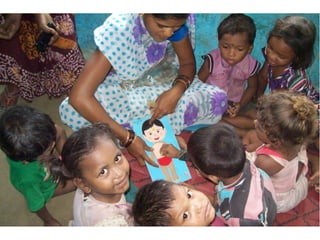
The Village Health, Sanitation and Nutrition Committees
supervised by the panchayats would ensure that there
is no exclusion and that locally felt health priorities are
included.
Community based monitoring will be strengthened to
ensure continuous feedback on equity, access and
quality of services
Most elements of primary care can be delivered by
suitably trained and authorized AYUSH doctor, Nurse
practitioners, pharmacists or paramedical
Community Health
Community based interventions strategies go beyond immunization
to include ready availability and access to ORS and Zinc for
diarrhea and appropriate antibiotics for pneumonia, better
identification and management of anemia, and screening for
developmental defects.
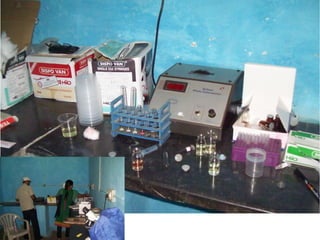
Good quality disease surveillance data should also include
entomological information for which a dedicated team of
entomologists with support staff is essential. Taken together the
battle against vector borne disease is an example of how one
needs to be ahead of the problem in biomedical research with
very short lag time lab to field and in building public health
capacity at district levels.
One important source of information is vital events reporting,
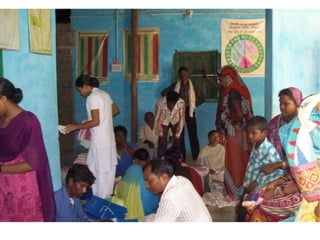
Nurses
Recognizing that nurses form about two-thirds of the health workforce in India,
nurses are enabled to assume leadership positions, regulation of practice is
improved, quality of nursing education is strengthened establishing cadres
like nurse practitioners and public health nurses
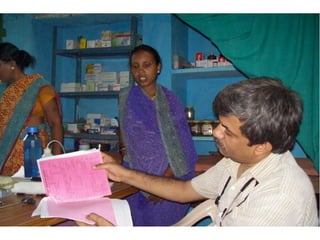
Doctors
A positive determinant of voluntary rural location of doctors is a more rural
location of medical colleges and a curriculum and medical education which
provides exposure and motivation to work with communities. Equally
important is to create a positive practice environment where professionals
can stay in touch with peers and upgrade their skills and a positive social
environment, through better housing, more flexible terms of employment and
active measures of community support.
An upgradation of short term training to medical officers who are willing to work
in these areas and providing them with a set of basic specialist skills as
needed at the block and district level. MD courses in family medicine courses
have started on a small scale and with the necessary support. Policy initiative
needed to make this post interchangeable with any of the basic specialists
sanctioned for CHC.
Specialists
Specialist attraction and retention is a challenge - the public sector has been
performing very poorly on this. Most needs for specialist consultation would
be met within a district. The requirement of patient care in super specialty
services is very different from the General Specialties with regard to skills
required to render effective care. This calls for developing human resources
and training centres for super specialty care.
Convert National Board of Examinations as a statutory body to innovate new
education and training models to train appropriate specialists. Technological
innovations coupled with advances in cellular biology knowledge are
influencing therapeutic interventions. Hence, developing teams comprising of
clinicians, cellular biologists, researchers, academicians in each specialty
who can deliver holistic care
Quality
Ensure that every public health care facility is
measured and scored for quality, and certified
and incentivized when it achieves a certain
minimum score. Quality measurements would
include clinical quality of care, also patient
safety, comfort and satisfaction.
Quality Improvement would require technical
support and capacity building as well as
institutional arrangements for measurement and
certifying.
In private sector accreditation process and quality
of care provided would necessarily abide by

Comprehensive Primary Health Care

  • 1.
    Comprehensive Primary HealthCare High quality Universally accessible, Free Close to where people live and work CPHC is value for money and would reduce morbidity and mortality greatly at much lower costs and would significantly reduce the need for secondary and tertiary care.
  • 3.
    Primary Health Careto CPHC Primary care has been very selective in the past, covering less than 20% of primary health care needs. This has made primary care less responsive to felt health care needs and created the image of the under-performing system. Primary Health Care is necessarily comprehensive- addressing primary care for all of reproductive and child health, communicable, and non-communicable diseases and accidents and injuries through appropriate health communication, technologies and care provision. Comprehensive primary health care package will also include nutrition, geriatric health care, palliative care and rehabilitative care services. To denote this important policy change, facilities which start providing the larger package of comprehensive primary health care will be called Health and Wellness centers.
  • 5.
    Grass Roots PrimaryHealth Care The Village Health, Sanitation and Nutrition Committees supervised by the panchayats would ensure that there is no exclusion and that locally felt health priorities are included. Community based monitoring will be strengthened to ensure continuous feedback on equity, access and quality of services Most elements of primary care can be delivered by suitably trained and authorized AYUSH doctor, Nurse practitioners, pharmacists or paramedical
  • 7.
    Community Health Community basedinterventions strategies go beyond immunization to include ready availability and access to ORS and Zinc for diarrhea and appropriate antibiotics for pneumonia, better identification and management of anemia, and screening for developmental defects. Good quality disease surveillance data should also include entomological information for which a dedicated team of entomologists with support staff is essential. Taken together the battle against vector borne disease is an example of how one needs to be ahead of the problem in biomedical research with very short lag time lab to field and in building public health capacity at district levels. One important source of information is vital events reporting,
  • 9.
    Nurses Recognizing that nursesform about two-thirds of the health workforce in India, nurses are enabled to assume leadership positions, regulation of practice is improved, quality of nursing education is strengthened establishing cadres like nurse practitioners and public health nurses
  • 11.
    Doctors A positive determinantof voluntary rural location of doctors is a more rural location of medical colleges and a curriculum and medical education which provides exposure and motivation to work with communities. Equally important is to create a positive practice environment where professionals can stay in touch with peers and upgrade their skills and a positive social environment, through better housing, more flexible terms of employment and active measures of community support. An upgradation of short term training to medical officers who are willing to work in these areas and providing them with a set of basic specialist skills as needed at the block and district level. MD courses in family medicine courses have started on a small scale and with the necessary support. Policy initiative needed to make this post interchangeable with any of the basic specialists sanctioned for CHC.
  • 13.
    Specialists Specialist attraction andretention is a challenge - the public sector has been performing very poorly on this. Most needs for specialist consultation would be met within a district. The requirement of patient care in super specialty services is very different from the General Specialties with regard to skills required to render effective care. This calls for developing human resources and training centres for super specialty care. Convert National Board of Examinations as a statutory body to innovate new education and training models to train appropriate specialists. Technological innovations coupled with advances in cellular biology knowledge are influencing therapeutic interventions. Hence, developing teams comprising of clinicians, cellular biologists, researchers, academicians in each specialty who can deliver holistic care
  • 14.
    Quality Ensure that everypublic health care facility is measured and scored for quality, and certified and incentivized when it achieves a certain minimum score. Quality measurements would include clinical quality of care, also patient safety, comfort and satisfaction. Quality Improvement would require technical support and capacity building as well as institutional arrangements for measurement and certifying. In private sector accreditation process and quality of care provided would necessarily abide by