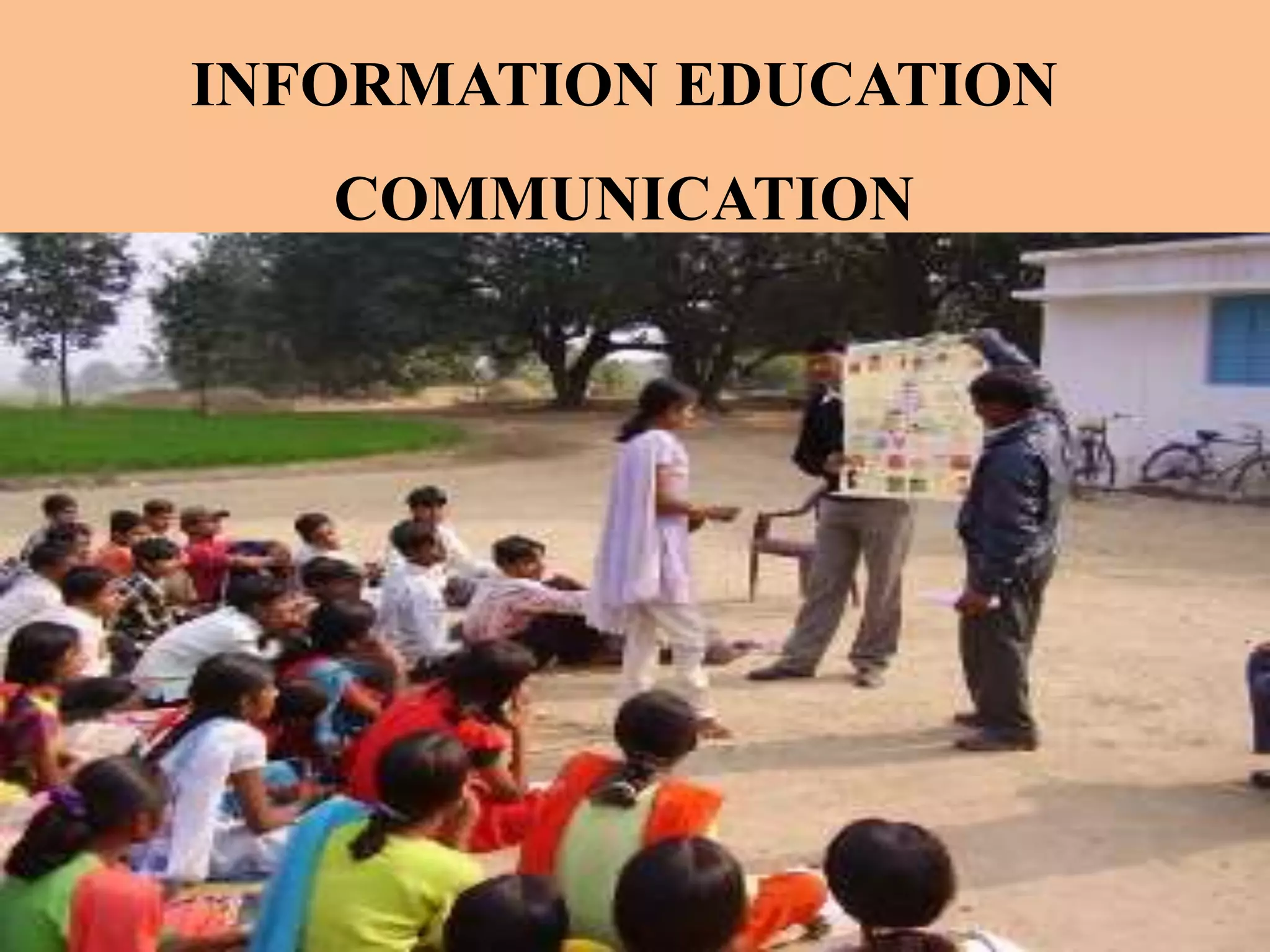
INFORMATION EDUCATION
COMMUNICATION
Definition
IEC can be defined as an approach which
attempts to change or reinforce a set of behaviors
in a target audience regarding specific problem in
a predefined period of time.
Reproductive health and research, WHO
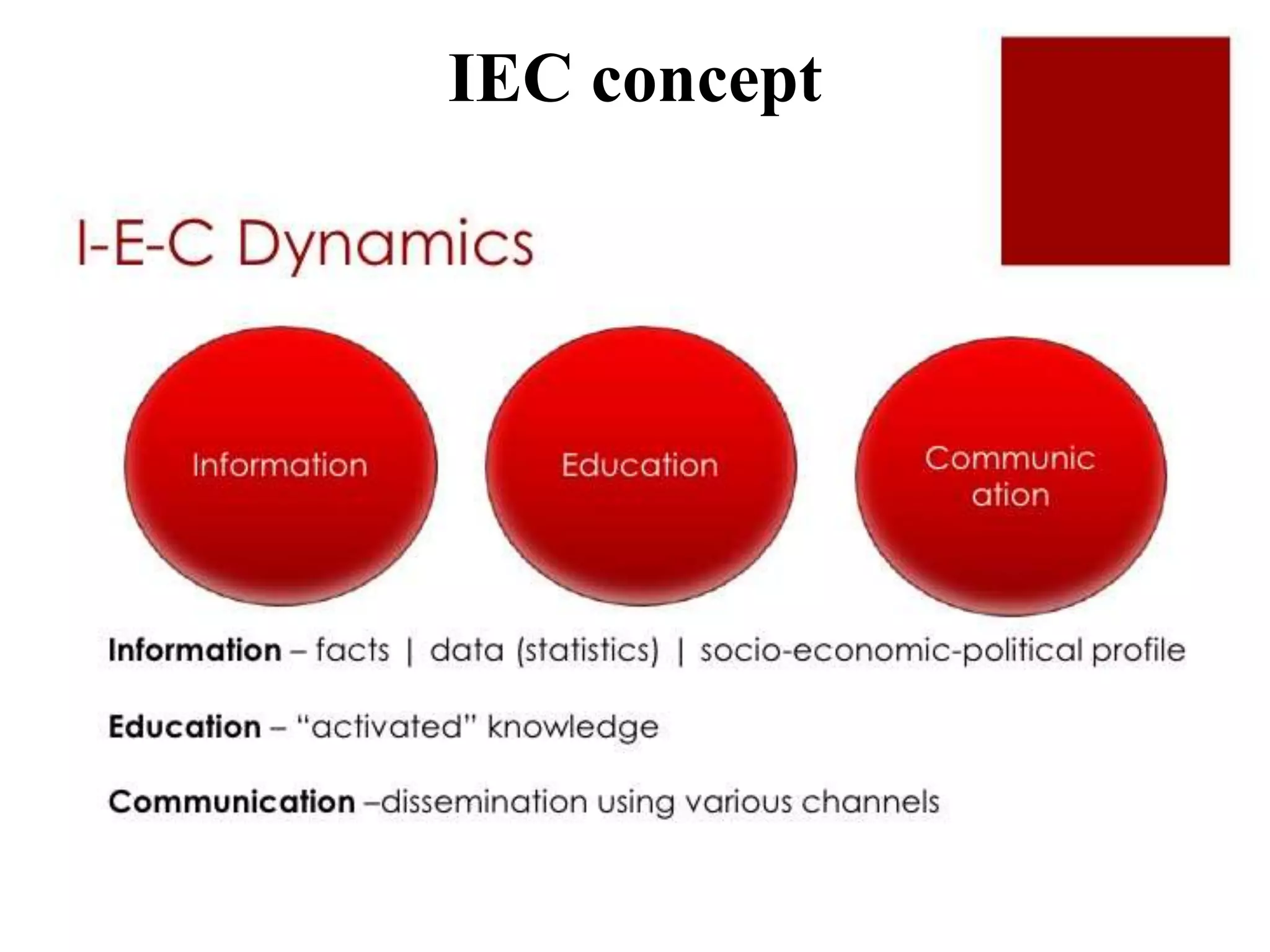
IEC concept
Aims
• To change the health behavior of individuals, family
and community.
• To prepare background or basis for change in health
behavior.
• To change the norms of the community.
• To facilitate education for audience about public health
and to create awareness in public opinion.
• To obtain social, political support for health activities.
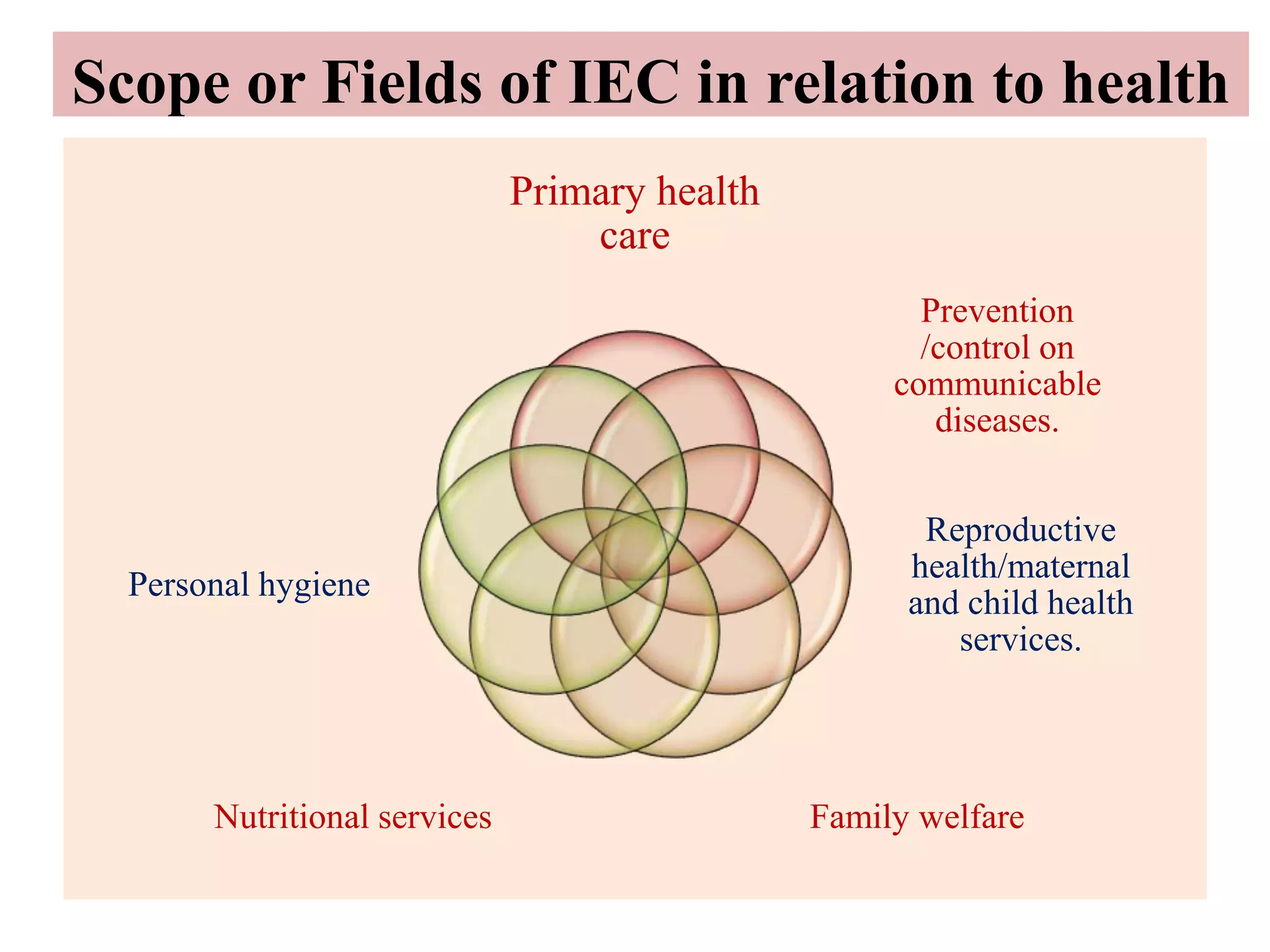
Scope or Fields of IEC in relation to health
Primary health
care
Prevention
/control on
communicable
diseases.
Reproductive
health/maternal
and child health
services.
Family welfareNutritional services
Personal hygiene
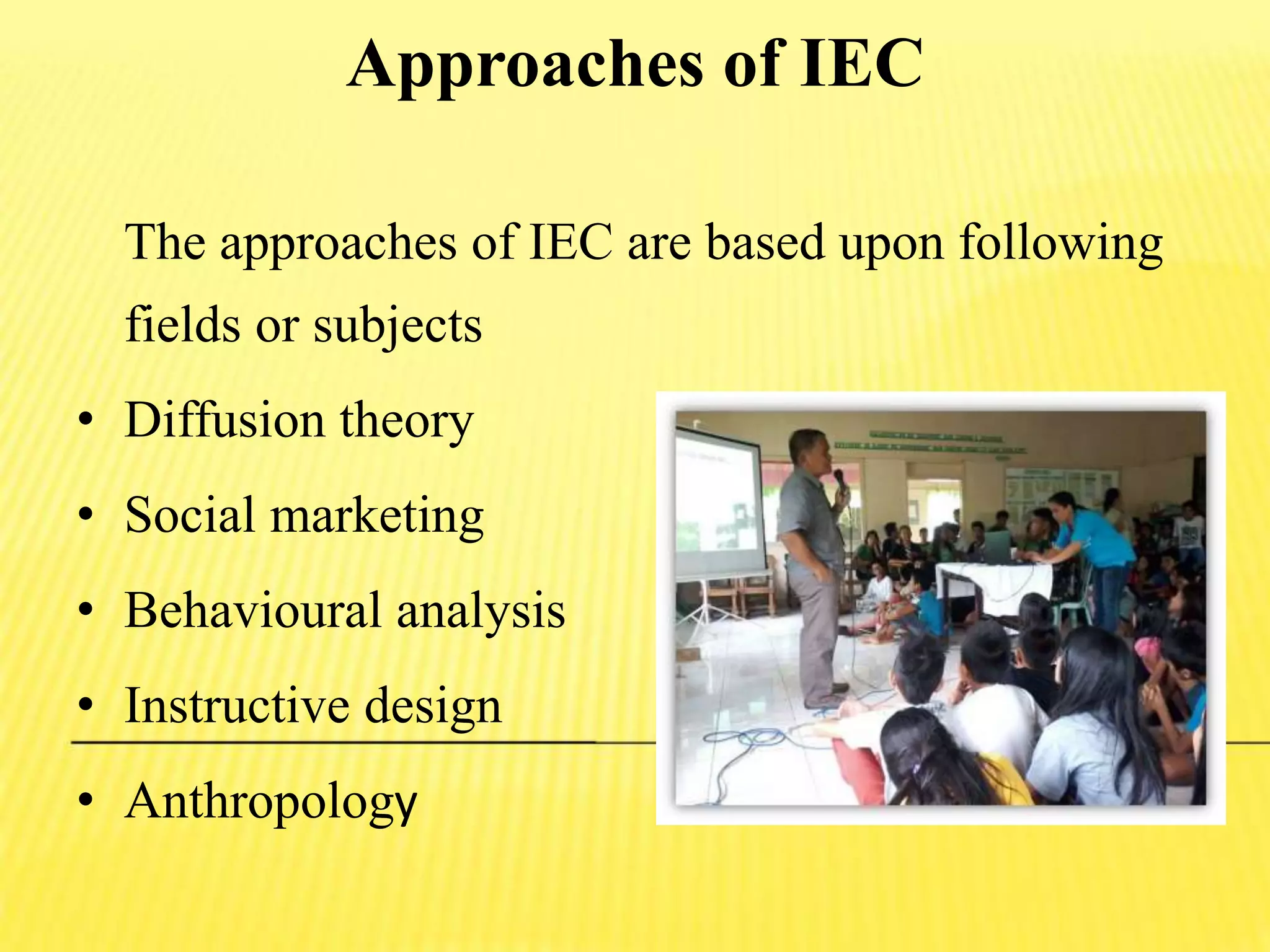
Approaches of IEC
The approaches of IEC are based upon following
fields or subjects
• Diffusion theory
• Social marketing
• Behavioural analysis
• Instructive design
• Anthropology
INFORMATION
This consists of
providing scientific
knowledge to the people
about the health problems
and how to prevent them
and promote and
maintain health.
Definition
Health education can be defined as a process aimed at
encouraging people to want to be healthy, to know how to stay
healthy, to do what they can individually and collectively to
maintain health and to seek help when needed.
The Declaration of Alma Ata(1978)
Aims and objectives
• To encourage people to adopt and sustain health promoting life
style and practices.
• To promote the proper use of health services available to them.
• To arouse interest, provide new knowledge, improve skills and
change attitudes in making rational decisions to solve their own
problems.
• To stimulate individual and community self reliance and
participation to achieve health development through individual
and community involvement at every step from identifying
problems to solve them.
Approaches to health education
• Regulatory
• Service approach
• Health education
approach
• Primary health care
approach
Models of health education
• Medical model
• Motivation model
• Social intervention model
Principles of health education
1. Credibility
2. Interest
3. Participation
4. Motivation
5. Comprehension
6. Reinforcement
Principles of health education
7. Learning by doing
8. Known to unknown
9.Setting an example
10. Good human relations
11. Feed back
12. Leaders
COMMUNICATION
• The word communication is derived
from latin word, communicare which
means to participate, to inform, or
impart.
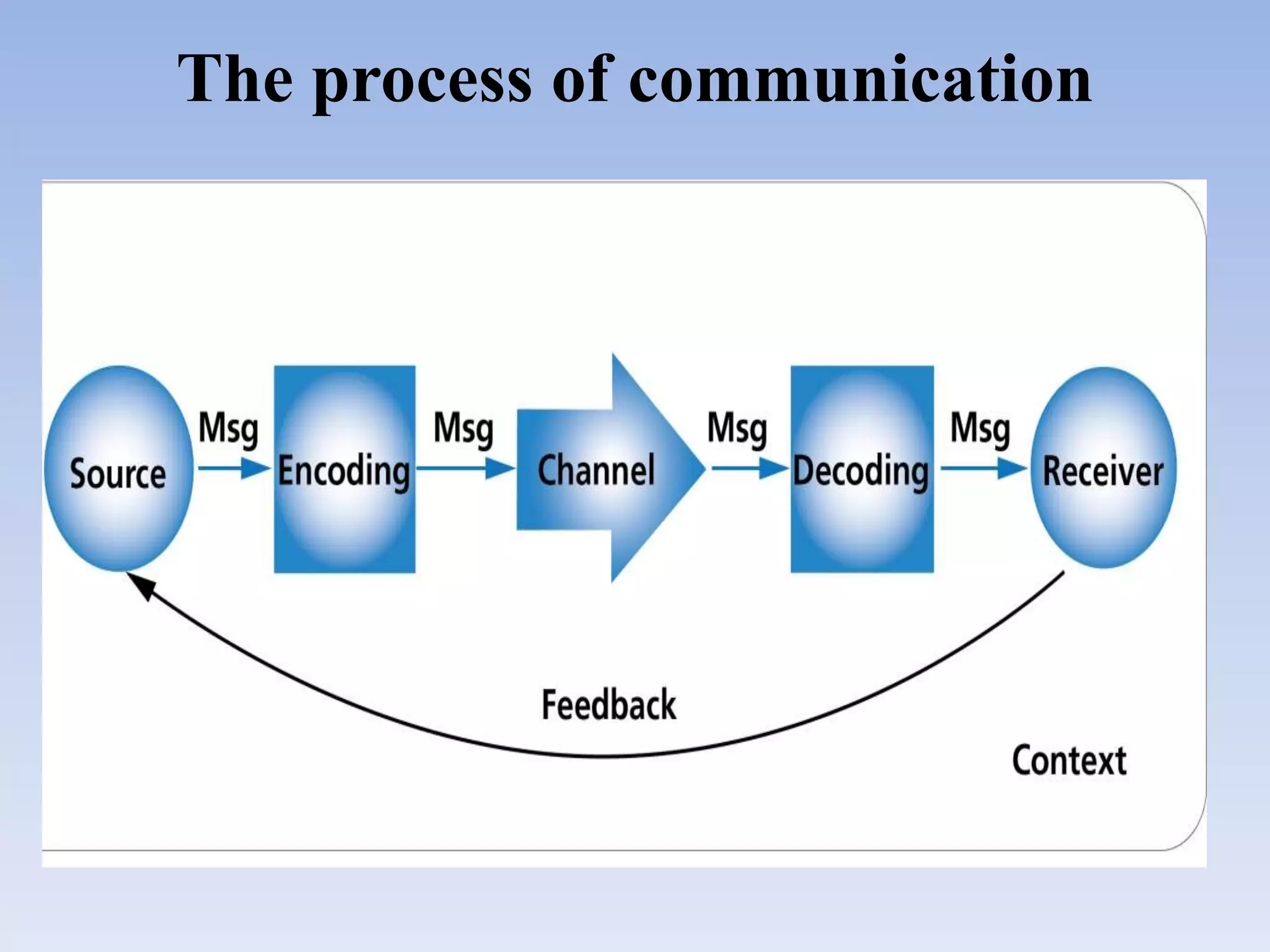
• Communication can be regarded as a two
way process of exchanging or shaping
ideas, feelings and information.
The process of communication
Types of communication
• One way communication
• Two way communication
• Verbal communication
• Non verbal communication
• Formal and Informal communication
• Visual communication
• Tele communication and internet
Barriers of communication
• Physiological
• Linguistic barriers
• Psychological
• Organizational barriers
• Environmental
• Cultural
Functions of Health communication
• Information
• Education
• Motivation
• Persuasion
• Counseling
• Raising morale
• Health development
• Health organization
AUDIOVISUAL AIDS
• Auditory aids
• Visual aids
o Not requiring projection
o Requiring projection
• Combined AV aids
METHODS IN HEALTH COMMUNICATION
• Individual approach
• Group approach
• Mass approach
Measures for successful Communication
• Clarity of thought with simple and understandable language.
• Use two way communication
• Usefulness of health message
• Proper use of audio visual aids, gestures, words and pictures.
• Credibility and genuiness of communication.
• Topics for health education according to requirement, feelings,
beliefs and experiences of people.
• Latest and reliable information.
• Correct medium or method of communication.
• Appropriate attention to verbal as well as non verbal messages.
Measures for successful Communication
• Increase communication skill by
 Be confident in your ability to relate people.
 Be honest with your feelings.
 Be sensitive to the needs of others.
 Be consistent and know yourself.
 Recognize symptoms of anxiety.
 Recognize differences.
 Use words carefully.
 Recognize and evaluate your actions and responses.
 Be careful in non verbal communication.
STEPS FOR HEALTH EDUCATION
PROGRAMME
Evaluation
Process
Content
Need assessment
Process of health education
• Giving information/questioning
• Contracting
• Demonstration and return
demonstration
• Environmental cuing
• Group norms
• System change.
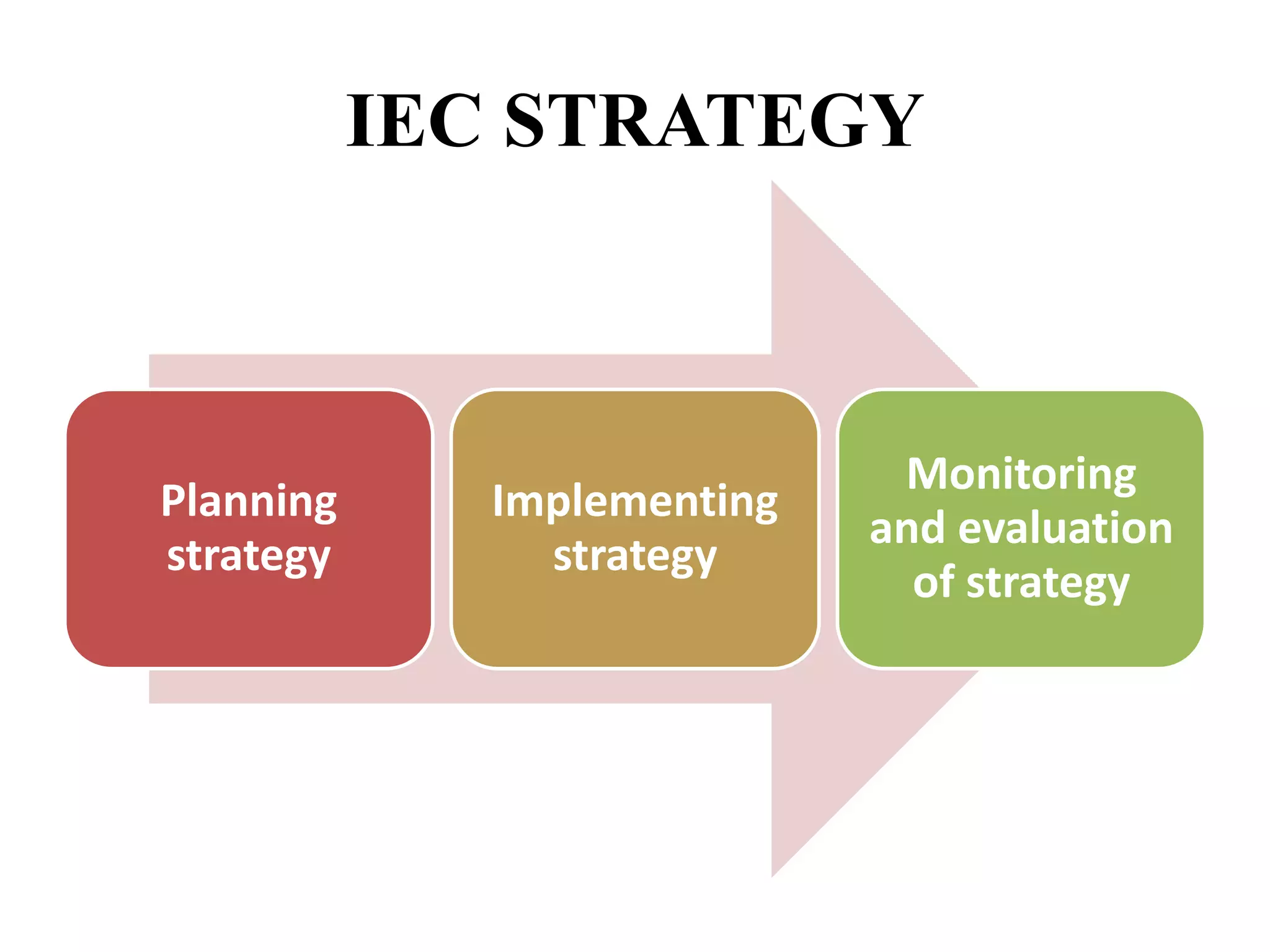
IEC STRATEGY
Planning
strategy
Implementing
strategy
Monitoring
and evaluation
of strategy
BEHAVIOUR CHANGE COMMUNICATION
(BCC)
BCC can be defined as a process
that motivates people to adopt and
sustain healthy behavior and life
styles
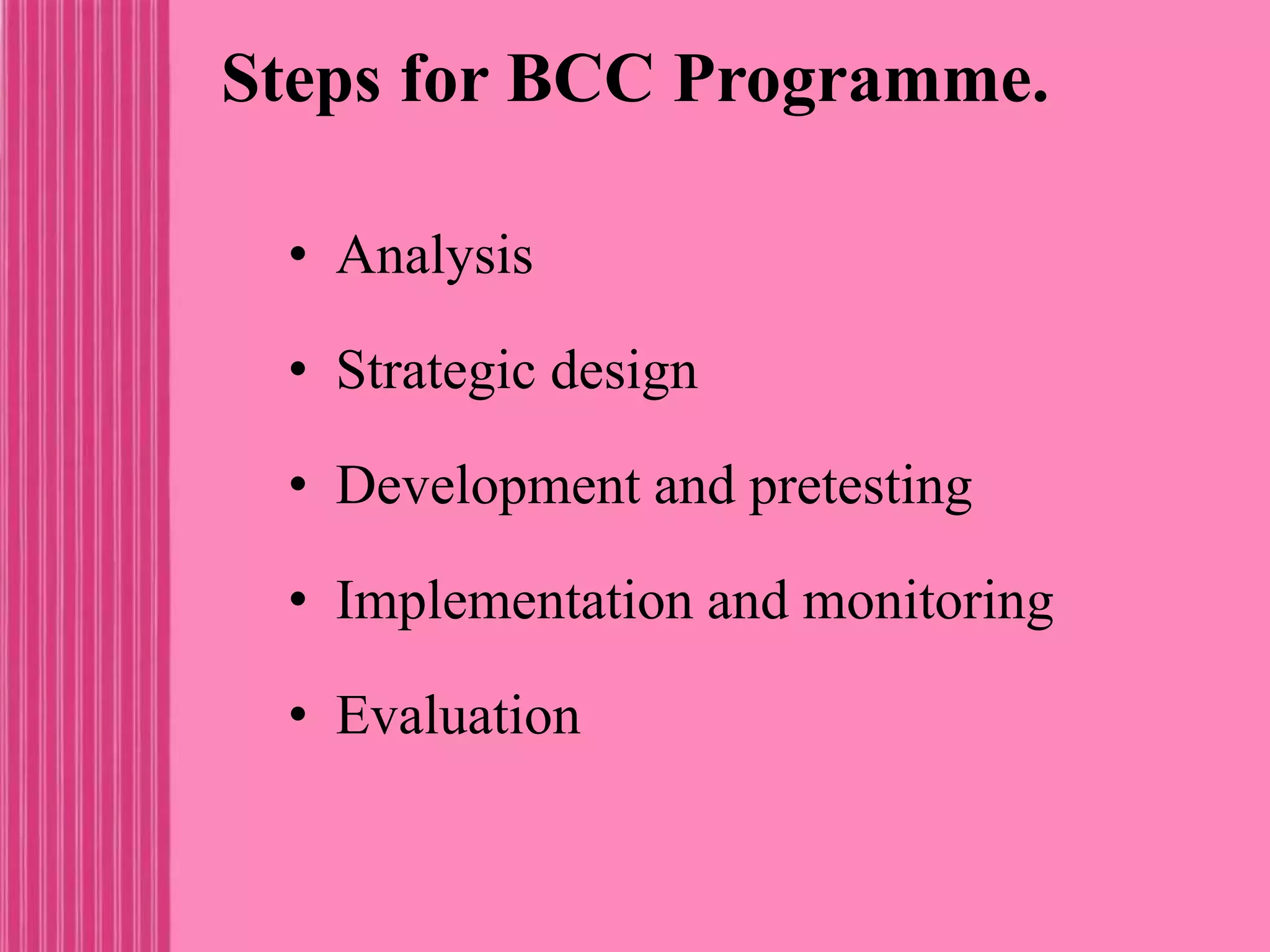
Steps for BCC Programme.
• Analysis
• Strategic design
• Development and pretesting
• Implementation and monitoring
• Evaluation
HEALTH EDUCATION
AGENCIES
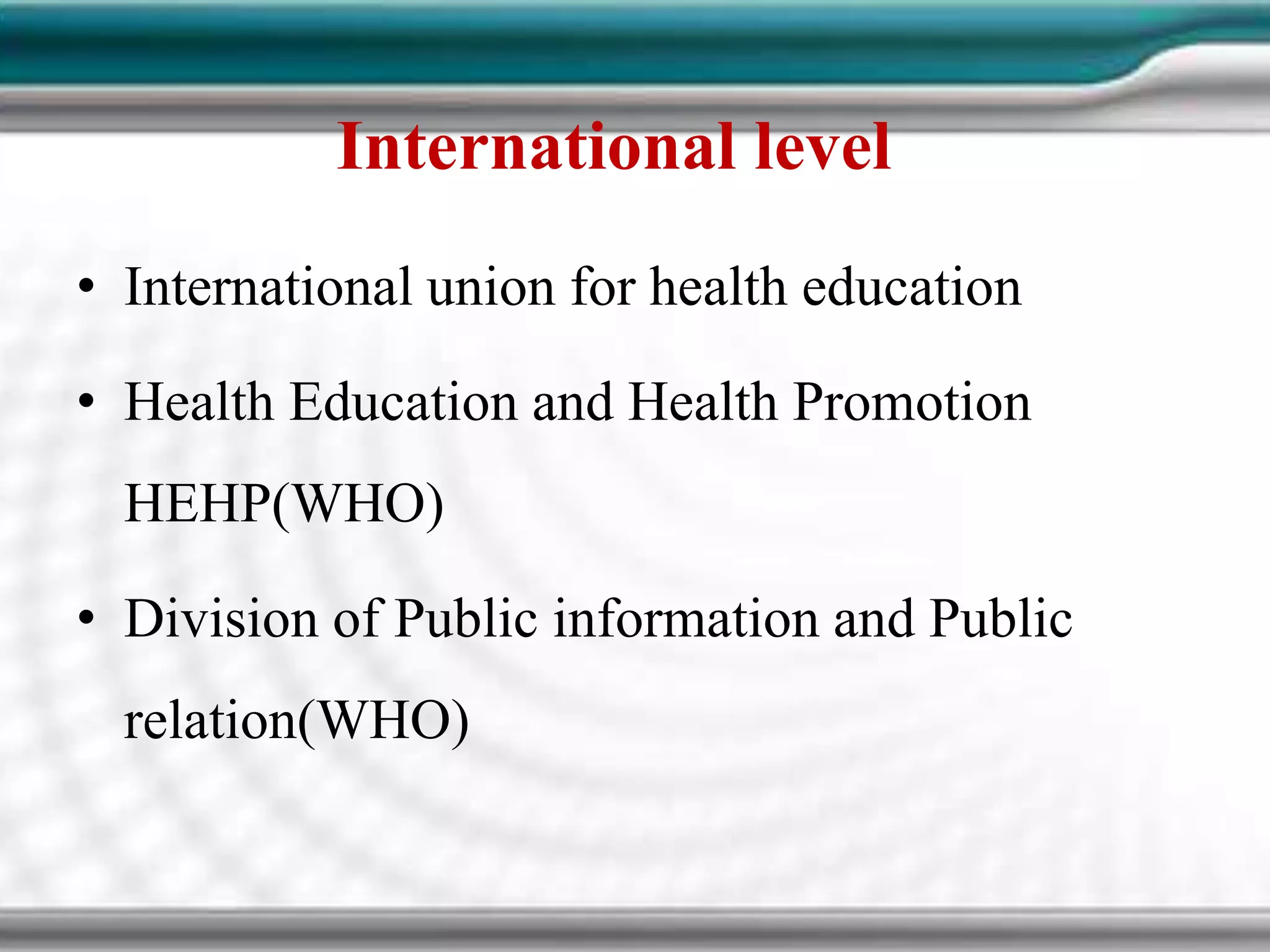
International level
• International union for health education
• Health Education and Health Promotion
HEHP(WHO)
• Division of Public information and Public
relation(WHO)
National level
• Central Health Education Bureau (CHEB)
• Under the Ministry and Broad casting,
different division or units are playing
important part in providing health education to
community.
Central Health Education
Bureau (CHEB)
Objectives
• To make available facilities of communication for health education.
• To carry out training and research in health education.
• To exchange latest information about the development and
programmes.
• To publish and distribute various health bulletins, magazines and
information.
• To provide technical support to central and state health services and
various health organizations.
Central Health Education Bureau
(CHEB)
Divisions
1. Training division
2. Publicity division
3. Editorial division
4. Health education division
5. Regional study division
6. Exhibition center division
7. Professional syllabus division
8. Research and evaluation division
Under the Ministry and Broad casting, different
division or units
• Press information Bureau(PIB)
• Directorate of field publicity
• Directorate of advertising and Visual publicity
• Prasar Bharti
• Songs and Drama division
• National medical Library
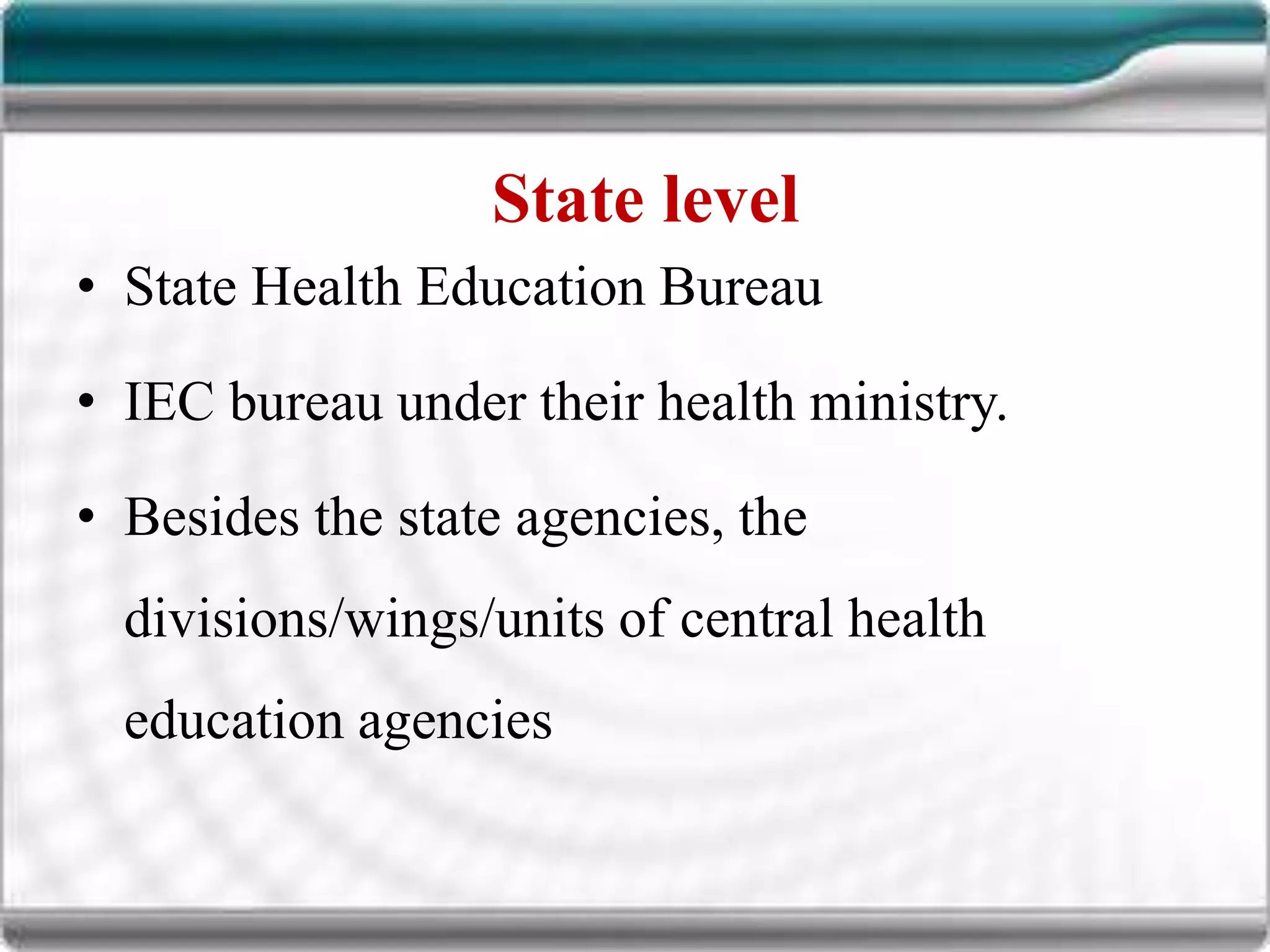
State level
• State Health Education Bureau
• IEC bureau under their health ministry.
• Besides the state agencies, the
divisions/wings/units of central health
education agencies
District level
• All district level health officers
• family planning officers
• RCH wings .
• District information centres
• District Collector
Local level
• In cities; Municipalities, municipal corporation,
development authorities etc
• In villages panchayats, Block development
officers
• Beside these various NGOS and voluntary
organizations, health and nursing professional
associations
NURSES RESPONSIBILITY
IN IEC
NURSES RESPONSIBILITY IN IEC
 The nurse should consider the following points in health
education
• To gain confidence of people.
• To arouse the interest in people about good health.
• To motivate them to bring about changes in habits for
healthy life.
• To prepare them for utilization of available health services.
• To develop a sense of responsibility among people towards
good health of the whole community.
NURSES RESPONSIBILITY IN IEC
A friendly and cooperative feeling should be kept
for health education.
The opportunities for health education should be
widely used.
It is necessary to select the subject matter
cautiously. The nurse should be proficient in the
art of incidental and timely health education.
It is necessary to use appropriate audio visual aids
to enhance the effect of health education.
NURSES RESPONSIBILITY IN IEC
 The sufficient preparation and cooperation of the government
and voluntary agencies, central health education bureau, state
health education bureau, directorate of audio visual publicity,
local leaders, teachers, health workers etc.
 It is necessary to remove various obstacles in communication.
 Health education should be planned and continuous.
 Periodical evaluation and expected correction of health
education programmes with the help of various tools and
observation are also the responsibilities of a nurse.
Information education communication

Information education communication

  • 1.
  • 2.
    Definition IEC can bedefined as an approach which attempts to change or reinforce a set of behaviors in a target audience regarding specific problem in a predefined period of time. Reproductive health and research, WHO
  • 3.
  • 4.
    Aims • To changethe health behavior of individuals, family and community. • To prepare background or basis for change in health behavior. • To change the norms of the community. • To facilitate education for audience about public health and to create awareness in public opinion. • To obtain social, political support for health activities.
  • 5.
    Scope or Fieldsof IEC in relation to health Primary health care Prevention /control on communicable diseases. Reproductive health/maternal and child health services. Family welfareNutritional services Personal hygiene
  • 6.
    Approaches of IEC Theapproaches of IEC are based upon following fields or subjects • Diffusion theory • Social marketing • Behavioural analysis • Instructive design • Anthropology
  • 7.
    INFORMATION This consists of providingscientific knowledge to the people about the health problems and how to prevent them and promote and maintain health.
  • 8.
    Definition Health education canbe defined as a process aimed at encouraging people to want to be healthy, to know how to stay healthy, to do what they can individually and collectively to maintain health and to seek help when needed. The Declaration of Alma Ata(1978)
  • 9.
    Aims and objectives •To encourage people to adopt and sustain health promoting life style and practices. • To promote the proper use of health services available to them. • To arouse interest, provide new knowledge, improve skills and change attitudes in making rational decisions to solve their own problems. • To stimulate individual and community self reliance and participation to achieve health development through individual and community involvement at every step from identifying problems to solve them.
  • 10.
    Approaches to healtheducation • Regulatory • Service approach • Health education approach • Primary health care approach
  • 11.
    Models of healtheducation • Medical model • Motivation model • Social intervention model
  • 12.
    Principles of healtheducation 1. Credibility 2. Interest 3. Participation 4. Motivation 5. Comprehension 6. Reinforcement
  • 13.
    Principles of healtheducation 7. Learning by doing 8. Known to unknown 9.Setting an example 10. Good human relations 11. Feed back 12. Leaders
  • 14.
    COMMUNICATION • The wordcommunication is derived from latin word, communicare which means to participate, to inform, or impart. • Communication can be regarded as a two way process of exchanging or shaping ideas, feelings and information.
  • 15.
    The process ofcommunication
  • 16.
    Types of communication •One way communication • Two way communication • Verbal communication • Non verbal communication • Formal and Informal communication • Visual communication • Tele communication and internet
  • 17.
    Barriers of communication •Physiological • Linguistic barriers • Psychological • Organizational barriers • Environmental • Cultural
  • 18.
    Functions of Healthcommunication • Information • Education • Motivation • Persuasion • Counseling • Raising morale • Health development • Health organization
  • 19.
    AUDIOVISUAL AIDS • Auditoryaids • Visual aids o Not requiring projection o Requiring projection • Combined AV aids
  • 20.
    METHODS IN HEALTHCOMMUNICATION • Individual approach • Group approach • Mass approach
  • 21.
    Measures for successfulCommunication • Clarity of thought with simple and understandable language. • Use two way communication • Usefulness of health message • Proper use of audio visual aids, gestures, words and pictures. • Credibility and genuiness of communication. • Topics for health education according to requirement, feelings, beliefs and experiences of people. • Latest and reliable information. • Correct medium or method of communication. • Appropriate attention to verbal as well as non verbal messages.
  • 22.
    Measures for successfulCommunication • Increase communication skill by  Be confident in your ability to relate people.  Be honest with your feelings.  Be sensitive to the needs of others.  Be consistent and know yourself.  Recognize symptoms of anxiety.  Recognize differences.  Use words carefully.  Recognize and evaluate your actions and responses.  Be careful in non verbal communication.
  • 23.
    STEPS FOR HEALTHEDUCATION PROGRAMME Evaluation Process Content Need assessment
  • 24.
    Process of healtheducation • Giving information/questioning • Contracting • Demonstration and return demonstration • Environmental cuing • Group norms • System change.
  • 25.
  • 26.
    BEHAVIOUR CHANGE COMMUNICATION (BCC) BCCcan be defined as a process that motivates people to adopt and sustain healthy behavior and life styles
  • 27.
    Steps for BCCProgramme. • Analysis • Strategic design • Development and pretesting • Implementation and monitoring • Evaluation
  • 28.
  • 29.
    International level • Internationalunion for health education • Health Education and Health Promotion HEHP(WHO) • Division of Public information and Public relation(WHO)
  • 30.
    National level • CentralHealth Education Bureau (CHEB) • Under the Ministry and Broad casting, different division or units are playing important part in providing health education to community.
  • 31.
    Central Health Education Bureau(CHEB) Objectives • To make available facilities of communication for health education. • To carry out training and research in health education. • To exchange latest information about the development and programmes. • To publish and distribute various health bulletins, magazines and information. • To provide technical support to central and state health services and various health organizations.
  • 32.
    Central Health EducationBureau (CHEB) Divisions 1. Training division 2. Publicity division 3. Editorial division 4. Health education division 5. Regional study division 6. Exhibition center division 7. Professional syllabus division 8. Research and evaluation division
  • 33.
    Under the Ministryand Broad casting, different division or units • Press information Bureau(PIB) • Directorate of field publicity • Directorate of advertising and Visual publicity • Prasar Bharti • Songs and Drama division • National medical Library
  • 34.
    State level • StateHealth Education Bureau • IEC bureau under their health ministry. • Besides the state agencies, the divisions/wings/units of central health education agencies
  • 35.
    District level • Alldistrict level health officers • family planning officers • RCH wings . • District information centres • District Collector
  • 36.
    Local level • Incities; Municipalities, municipal corporation, development authorities etc • In villages panchayats, Block development officers • Beside these various NGOS and voluntary organizations, health and nursing professional associations
  • 37.
  • 38.
    NURSES RESPONSIBILITY INIEC  The nurse should consider the following points in health education • To gain confidence of people. • To arouse the interest in people about good health. • To motivate them to bring about changes in habits for healthy life. • To prepare them for utilization of available health services. • To develop a sense of responsibility among people towards good health of the whole community.
  • 39.
    NURSES RESPONSIBILITY INIEC A friendly and cooperative feeling should be kept for health education. The opportunities for health education should be widely used. It is necessary to select the subject matter cautiously. The nurse should be proficient in the art of incidental and timely health education. It is necessary to use appropriate audio visual aids to enhance the effect of health education.
  • 40.
    NURSES RESPONSIBILITY INIEC  The sufficient preparation and cooperation of the government and voluntary agencies, central health education bureau, state health education bureau, directorate of audio visual publicity, local leaders, teachers, health workers etc.  It is necessary to remove various obstacles in communication.  Health education should be planned and continuous.  Periodical evaluation and expected correction of health education programmes with the help of various tools and observation are also the responsibilities of a nurse.