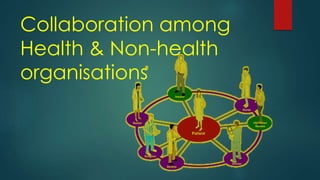
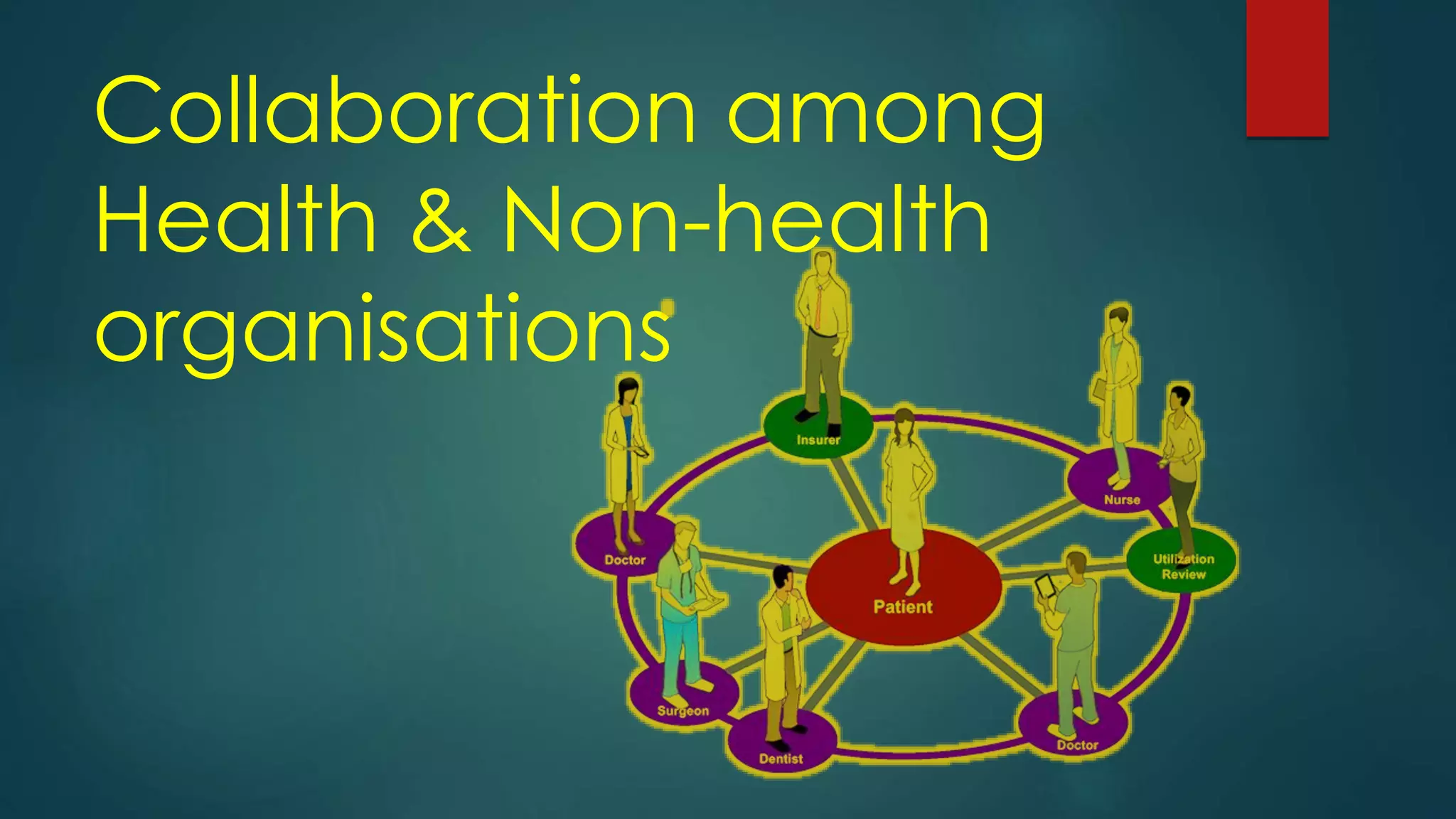
Collaboration among
Health & Non-health
organisations
Group 4 Members
 Raymond Bondo-ou
 Jimmy Elliot
 Sudarshan Giri
 Florence Kerry
 Joy Manda McKay
 Venkata Rajashekhara
 Jaswinder Kaur
Assessment Question
 Question # 7
Health organisations in any sector need to put importance
on the ability to work collaboratively with other health and
non-health organisations. In your presentation develop an
argument on what would be the best practices and
behaviours of leaders in these organisations to achieve this
important goal.
Presentation Outline
 COLLABORATIVE LEADERSHIP
 COLLABORATION
 BENEFITS OF COLLABORATION AND LEADERSHIP
 BARRIERS OF COLLABORATION AND LEADERSHIP
 SOLUTIONS: BEST PRACTICES AND BEHAVIOURS
 CASE STUDY AND COLLABORATIVE LEADERSHIP
Objective
What is & Why collaborate?
Identify the collaborative processes
Who collaborates with who?
Conditions for collaborating
Practices and behaviours for collaborative
leaders
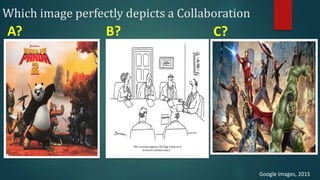
Which image perfectly depicts a Collaboration
Google images, 2015
A? B? C?
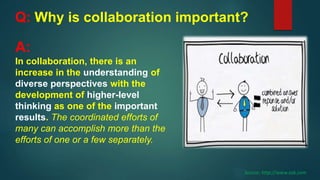
Q: Why is collaboration important?
A:
In collaboration, there is an
increase in the understanding of
diverse perspectives with the
development of higher-level
thinking as one of the important
results. The coordinated efforts of
many can accomplish more than the
efforts of one or a few separately.
Source: http://www.ask.com
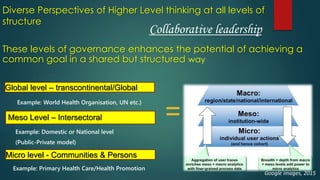
Diverse Perspectives of Higher Level thinking at all levels of
structure
Global level – transcontinental/Global
Micro level - Communities & Persons
=
Collaborative leadership
Google images, 2015
Meso Level – Intersectoral
Example: Domestic or National level
(Public-Private model)
Example: Primary Health Care/Health Promotion
Example: World Health Organisation, UN etc.)
These levels of governance enhances the potential of achieving a
common goal in a shared but structured way
The Power of Collaboration
The Collaborative environment

Shared Goals : Team including patients , family members
and others supportive persons work to established shared
goals that reflects patient and family priorities .
Mutual Trust : Partner organisation members should earns
each others trust ,creating strong norms and greater
opportunities for shared achievement .
Effective communication : Teams working together should
have regular flow of information and continuously refines its
communication skills. Consistent channels for candid and
complete communication , which are assed and used by
all team members across all setting.( Mitchell et al 212)
Principles of Collaboration
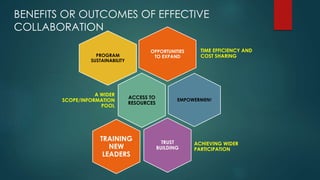
BENEFITS OR OUTCOMES OF EFFECTIVE
COLLABORATION
OPPORTUNITIES
TO EXPAND
TIME EFFICIENCY AND
COST SHARINGPROGRAM
SUSTAINABILITY
ACCESS TO
RESOURCES
A WIDER
SCOPE/INFORMATION
POOL
EMPOWERMENT
TRUST
BUILDING
ACHIEVING WIDER
PARTICIPATION
TRAINING
NEW
LEADERS
BARRIERS IN COLLABORATION
 Interpersonal conflicts & Conflict within the Group
Possible Ambiguity in Roles and Responsibility
 Lack of communication & coordination
 Cultural differences
Barriers in Collaborative Leadership
Practice
 Lack of Transparent Decision Making
 Lack of Honesty and Trust
 Lack of Motivation and Vision
 Dominance (value one group over another)
How can be Solve the barriers in
collaboration ?
 Well define role and responsibilities
 Strong communication channel
 Conflict resolution mechanism
 Understand the values of different cultures
 Participative leadership
 Proper representation of every group
 Transparent decision process
 Appropriate motivation and vision
Solution of Barriers in Leadership
Collaboration of Health Organisations
with other Health and Non-health
organisations
Collaboration of Health & Non-health
Organisations
 Determinants of health – social, economic, demographic,
geographic, politics
 Most health determinants lie outside scope of health sector, esp.
social & economic
 Inter-sectoral action → improved health equity
 Inters-sectoral action – within and between sectors at local,
regional, provincial, national and global levels
 Collaboration – creates a supportive environment and enhance
access to marginalised populations
 Not a new concept in health
(Ndumne-Eyoh and Moffatt,
2013)
Alma Ata Declaration – Inter-sectoral
Collaboration (ISC)
 Section VII (4) - PHC
- involves, in addition to the health sector,
all related aspects of national and
community development, in particular,
agriculture, animal husbandry, food,
industry, education, housing, public
works, communication and other sectors,
- demands the coordinated efforts of all
these sectors
 Section VIII
- All government should formulate national
policies, strategies and plans of action to
launch and sustain PHC as part of a
comprehensive national health system
and in coordination with others sectors. To
this end, it will be necessary to exercise
political will, to mobilise the countries
resources and to use available external
resources rationally.
(Adeleye and Ofili,
2010)
Millennium Development Goals (MDG)
 Indicators closely relate to PHC tenets, esp. maternal &
child health, water & environment and poverty reduction
 However, ISC not formally presented as a MDG strategy
 ICS required – achievement of MDG outcomes is
dependent on inputs from other sectors
Inter-sectoral Action for Health (IAH)
 WHO defined IAH as:
- “A recognised relationship between part or parts of the health
sector with parts of another sector which has been formed to take
action on an issue to achieve health outcomes (or intermediate
outcomes) in a way that is more effective, efficient or sustainable
than could be achieved by the health sector acting alone”
- Involvement of parts of sector → structural, functional or
conceptual in nature
- Aim → relationship formed will achieve improved effectiveness,
efficiency & sustainability
Best Practice & Behaviour in leading
ISC/IAH
 Applied at political level down to community level
 Current HC environment & reforms → transform HC delivery, both
culturally and structurally
 Creative thinking and adaptive leadership ensure HC orgs. & networks
formed are sustainable – achieve health outcomes
 Competencies required of leaders & other orgs must continue to evolve
 Change is inevitable and requires a collaborative interdependent culture
and solutions that cut across function, region and profession
 Leaders must move towards models that leverages cross-boundry groups
and teams and span sectors, disciplines, levels, functions, generations
and professions
(Browning et. al., 2011)
Examples
1. Education - School Health Programs
2. Provision of basic infrastructure – Electricity
Conclusion
 Effective collaboration among health and non-health organisations in the public,
private and NGO sector can positively impact determinants of health and lead to
achievement of health outcomes especially in PHC
 Collaborative leadership is essential in setting the direction for the desired
outcomes and the mobilisation of required resources
 Challenge - neglect of ISC:
o non-health PHC strategies, out of health sector control
o PHC not an agenda for non-health sectors
o Lack of practical initiatives from health sector towards ISC
References
 Brownlee, T, (2014). Multicultural Collaboration. Retrieved from: http://ctb.ku.edu/en/table-of-
contents/culture/cultural-competence/multicultural-collaboration/main
 Holmes& Leonard, (2010). Dominance of Management: A Participatory Critique. Retrieved
from:
http://site.ebrary.com.libraryproxy.griffith.edu.au/lib/griffith/detail.action?docID=10400549
 George N. Root III, (2015). The Advantages of Participative Leadership. Retrieved from:
http://smallbusiness.chron.com/advantages-participative-leadership-17629.html
 Thomas-Kilmann, (2014). Conflict Mode Instrument (TKI). Retrieved from:
http://www.usgs.gov/humancapital/ecd/ecd_thomaskilmann.ht
 W. Roger Miller and Jeffrey P. Miller (1996). Leadership Styles for Success in Collaborative Work.
Retrieved from
http://www.leadershipeducators.org/resources/documents/conferences/fortworth/miller.pdf
 Roussos, S. T., & Fawcett, S. B. (2000). A review of collaborative partnerships as a
strategy for improving community health. Annual review of public health,21(1),
369-402.
 Community toolbox. (2014). Section 11: Collaborative Leadership, Retrieved from
http://ctb.ku.edu/en/table-of-contents/leadership/leadership-ideas/collaborative-
leadership/main

Group 4 presentation, collaborative leadership

  • 1.
    Collaboration among Health &Non-health organisations
  • 2.
    Group 4 Members Raymond Bondo-ou  Jimmy Elliot  Sudarshan Giri  Florence Kerry  Joy Manda McKay  Venkata Rajashekhara  Jaswinder Kaur
  • 3.
    Assessment Question  Question# 7 Health organisations in any sector need to put importance on the ability to work collaboratively with other health and non-health organisations. In your presentation develop an argument on what would be the best practices and behaviours of leaders in these organisations to achieve this important goal.
  • 4.
    Presentation Outline  COLLABORATIVELEADERSHIP  COLLABORATION  BENEFITS OF COLLABORATION AND LEADERSHIP  BARRIERS OF COLLABORATION AND LEADERSHIP  SOLUTIONS: BEST PRACTICES AND BEHAVIOURS  CASE STUDY AND COLLABORATIVE LEADERSHIP
  • 5.
    Objective What is &Why collaborate? Identify the collaborative processes Who collaborates with who? Conditions for collaborating Practices and behaviours for collaborative leaders
  • 6.
    Which image perfectlydepicts a Collaboration Google images, 2015 A? B? C?
  • 7.
    Q: Why iscollaboration important? A: In collaboration, there is an increase in the understanding of diverse perspectives with the development of higher-level thinking as one of the important results. The coordinated efforts of many can accomplish more than the efforts of one or a few separately. Source: http://www.ask.com
  • 8.
    Diverse Perspectives ofHigher Level thinking at all levels of structure Global level – transcontinental/Global Micro level - Communities & Persons = Collaborative leadership Google images, 2015 Meso Level – Intersectoral Example: Domestic or National level (Public-Private model) Example: Primary Health Care/Health Promotion Example: World Health Organisation, UN etc.) These levels of governance enhances the potential of achieving a common goal in a shared but structured way
  • 9.
    The Power ofCollaboration
  • 10.
  • 11.
     Shared Goals :Team including patients , family members and others supportive persons work to established shared goals that reflects patient and family priorities . Mutual Trust : Partner organisation members should earns each others trust ,creating strong norms and greater opportunities for shared achievement . Effective communication : Teams working together should have regular flow of information and continuously refines its communication skills. Consistent channels for candid and complete communication , which are assed and used by all team members across all setting.( Mitchell et al 212) Principles of Collaboration
  • 12.
    BENEFITS OR OUTCOMESOF EFFECTIVE COLLABORATION OPPORTUNITIES TO EXPAND TIME EFFICIENCY AND COST SHARINGPROGRAM SUSTAINABILITY ACCESS TO RESOURCES A WIDER SCOPE/INFORMATION POOL EMPOWERMENT TRUST BUILDING ACHIEVING WIDER PARTICIPATION TRAINING NEW LEADERS
  • 13.
    BARRIERS IN COLLABORATION Interpersonal conflicts & Conflict within the Group Possible Ambiguity in Roles and Responsibility  Lack of communication & coordination  Cultural differences
  • 14.
    Barriers in CollaborativeLeadership Practice  Lack of Transparent Decision Making  Lack of Honesty and Trust  Lack of Motivation and Vision  Dominance (value one group over another)
  • 15.
    How can beSolve the barriers in collaboration ?  Well define role and responsibilities  Strong communication channel  Conflict resolution mechanism  Understand the values of different cultures
  • 16.
     Participative leadership Proper representation of every group  Transparent decision process  Appropriate motivation and vision Solution of Barriers in Leadership
  • 17.
    Collaboration of HealthOrganisations with other Health and Non-health organisations
  • 18.
    Collaboration of Health& Non-health Organisations  Determinants of health – social, economic, demographic, geographic, politics  Most health determinants lie outside scope of health sector, esp. social & economic  Inter-sectoral action → improved health equity  Inters-sectoral action – within and between sectors at local, regional, provincial, national and global levels  Collaboration – creates a supportive environment and enhance access to marginalised populations  Not a new concept in health (Ndumne-Eyoh and Moffatt, 2013)
  • 19.
    Alma Ata Declaration– Inter-sectoral Collaboration (ISC)  Section VII (4) - PHC - involves, in addition to the health sector, all related aspects of national and community development, in particular, agriculture, animal husbandry, food, industry, education, housing, public works, communication and other sectors, - demands the coordinated efforts of all these sectors  Section VIII - All government should formulate national policies, strategies and plans of action to launch and sustain PHC as part of a comprehensive national health system and in coordination with others sectors. To this end, it will be necessary to exercise political will, to mobilise the countries resources and to use available external resources rationally. (Adeleye and Ofili, 2010)
  • 20.
    Millennium Development Goals(MDG)  Indicators closely relate to PHC tenets, esp. maternal & child health, water & environment and poverty reduction  However, ISC not formally presented as a MDG strategy  ICS required – achievement of MDG outcomes is dependent on inputs from other sectors
  • 21.
    Inter-sectoral Action forHealth (IAH)  WHO defined IAH as: - “A recognised relationship between part or parts of the health sector with parts of another sector which has been formed to take action on an issue to achieve health outcomes (or intermediate outcomes) in a way that is more effective, efficient or sustainable than could be achieved by the health sector acting alone” - Involvement of parts of sector → structural, functional or conceptual in nature - Aim → relationship formed will achieve improved effectiveness, efficiency & sustainability
  • 22.
    Best Practice &Behaviour in leading ISC/IAH  Applied at political level down to community level  Current HC environment & reforms → transform HC delivery, both culturally and structurally  Creative thinking and adaptive leadership ensure HC orgs. & networks formed are sustainable – achieve health outcomes  Competencies required of leaders & other orgs must continue to evolve  Change is inevitable and requires a collaborative interdependent culture and solutions that cut across function, region and profession  Leaders must move towards models that leverages cross-boundry groups and teams and span sectors, disciplines, levels, functions, generations and professions (Browning et. al., 2011)
  • 23.
    Examples 1. Education -School Health Programs 2. Provision of basic infrastructure – Electricity
  • 24.
    Conclusion  Effective collaborationamong health and non-health organisations in the public, private and NGO sector can positively impact determinants of health and lead to achievement of health outcomes especially in PHC  Collaborative leadership is essential in setting the direction for the desired outcomes and the mobilisation of required resources  Challenge - neglect of ISC: o non-health PHC strategies, out of health sector control o PHC not an agenda for non-health sectors o Lack of practical initiatives from health sector towards ISC
  • 25.
    References  Brownlee, T,(2014). Multicultural Collaboration. Retrieved from: http://ctb.ku.edu/en/table-of- contents/culture/cultural-competence/multicultural-collaboration/main  Holmes& Leonard, (2010). Dominance of Management: A Participatory Critique. Retrieved from: http://site.ebrary.com.libraryproxy.griffith.edu.au/lib/griffith/detail.action?docID=10400549  George N. Root III, (2015). The Advantages of Participative Leadership. Retrieved from: http://smallbusiness.chron.com/advantages-participative-leadership-17629.html  Thomas-Kilmann, (2014). Conflict Mode Instrument (TKI). Retrieved from: http://www.usgs.gov/humancapital/ecd/ecd_thomaskilmann.ht  W. Roger Miller and Jeffrey P. Miller (1996). Leadership Styles for Success in Collaborative Work. Retrieved from http://www.leadershipeducators.org/resources/documents/conferences/fortworth/miller.pdf  Roussos, S. T., & Fawcett, S. B. (2000). A review of collaborative partnerships as a strategy for improving community health. Annual review of public health,21(1), 369-402.  Community toolbox. (2014). Section 11: Collaborative Leadership, Retrieved from http://ctb.ku.edu/en/table-of-contents/leadership/leadership-ideas/collaborative- leadership/main