Presented by:
Lorraine D. Ellis, MS, MBA
President/CEO
Research Dynamics Consulting Group, Ltd.
and
William Gluck, Ph.D.
VP, DATATRAK Clinical and Consulting Services
DATATRAK International, Inc.
Integrating Clinical Operations and
Clinical Data Management Through EDC
Speakers
Lorraine D. Ellis, MS, MBA,
Research Dynamics Consulting Group,Ltd. @resdyn
Lorraine D. Ellis, is the founder/CEO of Research Dynamics, a full
service CRO. Most of her 35 years’ experience in the industry has
been in clinical research. Her expertise includes integrating
technology with clinical research processes over the past 20 years
and developing state-of-the-art training programs for clinical research
professionals.
William Gluck, Ph.D,
DATATRAK International,Inc. @DATATRAKinc
Bill Gluck joined DATATRAK International in October 2010 asVP of
DATATRAK’s Clinical and Consulting Services. Dr. Gluck has
more than 25 years of experience in the pharmaceutical and
biotechnology industries and has diversified experience in clinical trial
management systems and electronic data capture.
Speakers
Lorraine D. Ellis, MS, MBA,
Research Dynamics Consulting Group,Ltd. @resdyn
Lorraine D. Ellis, is the founder/CEO of Research Dynamics, a full
service CRO. Most of her 35 years’ experience in the industry has
been in clinical research. Her expertise includes integrating
technology with clinical research processes over the past 20 years
and developing state-of-the-art training programs for clinical research
professionals.
William Gluck, Ph.D,
DATATRAK International,Inc. @DATATRAKinc
Bill Gluck joined DATATRAK International in October 2010 asVP of
DATATRAK’s Clinical and Consulting Services. Dr. Gluck has
more than 25 years of experience in the pharmaceutical and
biotechnology industries and has diversified experience in clinical trial
management systems and electronic data capture.
Speakers
Lorraine D. Ellis, MS, MBA,
Research Dynamics Consulting Group,Ltd. @resdyn
Lorraine D. Ellis, is the founder/CEO of Research Dynamics, a full
service CRO. Most of her 35 years’ experience in the industry has
been in clinical research. Her expertise includes integrating
technology with clinical research processes over the past 20 years
and developing state-of-the-art training programs for clinical research
professionals.
William Gluck, Ph.D,
DATATRAK International,Inc. @DATATRAKinc
Bill Gluck joined DATATRAK International in October 2010 asVP of
DATATRAK’s Clinical and Consulting Services. Dr. Gluck has
more than 25 years of experience in the pharmaceutical and
biotechnology industries and has diversified experience in clinical trial
management systems and electronic data capture.
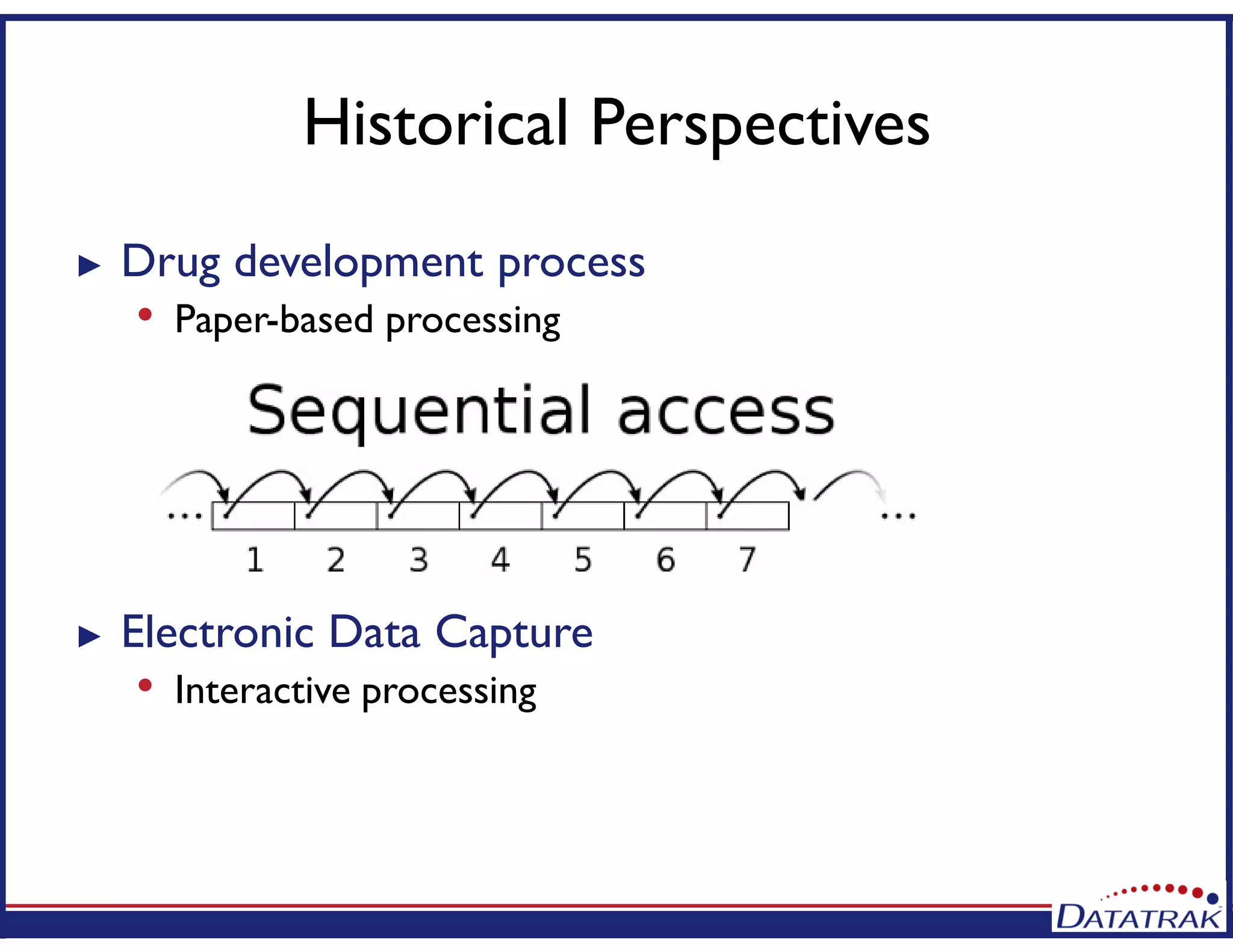
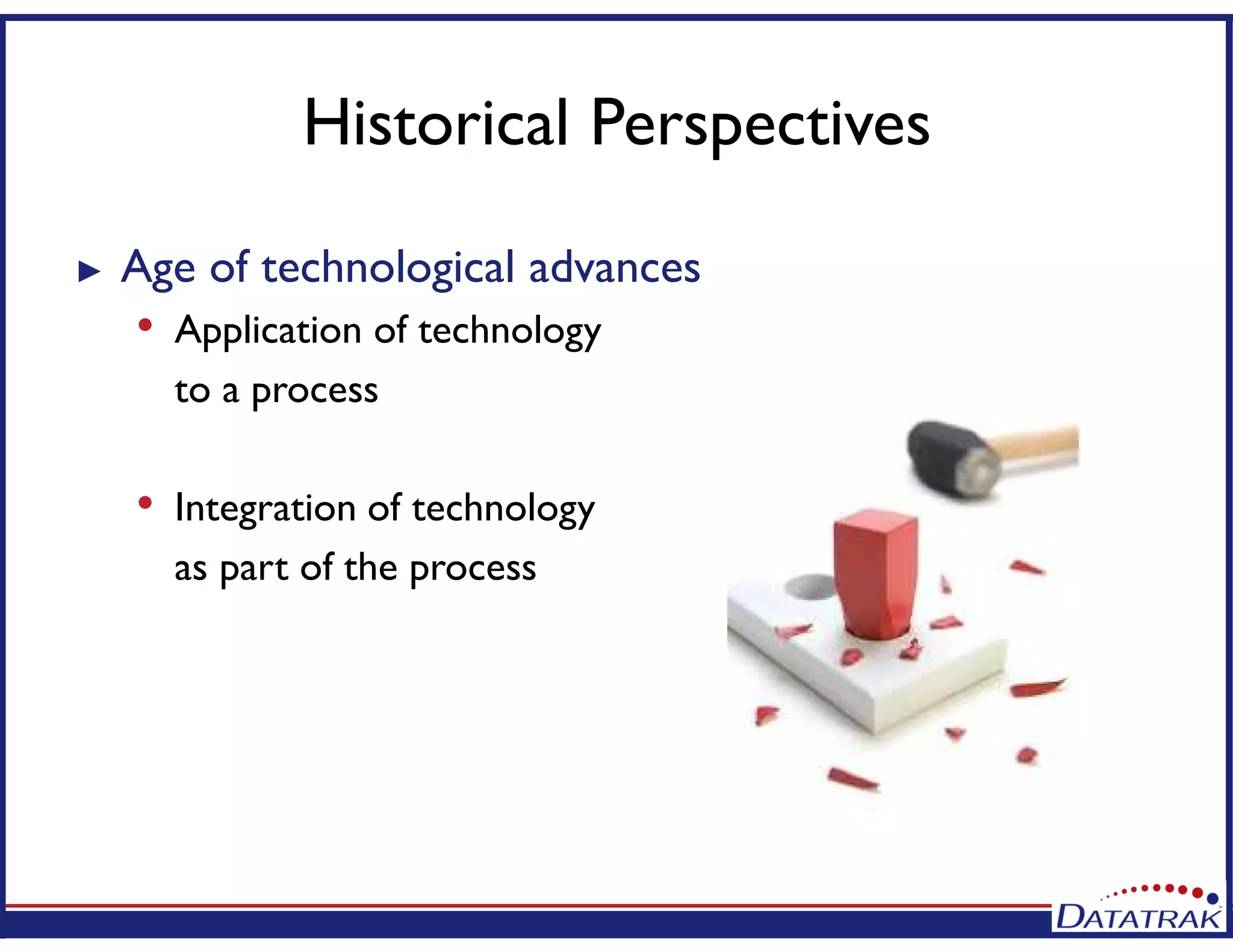
Historical Perspectives
► Age of technological advances
• Application of technology
to a process
• Integration of technology
as part of the process
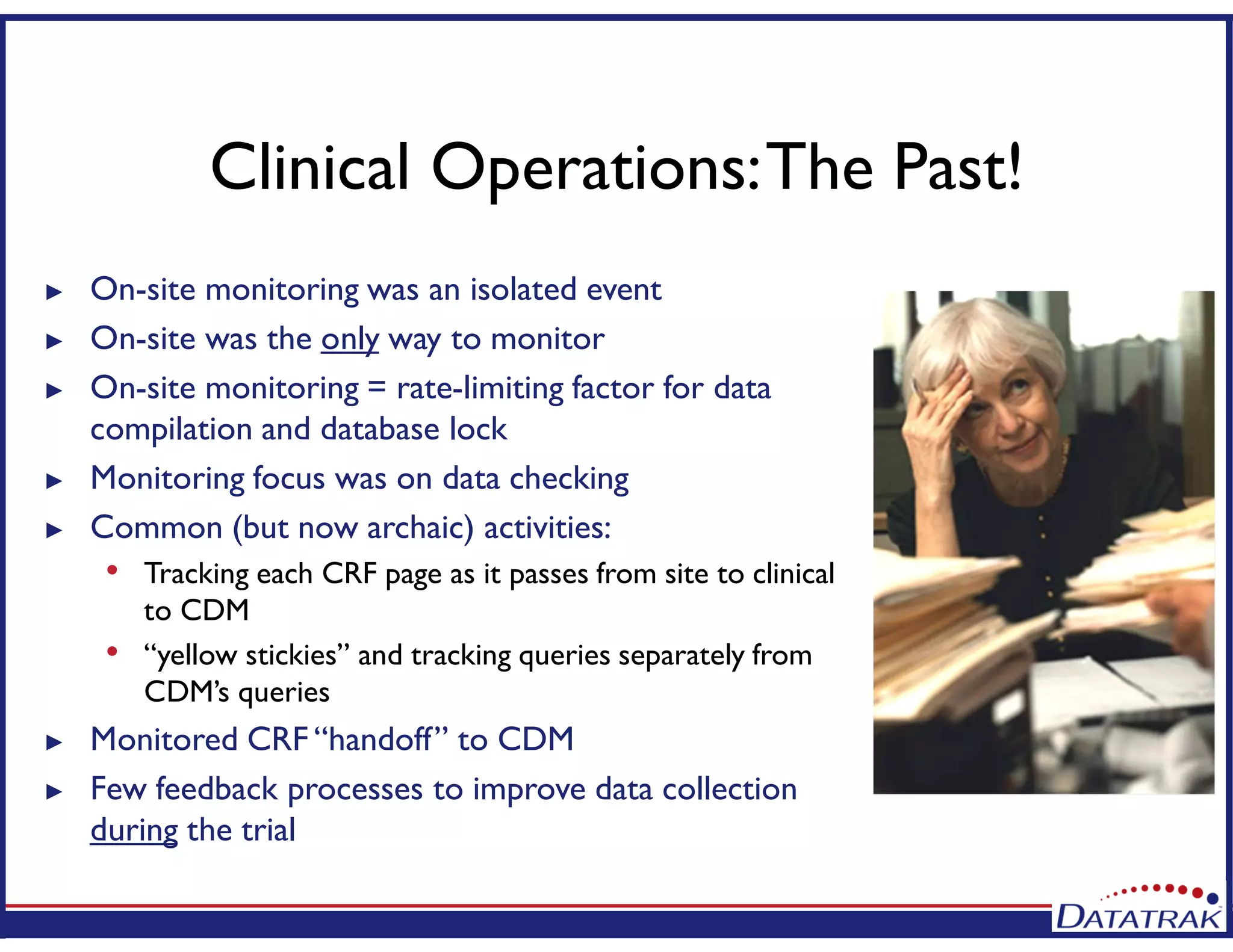
Clinical Operations:The Past!
► On-site monitoring was an isolated event
► On-site was the only way to monitor
► On-site monitoring = rate-limiting factor for data
compilation and database lock
► Monitoring focus was on data checking
► Common (but now archaic) activities:
• Tracking each CRF page as it passes from site to clinical
to CDM
• “yellow stickies” and tracking queries separately from
CDM’s queries
► Monitored CRF “handoff” to CDM
► Few feedback processes to improve data collection
during the trial
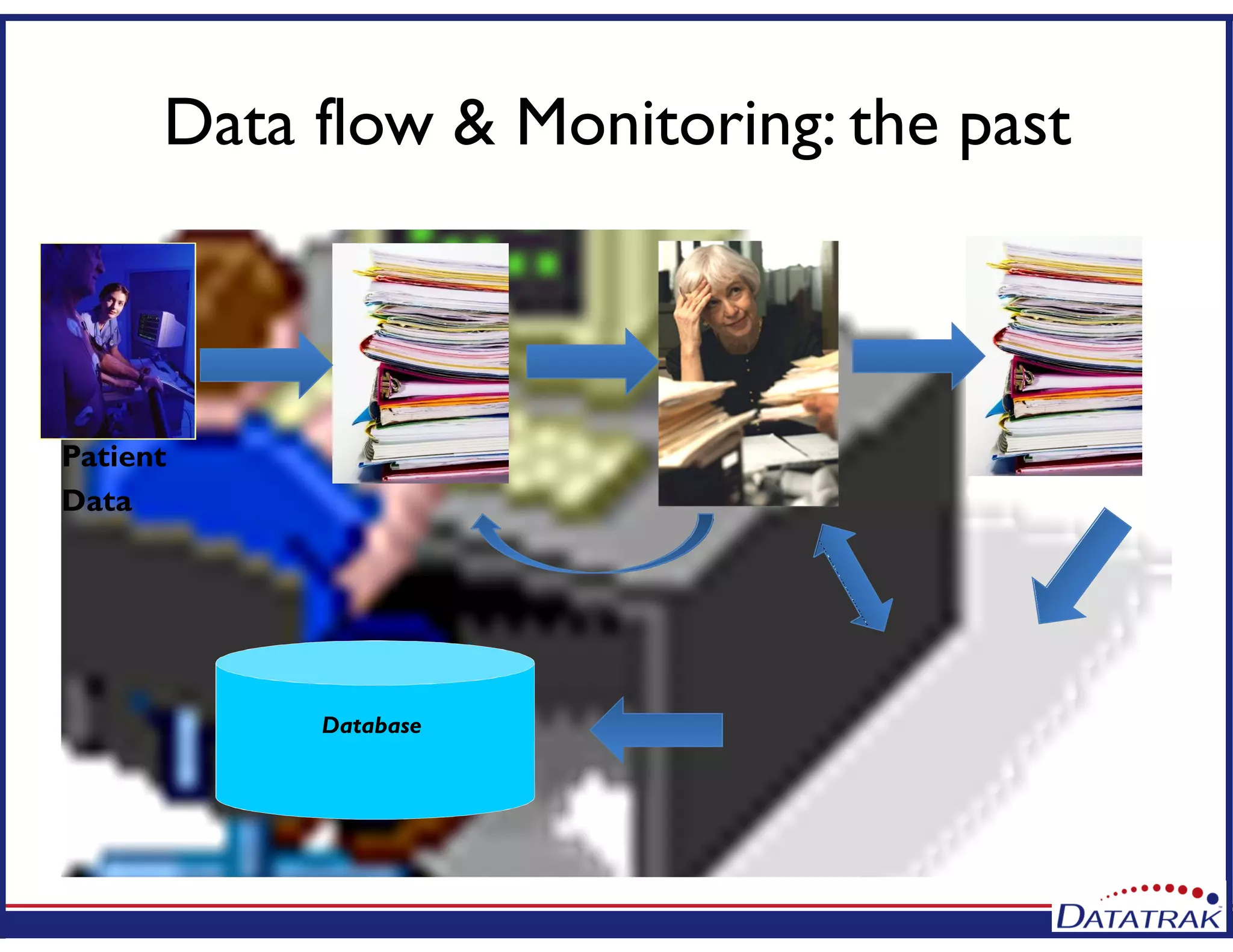
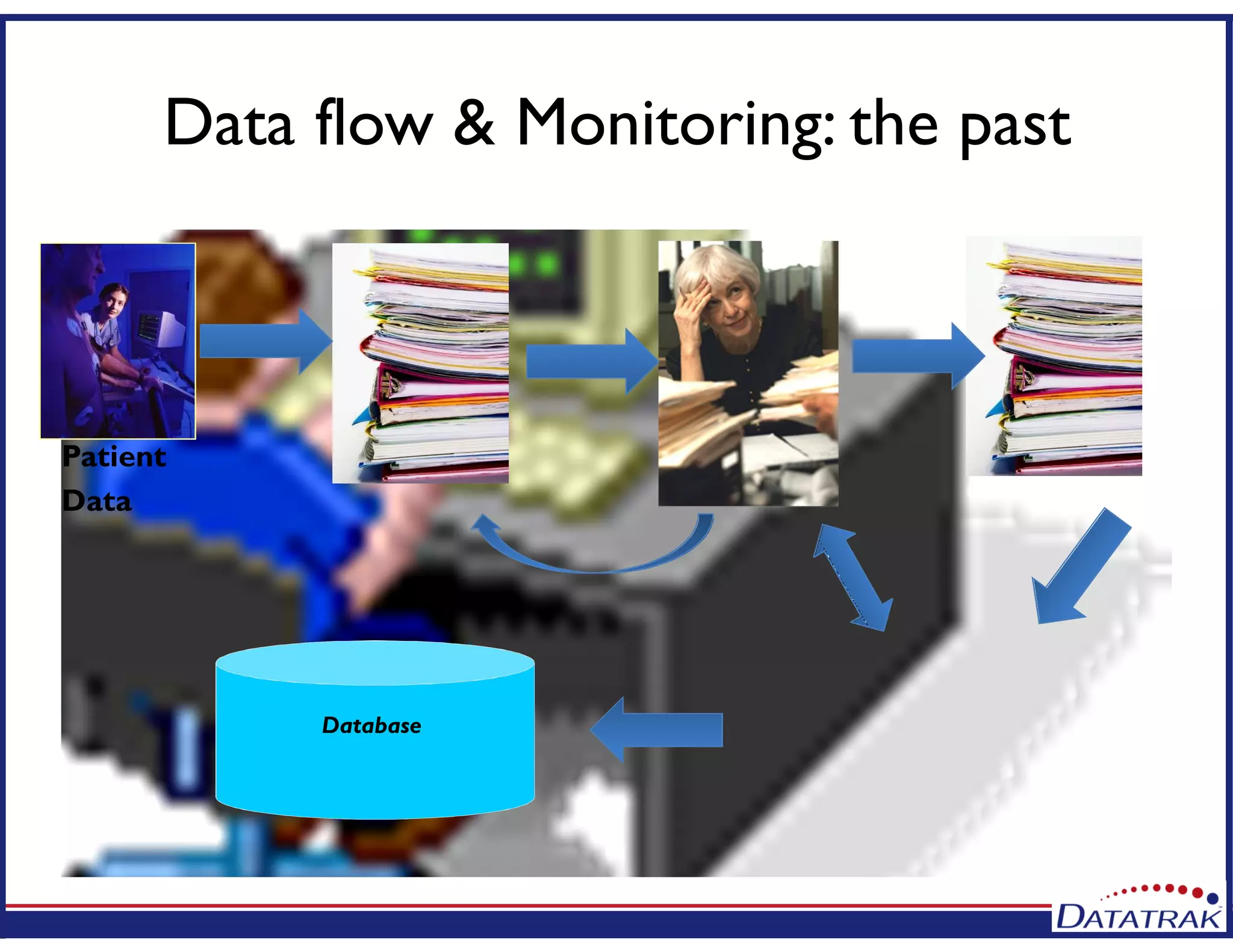
Data flow & Monitoring: the past
Patient
Data
Database
Data Flow in the past
► Data recording, collection, compilation and reporting was…..
• CRF design was often hampered by limited interaction with key parties
• Sequential process – little feedback to improve data
• Data was not sent to CDM until after each 4-6 week visit
• On-site monitoring visits were a limiting factor for data processing
• Silo’d processes with formal handoffs
• Paper movement from site to CRA to CDM was the rate limiting factor
• CRF Page tracking was inefficient and time consuming
• Query generation and resolution was a tracking-intensive
• Query process was labor-intensive with both CRA and CDM
• No feedback to improve data collection during trial
………………………………Very paper and process intensive and slow.
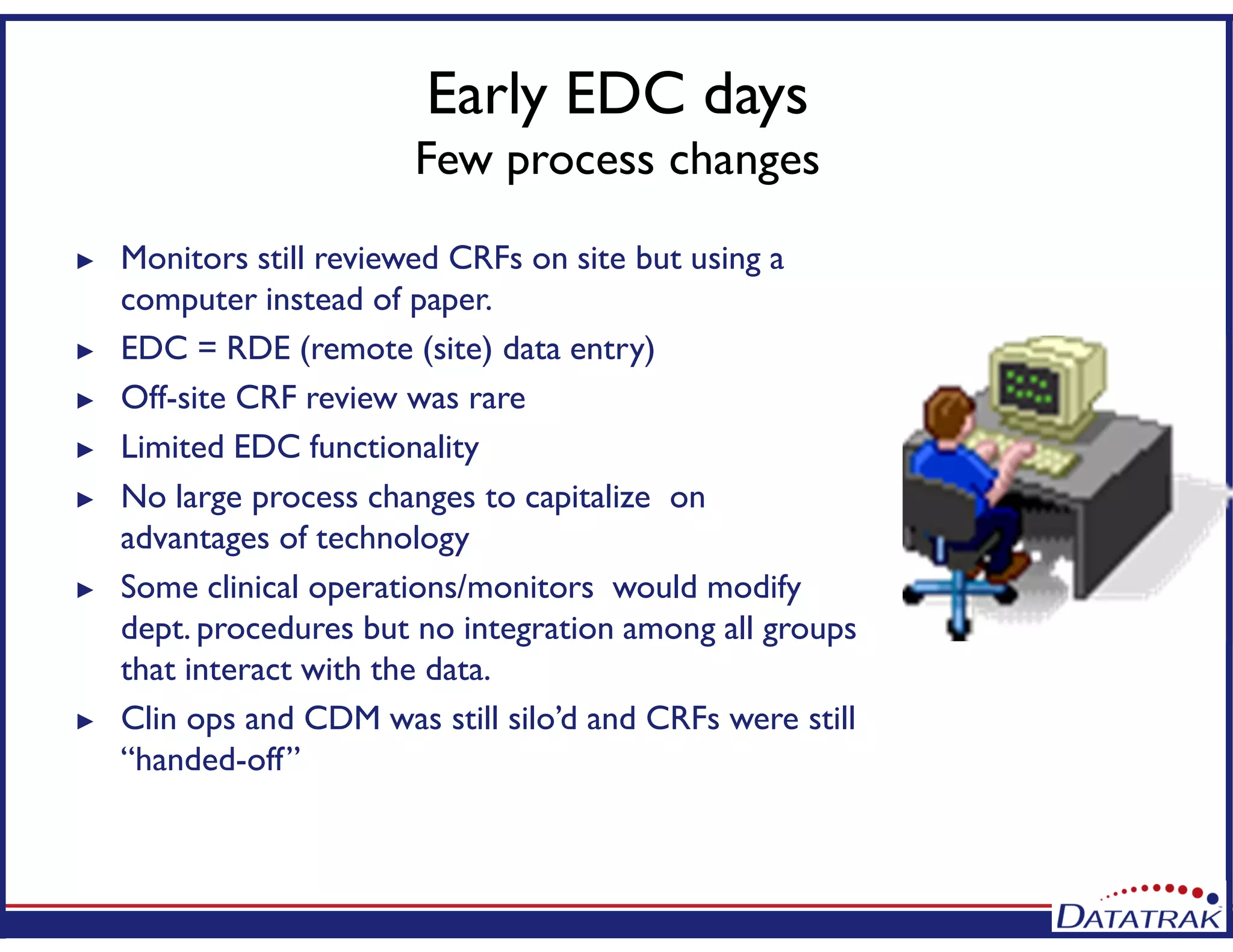
Early EDC days
Few process changes
► Monitors still reviewed CRFs on site but using a
computer instead of paper.
► EDC = RDE (remote (site) data entry)
► Off-site CRF review was rare
► Limited EDC functionality
► No large process changes to capitalize on
advantages of technology
► Some clinical operations/monitors would modify
dept. procedures but no integration among all groups
that interact with the data.
► Clin ops and CDM was still silo’d and CRFs were still
“handed-off”
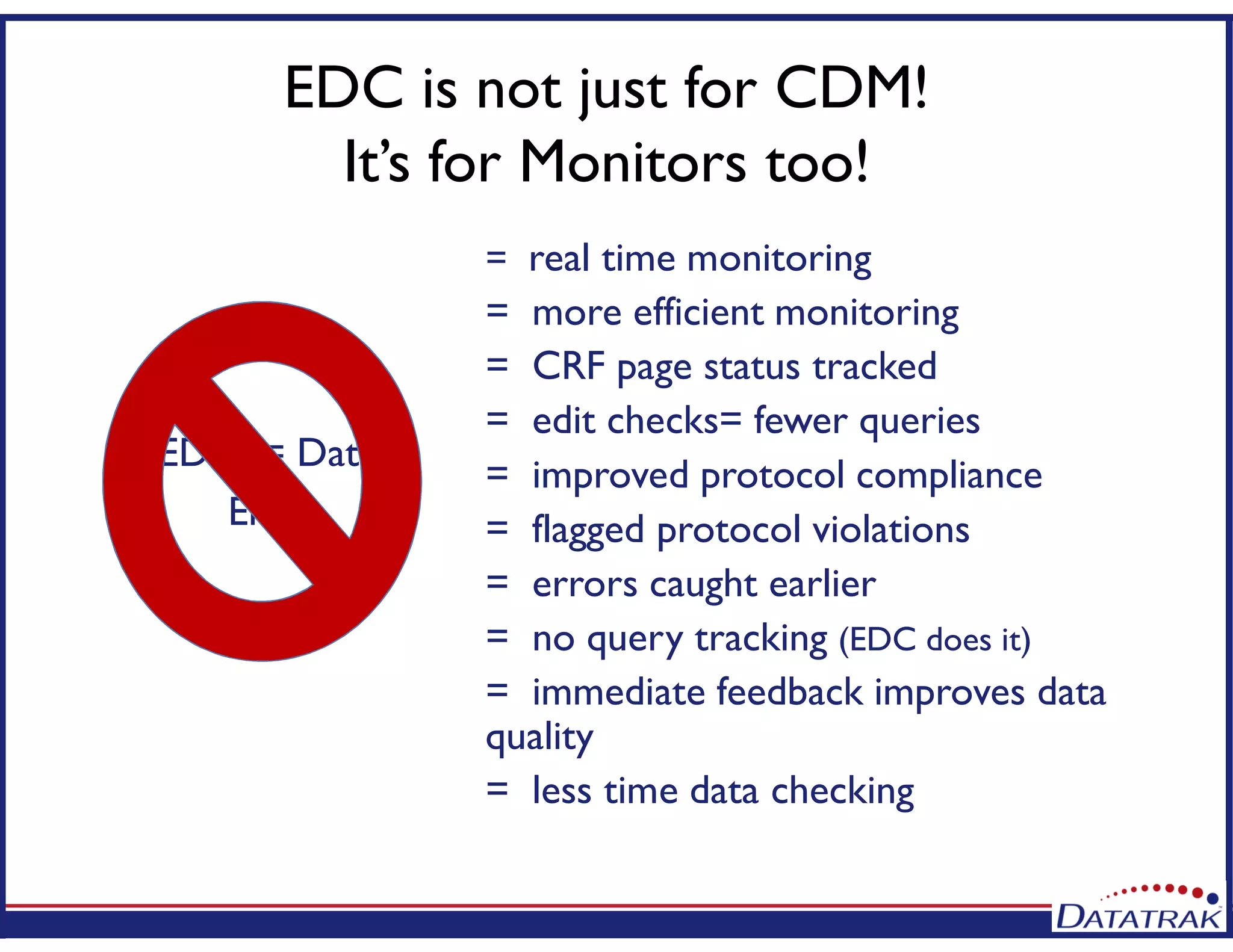
EDC is not just for CDM!
It’s for Monitors too!
= real time monitoring
= more efficient monitoring
= CRF page status tracked
= edit checks= fewer queries
= improved protocol compliance
= flagged protocol violations
= errors caught earlier
= no query tracking (EDC does it)
= immediate feedback improves data
quality
= less time data checking
EDC = Data
Entry
Time to maximize technology
and change processes
► Need changes in processes of:
• Collection, monitoring, tracking, cleaning
► Real time data processing requires real time
interaction between Clin Ops and CDM
► CRF design including protocol deviations and edit
checks require both Clin Ops and CDM
► Query process is more real time and interactive
between Clin Ops and CDM for real time changes.
Integration between Clin Ops and CDM
enhances efficiency of EDC
► CRF design to address monitoring issues
► Constant data flow to CDM with real time feedback
to Clin Ops
► Clin Ops can modify monitoring with EDC and CDM
feedback
► Query generation, tracking and resolution
simultaneous but integrated into one list
New Monitoring processes
► Real time monitoring
► Off-site and On-site monitoring
► Build edit checks into CRFS to decrease queries
► CRF design requires monitoring considerations (eg,
mandatory fields, protocol compliance, proper procedures, etc)
► NO tracking of pages or queries!
► Less data checking and focus on site performance
continuously
► EDC metrics provide “window” to performance
(time to eCRF completion, # queries, # data errors, etc)
FDA Guidance
► Risk Based monitoring!
► 1988 guidance withdrawn!
► Centralized (off-site) monitoring is encouraged!
► Centralized monitoring suggested to replace on-site
monitoring when it can complete activities better or as well
as on-site
► Centralized monitoring (when appropriate) should improve
ability to ensure the quality and integrity of data
• Pubs suggest that data anomalies may be more readily detected
► EDC can implement centralized monitoring methods that can
enable decreased reliance on on-site monitoring
Clinical Operations:The Future!
Monitoring process has changed.
► Real time monitoring (not just every 4-6 wks)
► Data reviewed off-site
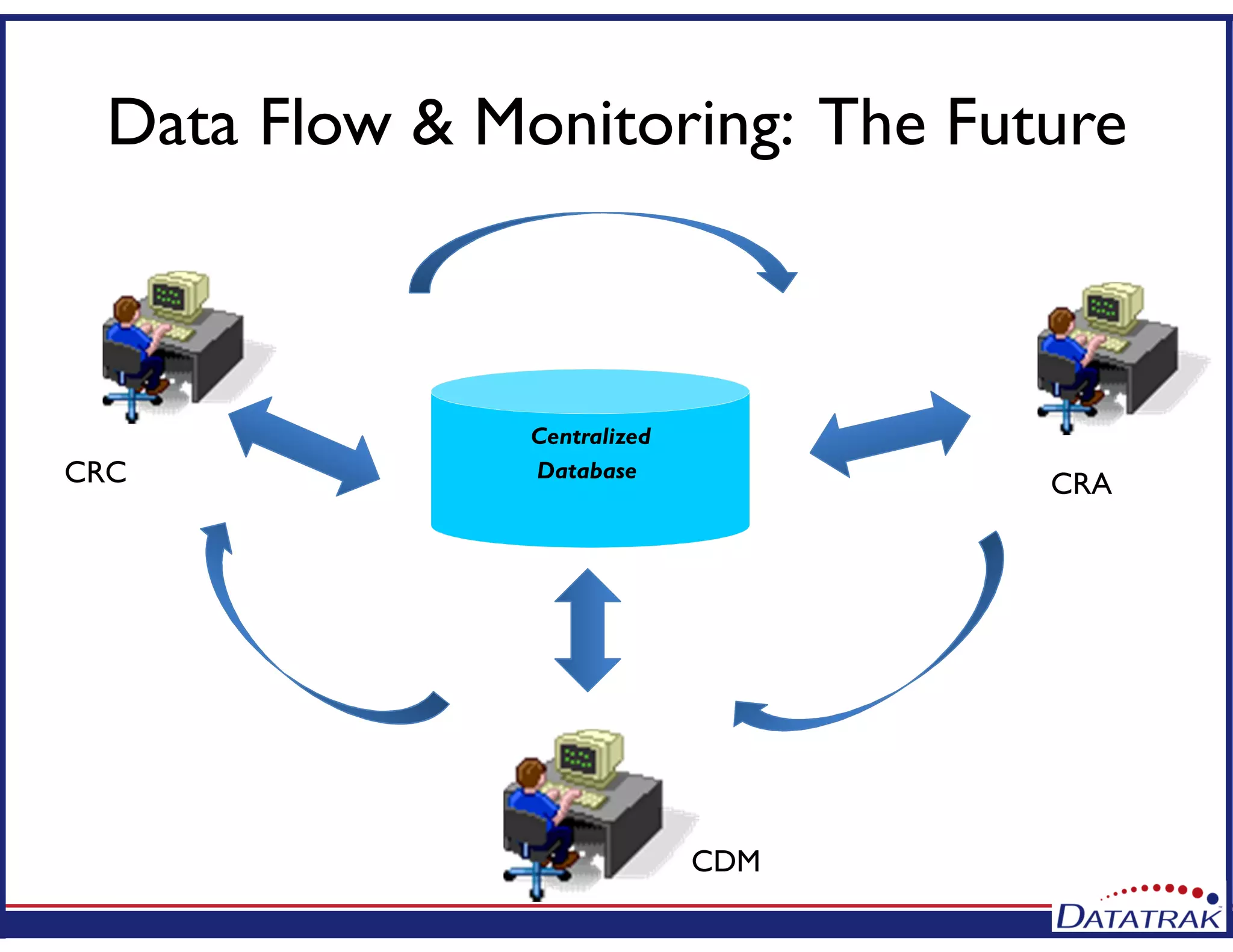
► Continuous data flow to CDM
► CRF design with Clin Ops and CDM
• Includes protocol compliance
• Edit checks to reduce queries
• Database designed early requiring earlier data decisions
► Sequential processes become simultaneous (Clin Ops &
CDM)
► Silo monitoring processes become integrated with CDM
► Poor communication is improved with interactive
communication tools in real time (from EDC system)
Data flow & Monitoring: the past
Patient
Data
Database
Data Flow & Monitoring: The Future
Centralized
DatabaseCRC CRA
CDM
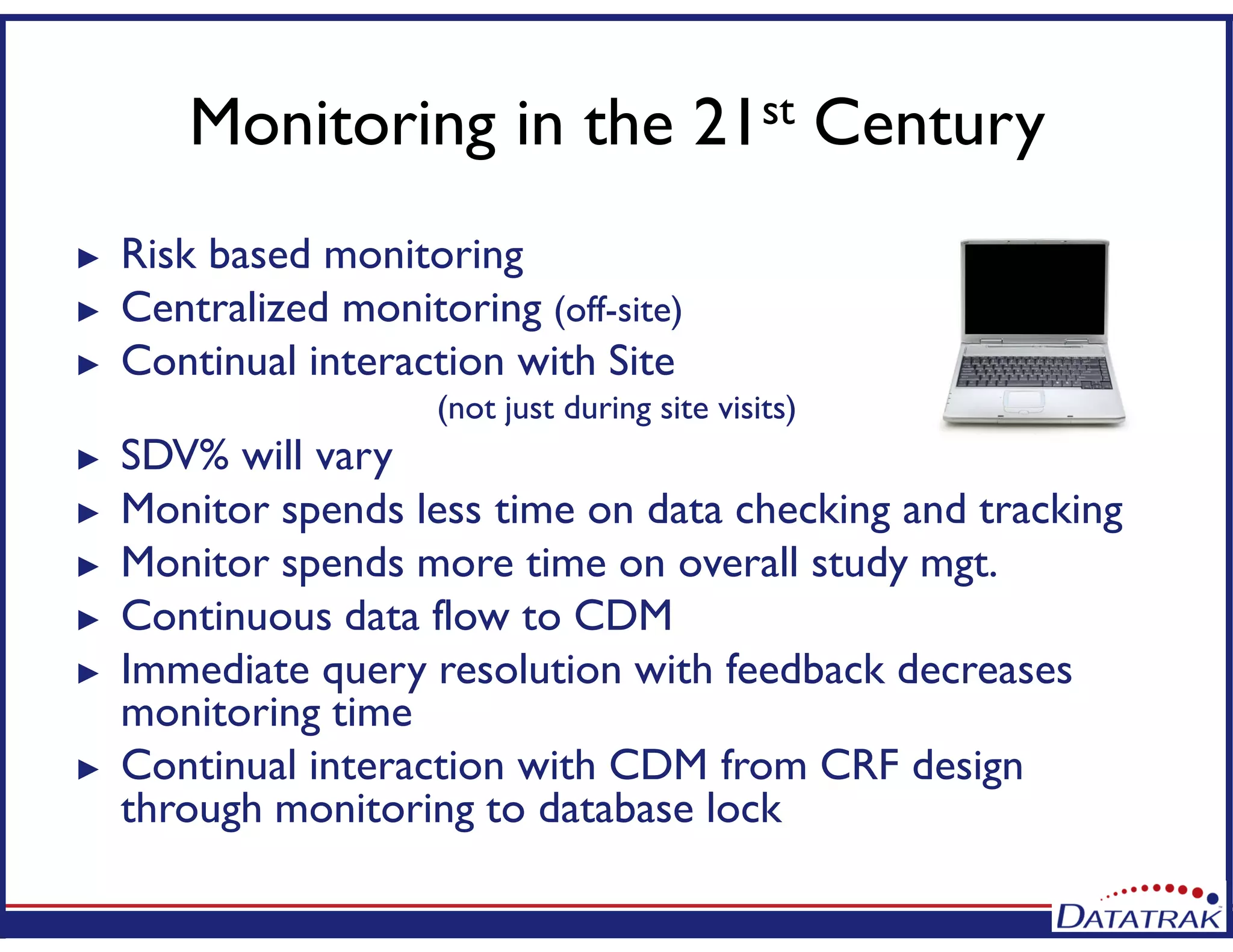
Monitoring in the 21st Century
► Risk based monitoring
► Centralized monitoring (off-site)
► Continual interaction with Site
(not just during site visits)
► SDV% will vary
► Monitor spends less time on data checking and tracking
► Monitor spends more time on overall study mgt.
► Continuous data flow to CDM
► Immediate query resolution with feedback decreases
monitoring time
► Continual interaction with CDM from CRF design
through monitoring to database lock
Agenda
► Historical Perspectives
► Integrating Clinical Operations
► Integrating Clinical Data Management
► Conclusions and Parting Thoughts
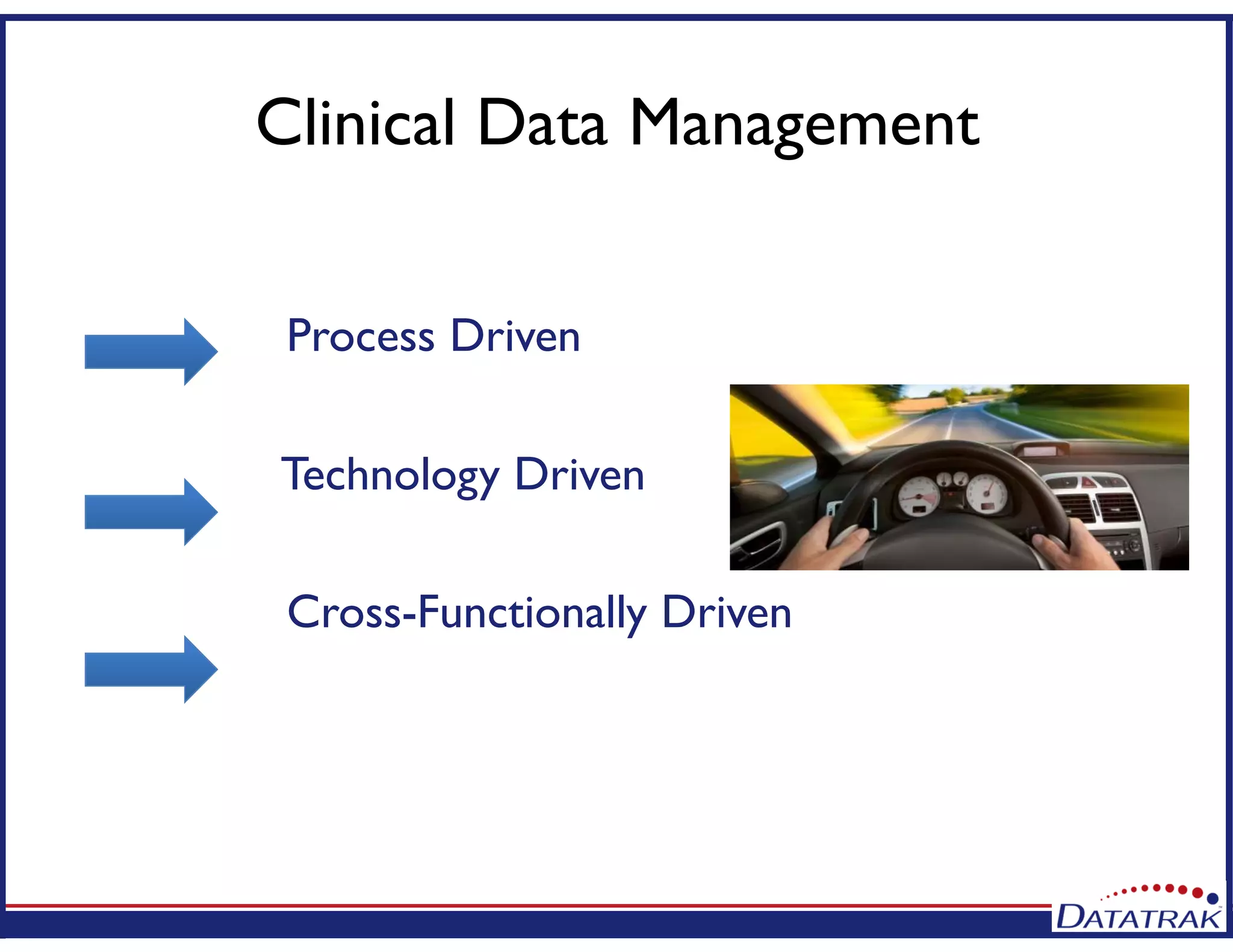
Clinical Data Management
Process Driven
Technology Driven
Cross-Functionally Driven
CDManagement
► Technology and EDC is not just a CDM tool
► Benefits extend to all functional areas
► Integration and Technology allows for companies to
put the MANAGEMENT back in Clinical Data
Management
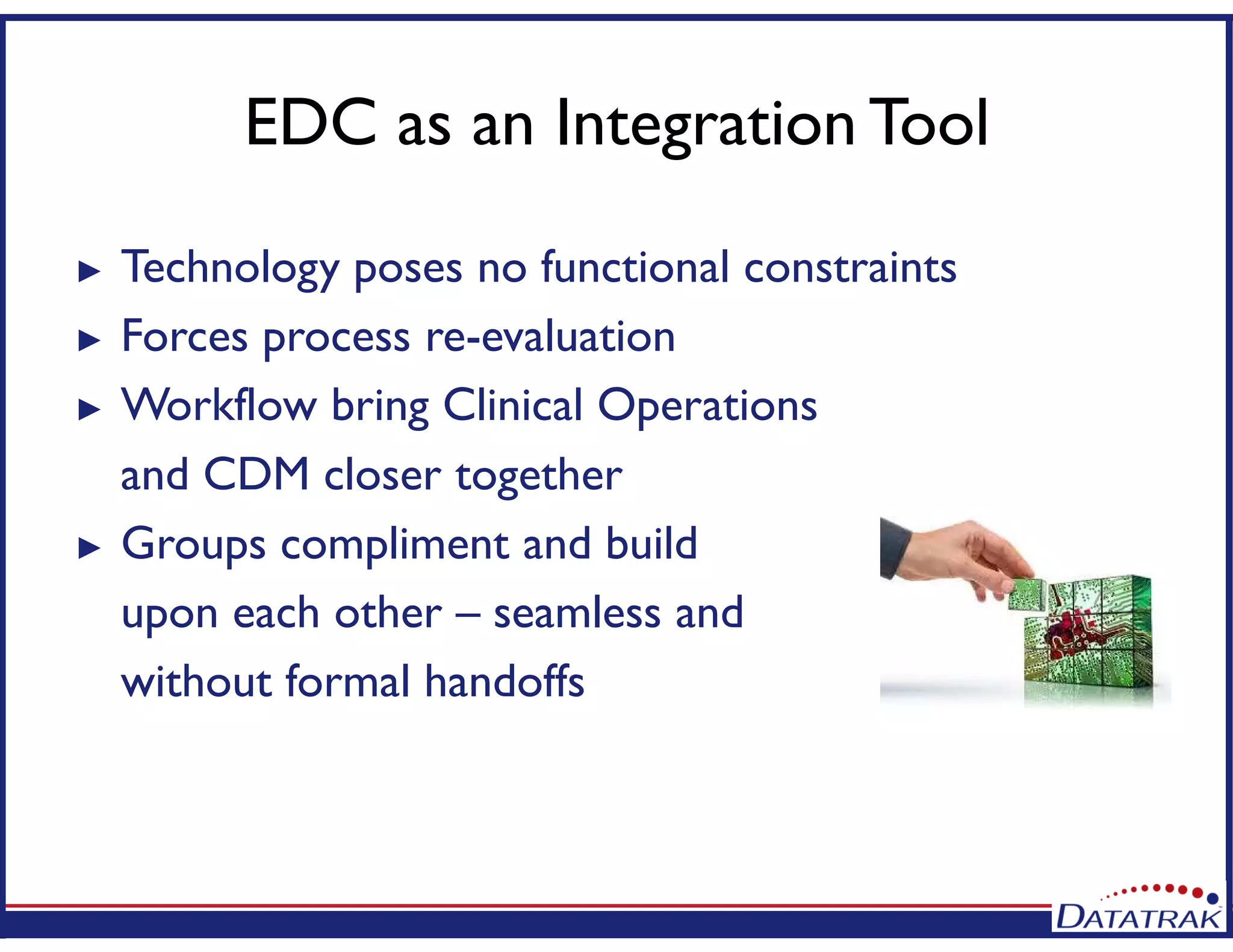
EDC as an Integration Tool
► Technology poses no functional constraints
► Forces process re-evaluation
► Workflow bring Clinical Operations
and CDM closer together
► Groups compliment and build
upon each other – seamless and
without formal handoffs
A Case Study
► Company A had a small clinical operations group
with offices next to the CDM and rest of Biometrics
► Paper-based data collection – time from last patient
to database freeze/lock was approximately 4 weeks
for a ‘typical’ Phase II study
A Case Study
► EDC decision made at Management-level
► Top-down implementation
► No process re-evaluations or changes
► Study protocol in a state of flux
► Costs for EDC builds over $300K and not in
production – EDC deemed a disaster
A Case Study
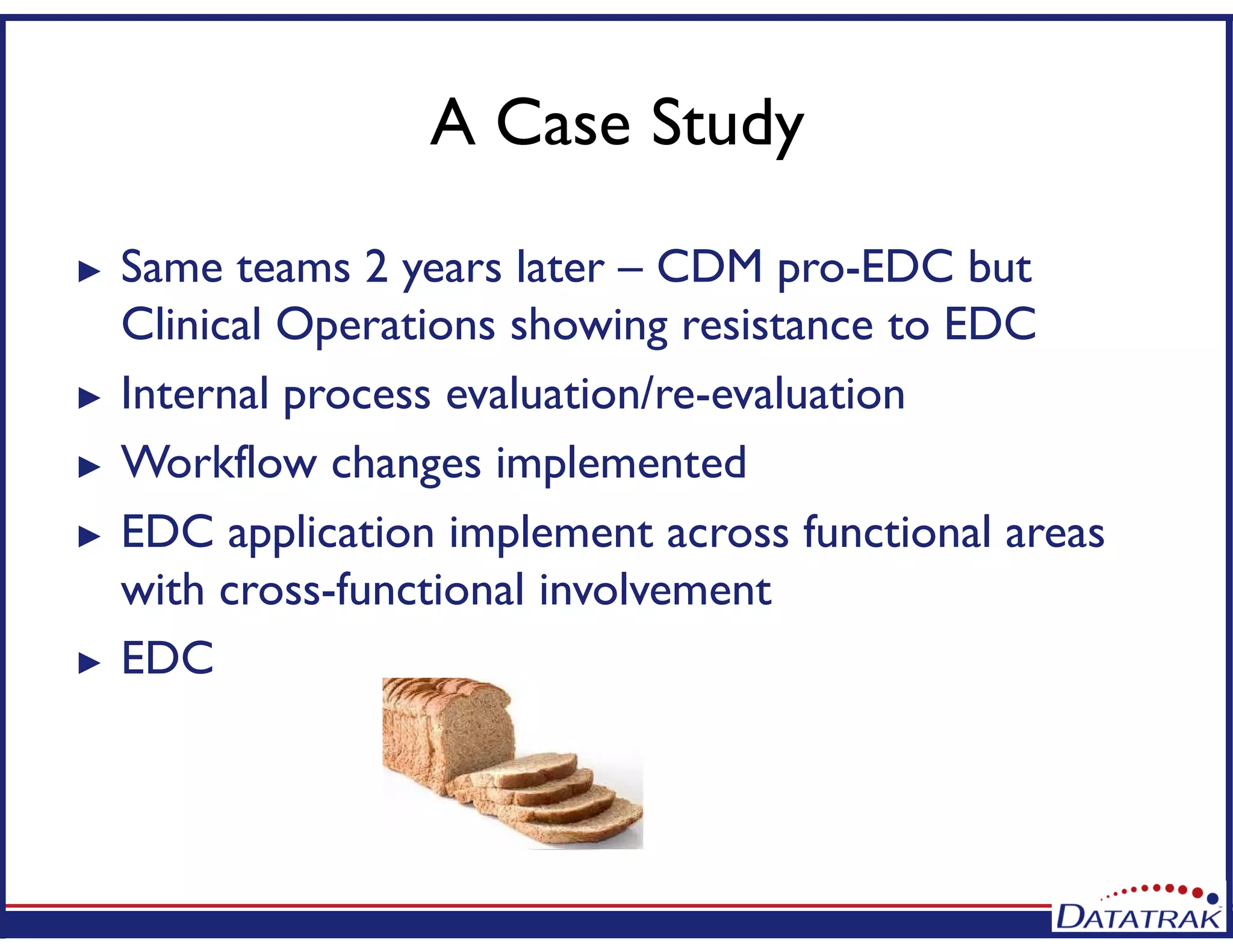
► Same teams 2 years later – CDM pro-EDC but
Clinical Operations showing resistance to EDC
► Internal process evaluation/re-evaluation
► Workflow changes implemented
► EDC application implement across functional areas
with cross-functional involvement
► EDC
Conclusions
► Use of technology is a great advance but we need to
assimilate it into re-engineered processes
► To gain maximum benefit we must approach
implementation of any technology through an
integrated approach
► EDC can bring together groups traditional separated
by process
Questions??
Contact Information:
Lorraine D. Ellis
Bill Gluck
585-381-1350 x283
440-443-0082 x114
lellis@resdyncg.com
bill.gluck@datatrak.net
@ResDyn @DATATRAKinc

Integrating Clinical Operations and Clinical Data Management Through EDC

  • 1.
    Presented by: Lorraine D.Ellis, MS, MBA President/CEO Research Dynamics Consulting Group, Ltd. and William Gluck, Ph.D. VP, DATATRAK Clinical and Consulting Services DATATRAK International, Inc. Integrating Clinical Operations and Clinical Data Management Through EDC
  • 2.
    Speakers Lorraine D. Ellis,MS, MBA, Research Dynamics Consulting Group,Ltd. @resdyn Lorraine D. Ellis, is the founder/CEO of Research Dynamics, a full service CRO. Most of her 35 years’ experience in the industry has been in clinical research. Her expertise includes integrating technology with clinical research processes over the past 20 years and developing state-of-the-art training programs for clinical research professionals. William Gluck, Ph.D, DATATRAK International,Inc. @DATATRAKinc Bill Gluck joined DATATRAK International in October 2010 asVP of DATATRAK’s Clinical and Consulting Services. Dr. Gluck has more than 25 years of experience in the pharmaceutical and biotechnology industries and has diversified experience in clinical trial management systems and electronic data capture.
  • 3.
    Speakers Lorraine D. Ellis,MS, MBA, Research Dynamics Consulting Group,Ltd. @resdyn Lorraine D. Ellis, is the founder/CEO of Research Dynamics, a full service CRO. Most of her 35 years’ experience in the industry has been in clinical research. Her expertise includes integrating technology with clinical research processes over the past 20 years and developing state-of-the-art training programs for clinical research professionals. William Gluck, Ph.D, DATATRAK International,Inc. @DATATRAKinc Bill Gluck joined DATATRAK International in October 2010 asVP of DATATRAK’s Clinical and Consulting Services. Dr. Gluck has more than 25 years of experience in the pharmaceutical and biotechnology industries and has diversified experience in clinical trial management systems and electronic data capture.
  • 4.
    Speakers Lorraine D. Ellis,MS, MBA, Research Dynamics Consulting Group,Ltd. @resdyn Lorraine D. Ellis, is the founder/CEO of Research Dynamics, a full service CRO. Most of her 35 years’ experience in the industry has been in clinical research. Her expertise includes integrating technology with clinical research processes over the past 20 years and developing state-of-the-art training programs for clinical research professionals. William Gluck, Ph.D, DATATRAK International,Inc. @DATATRAKinc Bill Gluck joined DATATRAK International in October 2010 asVP of DATATRAK’s Clinical and Consulting Services. Dr. Gluck has more than 25 years of experience in the pharmaceutical and biotechnology industries and has diversified experience in clinical trial management systems and electronic data capture.
  • 5.
    Historical Perspectives ► Ageof technological advances • Application of technology to a process • Integration of technology as part of the process
  • 7.
    Clinical Operations:The Past! ►On-site monitoring was an isolated event ► On-site was the only way to monitor ► On-site monitoring = rate-limiting factor for data compilation and database lock ► Monitoring focus was on data checking ► Common (but now archaic) activities: • Tracking each CRF page as it passes from site to clinical to CDM • “yellow stickies” and tracking queries separately from CDM’s queries ► Monitored CRF “handoff” to CDM ► Few feedback processes to improve data collection during the trial
  • 8.
    Data flow &Monitoring: the past Patient Data Database
  • 9.
    Data Flow inthe past ► Data recording, collection, compilation and reporting was….. • CRF design was often hampered by limited interaction with key parties • Sequential process – little feedback to improve data • Data was not sent to CDM until after each 4-6 week visit • On-site monitoring visits were a limiting factor for data processing • Silo’d processes with formal handoffs • Paper movement from site to CRA to CDM was the rate limiting factor • CRF Page tracking was inefficient and time consuming • Query generation and resolution was a tracking-intensive • Query process was labor-intensive with both CRA and CDM • No feedback to improve data collection during trial ………………………………Very paper and process intensive and slow.
  • 10.
    Early EDC days Fewprocess changes ► Monitors still reviewed CRFs on site but using a computer instead of paper. ► EDC = RDE (remote (site) data entry) ► Off-site CRF review was rare ► Limited EDC functionality ► No large process changes to capitalize on advantages of technology ► Some clinical operations/monitors would modify dept. procedures but no integration among all groups that interact with the data. ► Clin ops and CDM was still silo’d and CRFs were still “handed-off”
  • 11.
    EDC is notjust for CDM! It’s for Monitors too! = real time monitoring = more efficient monitoring = CRF page status tracked = edit checks= fewer queries = improved protocol compliance = flagged protocol violations = errors caught earlier = no query tracking (EDC does it) = immediate feedback improves data quality = less time data checking EDC = Data Entry
  • 12.
    Time to maximizetechnology and change processes ► Need changes in processes of: • Collection, monitoring, tracking, cleaning ► Real time data processing requires real time interaction between Clin Ops and CDM ► CRF design including protocol deviations and edit checks require both Clin Ops and CDM ► Query process is more real time and interactive between Clin Ops and CDM for real time changes.
  • 13.
    Integration between ClinOps and CDM enhances efficiency of EDC ► CRF design to address monitoring issues ► Constant data flow to CDM with real time feedback to Clin Ops ► Clin Ops can modify monitoring with EDC and CDM feedback ► Query generation, tracking and resolution simultaneous but integrated into one list
  • 14.
    New Monitoring processes ►Real time monitoring ► Off-site and On-site monitoring ► Build edit checks into CRFS to decrease queries ► CRF design requires monitoring considerations (eg, mandatory fields, protocol compliance, proper procedures, etc) ► NO tracking of pages or queries! ► Less data checking and focus on site performance continuously ► EDC metrics provide “window” to performance (time to eCRF completion, # queries, # data errors, etc)
  • 15.
    FDA Guidance ► RiskBased monitoring! ► 1988 guidance withdrawn! ► Centralized (off-site) monitoring is encouraged! ► Centralized monitoring suggested to replace on-site monitoring when it can complete activities better or as well as on-site ► Centralized monitoring (when appropriate) should improve ability to ensure the quality and integrity of data • Pubs suggest that data anomalies may be more readily detected ► EDC can implement centralized monitoring methods that can enable decreased reliance on on-site monitoring
  • 16.
    Clinical Operations:The Future! Monitoringprocess has changed. ► Real time monitoring (not just every 4-6 wks) ► Data reviewed off-site ► Continuous data flow to CDM ► CRF design with Clin Ops and CDM • Includes protocol compliance • Edit checks to reduce queries • Database designed early requiring earlier data decisions ► Sequential processes become simultaneous (Clin Ops & CDM) ► Silo monitoring processes become integrated with CDM ► Poor communication is improved with interactive communication tools in real time (from EDC system)
  • 17.
    Data flow &Monitoring: the past Patient Data Database
  • 18.
    Data Flow &Monitoring: The Future Centralized DatabaseCRC CRA CDM
  • 19.
    Monitoring in the21st Century ► Risk based monitoring ► Centralized monitoring (off-site) ► Continual interaction with Site (not just during site visits) ► SDV% will vary ► Monitor spends less time on data checking and tracking ► Monitor spends more time on overall study mgt. ► Continuous data flow to CDM ► Immediate query resolution with feedback decreases monitoring time ► Continual interaction with CDM from CRF design through monitoring to database lock
  • 20.
    Agenda ► Historical Perspectives ►Integrating Clinical Operations ► Integrating Clinical Data Management ► Conclusions and Parting Thoughts
  • 21.
    Clinical Data Management ProcessDriven Technology Driven Cross-Functionally Driven
  • 22.
    CDManagement ► Technology andEDC is not just a CDM tool ► Benefits extend to all functional areas ► Integration and Technology allows for companies to put the MANAGEMENT back in Clinical Data Management
  • 23.
    EDC as anIntegration Tool ► Technology poses no functional constraints ► Forces process re-evaluation ► Workflow bring Clinical Operations and CDM closer together ► Groups compliment and build upon each other – seamless and without formal handoffs
  • 24.
    A Case Study ►Company A had a small clinical operations group with offices next to the CDM and rest of Biometrics ► Paper-based data collection – time from last patient to database freeze/lock was approximately 4 weeks for a ‘typical’ Phase II study
  • 25.
    A Case Study ►EDC decision made at Management-level ► Top-down implementation ► No process re-evaluations or changes ► Study protocol in a state of flux ► Costs for EDC builds over $300K and not in production – EDC deemed a disaster
  • 26.
    A Case Study ►Same teams 2 years later – CDM pro-EDC but Clinical Operations showing resistance to EDC ► Internal process evaluation/re-evaluation ► Workflow changes implemented ► EDC application implement across functional areas with cross-functional involvement ► EDC
  • 27.
    Conclusions ► Use oftechnology is a great advance but we need to assimilate it into re-engineered processes ► To gain maximum benefit we must approach implementation of any technology through an integrated approach ► EDC can bring together groups traditional separated by process
  • 28.
    Questions?? Contact Information: Lorraine D.Ellis Bill Gluck 585-381-1350 x283 440-443-0082 x114 lellis@resdyncg.com bill.gluck@datatrak.net @ResDyn @DATATRAKinc