Integrated Water Resources Management Status Experiences & Challenges Adrian Cashman C.Eng., PhD University of the West Indies, Barbados
Outline Overview of Water Policy Developments Roadmaps Grenada Barbados
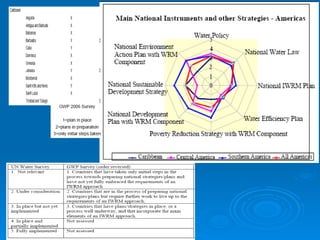
Background Johannesburg Plan of Implementation (2002) agreed to have IWRM Plans and WUE Plans in place by 2005 2008 UN Water Status  of IWRM & WUE
 
Water Policy Status 15 countries surveyed only three have approved and adopted sector water policies; Grenada (2007), Jamaica (2004) and St Lucia (2004) In 7 of the countries the development of a water national policy is being considered (Anguilla, Antigua and Barbuda, Barbados, Belize, British Virgin Islands, Guyana and, Trinidad and Tobago)
Antigua and Barbuda, Barbados, Dominica and St Kitts and Nevis have embarked upon processes that might result in the development of water policies (IWRM Roadmaps) Process not integrated into government’s policy making frameworks
How we got there:  Agents of change  Two predominant drivers of change can be identified; internally induced and externally driven change Internally drive change has been championed largely by water sector professionals and technocrats, regional NGOs The principal drivers of externally driven change have been  international funding agencies
Support for institutional change appears to be given when a crisis in the water sector arises, especially if it impacts go beyond the water sector
Policy pitfalls  No evidence of a discussion of the economically efficient use of water under conditions of scarcity and competition Water is predominantly a social good price is kept low in the interests of public health, equity and (possibly) political patronage Water for agriculture treated as a separate issue from water resources management and water service provisions
Agriculture’s organisational structures and the sector’s governance within IWRM tends to be vague  No specific inclusion of disaster mitigation or climate change
Regulatory roles  Roles: quality of drinking water, regulating the economic performance and quality of service provision regulation and management of water resources
Few instances of independent oversight of economic and service performance, and tariff approval Jamaica and St Lucia a separation of water resources management from service provision
Typology of Change Stage 1: Mind change – a new discourse of what needs to change gains critical consensus.  Countries at this stage would be: Anguilla, Antigua and Barbuda, Bahamas, Barbados, British Virgin Islands, St Kitts and Nevis and, St Vincent and the Grenadines. Stage 2: Political articulation – perceived need for change attracts political support and translates the discourse to the political sphere. Countries at this stage would be: Belize, Guyana, and, Trinidad and Tobago. Stage 3: Institutional change – the implementation of procedural changes and a reform programme. Countries at this stage would be: Grenada, St Lucia. Stage 4: Behavioural change. Countries at this stage would be: Jamaica ?
Lessons - 1 The need to establish political relevance and secure political support: for tighter but integrated management of resources and services.  This has proved to be the tipping point in the majority of cases though it does not guarantee change.  There are a number of instances where institutional reform was been put on hold due to political changes; The costs of not adopting IWRM are high as physical water scarcity and economic competition intensify
Lessons - 2 The network of water sector professionals and the advocacy role that they have played is of prime importance in promoting required institutional reform.  This role of the technical and scientific constituency in water needs to be supported and developed; Regionalised bodies have been more successful at working with national water sectors  in encouraging and supporting institutional change than other extra-national bodies;
Lessons - 3 Participation, the role of stakeholders and of citizens is problematic.  There has not been enough consideration given to what its role and contribution is supposed to be and how it is to be achieved; Issues of transparency and accountability need to be given more serious consideration.  Without this the credibility of any institutional changes will be open to challenge.  Change and improvement for the better has to be seen to be believed, not just by politicians and technocrats but by the public and citizens as well

Integrated Water Resources Management

  • 1.
    Integrated Water ResourcesManagement Status Experiences & Challenges Adrian Cashman C.Eng., PhD University of the West Indies, Barbados
  • 2.
    Outline Overview ofWater Policy Developments Roadmaps Grenada Barbados
  • 3.
    Background Johannesburg Planof Implementation (2002) agreed to have IWRM Plans and WUE Plans in place by 2005 2008 UN Water Status of IWRM & WUE
  • 4.
  • 5.
    Water Policy Status15 countries surveyed only three have approved and adopted sector water policies; Grenada (2007), Jamaica (2004) and St Lucia (2004) In 7 of the countries the development of a water national policy is being considered (Anguilla, Antigua and Barbuda, Barbados, Belize, British Virgin Islands, Guyana and, Trinidad and Tobago)
  • 6.
    Antigua and Barbuda,Barbados, Dominica and St Kitts and Nevis have embarked upon processes that might result in the development of water policies (IWRM Roadmaps) Process not integrated into government’s policy making frameworks
  • 7.
    How we gotthere: Agents of change Two predominant drivers of change can be identified; internally induced and externally driven change Internally drive change has been championed largely by water sector professionals and technocrats, regional NGOs The principal drivers of externally driven change have been international funding agencies
  • 8.
    Support for institutionalchange appears to be given when a crisis in the water sector arises, especially if it impacts go beyond the water sector
  • 9.
    Policy pitfalls No evidence of a discussion of the economically efficient use of water under conditions of scarcity and competition Water is predominantly a social good price is kept low in the interests of public health, equity and (possibly) political patronage Water for agriculture treated as a separate issue from water resources management and water service provisions
  • 10.
    Agriculture’s organisational structuresand the sector’s governance within IWRM tends to be vague No specific inclusion of disaster mitigation or climate change
  • 11.
    Regulatory roles Roles: quality of drinking water, regulating the economic performance and quality of service provision regulation and management of water resources
  • 12.
    Few instances ofindependent oversight of economic and service performance, and tariff approval Jamaica and St Lucia a separation of water resources management from service provision
  • 13.
    Typology of ChangeStage 1: Mind change – a new discourse of what needs to change gains critical consensus. Countries at this stage would be: Anguilla, Antigua and Barbuda, Bahamas, Barbados, British Virgin Islands, St Kitts and Nevis and, St Vincent and the Grenadines. Stage 2: Political articulation – perceived need for change attracts political support and translates the discourse to the political sphere. Countries at this stage would be: Belize, Guyana, and, Trinidad and Tobago. Stage 3: Institutional change – the implementation of procedural changes and a reform programme. Countries at this stage would be: Grenada, St Lucia. Stage 4: Behavioural change. Countries at this stage would be: Jamaica ?
  • 14.
    Lessons - 1The need to establish political relevance and secure political support: for tighter but integrated management of resources and services. This has proved to be the tipping point in the majority of cases though it does not guarantee change. There are a number of instances where institutional reform was been put on hold due to political changes; The costs of not adopting IWRM are high as physical water scarcity and economic competition intensify
  • 15.
    Lessons - 2The network of water sector professionals and the advocacy role that they have played is of prime importance in promoting required institutional reform. This role of the technical and scientific constituency in water needs to be supported and developed; Regionalised bodies have been more successful at working with national water sectors in encouraging and supporting institutional change than other extra-national bodies;
  • 16.
    Lessons - 3Participation, the role of stakeholders and of citizens is problematic. There has not been enough consideration given to what its role and contribution is supposed to be and how it is to be achieved; Issues of transparency and accountability need to be given more serious consideration. Without this the credibility of any institutional changes will be open to challenge. Change and improvement for the better has to be seen to be believed, not just by politicians and technocrats but by the public and citizens as well