
Economic and Financial Instruments for IWRM Introduction to economic instruments for water management
Goals and objectives of the session To know what are the public good aspects of water benefits To manage basic economic concepts of supply and demand, and full cost recovery To have clear definitions of economic instrument for water management
Outline  Public-good nature of water resources Supply and demand Main approach: full cost recovery Definition of economic instruments
Introduction Economic instruments are increasingly important for IWRM Traditional supply-oriented approaches fail to use economic instruments, especially for demand management Economic instruments are valuable to implement a more balanced supply-demand management approach to IWRM
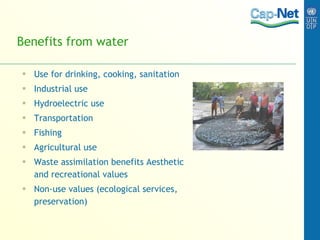
Benefits from water Use for drinking, cooking, sanitation Industrial use Hydroelectric use Transportation Fishing Agricultural use  Waste assimilation benefits Aesthetic and recreational values Non-use values (ecological services, preservation)
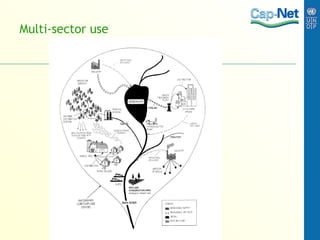
Multi-sector use
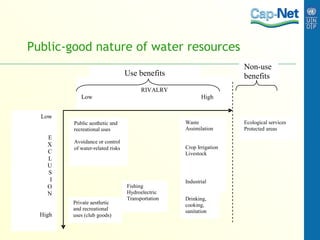
Public-good nature of water resources
Supply: producers behaviour Try to seek to  maximize benefits  from the production of a good or service Use some  technology  to transform inputs into some output (or multiple outputs) Demand inputs Will react to changes in input and output  prices
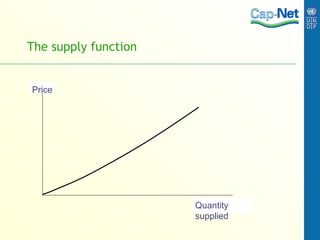
The supply function Quantity supplied Price
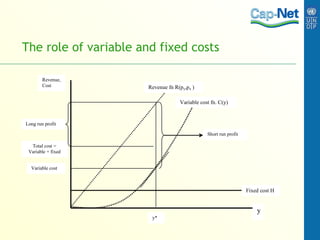
The role of variable and fixed costs
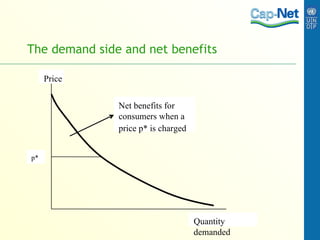
Demand: consumers behaviour Have defined  preferences  for goods and services; Seek to maximize the benefits (utility) they get from consumption; Consider the costs (price) they have to pay for consuming a good or service; Be restricted by their budgets when taking consumption decisions. Importance of willingness to pay (WTP)
The demand side and net benefits Price Quantity  demanded Net benefits for   consumers when a   price p* is charged p*
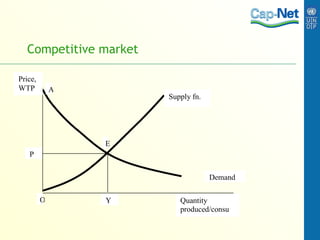
Competitive  market
Reasons why   markets  are  not  active in the water sector In competitive markets, supply and demand will interact to form an equilibrium  price  with optimal allocation of resources.  Competitive firms will recover automatically their production costs (otherwise these are out of the market).  Competitive markets, however, are seldom feasible for water services given its many public-good features and high transaction costs.  Monopoly tends to appear in the provision of large infrastructure water services (domestic use, hydropower and irrigation). However, costs are still generated and somebody has to pay for them.
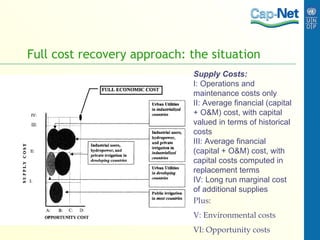
Full cost recovery approach: the situation Plus: V: Environmental costs VI: Opportunity costs Supply Costs: I: Operations and maintenance costs only II: Average financial (capital + O&M) cost, with capital valued in terms of historical costs III: Average financial (capital + O&M) cost, with capital costs computed in replacement terms IV: Long run marginal cost of additional supplies
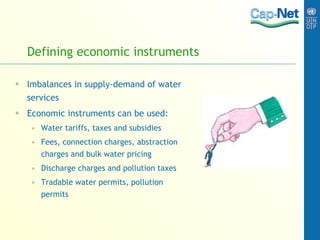
Defining economic instruments Imbalances in supply-demand of water services Economic instruments can be used: Water tariffs, taxes and subsidies Fees, connection charges, abstraction charges and bulk water pricing Discharge charges and pollution taxes Tradable water permits, pollution permits
Think about it Could you give examples from your own experience regarding the public good nature of water in different circumstances? Do you think the full cost recovery policy is currently applied in your country to the water sector? How? Why?
End The next presentation, still related to chapter 3, deals with water valuation methods.

Chapter+3 +introduction+to+economic+instruments

  • 1.
    Economic and FinancialInstruments for IWRM Introduction to economic instruments for water management
  • 2.
    Goals and objectivesof the session To know what are the public good aspects of water benefits To manage basic economic concepts of supply and demand, and full cost recovery To have clear definitions of economic instrument for water management
  • 3.
    Outline Public-goodnature of water resources Supply and demand Main approach: full cost recovery Definition of economic instruments
  • 4.
    Introduction Economic instrumentsare increasingly important for IWRM Traditional supply-oriented approaches fail to use economic instruments, especially for demand management Economic instruments are valuable to implement a more balanced supply-demand management approach to IWRM
  • 5.
    Benefits from waterUse for drinking, cooking, sanitation Industrial use Hydroelectric use Transportation Fishing Agricultural use Waste assimilation benefits Aesthetic and recreational values Non-use values (ecological services, preservation)
  • 6.
  • 7.
    Public-good nature ofwater resources
  • 8.
    Supply: producers behaviourTry to seek to maximize benefits from the production of a good or service Use some technology to transform inputs into some output (or multiple outputs) Demand inputs Will react to changes in input and output prices
  • 9.
    The supply functionQuantity supplied Price
  • 10.
    The role ofvariable and fixed costs
  • 11.
    Demand: consumers behaviourHave defined preferences for goods and services; Seek to maximize the benefits (utility) they get from consumption; Consider the costs (price) they have to pay for consuming a good or service; Be restricted by their budgets when taking consumption decisions. Importance of willingness to pay (WTP)
  • 12.
    The demand sideand net benefits Price Quantity demanded Net benefits for consumers when a price p* is charged p*
  • 13.
  • 14.
    Reasons why markets are not active in the water sector In competitive markets, supply and demand will interact to form an equilibrium price with optimal allocation of resources. Competitive firms will recover automatically their production costs (otherwise these are out of the market). Competitive markets, however, are seldom feasible for water services given its many public-good features and high transaction costs. Monopoly tends to appear in the provision of large infrastructure water services (domestic use, hydropower and irrigation). However, costs are still generated and somebody has to pay for them.
  • 15.
    Full cost recoveryapproach: the situation Plus: V: Environmental costs VI: Opportunity costs Supply Costs: I: Operations and maintenance costs only II: Average financial (capital + O&M) cost, with capital valued in terms of historical costs III: Average financial (capital + O&M) cost, with capital costs computed in replacement terms IV: Long run marginal cost of additional supplies
  • 16.
    Defining economic instrumentsImbalances in supply-demand of water services Economic instruments can be used: Water tariffs, taxes and subsidies Fees, connection charges, abstraction charges and bulk water pricing Discharge charges and pollution taxes Tradable water permits, pollution permits
  • 17.
    Think about itCould you give examples from your own experience regarding the public good nature of water in different circumstances? Do you think the full cost recovery policy is currently applied in your country to the water sector? How? Why?
  • 18.
    End The nextpresentation, still related to chapter 3, deals with water valuation methods.