GWP ToolBox:  Knowledge Sharing Tool D. Thalmeinerova, GWP
Challenge in GWP Picture from V.Pangare: Global Perspectives on IWRM, 2006
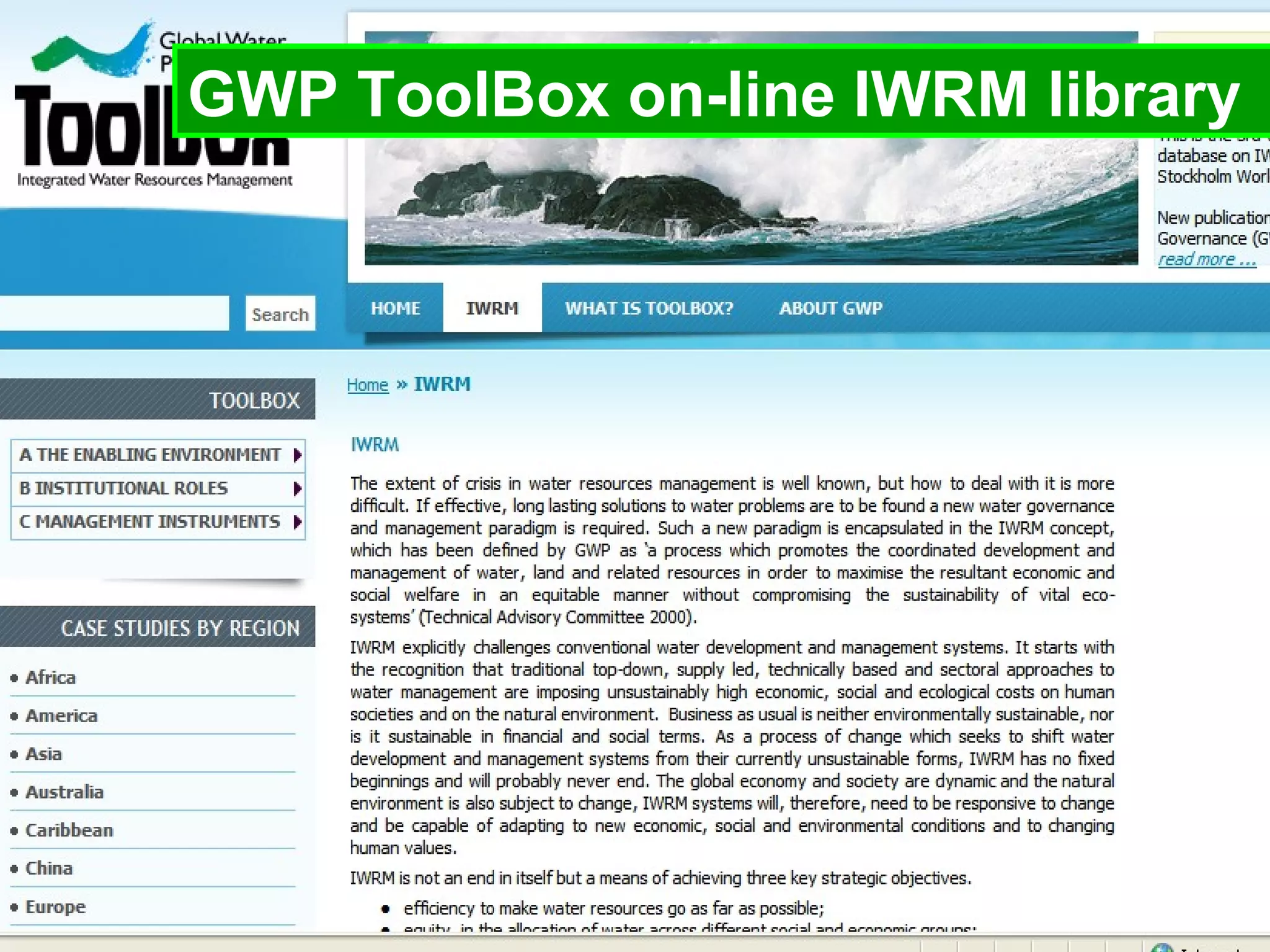
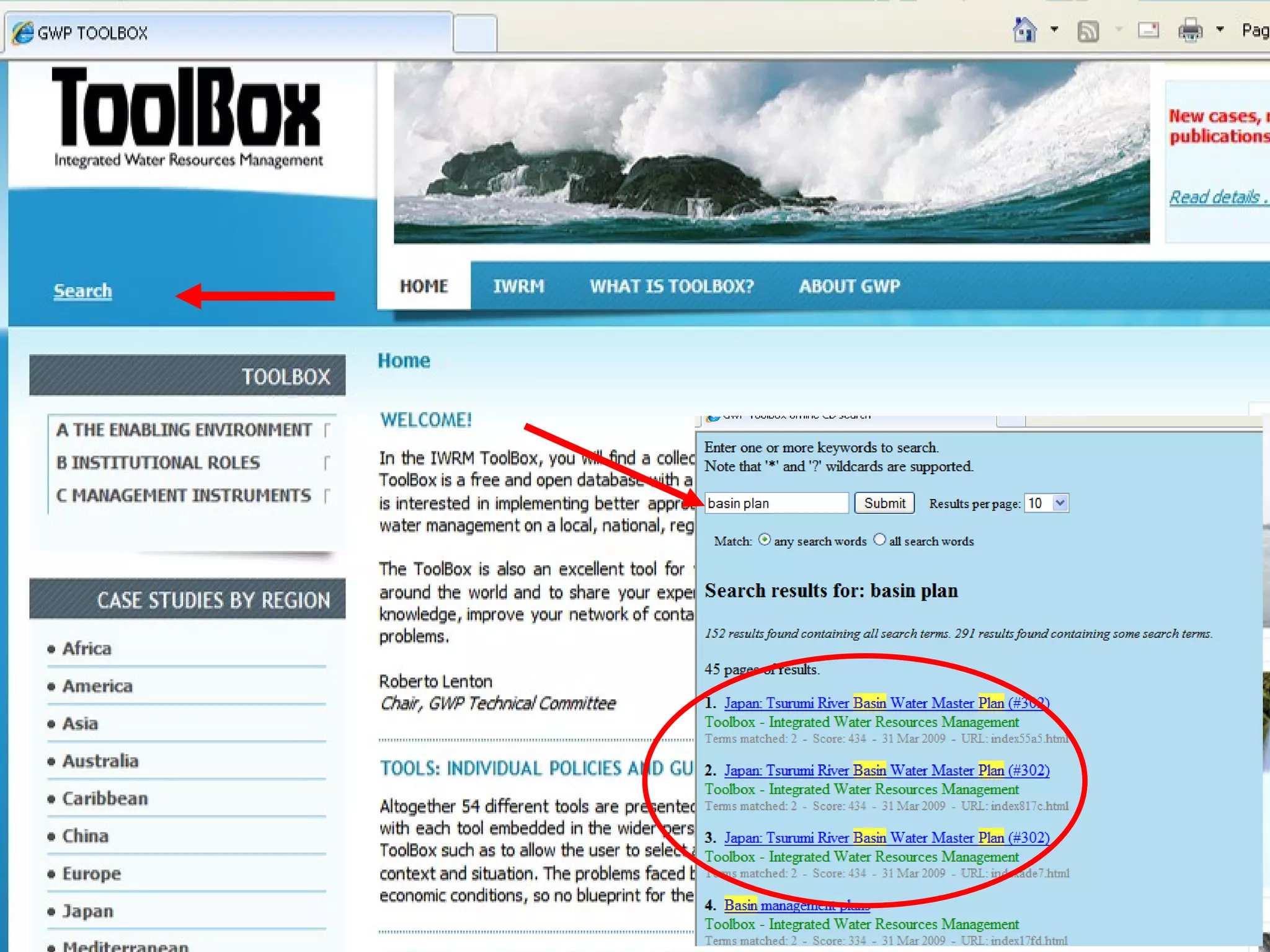
GWP ToolBox on-line IWRM library
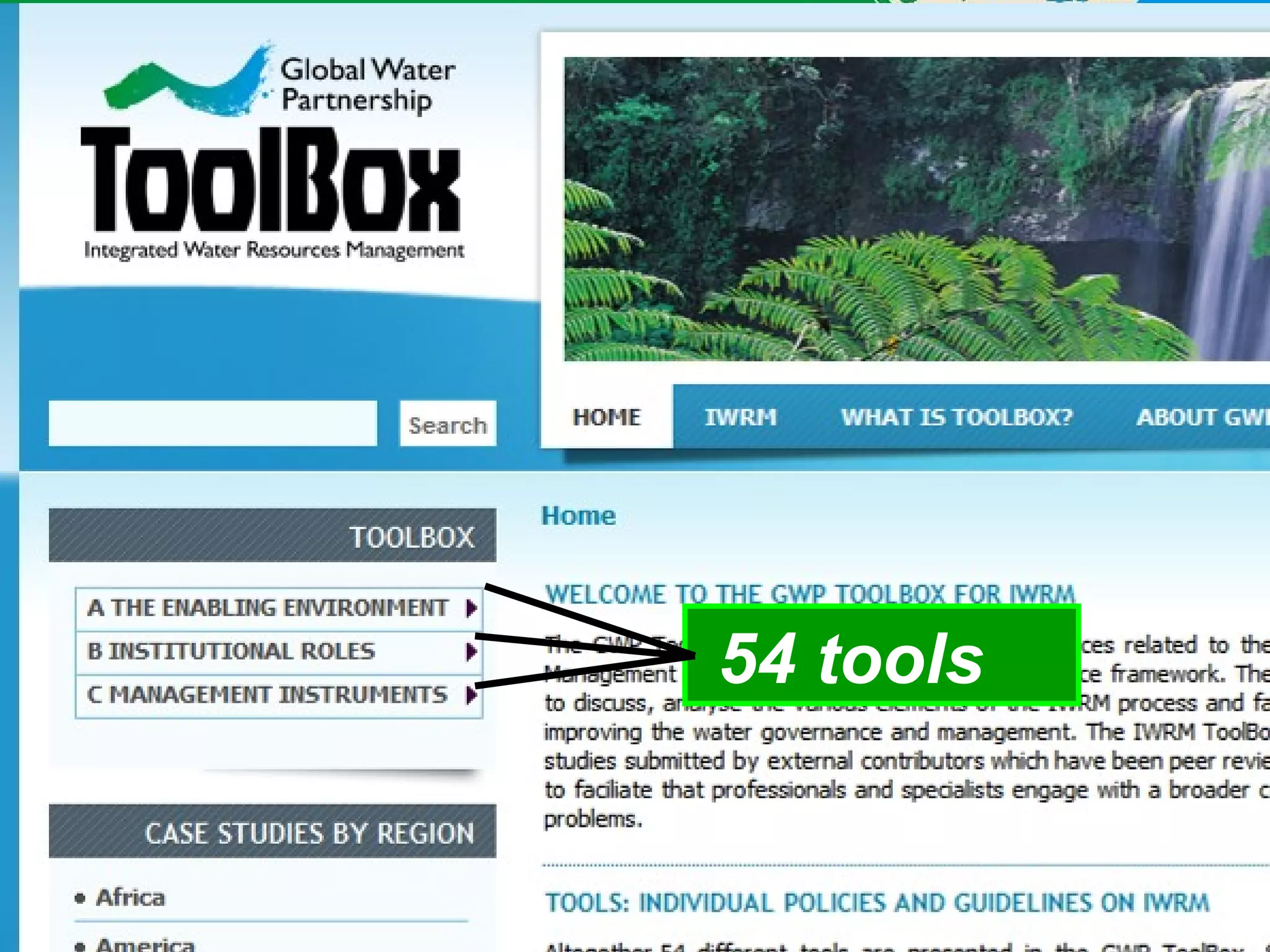
GWP ToolBox Purpose IWRM knowledge sharing and dissemination tool Goal To contribute to  establishing a global communication platform to share knowledge and develop capacity Components Tools (54 tools – guidelines how to implement IWRM); Case studies (193 cases – illustrate how tools work in practice); References (178 references – support documents, manuals, papers, and external IWRM knowledge databases).
What is ToolBox? It is on online forum for water experts and the broader community to address and improve the managment of water resources It decribes the pillars and components of IWRM It shows best practices and case studies It gather relevant publications, support documents, organizations and web links on IWRM
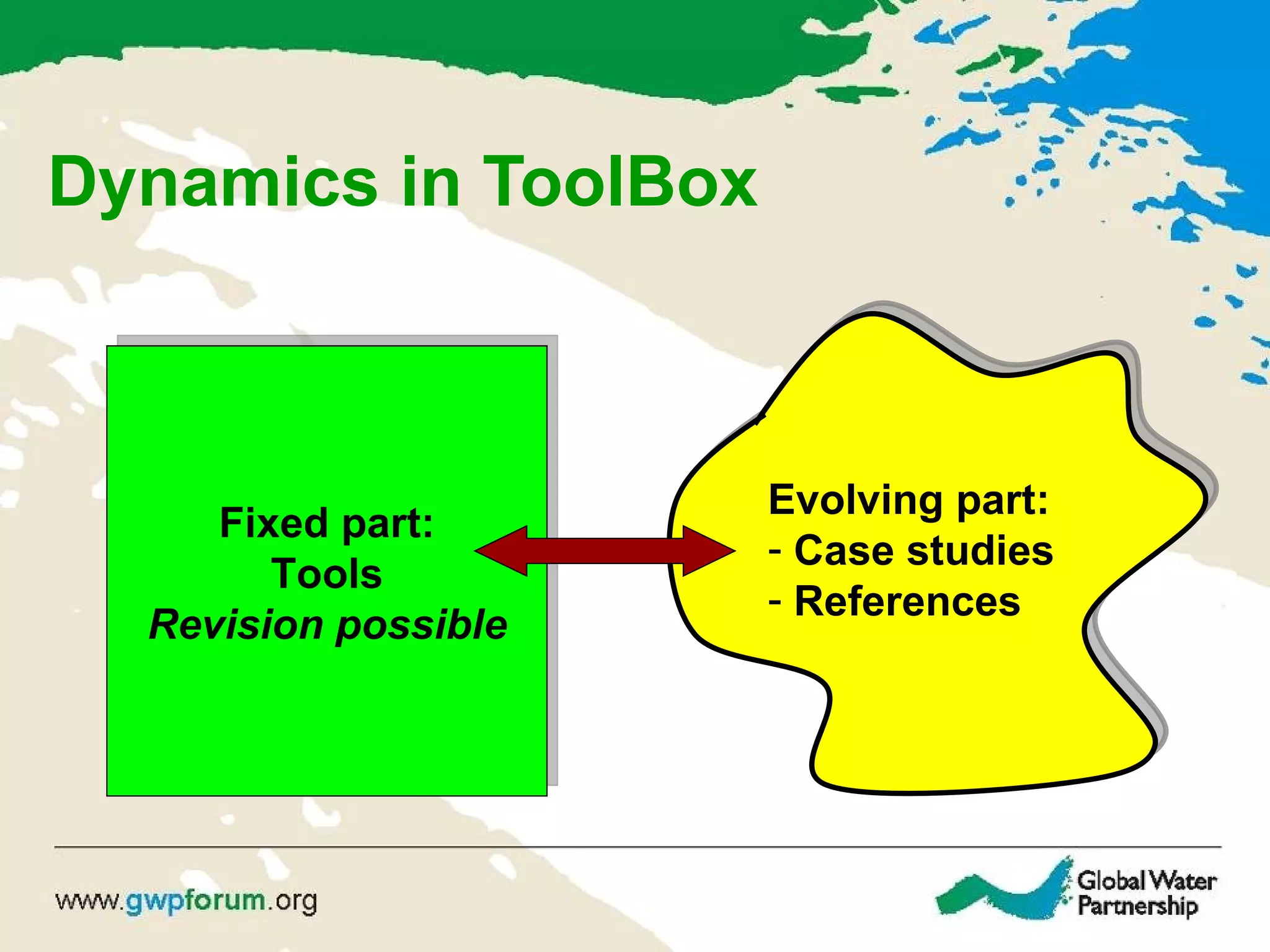
Dynamics in ToolBox Fixed part: Tools Revision possible Evolving part: Case studies References
54 tools
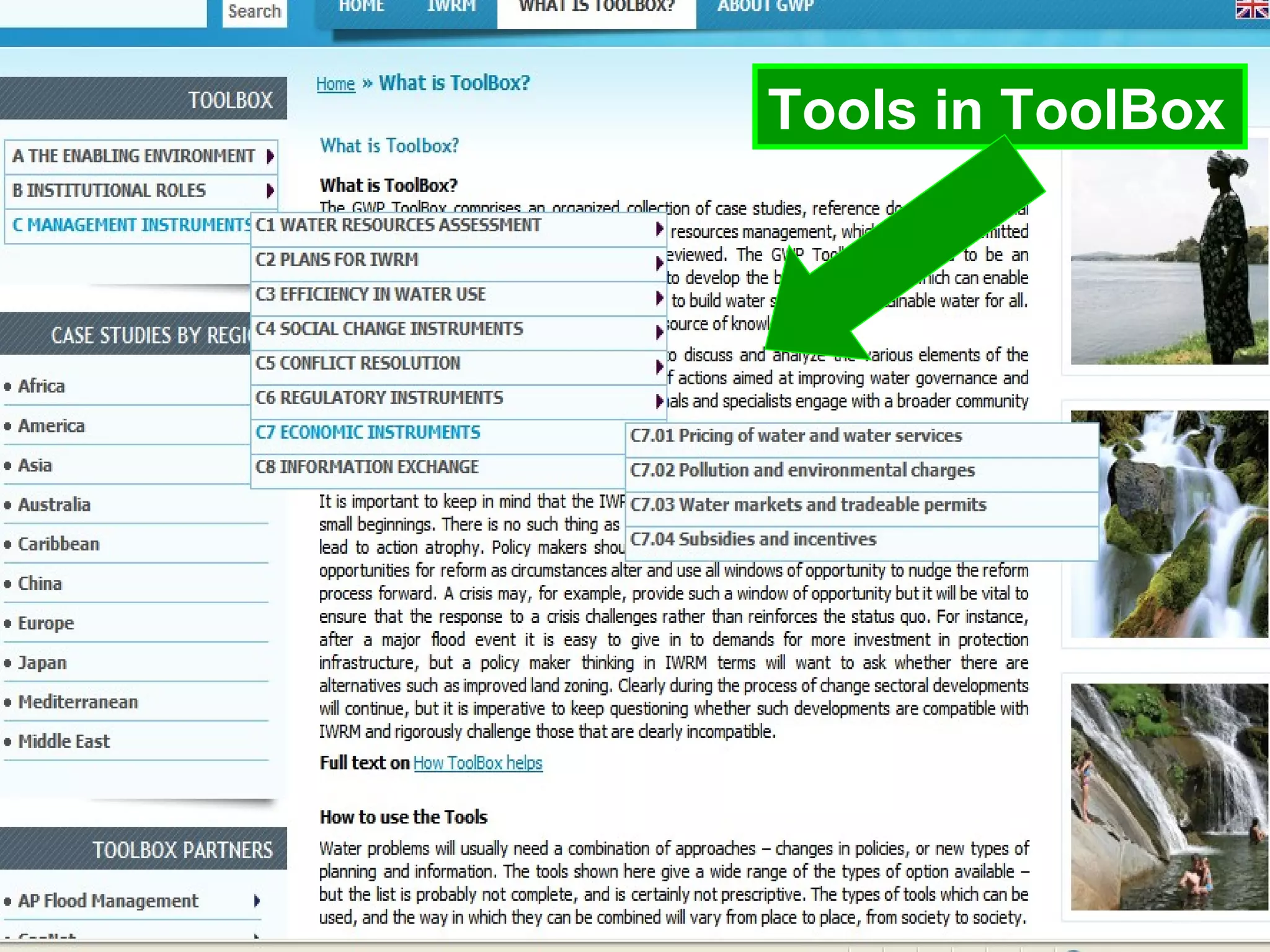
Tools in ToolBox
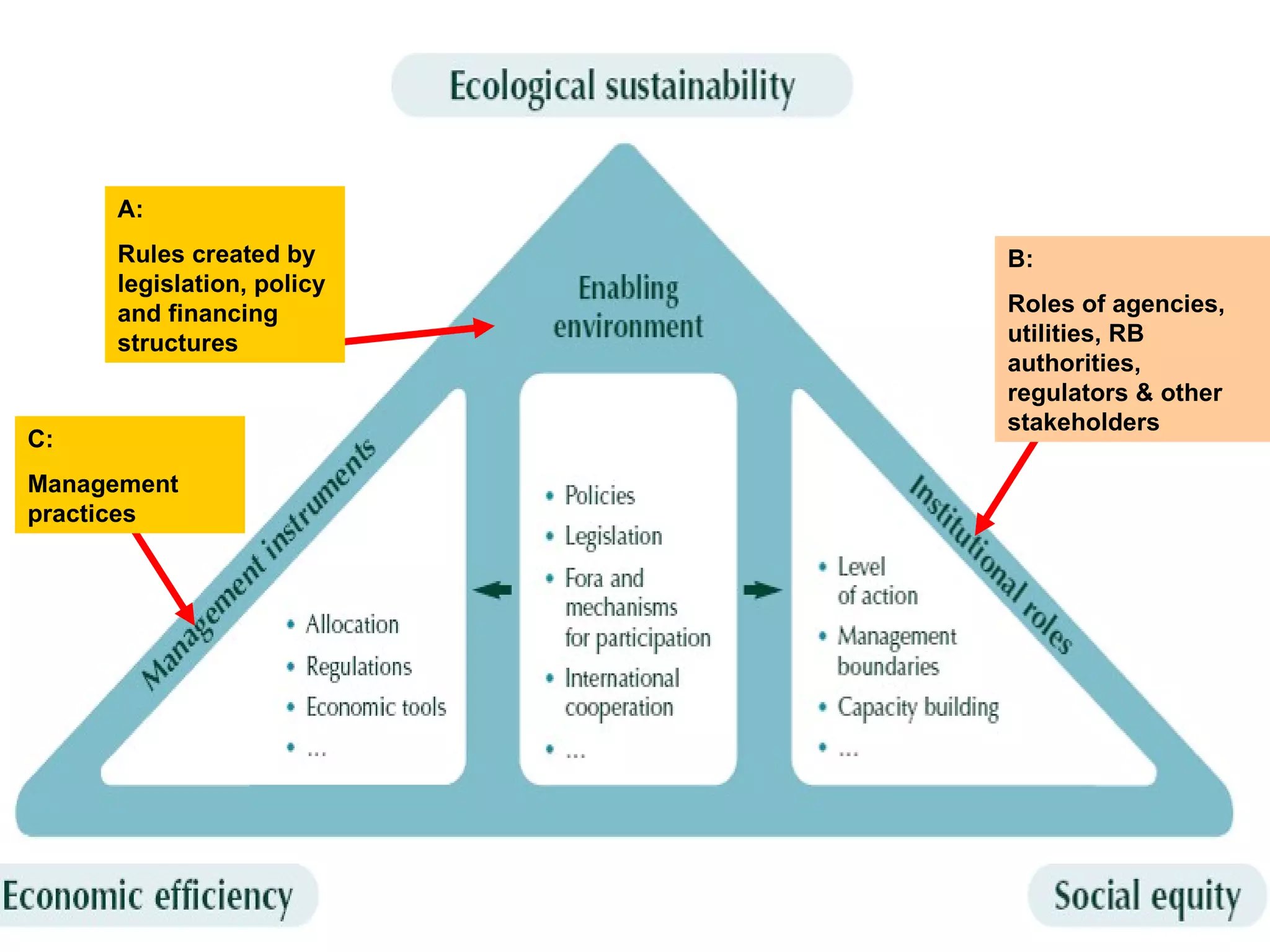
工具的构成 A:  Rules created by legislation, policy and financing structures B: Roles of agencies, utilities, RB authorities, regulators & other stakeholders C: Management practices
Enabling Environment (A - tools) Deal with water policies and their development A1.1 Preparation of a national water resources policy A1.2 Policies with relation to water resources Include tools for use in the development of water law   A2.1 Water rights A2.2 Legislation for water quality A2.3 Reform of existing legislation   Deal with  financial resources to meet water needs A3.1 Investment policies A3.2 Financing options I: grants and internal sources A3.3 Financing options II: Loans and equity
Institutional Roles (B - tools) Deals with forms and functions of institutions B1.1 Reforming institutions for better governance B1.2 Transboundary organisations for water resource management B1.3 National apex bodies  B1.4 River basin organisations B1.5 Regulatory bodies and enforcement agencies B1.6 Service providers and IWRM B1.7 Strengthening public sector water utilities B1.8 Role of the private sector  B1.9 Civil society institutions and community based organisation  B1.10 Local authorities Includes tools for upgrading the skills B2.1 Participatory capacity and empowerment in civil society B2.2  Training to build capacity in water professionals B2.3 Regulatory capacity
Management Instruments (C - tools) About understanding  resources  C1.1 Water resources knowledge base C1.2 Water resources assessment C1.3 Modelling in IWRM  C1.4 Developing water management indicators C1.5 Ecosystem assessment Combine development options, resource use and human interaction   C2.1  National integrated water resources plans C2.2  River basin plans C2.3  Groundwater management plans C2.4  Coastal zone management plans C2.5  Risk assessment and management C2.6  Environmental assessment (EA) C2.7  Social assessment (SA) C2.8  Economic assessment
Management Instruments (C - tools) Involves various tools for balancing supply and demand C3.1  Improved efficiency of use  C3.2  Recycling and reuse C3.3  Improved efficiency of supply Encourages social change instruments C4.1  Education curricula on water management C4.2  Communication with stakeholders C4.3  Information and transparency for raising awareness Shows how to manage disputes C5.1  Conflict management C5.2  Shared vision planning C5.3  Consensus building
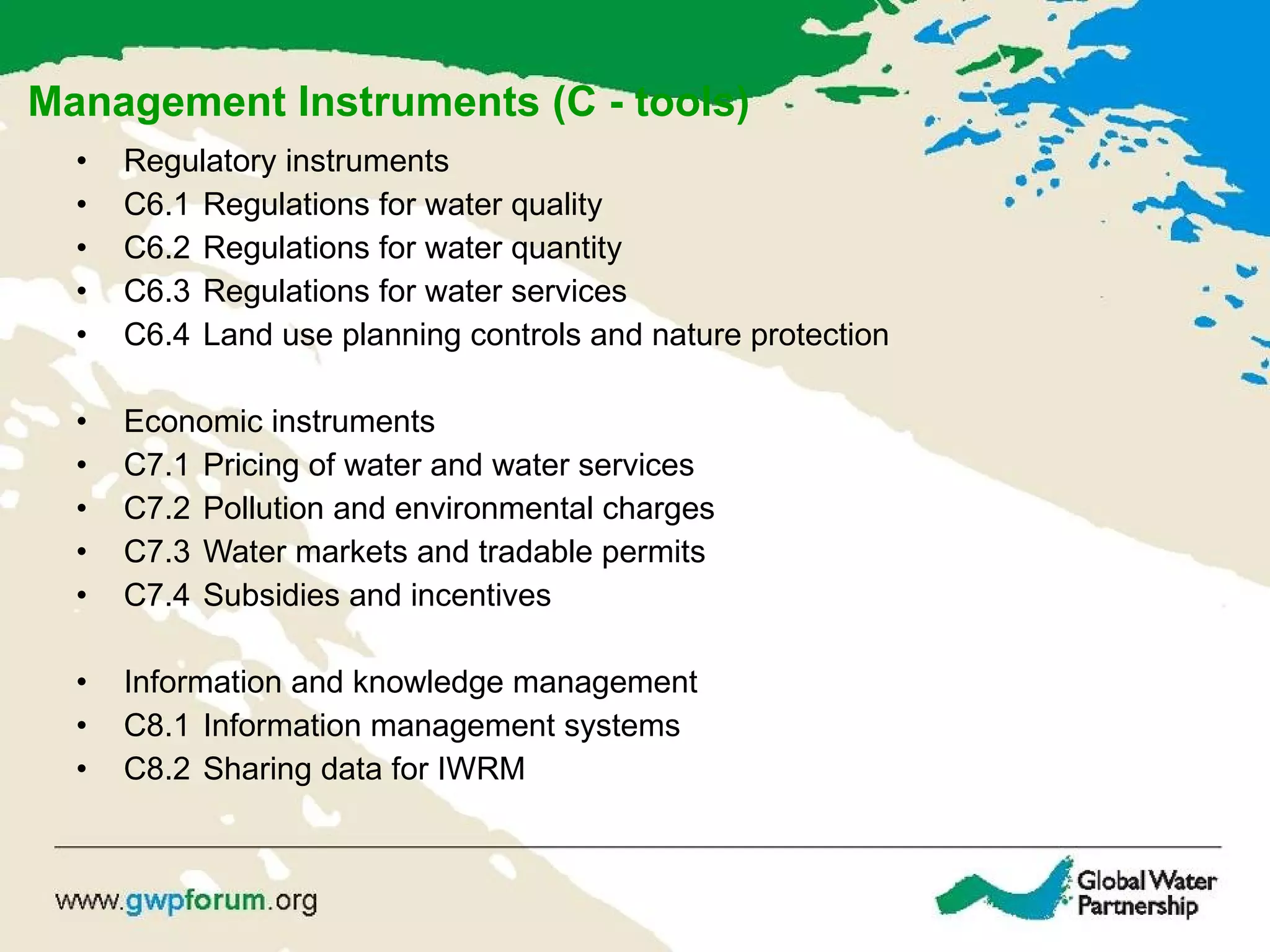
Management Instruments (C - tools) Regulatory instruments C6.1  Regulations for water quality C6.2  Regulations for water quantity C6.3  Regulations for water services C6.4  Land use planning controls and nature protection Economic instruments C7.1  Pricing of water and water services C7.2  Pollution and environmental charges C7.3 Water markets and tradable permits C7.4 Subsidies and incentives Information and knowledge management C8.1 Information management systems C8.2  Sharing data for IWRM
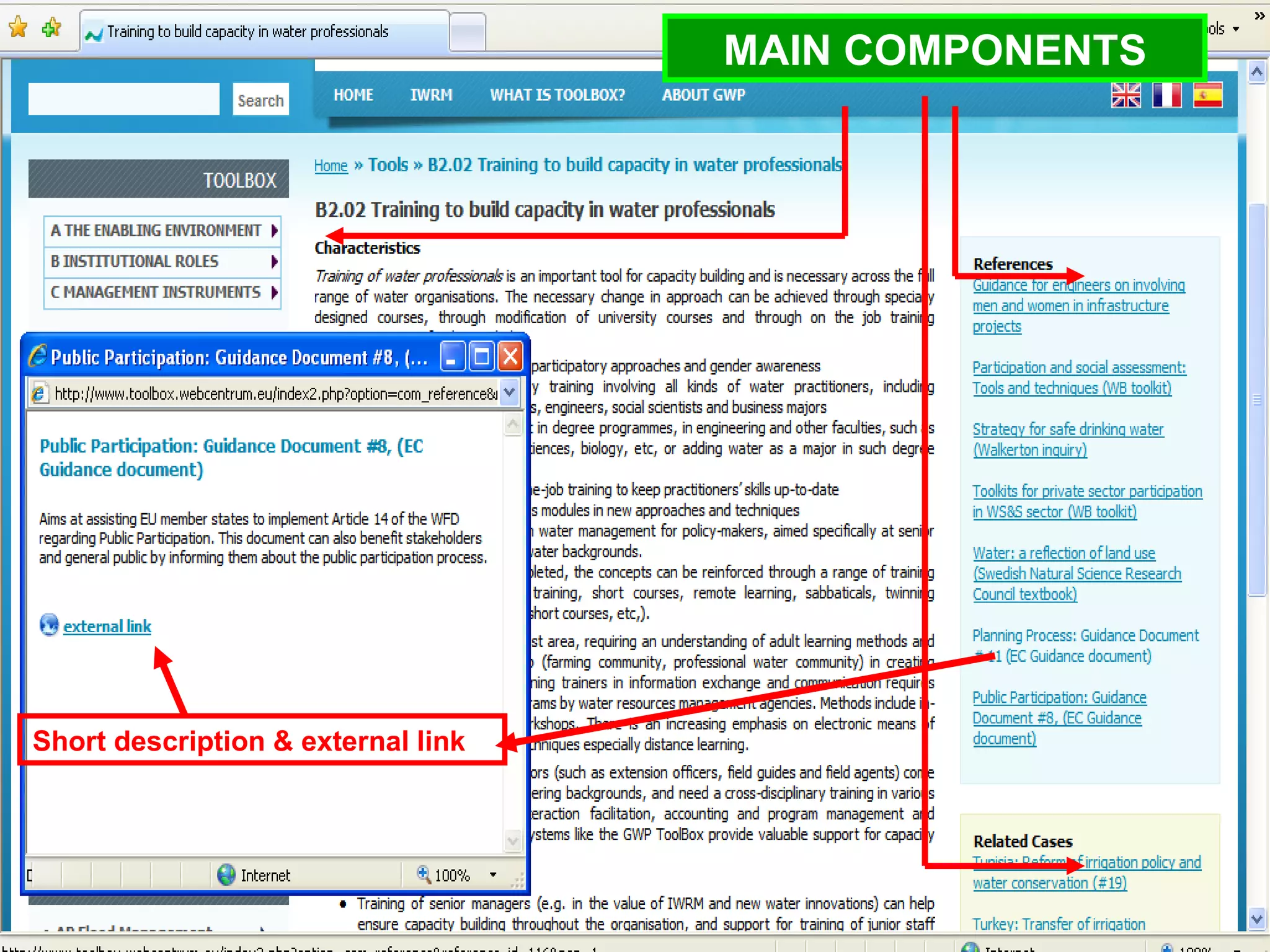
Short description & external link MAIN COMPONENTS
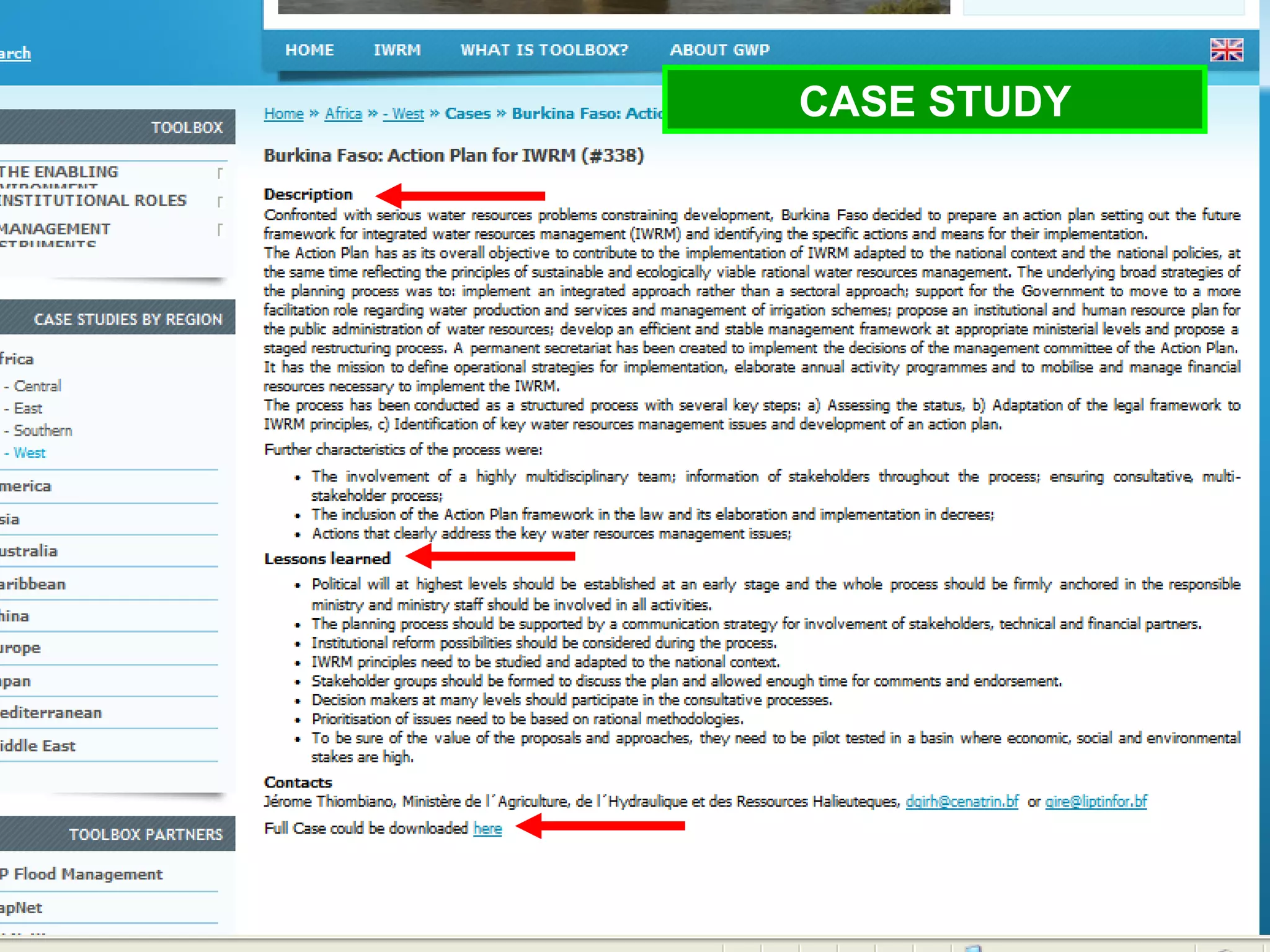
CASE STUDY
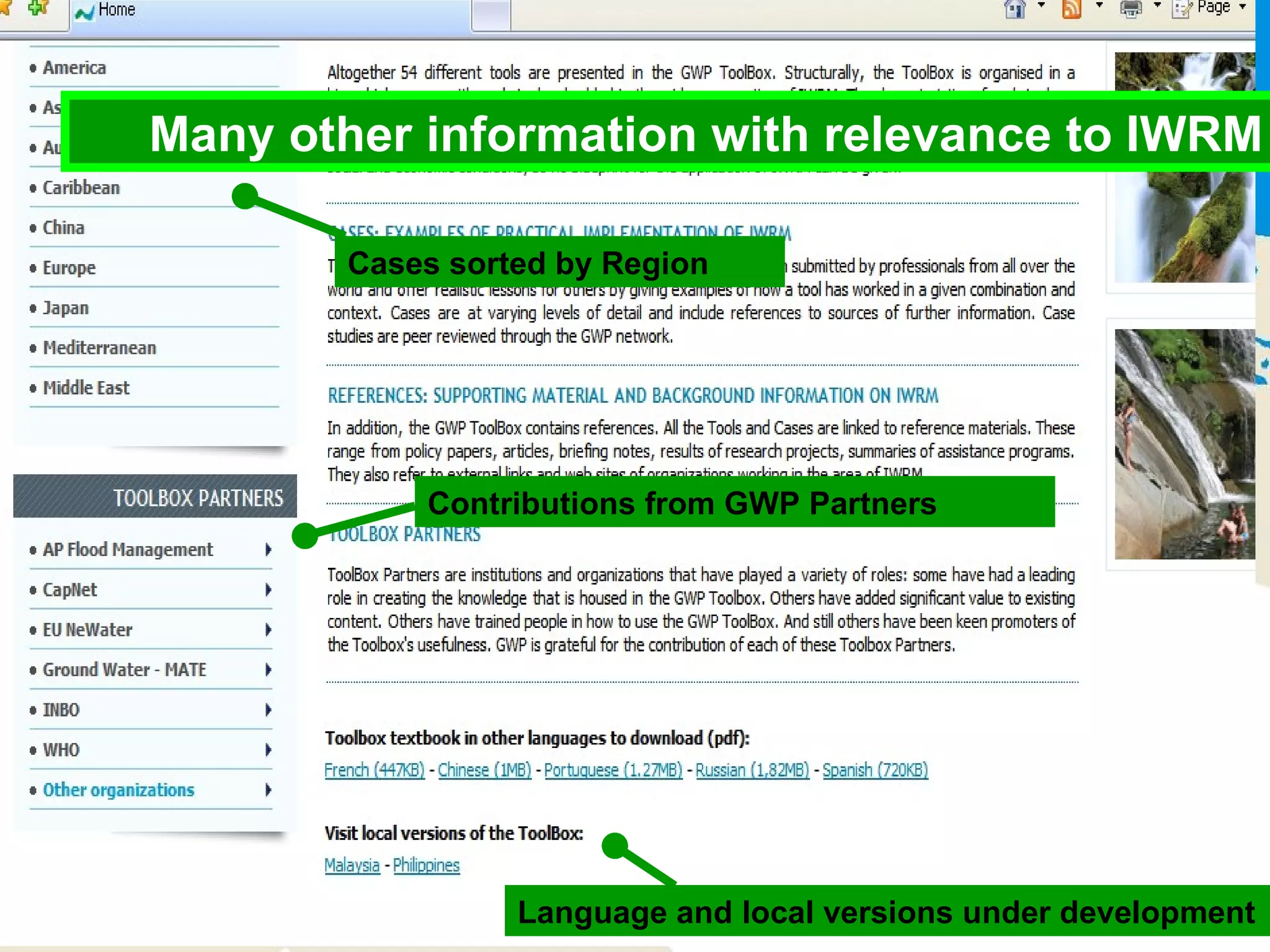
Many other information with relevance to IWRM Cases sorted by Region Contributions from GWP Partners Language and local versions under development
 
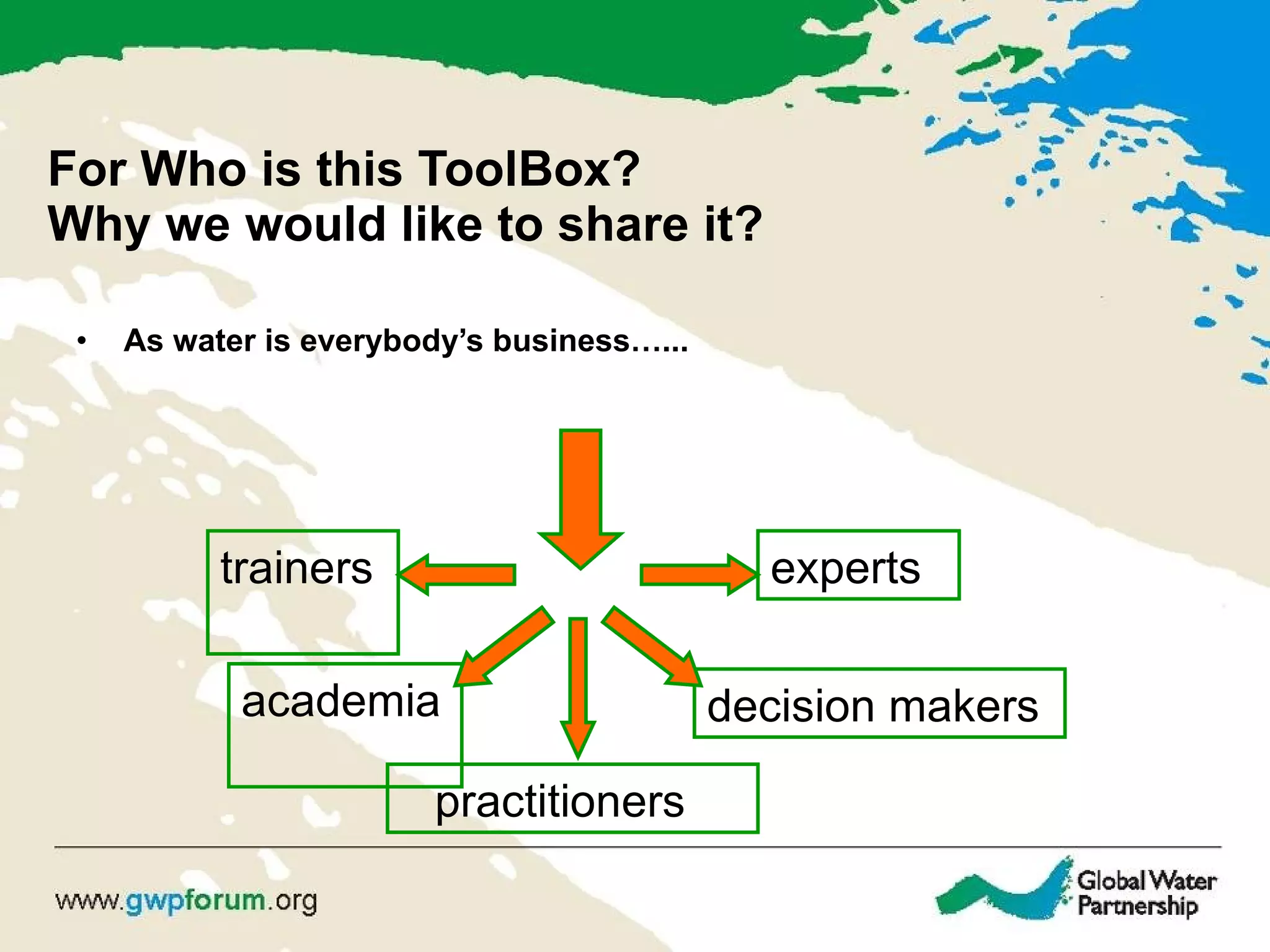
For Who is this ToolBox?  Why we would like to share it? As water is everybody’s business…... trainers  practitioners  decision makers  experts  academia
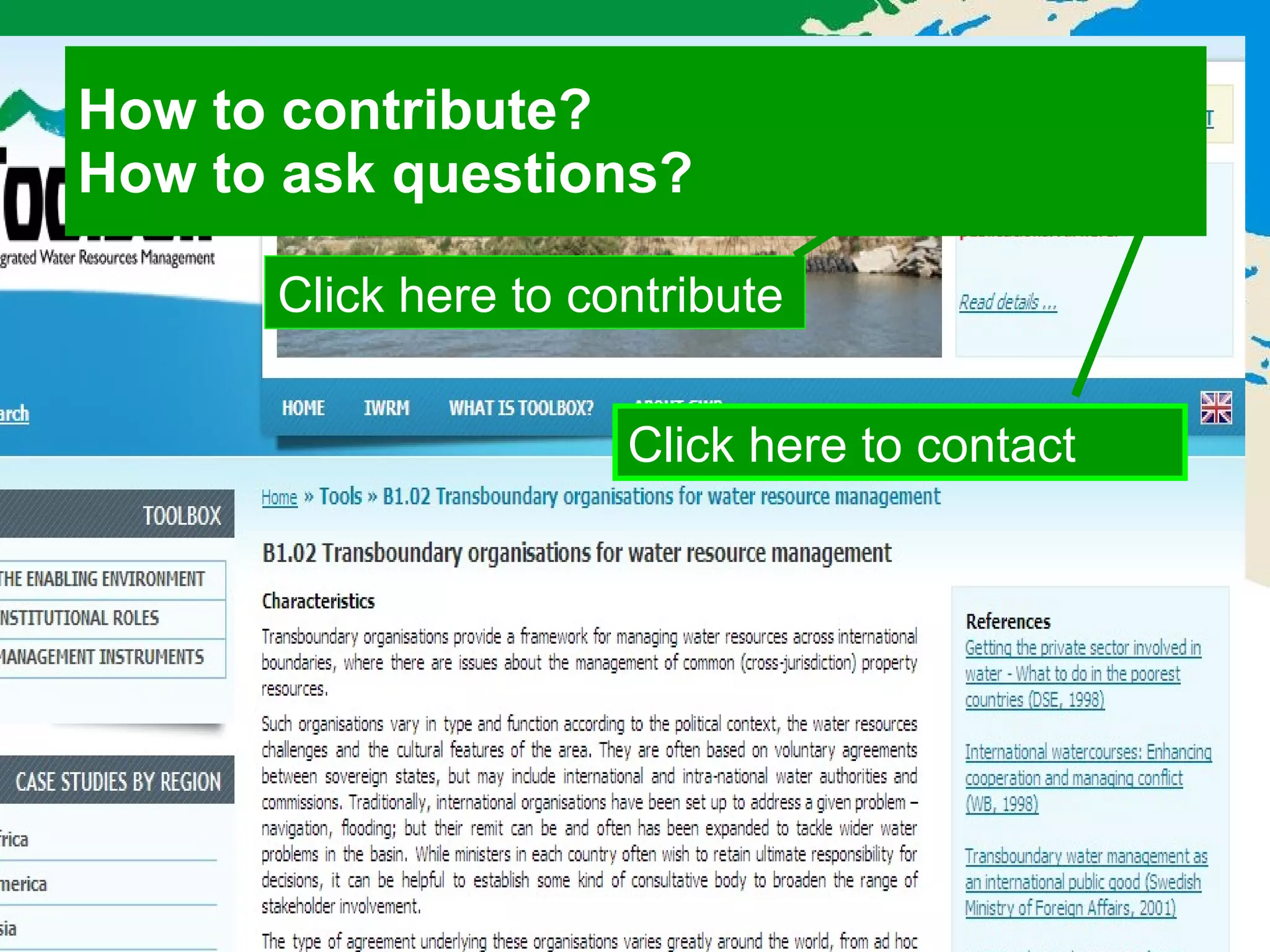
How to contribute?  How to ask questions? Click here to contribute Click here to contact
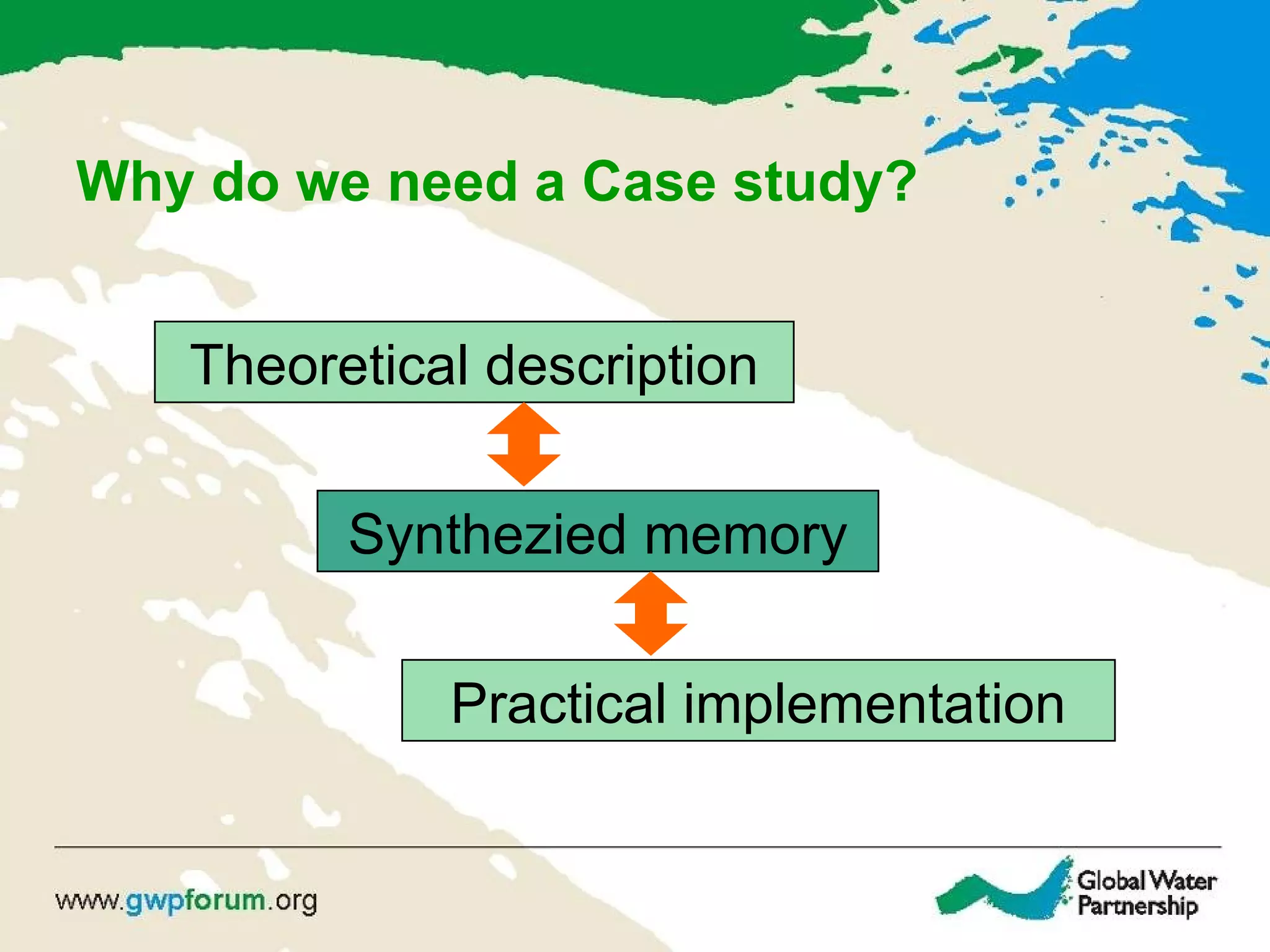
Why do we need a Case study?   Theoretical description Synthezied memory Practical implementation
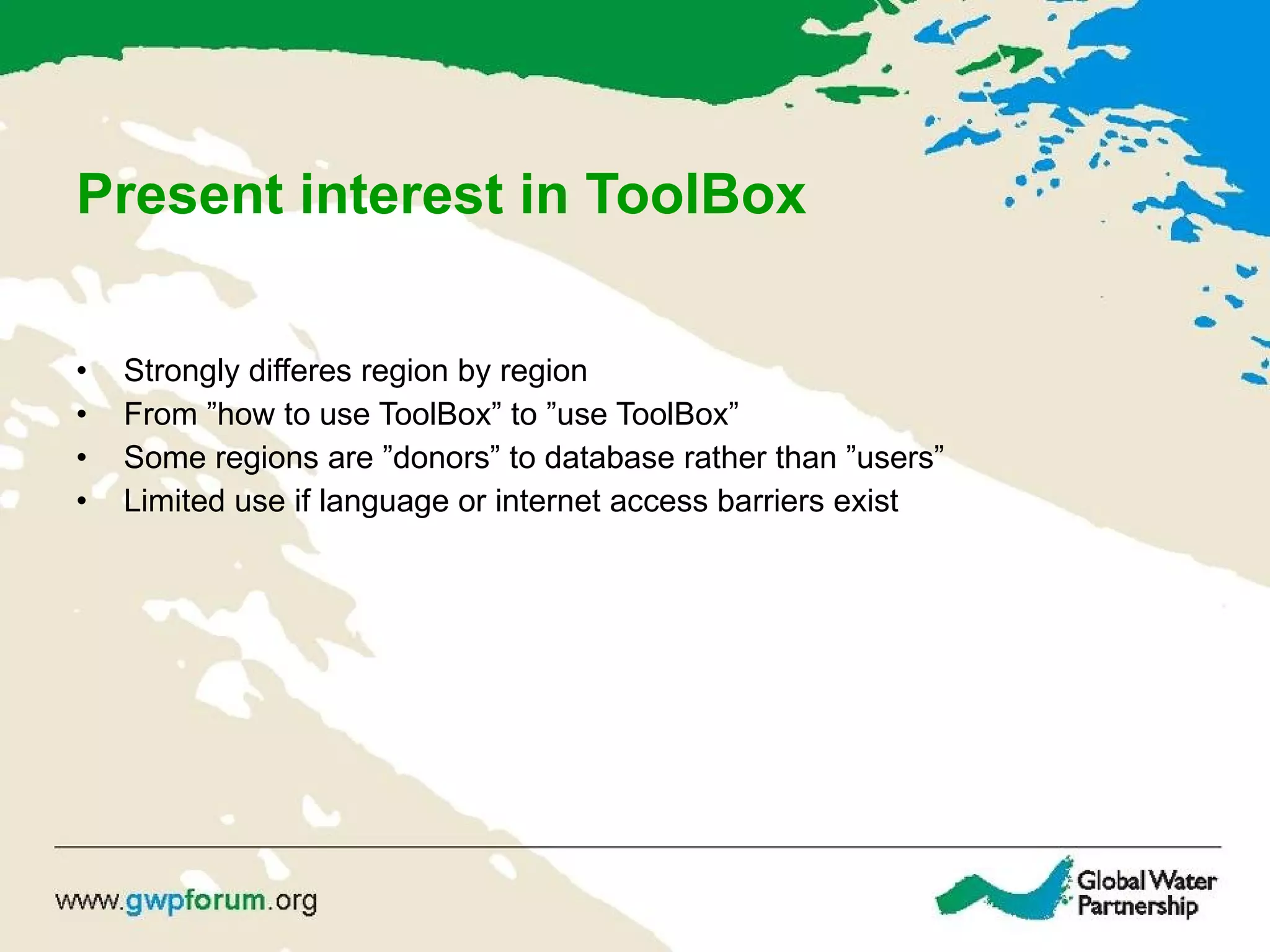
Problems in interpretation INTEGRATED  WRM approach  versus  individual TOOLS Popularization of term “IWRM” results in replacing the integrated system by its fragments (IWRM became to be  a slogan)
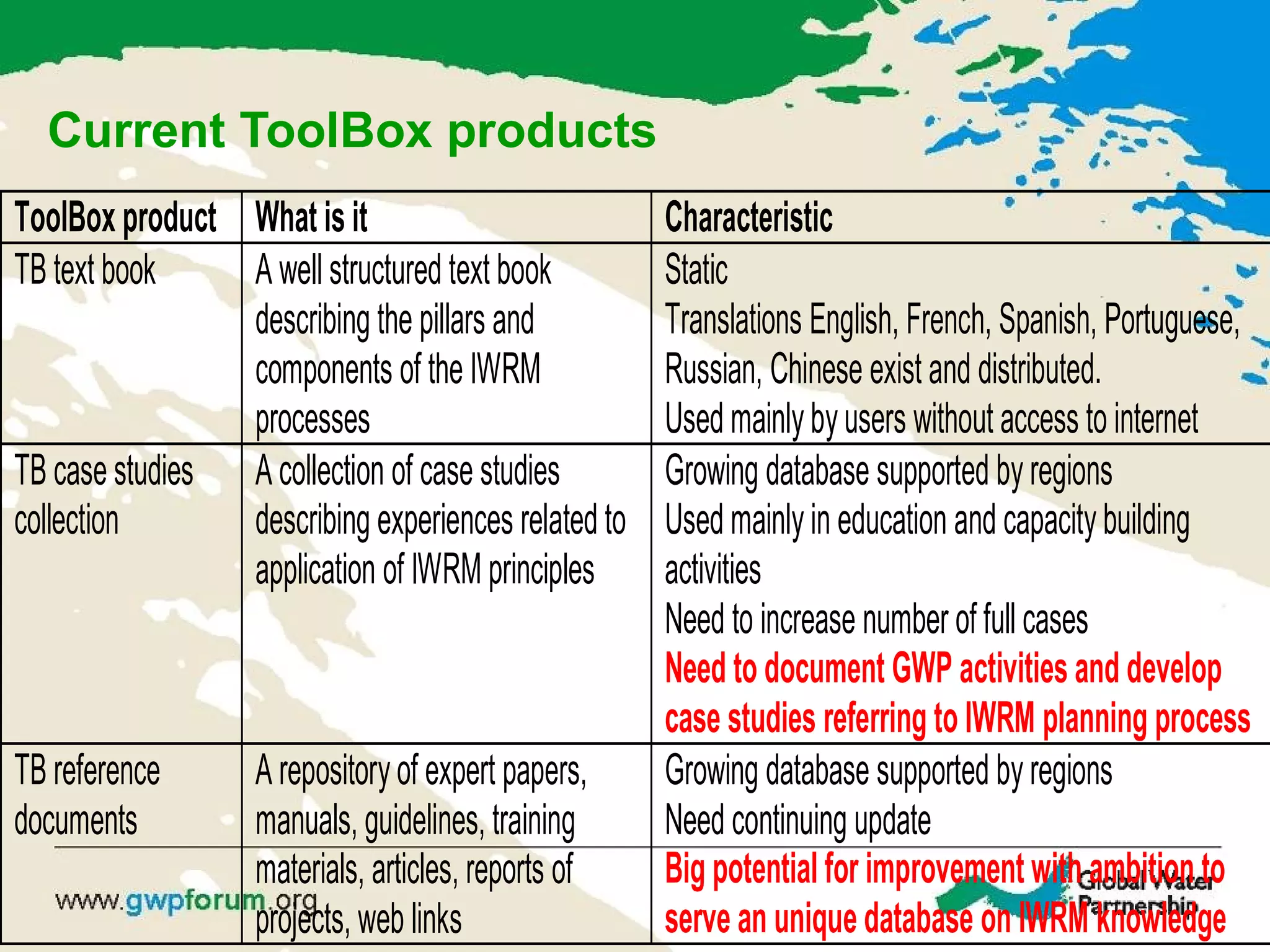
Present interest in ToolBox Strongly differes region by region From ”how to use ToolBox” to ”use ToolBox” Some regions are ”donors” to database rather than ”users” Limited use if language or internet access barriers exist
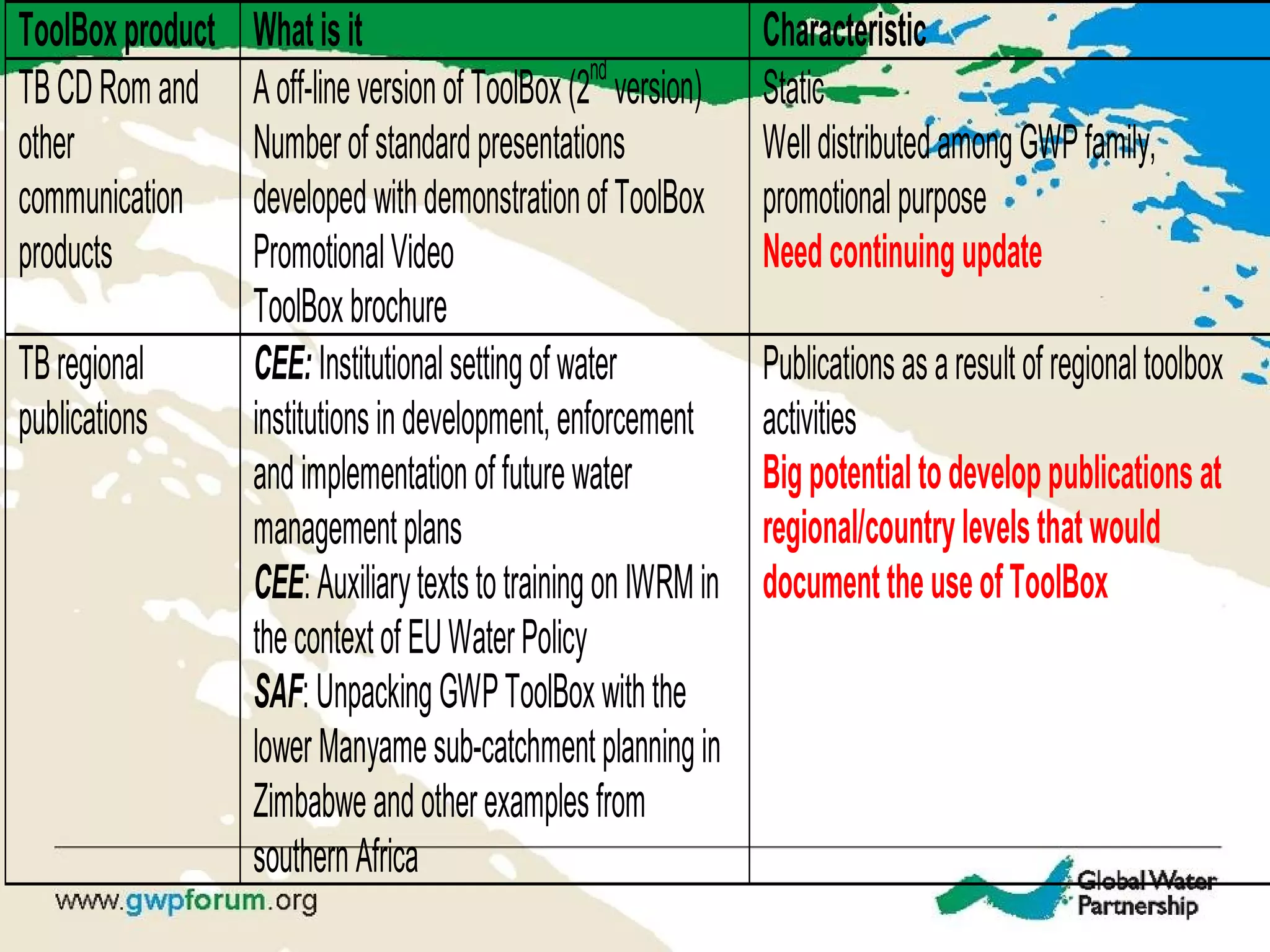
Current ToolBox products
 
Vision and goal Vision : ToolBox will be an internet based repository of all GWP knowledge on IWRM and the first choice site for water practitioners, decision makers and partners Goal : ToolBox will contribute to  establishing a global communication platform to share knowledge and develop capacity
Areas of intervention Shift from ”introduction of ToolBox” to ”application of tools in ToolBox” Establishment of mechanism to provide for ”region-to-region” knowledge exchange Maintain current partners and bring new partners to share IWRM knowledge
ToolBox in Practice: how to benefit ToolBox as a guide for IWRM planning, implementation (and monitoring achievements) ToolBox gives handy hints on water governance problems ToolBox provides for comprehensive summaries on mix of tools to be considered when carrying water projects ToolBox illustrates good practices in cross sectoral integration ToolBox is useful in training courses
ToolBox in Practice: how to contribute Elaborate cases and share them with others Provide references to enlarge on-line IWRM library Document experience from your work

GWP ToolBox: Knowledge Sharing Tool presented by D. Thalmeinerova, GWP

  • 1.
    GWP ToolBox: Knowledge Sharing Tool D. Thalmeinerova, GWP
  • 2.
    Challenge in GWPPicture from V.Pangare: Global Perspectives on IWRM, 2006
  • 3.
    GWP ToolBox on-lineIWRM library
  • 4.
    GWP ToolBox PurposeIWRM knowledge sharing and dissemination tool Goal To contribute to establishing a global communication platform to share knowledge and develop capacity Components Tools (54 tools – guidelines how to implement IWRM); Case studies (193 cases – illustrate how tools work in practice); References (178 references – support documents, manuals, papers, and external IWRM knowledge databases).
  • 5.
    What is ToolBox?It is on online forum for water experts and the broader community to address and improve the managment of water resources It decribes the pillars and components of IWRM It shows best practices and case studies It gather relevant publications, support documents, organizations and web links on IWRM
  • 6.
    Dynamics in ToolBoxFixed part: Tools Revision possible Evolving part: Case studies References
  • 7.
  • 8.
  • 9.
    工具的构成 A: Rules created by legislation, policy and financing structures B: Roles of agencies, utilities, RB authorities, regulators & other stakeholders C: Management practices
  • 10.
    Enabling Environment (A- tools) Deal with water policies and their development A1.1 Preparation of a national water resources policy A1.2 Policies with relation to water resources Include tools for use in the development of water law A2.1 Water rights A2.2 Legislation for water quality A2.3 Reform of existing legislation Deal with financial resources to meet water needs A3.1 Investment policies A3.2 Financing options I: grants and internal sources A3.3 Financing options II: Loans and equity
  • 11.
    Institutional Roles (B- tools) Deals with forms and functions of institutions B1.1 Reforming institutions for better governance B1.2 Transboundary organisations for water resource management B1.3 National apex bodies B1.4 River basin organisations B1.5 Regulatory bodies and enforcement agencies B1.6 Service providers and IWRM B1.7 Strengthening public sector water utilities B1.8 Role of the private sector B1.9 Civil society institutions and community based organisation B1.10 Local authorities Includes tools for upgrading the skills B2.1 Participatory capacity and empowerment in civil society B2.2 Training to build capacity in water professionals B2.3 Regulatory capacity
  • 12.
    Management Instruments (C- tools) About understanding resources C1.1 Water resources knowledge base C1.2 Water resources assessment C1.3 Modelling in IWRM C1.4 Developing water management indicators C1.5 Ecosystem assessment Combine development options, resource use and human interaction C2.1 National integrated water resources plans C2.2 River basin plans C2.3 Groundwater management plans C2.4 Coastal zone management plans C2.5 Risk assessment and management C2.6 Environmental assessment (EA) C2.7 Social assessment (SA) C2.8 Economic assessment
  • 13.
    Management Instruments (C- tools) Involves various tools for balancing supply and demand C3.1 Improved efficiency of use C3.2 Recycling and reuse C3.3 Improved efficiency of supply Encourages social change instruments C4.1 Education curricula on water management C4.2 Communication with stakeholders C4.3 Information and transparency for raising awareness Shows how to manage disputes C5.1 Conflict management C5.2 Shared vision planning C5.3 Consensus building
  • 14.
    Management Instruments (C- tools) Regulatory instruments C6.1 Regulations for water quality C6.2 Regulations for water quantity C6.3 Regulations for water services C6.4 Land use planning controls and nature protection Economic instruments C7.1 Pricing of water and water services C7.2 Pollution and environmental charges C7.3 Water markets and tradable permits C7.4 Subsidies and incentives Information and knowledge management C8.1 Information management systems C8.2 Sharing data for IWRM
  • 15.
    Short description &external link MAIN COMPONENTS
  • 16.
  • 17.
    Many other informationwith relevance to IWRM Cases sorted by Region Contributions from GWP Partners Language and local versions under development
  • 18.
  • 19.
    For Who isthis ToolBox? Why we would like to share it? As water is everybody’s business…... trainers practitioners decision makers experts academia
  • 20.
    How to contribute? How to ask questions? Click here to contribute Click here to contact
  • 21.
    Why do weneed a Case study? Theoretical description Synthezied memory Practical implementation
  • 22.
    Problems in interpretationINTEGRATED WRM approach versus individual TOOLS Popularization of term “IWRM” results in replacing the integrated system by its fragments (IWRM became to be a slogan)
  • 23.
    Present interest inToolBox Strongly differes region by region From ”how to use ToolBox” to ”use ToolBox” Some regions are ”donors” to database rather than ”users” Limited use if language or internet access barriers exist
  • 24.
  • 25.
  • 26.
    Vision and goalVision : ToolBox will be an internet based repository of all GWP knowledge on IWRM and the first choice site for water practitioners, decision makers and partners Goal : ToolBox will contribute to establishing a global communication platform to share knowledge and develop capacity
  • 27.
    Areas of interventionShift from ”introduction of ToolBox” to ”application of tools in ToolBox” Establishment of mechanism to provide for ”region-to-region” knowledge exchange Maintain current partners and bring new partners to share IWRM knowledge
  • 28.
    ToolBox in Practice:how to benefit ToolBox as a guide for IWRM planning, implementation (and monitoring achievements) ToolBox gives handy hints on water governance problems ToolBox provides for comprehensive summaries on mix of tools to be considered when carrying water projects ToolBox illustrates good practices in cross sectoral integration ToolBox is useful in training courses
  • 29.
    ToolBox in Practice:how to contribute Elaborate cases and share them with others Provide references to enlarge on-line IWRM library Document experience from your work