Prepared By:
VISHVAM PANCHOLI
(130280712013)
ME-Water Resources & Management
L.D.College of Engineering,Ahmedabad-380061
Outline of seminar
*Basic Concept of modelling
*Introduction of modelling
*Introduction to HEC RAS Model
*Overview of HEC RAS Model
What is
Hydrological
modelling
Hydrologic models are simplified, conceptual representations of the
Hydrologic cycle.
Source:- U.S.D.S
Why Modelling is Required ?
Modelling has become an integral part of the decision making
process for water engineers and managers.
Recent research in hydrologic modelling tries to have a more global
approach to the understanding of the behaviour of hydrologic systems to
make better predictions and to face the major challenges in water
resources management.
Recently, Hydrological models have taken over the most important tasks in
problem solving in hydrology (UNESCO, 1985). It is valuable for studying
potential impacts of changes in land use or climate.
As one report of CSDMS ( Community Surface Dynamics Modelling
System) 56 Hydrological models are Present.
What are the use of a model?
Forecast / Prediction
Instead of expensive and time consuming measurements
What happens if’ questions
Summarize and test knowledge
Education
Hydrological
Modelling
Black Box
Conceptual
Deterministic
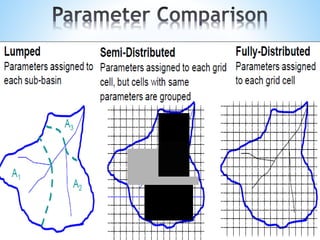
Lumped
Semi-
Distributed
Distibuted
1).Lumped models
Do not account for the spatial distribution of input variables or
parameters.
Do not require a digital elevation model (DEM) as input.
Also Known as “Low Rank” Models.
Ex- SRM (Snowmelt-Runoff Model), WATBAL etc.
2).Semi-distributed models
Models Parameters are partially vary in space by dividing the basin into
sub basins.
It has Two types
1) Kinematic wave theory models (KW models, such as HEC-HMS),
2) Probability distributed models (PD models, such as TOPMODEL).
The KW models are simplified versions of the surface and/or subsurface
flow equations
The PD models are accounted distributions of input parameters across the
basin.
Also Known as “Medium Rank” Models.
Ex-HEC-HMS,HEC-RAS, Storm Water Management Model (SWMM),
TOPMODEL.
3).Distributed models
Parameters are fully allowed to vary in space.
It require large amounts of (often unavailable) data.
Distributed models require a DEM as input.
Also Known as “High Rank” Models.
EX-MIKE11/SHE, WATFLOOD etc.
Introduction to HEC RAS
HEC-RAS
(Hydrologic Engineering Centers River Analysis System)
HEC-RAS is a one-dimensional flow hydraulic model designed to
aid hydraulic engineers in channel flow analysis and floodplain
determination.
HEC-RAS program was developed by the US Army Corps of
Engineers to manage the rivers, harbors,other public works under
their jurisdiction.
HEC-RAS model offering a simple way to set model parameters and
a graphical user interface(GUI) to run the model and visualize the
results.
River Analysis
Water depth
Flow
Use of HES RAS
Water flowing through systems of open channels ;
Computing water surface profiles.
Floodplain management ;
Flood insurance studies to evaluate floodway encroachments.
Additional uses
 Bridge and culvert design and analysis,
 Levee studies,
 Channel modification studies,
 Dam breach analysis.
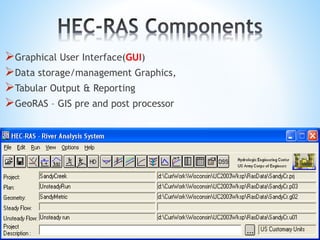
Graphical User Interface(GUI)
Data storage/management Graphics,
Tabular Output & Reporting
GeoRAS – GIS pre and post processor
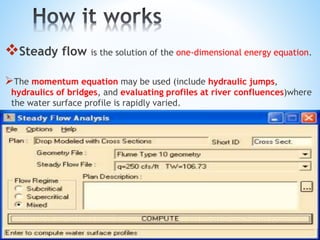
Steady flow is the solution of the one-dimensional energy equation.
The momentum equation may be used (include hydraulic jumps,
hydraulics of bridges, and evaluating profiles at river confluences)where
the water surface profile is rapidly varied.
Unsteady flow is based on solution of 1-D Saint Venant Equation
using an finite difference method.
It is capable of modelling subcritical, supercritical, and mixed flow
regime flow along with the effects of bridges, culverts, weirs, and
structures.
Advantages :-
It support by the US Army Corps of Engineers, also acceptance by
many government agencies and private firms.
It is in the public domain and peer-reviewed,
available to download free of charge from HEC's web site.
Various private companies are registered as official "vendors" and
offer consulting support and add on software.
Limitations :-
Steep bed slopes (HEC RAS User's manual says >10%);
multi-dimensional flow characteristics;
complex pipe systems.
Large Data Accuracy Required
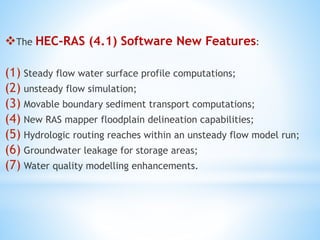
The HEC-RAS (4.1) Software New Features:
(1) Steady flow water surface profile computations;
(2) unsteady flow simulation;
(3) Movable boundary sediment transport computations;
(4) New RAS mapper floodplain delineation capabilities;
(5) Hydrologic routing reaches within an unsteady flow model run;
(6) Groundwater leakage for storage areas;
(7) Water quality modelling enhancements.
*
http://www.hec.usace.army.mil
http://csdms.colorado.edu/wiki/Hydrological_Models
http://en.wikipedia.org/wiki/HEC-RAS
http://www.forrex.org
http://www.eng.uwo.ca/research
http://www.fema.gov
Seminar on Hydrological modelling

Seminar on Hydrological modelling

  • 1.
    Prepared By: VISHVAM PANCHOLI (130280712013) ME-WaterResources & Management L.D.College of Engineering,Ahmedabad-380061
  • 2.
    Outline of seminar *BasicConcept of modelling *Introduction of modelling *Introduction to HEC RAS Model *Overview of HEC RAS Model
  • 3.
  • 4.
    Hydrologic models aresimplified, conceptual representations of the Hydrologic cycle. Source:- U.S.D.S
  • 5.
    Why Modelling isRequired ? Modelling has become an integral part of the decision making process for water engineers and managers. Recent research in hydrologic modelling tries to have a more global approach to the understanding of the behaviour of hydrologic systems to make better predictions and to face the major challenges in water resources management. Recently, Hydrological models have taken over the most important tasks in problem solving in hydrology (UNESCO, 1985). It is valuable for studying potential impacts of changes in land use or climate. As one report of CSDMS ( Community Surface Dynamics Modelling System) 56 Hydrological models are Present.
  • 6.
    What are theuse of a model? Forecast / Prediction Instead of expensive and time consuming measurements What happens if’ questions Summarize and test knowledge Education
  • 7.
  • 9.
    1).Lumped models Do notaccount for the spatial distribution of input variables or parameters. Do not require a digital elevation model (DEM) as input. Also Known as “Low Rank” Models. Ex- SRM (Snowmelt-Runoff Model), WATBAL etc. 2).Semi-distributed models Models Parameters are partially vary in space by dividing the basin into sub basins. It has Two types 1) Kinematic wave theory models (KW models, such as HEC-HMS), 2) Probability distributed models (PD models, such as TOPMODEL).
  • 10.
    The KW modelsare simplified versions of the surface and/or subsurface flow equations The PD models are accounted distributions of input parameters across the basin. Also Known as “Medium Rank” Models. Ex-HEC-HMS,HEC-RAS, Storm Water Management Model (SWMM), TOPMODEL. 3).Distributed models Parameters are fully allowed to vary in space. It require large amounts of (often unavailable) data. Distributed models require a DEM as input. Also Known as “High Rank” Models. EX-MIKE11/SHE, WATFLOOD etc.
  • 11.
  • 12.
    HEC-RAS (Hydrologic Engineering CentersRiver Analysis System) HEC-RAS is a one-dimensional flow hydraulic model designed to aid hydraulic engineers in channel flow analysis and floodplain determination. HEC-RAS program was developed by the US Army Corps of Engineers to manage the rivers, harbors,other public works under their jurisdiction.
  • 13.
    HEC-RAS model offeringa simple way to set model parameters and a graphical user interface(GUI) to run the model and visualize the results. River Analysis Water depth Flow
  • 14.
    Use of HESRAS Water flowing through systems of open channels ; Computing water surface profiles. Floodplain management ; Flood insurance studies to evaluate floodway encroachments. Additional uses  Bridge and culvert design and analysis,  Levee studies,  Channel modification studies,  Dam breach analysis.
  • 15.
    Graphical User Interface(GUI) Datastorage/management Graphics, Tabular Output & Reporting GeoRAS – GIS pre and post processor
  • 17.
    Steady flow isthe solution of the one-dimensional energy equation. The momentum equation may be used (include hydraulic jumps, hydraulics of bridges, and evaluating profiles at river confluences)where the water surface profile is rapidly varied.
  • 19.
    Unsteady flow isbased on solution of 1-D Saint Venant Equation using an finite difference method. It is capable of modelling subcritical, supercritical, and mixed flow regime flow along with the effects of bridges, culverts, weirs, and structures.
  • 21.
    Advantages :- It supportby the US Army Corps of Engineers, also acceptance by many government agencies and private firms. It is in the public domain and peer-reviewed, available to download free of charge from HEC's web site. Various private companies are registered as official "vendors" and offer consulting support and add on software. Limitations :- Steep bed slopes (HEC RAS User's manual says >10%); multi-dimensional flow characteristics; complex pipe systems. Large Data Accuracy Required
  • 22.
    The HEC-RAS (4.1)Software New Features: (1) Steady flow water surface profile computations; (2) unsteady flow simulation; (3) Movable boundary sediment transport computations; (4) New RAS mapper floodplain delineation capabilities; (5) Hydrologic routing reaches within an unsteady flow model run; (6) Groundwater leakage for storage areas; (7) Water quality modelling enhancements.
  • 23.