
Economic and Financial Instruments for IWRM Introduction to IWRM Part 3: Introducing Economic and Finance Instruments
Goal and objectives of the session To introduce the importance of economic and financial instruments in IWRM To introduce the requirements for implementing IWRM
Outline presentation Basic definitions of economics and finance Importance of economic instruments and  examples Importance of financial instruments and examples  Introduce the requirements for implementing IWRM
Introduction: Basic definition of Economics The allocation of scarce resources among alternative uses. It focuses on the efficiency of the allocation and distribution of assets and income.
Economics and IWRM Economic instruments are rationing rules or incentives which influence the allocation and distribution of water or water-related assets and incomes.
Examples of economic instruments Water tariffs; Abstraction charges; Water subsidies; and Water taxes
Economic instruments are evaluated using the criteria of: Efficiency; Equity; Environmental sustainability; Administrative feasibility; and  Political acceptability.
What is Finance? Specific decisions taken by organisations or firms (public or private) to maximise short or long run returns to their assets and investments.
Categories of financial instruments: Charges for use or benefits (water tariff); National or local government grants, soft loans and guarantees (payments from national, state or municipal budgets); External grants and concessional loans; Philanthropic agencies (NGOs); Commercial loans and equity (IFI loans, bonds etc.)
Importance of Use of Economic and Financial Instruments in IWRM Water is becoming scarcer. Need to ration use; Vulnerability of the environment. Need to charge for pollution; Need for finance for water infrastructure provision, upgrading or expansion.
Implementing IWRM Several roadblocks to implementing IWRM Sectoral interests; Professional insecurities; Socio-cultural myths; Politics
Approaches to Breaking Barriers Barriers to implementing IWRM require an incremental approach to: Negotiating differences; Cross-sectoral integration; Instituting reforms.
Negotiating differences Conflicts and insecurities among professionals working in various sectors in adopting and implementing alternative water resources management approach calls for: Negotiating win-win solutions; Platforms for different stakeholders to have a voice and collaborate; Takes time and patience.
Cross-sectoral integration Various perspectives and interests of different water users across sectors must be integrated to successfully implement IWRM; Formal mechanisms for commitment to integration needed; Informal attempts have failed.
Reforms Existing institutional and legal frameworks not sufficiently responsive to demands and requirements for preparing & implementing IWRM plans. Reforms needed in all phases of the IWRM planning process and implementation of the IWRM plans. Reforms needed to finance implementation of IWRM plans. Interactive process that takes several years of planning, creating enabling environment capacity building.
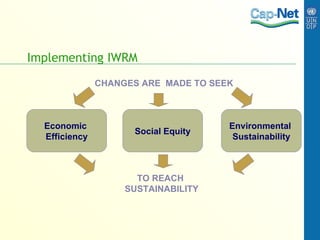
Implementing IWRM Economic  Efficiency CHANGES ARE  MADE TO SEEK Environmental  Sustainability Social Equity TO REACH  SUSTAINABILITY
Think about it Having gone through the basic principles of IWRM you will probably be able to assess the situation in your own country when it comes to implementation of IWRM.
Questions What is the evidence of commitment to integrated water resources management in your country?  Are economic and financial instruments being used in water resources management in your country. Give examples where possible.
End Next chapters will go deeper into water management issues, forces causing them and the role of economic and financial instruments in creating an enabling environment for water management.

Chapter 1 _part_3__e&f_instruments

  • 1.
    Economic and FinancialInstruments for IWRM Introduction to IWRM Part 3: Introducing Economic and Finance Instruments
  • 2.
    Goal and objectivesof the session To introduce the importance of economic and financial instruments in IWRM To introduce the requirements for implementing IWRM
  • 3.
    Outline presentation Basicdefinitions of economics and finance Importance of economic instruments and examples Importance of financial instruments and examples Introduce the requirements for implementing IWRM
  • 4.
    Introduction: Basic definitionof Economics The allocation of scarce resources among alternative uses. It focuses on the efficiency of the allocation and distribution of assets and income.
  • 5.
    Economics and IWRMEconomic instruments are rationing rules or incentives which influence the allocation and distribution of water or water-related assets and incomes.
  • 6.
    Examples of economicinstruments Water tariffs; Abstraction charges; Water subsidies; and Water taxes
  • 7.
    Economic instruments areevaluated using the criteria of: Efficiency; Equity; Environmental sustainability; Administrative feasibility; and Political acceptability.
  • 8.
    What is Finance?Specific decisions taken by organisations or firms (public or private) to maximise short or long run returns to their assets and investments.
  • 9.
    Categories of financialinstruments: Charges for use or benefits (water tariff); National or local government grants, soft loans and guarantees (payments from national, state or municipal budgets); External grants and concessional loans; Philanthropic agencies (NGOs); Commercial loans and equity (IFI loans, bonds etc.)
  • 10.
    Importance of Useof Economic and Financial Instruments in IWRM Water is becoming scarcer. Need to ration use; Vulnerability of the environment. Need to charge for pollution; Need for finance for water infrastructure provision, upgrading or expansion.
  • 11.
    Implementing IWRM Severalroadblocks to implementing IWRM Sectoral interests; Professional insecurities; Socio-cultural myths; Politics
  • 12.
    Approaches to BreakingBarriers Barriers to implementing IWRM require an incremental approach to: Negotiating differences; Cross-sectoral integration; Instituting reforms.
  • 13.
    Negotiating differences Conflictsand insecurities among professionals working in various sectors in adopting and implementing alternative water resources management approach calls for: Negotiating win-win solutions; Platforms for different stakeholders to have a voice and collaborate; Takes time and patience.
  • 14.
    Cross-sectoral integration Variousperspectives and interests of different water users across sectors must be integrated to successfully implement IWRM; Formal mechanisms for commitment to integration needed; Informal attempts have failed.
  • 15.
    Reforms Existing institutionaland legal frameworks not sufficiently responsive to demands and requirements for preparing & implementing IWRM plans. Reforms needed in all phases of the IWRM planning process and implementation of the IWRM plans. Reforms needed to finance implementation of IWRM plans. Interactive process that takes several years of planning, creating enabling environment capacity building.
  • 16.
    Implementing IWRM Economic Efficiency CHANGES ARE MADE TO SEEK Environmental Sustainability Social Equity TO REACH SUSTAINABILITY
  • 17.
    Think about itHaving gone through the basic principles of IWRM you will probably be able to assess the situation in your own country when it comes to implementation of IWRM.
  • 18.
    Questions What isthe evidence of commitment to integrated water resources management in your country? Are economic and financial instruments being used in water resources management in your country. Give examples where possible.
  • 19.
    End Next chapterswill go deeper into water management issues, forces causing them and the role of economic and financial instruments in creating an enabling environment for water management.