Economic and Financial Instruments for IWRM Introduction to water finance
Goal and objectives of the session To explain how the main constituent parts of the water sector obtain their finance. To consider how a financing structure can be put together that is coherent, adequate and sustainable.
Outline presentation Financial and economic instruments Finance for the water sector Cost categories and funding sources Building a financing strategy for IWRM The range of financial instruments Case study: two examples of coherent financing, the Netherlands and France
Introduction A nation’s water sector comprises a range of functions and services. The starting point in constructing a financing strategy is to consider, for each part of the sector, its sources and modalities of finance, the financial status of the entities involved, and their estimated future financial requirements.
Financial and economic instruments Some instruments can perform both economic and financial purposes:  1.  economic  instruments influence the behaviour of users and hence the allocation of the resource. 2.  financial  instruments generate financial revenues for the operation and development of the sector. However, the two effects may overlap, and the same instrument may perform one or both purposes in different circumstances. For example a tariff can serve both purposes.
Catalogue of the national water sector Water sector policy setting & coordination Environmental & economic regulation & performance monitoring Water resource development & management Distribution of water  &bulk supply Sanitation and wastewater collection, transport & treatment
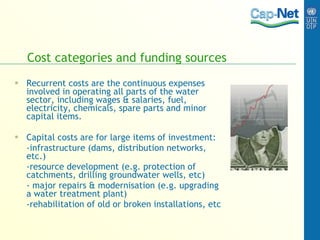
Cost categories and funding sources Recurrent costs are the continuous expenses involved in operating all parts of the water sector, including wages & salaries, fuel, electricity, chemicals, spare parts and minor capital items. Capital   costs are for large items of investment:  -infrastructure (dams, distribution networks, etc.) -resource development (e.g. protection of catchments, drilling groundwater wells, etc) - major repairs & modernisation (e.g. upgrading a water treatment plant)  -rehabilitation of old or broken installations, etc
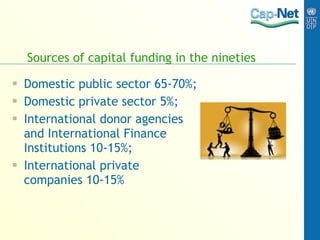
Sources of capital funding in the nineties Domestic public sector 65-70%;  Domestic private sector 5%;  International donor agencies and International Finance Institutions 10-15%;  International private companies 10-15%
Building a financing strategy for IWRM (1) Using public finance for public goods   Recover costs from users for directly productive services Appropriate delegation of financial power to sub-sovereign & local bodies Increased self-financing of service providers Take up of external grants
Building a financing strategy for IWRM (2) Co-financing should be sought for transnational projects and those with international benefits The cost of  multipurpose schemes can be shared with other sectors   Some externalities of  water can be captured in monetary form and the proceeds applied to IWRM Partnerships are a good way to tap new sources of finance Tapping finance from commercial sources
The range of financial instruments Charges for use or benefits National or local government grants or other support External grants (oda) Philanthropy Commercial loans and equity
Instruments for financing the water sector (1) i) Charges for the use of water and water services: -Water abstraction charge  -Water tariffs for households, industries, farmers & other major users -Sewerage & effluent charge -Water pollution charges and taxes -Licence fees & charges for use of specific services -Flood protection levies
Instruments for financing the water sector (2) ii) National government grants, soft loans & guarantees, from National, state or municipal budgets and/or financial intermediaries & development banks. iii) External grants & concessional loans (oda) iv) Philanthropic agencies & partnerships v) Commercial loans, equity & PSP, for example, IFI loans, Commercial bank loans & microfinance, Bonds, Private equity, External guarantees & risk sharing, PSP contracts of various kinds (BOTs, concessions, etc).
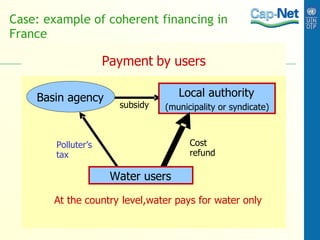
Case: example of coherent financing in France   Payment by  users subsidy Basin agency Polluter’s  tax Local authority (municipality or syndicate) Cost refund At the country  level water pays for water only ,  Water users
Distinctive features of the Dutch model Public sector ownership model for Water Boards & Drinking Water companies (plcs);  Democratic structure of Water Boards, with strong stakeholder representation; Strong revenue streams for WBs & water supply plcs; Water Bank a dedicated source of long term loans; Water supply & wastewater collection & treatment now self-financed (through cash flow & loans) Strong sub-sovereign agencies attracting long term finance on fine terms High degree of self-regulation & benchmarking by WBs & plcs
Think about it Is there any scope for involving private equity and commercial finance in the water sector your country?  Which are the main constituent parts of your country's water sector? Which are finance sources for each? (distinguishing recurrent spending from capital investment items) Is the current financing structure rational and sensible? Suggest ways in which it could be improved. Make suggestions for attracting more financial resources into the water sector of your country. There are always things not seen!
End The next chapter will give some examples of financial instruments used in the water sector in developing countries.

Chapter+5 introduction+to+finance+instruments

  • 1.
    Economic and FinancialInstruments for IWRM Introduction to water finance
  • 2.
    Goal and objectivesof the session To explain how the main constituent parts of the water sector obtain their finance. To consider how a financing structure can be put together that is coherent, adequate and sustainable.
  • 3.
    Outline presentation Financialand economic instruments Finance for the water sector Cost categories and funding sources Building a financing strategy for IWRM The range of financial instruments Case study: two examples of coherent financing, the Netherlands and France
  • 4.
    Introduction A nation’swater sector comprises a range of functions and services. The starting point in constructing a financing strategy is to consider, for each part of the sector, its sources and modalities of finance, the financial status of the entities involved, and their estimated future financial requirements.
  • 5.
    Financial and economicinstruments Some instruments can perform both economic and financial purposes: 1. economic instruments influence the behaviour of users and hence the allocation of the resource. 2. financial instruments generate financial revenues for the operation and development of the sector. However, the two effects may overlap, and the same instrument may perform one or both purposes in different circumstances. For example a tariff can serve both purposes.
  • 6.
    Catalogue of thenational water sector Water sector policy setting & coordination Environmental & economic regulation & performance monitoring Water resource development & management Distribution of water &bulk supply Sanitation and wastewater collection, transport & treatment
  • 7.
    Cost categories andfunding sources Recurrent costs are the continuous expenses involved in operating all parts of the water sector, including wages & salaries, fuel, electricity, chemicals, spare parts and minor capital items. Capital costs are for large items of investment: -infrastructure (dams, distribution networks, etc.) -resource development (e.g. protection of catchments, drilling groundwater wells, etc) - major repairs & modernisation (e.g. upgrading a water treatment plant) -rehabilitation of old or broken installations, etc
  • 8.
    Sources of capitalfunding in the nineties Domestic public sector 65-70%; Domestic private sector 5%; International donor agencies and International Finance Institutions 10-15%; International private companies 10-15%
  • 9.
    Building a financingstrategy for IWRM (1) Using public finance for public goods Recover costs from users for directly productive services Appropriate delegation of financial power to sub-sovereign & local bodies Increased self-financing of service providers Take up of external grants
  • 10.
    Building a financingstrategy for IWRM (2) Co-financing should be sought for transnational projects and those with international benefits The cost of multipurpose schemes can be shared with other sectors Some externalities of water can be captured in monetary form and the proceeds applied to IWRM Partnerships are a good way to tap new sources of finance Tapping finance from commercial sources
  • 11.
    The range offinancial instruments Charges for use or benefits National or local government grants or other support External grants (oda) Philanthropy Commercial loans and equity
  • 12.
    Instruments for financingthe water sector (1) i) Charges for the use of water and water services: -Water abstraction charge -Water tariffs for households, industries, farmers & other major users -Sewerage & effluent charge -Water pollution charges and taxes -Licence fees & charges for use of specific services -Flood protection levies
  • 13.
    Instruments for financingthe water sector (2) ii) National government grants, soft loans & guarantees, from National, state or municipal budgets and/or financial intermediaries & development banks. iii) External grants & concessional loans (oda) iv) Philanthropic agencies & partnerships v) Commercial loans, equity & PSP, for example, IFI loans, Commercial bank loans & microfinance, Bonds, Private equity, External guarantees & risk sharing, PSP contracts of various kinds (BOTs, concessions, etc).
  • 14.
    Case: example ofcoherent financing in France Payment by users subsidy Basin agency Polluter’s tax Local authority (municipality or syndicate) Cost refund At the country level water pays for water only , Water users
  • 15.
    Distinctive features ofthe Dutch model Public sector ownership model for Water Boards & Drinking Water companies (plcs); Democratic structure of Water Boards, with strong stakeholder representation; Strong revenue streams for WBs & water supply plcs; Water Bank a dedicated source of long term loans; Water supply & wastewater collection & treatment now self-financed (through cash flow & loans) Strong sub-sovereign agencies attracting long term finance on fine terms High degree of self-regulation & benchmarking by WBs & plcs
  • 16.
    Think about itIs there any scope for involving private equity and commercial finance in the water sector your country? Which are the main constituent parts of your country's water sector? Which are finance sources for each? (distinguishing recurrent spending from capital investment items) Is the current financing structure rational and sensible? Suggest ways in which it could be improved. Make suggestions for attracting more financial resources into the water sector of your country. There are always things not seen!
  • 17.
    End The nextchapter will give some examples of financial instruments used in the water sector in developing countries.