Economic and Financial Instruments for IWRM Application of financial instruments
Goal and objectives of the session To examine in greater detail than in chapter 5 the main financing options for a water system. To evaluate the relevance of these financing instruments for different purposes.
Outline presentation Charges for use of water & water services. National government grants, soft loans & guarantees. External grants (Official Development Aid). Philanthropic & not-for-profit agencies & partnerships. Commercial loans, bonds & private equity. How do guarantees work?
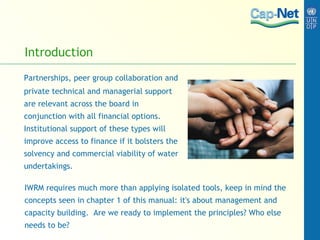
Introduction Partnerships, peer group collaboration and private technical and managerial support are relevant across the board in conjunction with all financial options. Institutional support of these types will improve access to finance if it bolsters the solvency and commercial viability of water undertakings. IWRM requires much more than applying isolated tools, keep in mind the concepts seen in chapter 1 of this manual: it's about management and capacity building.  Are we ready to implement the principles? Who else needs to be?
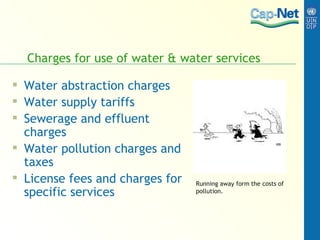
Charges for use of water & water services Water abstraction charges Water supply tariffs Sewerage and effluent charges Water pollution charges and taxes License fees and charges for specific services Running away form the costs of pollution.
Financing flood risk management (1) Charges on water users Example: “French  Agences de Bassin”  fund their water resource management activities (including flood control) through surcharges on customers’ water bills, sometimes referred to as a “polluters’ tax” Surcharge on property owners Example: “Netherlands Water Boards”, responsible for surface water management including flood control, recover costs through charges on property owners
Financing flood risk management (2) Negotiated contributions from beneficiaries   Large landowners, property developers, sporting complexes, factories, power stations. Charges and fees for use of facilities and attractions Assets created by flood risk management have recreational and touristic benefits which can be the basis of entry charges and fees to the general public.
Financing flood risk management (3) Cost sharing from multipurpose schemes Costs can be shared because FRM is often one of the purposes of hydropower projects, river flow management, preservation of wetlands, etc.  Cost sharing in transboundary projects FRM frequently entails transboundary projects, where costs can be shared with neighbours Insurance Many governments encourage   their citizens to take out private insurance policies to cover flood risk
The national budget for recurrent cost funding Covering recurrent overhead water services costs Providing the variable costs of operating water services Underwriting any financial deficits incurred by local water undertakings, this removes any incentive on undertaking to improve its finance Providing subsidies to cover stated and specific purposes (free water for deserving & sanitation) Targeted or smart subsidies avoid disadvantages of general subsidies, if predictable and transparent
National government grants, soft loans & guarantees Advantages of government funding of projects are:  Fund raising is related to national financial capacity, and can avoid local over-borrowing & debt problems The national Treasury can get better terms in financial markets than local authorities It can set national priorities and steer funds towards urgent/priority cases, ensuring equity between richer and poorer parts of the country The foreign exchange risk of foreign loans is borne by central government
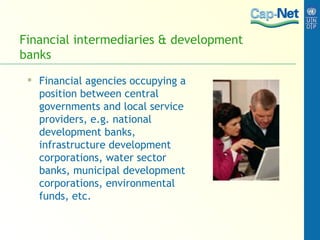
Financial intermediaries & development banks Financial agencies occupying a position between central governments and local service providers, e.g. national development banks, infrastructure development corporations, water sector banks, municipal development corporations, environmental funds, etc.
External grants (Official Development Aid) Grants or concessional loans are available from a wide variety of international agencies. It is sensible for developing countries to maximise their uptake of ODA grant money, before contemplating commercial finance for this sector. Concessional loan is one that is available on better terms than those provided by private financial markets – lower interest, longer maturities, and/or grace periods before interest or repayments are due.
Philanthropic & not-for-profit agencies & partnerships A high proportion of W&S programmes are undertaken in partnership with NGOs, foundations, Community Based organisations, church groups, charities and other philanthropic and not-for-profit bodies. UN agencies (UNICEF), or branches of the International Red Cross are active in WASH.
Commercial loans, bonds & private equity (1) Loans from International Financial Institutions (IFIs) Medium/long term loans are available from for management and infrastructure. IFIs’ shareholders are national governments, and they operate in many different countries. Some of them are obliged by their statutes to lend only to national governments, others have the means to deal with private borrowers and can deal with sub-sovereign borrowers. Their terms are normally more favourable than those on offer from commercial sources
Commercial loans, bonds & private equity (2) Bank loans for infrastructure are of two main types, depending on how risks are borne:  c orporate finance   the loan is made to a company or public corporation, which undertakes the servicing of the debt.  project finance , where the loan is made to a “special purpose vehicle” undertaking the project, and the security for loan is the expected cash flow
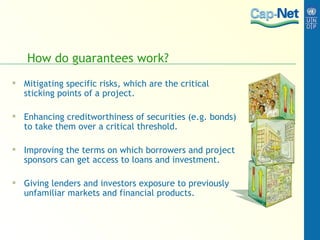
How do guarantees work? Mitigating specific risks, which are the critical sticking points of a project. Enhancing creditworthiness of securities (e.g. bonds) to take them over a critical threshold. Improving the terms on which borrowers and project sponsors can get access to loans and investment. Giving lenders and investors exposure to previously unfamiliar markets and financial products.
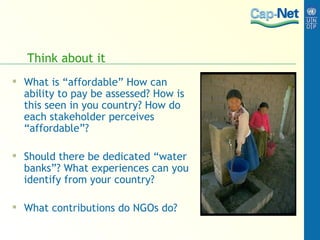
Think about it What is “affordable” How can ability to pay be assessed? How is this seen in you country? How do each stakeholder perceives “affordable”?  Should there be dedicated “water banks”? What experiences can you identify from your country? What contributions do NGOs do?
End Chapter 7 goes specifically into financing by means of bonds, BOTs and reforms. Chapter 8, the last chapter of the manual explores local financing mechanisms.

Chapter+6 application+of+finance+instruments

  • 1.
    Economic and FinancialInstruments for IWRM Application of financial instruments
  • 2.
    Goal and objectivesof the session To examine in greater detail than in chapter 5 the main financing options for a water system. To evaluate the relevance of these financing instruments for different purposes.
  • 3.
    Outline presentation Chargesfor use of water & water services. National government grants, soft loans & guarantees. External grants (Official Development Aid). Philanthropic & not-for-profit agencies & partnerships. Commercial loans, bonds & private equity. How do guarantees work?
  • 4.
    Introduction Partnerships, peergroup collaboration and private technical and managerial support are relevant across the board in conjunction with all financial options. Institutional support of these types will improve access to finance if it bolsters the solvency and commercial viability of water undertakings. IWRM requires much more than applying isolated tools, keep in mind the concepts seen in chapter 1 of this manual: it's about management and capacity building. Are we ready to implement the principles? Who else needs to be?
  • 5.
    Charges for useof water & water services Water abstraction charges Water supply tariffs Sewerage and effluent charges Water pollution charges and taxes License fees and charges for specific services Running away form the costs of pollution.
  • 6.
    Financing flood riskmanagement (1) Charges on water users Example: “French Agences de Bassin” fund their water resource management activities (including flood control) through surcharges on customers’ water bills, sometimes referred to as a “polluters’ tax” Surcharge on property owners Example: “Netherlands Water Boards”, responsible for surface water management including flood control, recover costs through charges on property owners
  • 7.
    Financing flood riskmanagement (2) Negotiated contributions from beneficiaries Large landowners, property developers, sporting complexes, factories, power stations. Charges and fees for use of facilities and attractions Assets created by flood risk management have recreational and touristic benefits which can be the basis of entry charges and fees to the general public.
  • 8.
    Financing flood riskmanagement (3) Cost sharing from multipurpose schemes Costs can be shared because FRM is often one of the purposes of hydropower projects, river flow management, preservation of wetlands, etc. Cost sharing in transboundary projects FRM frequently entails transboundary projects, where costs can be shared with neighbours Insurance Many governments encourage their citizens to take out private insurance policies to cover flood risk
  • 9.
    The national budgetfor recurrent cost funding Covering recurrent overhead water services costs Providing the variable costs of operating water services Underwriting any financial deficits incurred by local water undertakings, this removes any incentive on undertaking to improve its finance Providing subsidies to cover stated and specific purposes (free water for deserving & sanitation) Targeted or smart subsidies avoid disadvantages of general subsidies, if predictable and transparent
  • 10.
    National government grants,soft loans & guarantees Advantages of government funding of projects are: Fund raising is related to national financial capacity, and can avoid local over-borrowing & debt problems The national Treasury can get better terms in financial markets than local authorities It can set national priorities and steer funds towards urgent/priority cases, ensuring equity between richer and poorer parts of the country The foreign exchange risk of foreign loans is borne by central government
  • 11.
    Financial intermediaries &development banks Financial agencies occupying a position between central governments and local service providers, e.g. national development banks, infrastructure development corporations, water sector banks, municipal development corporations, environmental funds, etc.
  • 12.
    External grants (OfficialDevelopment Aid) Grants or concessional loans are available from a wide variety of international agencies. It is sensible for developing countries to maximise their uptake of ODA grant money, before contemplating commercial finance for this sector. Concessional loan is one that is available on better terms than those provided by private financial markets – lower interest, longer maturities, and/or grace periods before interest or repayments are due.
  • 13.
    Philanthropic & not-for-profitagencies & partnerships A high proportion of W&S programmes are undertaken in partnership with NGOs, foundations, Community Based organisations, church groups, charities and other philanthropic and not-for-profit bodies. UN agencies (UNICEF), or branches of the International Red Cross are active in WASH.
  • 14.
    Commercial loans, bonds& private equity (1) Loans from International Financial Institutions (IFIs) Medium/long term loans are available from for management and infrastructure. IFIs’ shareholders are national governments, and they operate in many different countries. Some of them are obliged by their statutes to lend only to national governments, others have the means to deal with private borrowers and can deal with sub-sovereign borrowers. Their terms are normally more favourable than those on offer from commercial sources
  • 15.
    Commercial loans, bonds& private equity (2) Bank loans for infrastructure are of two main types, depending on how risks are borne: c orporate finance the loan is made to a company or public corporation, which undertakes the servicing of the debt. project finance , where the loan is made to a “special purpose vehicle” undertaking the project, and the security for loan is the expected cash flow
  • 16.
    How do guaranteeswork? Mitigating specific risks, which are the critical sticking points of a project. Enhancing creditworthiness of securities (e.g. bonds) to take them over a critical threshold. Improving the terms on which borrowers and project sponsors can get access to loans and investment. Giving lenders and investors exposure to previously unfamiliar markets and financial products.
  • 17.
    Think about itWhat is “affordable” How can ability to pay be assessed? How is this seen in you country? How do each stakeholder perceives “affordable”? Should there be dedicated “water banks”? What experiences can you identify from your country? What contributions do NGOs do?
  • 18.
    End Chapter 7goes specifically into financing by means of bonds, BOTs and reforms. Chapter 8, the last chapter of the manual explores local financing mechanisms.