Semester 2 Session 2021/2022
Subtopics
Integration of Functions
3.1
Integration of
Trigonometric Functions
3.2
Techniques of Integration
3.3
Definite Integrals
3.4
3.1 INTEGRATION OF FUNCTIONS
At the end of this unit, students will be able to :
relate integration
and differentiation
use basic rules
of integration
find ‫׬‬
𝟏
𝒙
𝒅𝒙 = 𝐥𝐧 𝒙 + 𝒄 and
‫׬‬
𝟏
𝒂𝒙+𝒃
𝒅𝒙 =
𝟏
𝒂
𝒍𝒏 𝒂𝒙 + 𝒃 + 𝒄
1
2
3
4
determine the integral of the forms
(I) ‫׬‬ 𝒆𝒙
𝒅𝒙
(II) ‫׬‬ 𝒆𝒂𝒙+𝒃
𝒅𝒙
(III) ‫׬‬ 𝒂𝒙
𝒅𝒙
(IV) ‫׬‬ 𝒂𝒂𝒙+𝒃
𝒅𝒙
Introduction To INTEGRATION
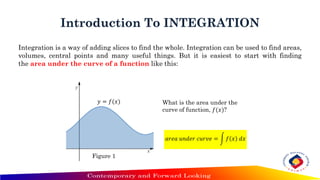
Integration is a way of adding slices to find the whole. Integration can be used to find areas,
volumes, central points and many useful things. But it is easiest to start with finding
the area under the curve of a function like this:
𝑎𝑟𝑒𝑎 𝑢𝑛𝑑𝑒𝑟 𝑐𝑢𝑟𝑣𝑒 = න 𝑓 𝑥 𝑑𝑥
𝑦 = 𝑓(𝑥) What is the area under the
curve of function, 𝑓(𝑥)?
Figure 1
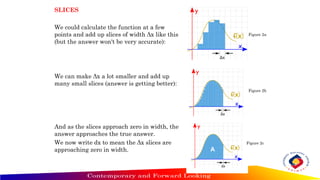
SLICES
We could calculate the function at a few
points and add up slices of width Δx like this
(but the answer won't be very accurate):
We can make Δx a lot smaller and add up
many small slices (answer is getting better):
And as the slices approach zero in width, the
answer approaches the true answer.
We now write dx to mean the Δx slices are
approaching zero in width.
Figure 2a
Figure 2b
Figure 2c
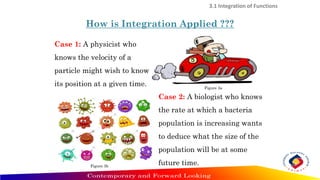
Case 1: A physicist who
knows the velocity of a
particle might wish to know
its position at a given time.
3.1 Integration of Functions
How is Integration Applied ???
Case 2: A biologist who knows
the rate at which a bacteria
population is increasing wants
to deduce what the size of the
population will be at some
future time.
Figure 3a
Figure 3b
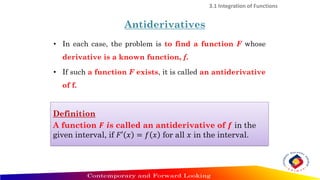
• In each case, the problem is to find a function F whose
derivative is a known function, f.
• If such a function F exists, it is called an antiderivative
of f.
3.1 Integration of Functions
Antiderivatives
Definition
A function 𝑭 is called an antiderivative of 𝒇 in the
given interval, if 𝐹′ 𝑥 = 𝑓 𝑥 for all 𝑥 in the interval.
3.1 Integration of Functions
Recall
Chapter 1 Differentiation
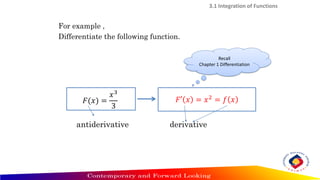
For example ,
Differentiate the following function.
𝐹′ 𝑥 = 𝑥2 = 𝑓 𝑥
𝐹(𝑥) =
𝑥3
3
derivative
antiderivative
3.1 Integration of Functions
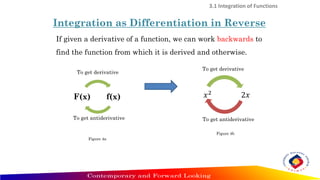
If given a derivative of a function, we can work backwards to
find the function from which it is derived and otherwise.
f(x)
F(x)
To get antiderivative
2𝑥
𝑥2
To get derivative
To get derivative
To get antiderivative
Integration as Differentiation in Reverse
Figure 4a
Figure 4b
3.1 Integration of Functions
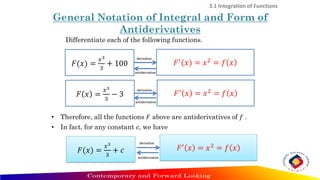
Differentiate each of the following functions.
𝐹′ 𝑥 = 𝑥2 = 𝑓 𝑥
𝐹′(𝑥) = 𝑥2 = 𝑓 𝑥
𝐹 𝑥 =
𝑥3
3
− 3
𝐹(𝑥) =
𝑥3
3
+ 100
• In fact, for any constant c, we have
𝐹(𝑥) =
𝑥3
3
+ 𝑐 𝐹′ 𝑥 = 𝑥2 = 𝑓 𝑥
• Therefore, all the functions 𝐹 above are antiderivatives of 𝑓 .
General Notation of Integral and Form of
Antiderivatives
derivative
derivative
derivative
antiderivative
antiderivative
antiderivative
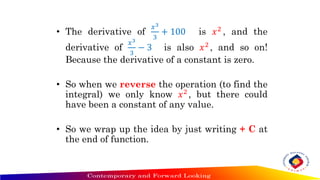
• The derivative of
𝑥3
3
+ 100 is 𝑥2 , and the
derivative of
𝑥3
3
− 3 is also 𝑥2 , and so on!
Because the derivative of a constant is zero.
• So when we reverse the operation (to find the
integral) we only know 𝑥2 , but there could
have been a constant of any value.
• So we wrap up the idea by just writing + C at
the end of function.
3.1 Integration of Functions
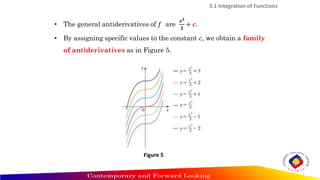
• The general antiderivatives of 𝑓 are
𝒙𝟑
𝟑
+ 𝒄.
• By assigning specific values to the constant 𝑐, we obtain a family
of antiderivatives as in Figure 5.
Figure 5
3.1 Integration of Functions
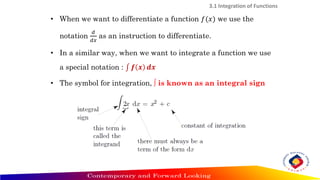
• When we want to differentiate a function 𝑓(𝑥) we use the
notation
𝑑
𝑑𝑥
as an instruction to differentiate.
• In a similar way, when we want to integrate a function we use
a special notation : ‫׬‬ 𝒇 𝒙 𝒅𝒙
• The symbol for integration, ∫ is known as an integral sign
3.1 Integration of Functions
• Hence, the notation ‫׬‬ 𝑓 𝑥 𝑑𝑥 which means “integrate the
integrand 𝑓 𝑥 with respect to 𝑥” is traditionally used for an
antiderivative of f and is called an indefinite integral.
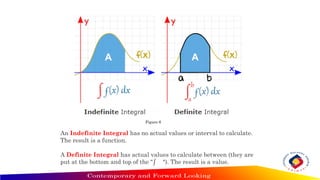
• An indefinite integral ‫׬‬ 𝑓(𝑥) 𝑑𝑥 is a function (or family of
functions), whereas a definite integral ‫׬‬
𝑎
𝑏
𝑓 𝑥 𝑑𝑥 is a number.
An Indefinite Integral has no actual values or interval to calculate.
The result is a function.
A Definite Integral has actual values to calculate between (they are
put at the bottom and top of the "‫׬‬ "). The result is a value.
Figure 6
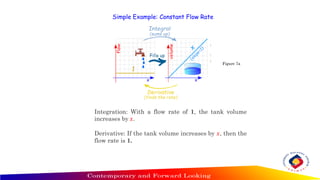
Simple Example: Constant Flow Rate
Integration: With a flow rate of 1, the tank volume
increases by 𝑥.
Derivative: If the tank volume increases by 𝑥, then the
flow rate is 1.
Figure 7a
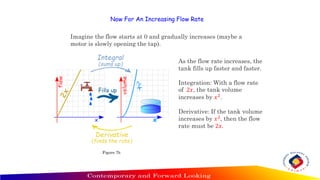
Now For An Increasing Flow Rate
As the flow rate increases, the
tank fills up faster and faster.
Integration: With a flow rate
of 2𝑥, the tank volume
increases by 𝑥2.
Derivative: If the tank volume
increases by 𝑥2
, then the flow
rate must be 2𝑥.
Imagine the flow starts at 0 and gradually increases (maybe a
motor is slowly opening the tap).
Figure 7b
Based on the previous example, if the flow rate of
water is 2𝑥 and the tank volume increases by 𝑥2
+ 𝑐,
explain what it means by + 𝑐 ??
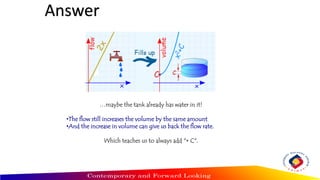
…maybe the tank already has water in it!
•The flow still increases the volume by the same amount
•And the increase in volume can give us back the flow rate.
Which teaches us to always add "+ C".
Answer
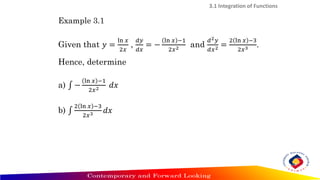
Example 3.1
Given that 𝑦 =
ln 𝑥
2𝑥
,
𝑑𝑦
𝑑𝑥
= −
ln 𝑥 −1
2𝑥2 and
𝑑2𝑦
𝑑𝑥2 =
2 ln 𝑥 −3
2𝑥3 .
Hence, determine
a) ‫׬‬ −
ln 𝑥 −1
2𝑥2 𝑑𝑥
b) ‫׬‬
2 ln 𝑥 −3
2𝑥3 𝑑𝑥
3.1 Integration of Functions
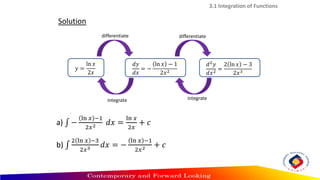
Solution
3.1 Integration of Functions
𝑦 =
ln 𝑥
2𝑥
𝑑𝑦
𝑑𝑥
= −
ln 𝑥 − 1
2𝑥2
𝑑2𝑦
𝑑𝑥2
=
2 ln 𝑥 − 3
2𝑥3
differentiate differentiate
integrate integrate
a) ‫׬‬ −
ln 𝑥 −1
2𝑥2 𝑑𝑥 =
ln 𝑥
2𝑥
+ 𝑐
b) ‫׬‬
2 ln 𝑥 −3
2𝑥3 𝑑𝑥 = −
ln 𝑥 −1
2𝑥2 + 𝑐
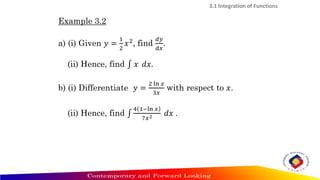
Example 3.2
a) (i) Given 𝑦 =
1
2
𝑥2
, find
𝑑𝑦
𝑑𝑥
.
(ii) Hence, find ‫׬‬ 𝑥 𝑑𝑥.
b) (i) Differentiate 𝑦 =
2 ln 𝑥
3𝑥
with respect to 𝑥.
(ii) Hence, find ‫׬‬
4 1−ln 𝑥
7𝑥2 𝑑𝑥 .
3.1 Integration of Functions
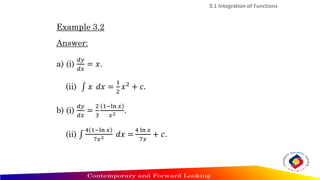
Example 3.2
Answer:
a) (i)
𝑑𝑦
𝑑𝑥
= 𝑥.
(ii) ‫׬‬ 𝑥 𝑑𝑥 =
1
2
𝑥2
+ 𝑐.
b) (i)
𝑑𝑦
𝑑𝑥
=
2
3
1−ln 𝑥
𝑥2 .
(ii) ‫׬‬
4 1−ln 𝑥
7𝑥2 𝑑𝑥 =
4 ln 𝑥
7𝑥
+ 𝑐.
3.1 Integration of Functions
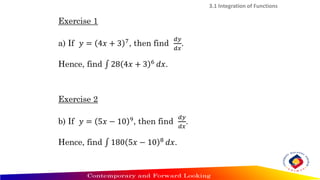
Exercise 1
a) If 𝑦 = 4𝑥 + 3 7
, then find
𝑑𝑦
𝑑𝑥
.
Hence, find ‫׬‬ 28 4𝑥 + 3 6 𝑑𝑥.
Exercise 2
b) If 𝑦 = 5𝑥 − 10 9
, then find
𝑑𝑦
𝑑𝑥
.
Hence, find ‫׬‬ 180 5𝑥 − 10 8
𝑑𝑥.
3.1 Integration of Functions
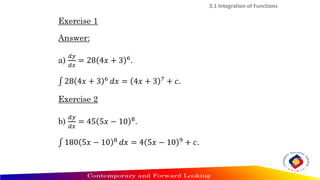
Exercise 1
Answer:
a)
𝑑𝑦
𝑑𝑥
= 28 4𝑥 + 3 6
.
‫׬‬ 28 4𝑥 + 3 6 𝑑𝑥 = 4𝑥 + 3 7 + 𝑐.
Exercise 2
b)
𝑑𝑦
𝑑𝑥
= 45 5𝑥 − 10 8
.
‫׬‬ 180 5𝑥 − 10 8
𝑑𝑥 = 4 5𝑥 − 10 9
+ 𝑐.
3.1 Integration of Functions
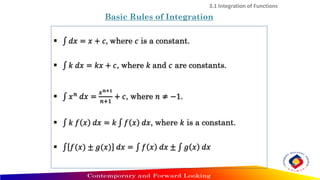
 ‫׬‬ 𝑑𝑥 = 𝑥 + 𝑐, where 𝑐 is a constant.
 ‫׬‬ 𝑘 𝑑𝑥 = 𝑘𝑥 + 𝑐, where 𝑘 and 𝑐 are constants.
 ‫׬‬ 𝑥𝑛 𝑑𝑥 =
𝑥𝑛+1
𝑛+1
+ 𝑐, where 𝑛 ≠ −1.
 ‫׬‬ 𝑘 𝑓 𝑥 𝑑𝑥 = 𝑘 ‫׬‬ 𝑓 𝑥 𝑑𝑥, where 𝑘 is a constant.
 ‫׬‬ 𝑓(𝑥) ± 𝑔(𝑥) 𝑑𝑥 = ‫׬‬ 𝑓 𝑥 𝑑𝑥 ± ‫׬‬ 𝑔 𝑥 𝑑𝑥
Basic Rules of Integration
3.1 Integration of Functions
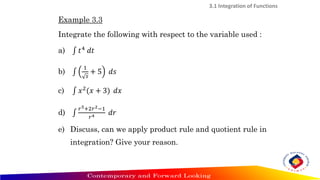
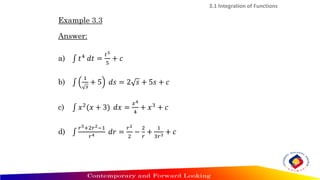
Example 3.3
Integrate the following with respect to the variable used :
a) ‫׬‬ 𝑡4 𝑑𝑡
b) ‫׬‬
1
𝑠
+ 5 𝑑𝑠
c) ‫׬‬ 𝑥2
(𝑥 + 3) 𝑑𝑥
d) ‫׬‬
𝑟5+2𝑟2−1
𝑟4 𝑑𝑟
e) Discuss, can we apply product rule and quotient rule in
integration? Give your reason.
3.1 Integration of Functions
Example 3.3
Answer:
a) ‫׬‬ 𝑡4 𝑑𝑡 =
𝑡5
5
+ 𝑐
b) ‫׬‬
1
𝑠
+ 5 𝑑𝑠 = 2 𝑠 + 5𝑠 + 𝑐
c) ‫׬‬ 𝑥2(𝑥 + 3) 𝑑𝑥 =
𝑥4
4
+ 𝑥3 + 𝑐
d) ‫׬‬
𝑟5+2𝑟2−1
𝑟4 𝑑𝑟 =
𝑟2
2
−
2
𝑟
+
1
3𝑟3 + 𝑐
3.1 Integration of Functions
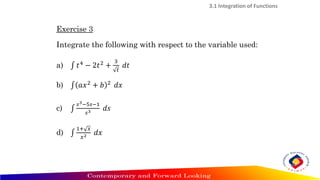
Exercise 3
Integrate the following with respect to the variable used:
a) ‫׬‬ 𝑡4 − 2𝑡2 +
3
𝑡
𝑑𝑡
b) ‫׬‬ 𝑎𝑥2 + 𝑏 2 𝑑𝑥
c) ‫׬‬
𝑠3−5𝑠−1
𝑠3 𝑑𝑠
d) ‫׬‬
1+ 𝑥
𝑥2 𝑑𝑥
3.1 Integration of Functions
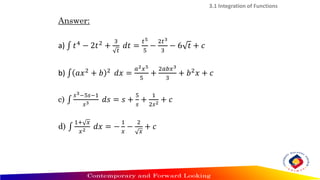
Answer:
a) ‫׬‬ 𝑡4
− 2𝑡2
+
3
𝑡
𝑑𝑡 =
𝑡5
5
−
2𝑡3
3
− 6 𝑡 + 𝑐
b) ‫׬‬ 𝑎𝑥2
+ 𝑏 2
𝑑𝑥 =
𝑎2𝑥5
5
+
2𝑎𝑏𝑥3
3
+ 𝑏2
𝑥 + 𝑐
c) ‫׬‬
𝑠3−5𝑠−1
𝑠3 𝑑𝑠 = 𝑠 +
5
𝑠
+
1
2𝑠2 + 𝑐
d) ‫׬‬
1+ 𝑥
𝑥2 𝑑𝑥 = −
1
𝑥
−
2
𝑥
+ 𝑐
3.1 Integration of Functions
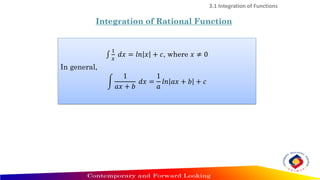
‫׬‬
1
𝑥
𝑑𝑥 = 𝑙𝑛 𝑥 + 𝑐, where 𝑥 ≠ 0
In general,
න
1
𝑎𝑥 + 𝑏
𝑑𝑥 =
1
𝑎
𝑙𝑛 𝑎𝑥 + 𝑏 + 𝑐
Integration of Rational Function
3.1 Integration of Functions
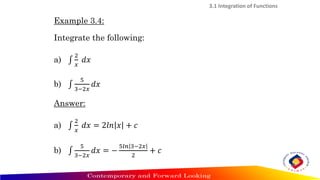
Example 3.4:
Integrate the following:
a) ‫׬‬
2
𝑥
𝑑𝑥
b) ‫׬‬
5
3−2𝑥
𝑑𝑥
Answer:
a) ‫׬‬
2
𝑥
𝑑𝑥 = 2𝑙𝑛 𝑥 + 𝑐
b) ‫׬‬
5
3−2𝑥
𝑑𝑥 = −
5𝑙𝑛 3−2𝑥
2
+ 𝑐
3.1 Integration of Functions
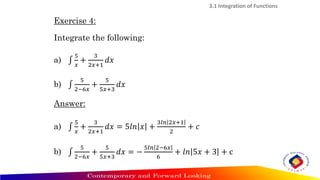
Exercise 4:
Integrate the following:
a) ‫׬‬
5
𝑥
+
3
2𝑥+1
𝑑𝑥
b) ‫׬‬
5
2−6𝑥
+
5
5𝑥+3
𝑑𝑥
Answer:
a) ‫׬‬
5
𝑥
+
3
2𝑥+1
𝑑𝑥 = 5𝑙𝑛 𝑥 +
3𝑙𝑛 2𝑥+1
2
+ 𝑐
b) ‫׬‬
5
2−6𝑥
+
5
5𝑥+3
𝑑𝑥 = −
5𝑙𝑛 2−6𝑥
6
+ 𝑙𝑛 5𝑥 + 3 + c
3.1 Integration of Functions
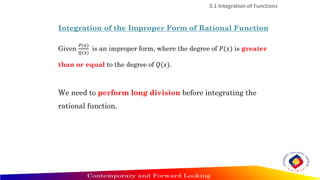
Integration of the Improper Form of Rational Function
Given
𝑃(𝑥)
𝑄(𝑥)
is an improper form, where the degree of 𝑃(𝑥) is greater
than or equal to the degree of 𝑄(𝑥).
We need to perform long division before integrating the
rational function.
3.1 Integration of Functions
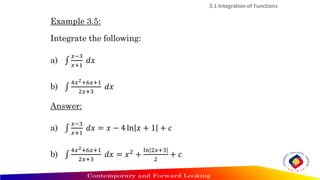
Example 3.5:
Integrate the following:
a) ‫׬‬
𝑥−3
𝑥+1
𝑑𝑥
b) ‫׬‬
4𝑥2+6𝑥+1
2𝑥+3
𝑑𝑥
Answer:
a) ‫׬‬
𝑥−3
𝑥+1
𝑑𝑥 = 𝑥 − 4 ln 𝑥 + 1 + 𝑐
b) ‫׬‬
4𝑥2+6𝑥+1
2𝑥+3
𝑑𝑥 = 𝑥2
+
ln 2𝑥+3
2
+ 𝑐
3.1 Integration of Functions
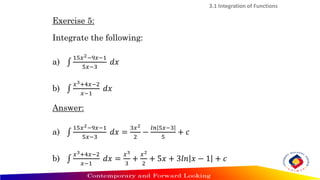
Exercise 5:
Integrate the following:
a) ‫׬‬
15𝑥2−9𝑥−1
5𝑥−3
𝑑𝑥
b) ‫׬‬
𝑥3+4𝑥−2
𝑥−1
𝑑𝑥
Answer:
a) ‫׬‬
15𝑥2−9𝑥−1
5𝑥−3
𝑑𝑥 =
3𝑥2
2
−
𝑙𝑛 5𝑥−3
5
+ 𝑐
b) ‫׬‬
𝑥3+4𝑥−2
𝑥−1
𝑑𝑥 =
𝑥3
3
+
𝑥2
2
+ 5𝑥 + 3𝑙𝑛 𝑥 − 1 + 𝑐
3.1 Integration of Functions
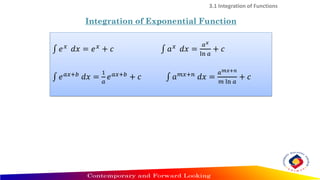
Integration of Exponential Function
‫׬‬ 𝑒𝑥
𝑑𝑥 = 𝑒𝑥
+ 𝑐 ‫׬‬ 𝑎𝑥
𝑑𝑥 =
𝑎𝑥
ln 𝑎
+ 𝑐
‫׬‬ 𝑒𝑎𝑥+𝑏 𝑑𝑥 =
1
𝑎
𝑒𝑎𝑥+𝑏 + 𝑐 ‫׬‬ 𝑎𝑚𝑥+𝑛 𝑑𝑥 =
𝑎𝑚𝑥+𝑛
𝑚 ln 𝑎
+ 𝑐
3.1 Integration of Functions
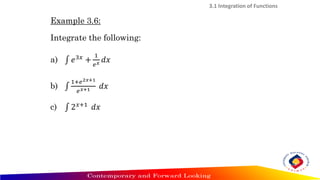
Example 3.6:
Integrate the following:
a) ‫׬‬ 𝑒3𝑥
+
1
𝑒𝑥 𝑑𝑥
b) ‫׬‬
1+𝑒2𝑥+1
𝑒𝑥+1 𝑑𝑥
c) ‫׬‬ 2𝑥+1
𝑑𝑥
3.1 Integration of Functions
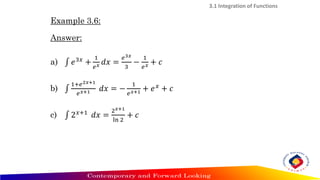
Example 3.6:
Answer:
a) ‫׬‬ 𝑒3𝑥
+
1
𝑒𝑥 𝑑𝑥 =
𝑒3𝑥
3
−
1
𝑒𝑥 + 𝑐
b) ‫׬‬
1+𝑒2𝑥+1
𝑒𝑥+1 𝑑𝑥 = −
1
𝑒𝑥+1 + 𝑒𝑥
+ 𝑐
c) ‫׬‬ 2𝑥+1
𝑑𝑥 =
2𝑥+1
ln 2
+ 𝑐
3.1 Integration of Functions
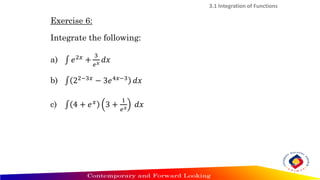
Exercise 6:
Integrate the following:
a) ‫׬‬ 𝑒2𝑥
+
3
𝑒𝑥 𝑑𝑥
b) ‫׬‬ 22−3𝑥
− 3𝑒4𝑥−3
𝑑𝑥
c) ‫׬‬ 4 + 𝑒𝑥
3 +
1
𝑒𝑥 𝑑𝑥
3.1 Integration of Functions
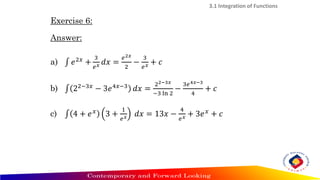
Exercise 6:
Answer:
a) ‫׬‬ 𝑒2𝑥
+
3
𝑒𝑥 𝑑𝑥 =
𝑒2𝑥
2
−
3
𝑒𝑥 + 𝑐
b) ‫׬‬ 22−3𝑥
− 3𝑒4𝑥−3
𝑑𝑥 =
22−3𝑥
−3 ln 2
−
3𝑒4𝑥−3
4
+ 𝑐
c) ‫׬‬ 4 + 𝑒𝑥
3 +
1
𝑒𝑥 𝑑𝑥 = 13𝑥 −
4
𝑒𝑥 + 3𝑒𝑥
+ 𝑐
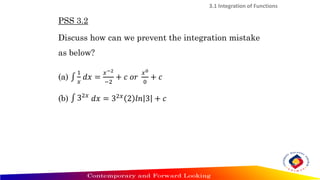
PSS 3.2
Discuss how can we prevent the integration mistake
as below?
(a) ‫׬‬
1
𝑥
𝑑𝑥 =
𝑥−2
−2
+ 𝑐 𝑜𝑟
𝑥0
0
+ 𝑐
(b) ‫׬‬ 32𝑥
𝑑𝑥 = 32𝑥
2 𝑙𝑛 3 + 𝑐
3.1 Integration of Functions
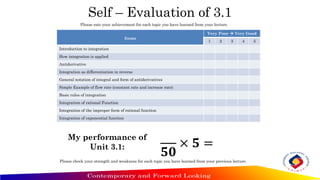
Self – Evaluation of 3.1
Items
Very Poor  Very Good
1 2 3 4 5
Introduction to integration
How integration is applied
Antiderivative
Integration as differentiation in reverse
General notation of integral and form of antiderivatives
Simple Example of flow rate (constant rate and increase rate)
Basic rules of integration
Integration of rational Function
Integration of the improper form of rational function
Integration of exponential function
Please rate your achievement for each topic you have learned from your lecture.
My performance of
Unit 3.1:
𝟓𝟎
× 𝟓 =
Please check your strength and weakness for each topic you have learned from your previous lecture.
3.2 INTEGRATION OF
TRIGONOMETRIC FUNCTIONS
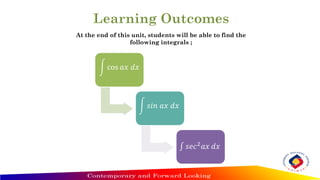
න cos 𝑎𝑥 𝑑𝑥
න 𝑠𝑖𝑛 𝑎𝑥 𝑑𝑥
‫׬‬ 𝑠𝑒𝑐2
𝑎𝑥 𝑑𝑥
At the end of this unit, students will be able to find the
following integrals ;
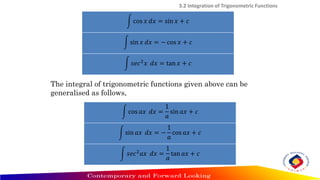
න cos 𝑥 𝑑𝑥 = sin 𝑥 + 𝑐
න sin 𝑥 𝑑𝑥 = − cos 𝑥 + 𝑐
න 𝑠𝑒𝑐2𝑥 𝑑𝑥 = tan 𝑥 + 𝑐
3.2 Integration of Trigonometric Functions
න cos 𝑎𝑥 𝑑𝑥 =
1
𝑎
sin 𝑎𝑥 + 𝑐
න sin 𝑎𝑥 𝑑𝑥 = −
1
𝑎
cos 𝑎𝑥 + 𝑐
න 𝑠𝑒𝑐2𝑎𝑥 𝑑𝑥 =
1
𝑎
tan 𝑎𝑥 + 𝑐
The integral of trigonometric functions given above can be
generalised as follows,
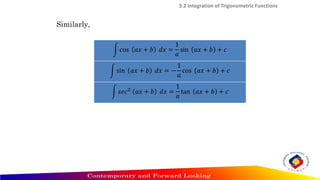
Similarly,
3.2 Integration of Trigonometric Functions
න cos 𝑎𝑥 + 𝑏 𝑑𝑥 =
1
𝑎
sin 𝑎𝑥 + 𝑏 + 𝑐
න sin 𝑎𝑥 + 𝑏 𝑑𝑥 = −
1
𝑎
cos 𝑎𝑥 + 𝑏 + 𝑐
න 𝑠𝑒𝑐2
𝑎𝑥 + 𝑏 𝑑𝑥 =
1
𝑎
tan 𝑎𝑥 + 𝑏 + 𝑐
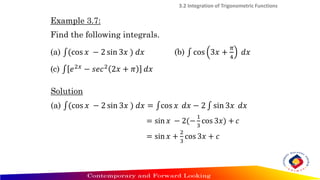
Example 3.7:
Find the following integrals.
(a) ‫׬‬(cos 𝑥 − 2 sin 3𝑥 ) 𝑑𝑥 (b) ‫׬‬ cos 3𝑥 +
𝜋
4
𝑑𝑥
(c) ‫׬‬ 𝑒2𝑥 − 𝑠𝑒𝑐2 2𝑥 + 𝜋 𝑑𝑥
Solution
(a) ‫׬‬(cos 𝑥 − 2 sin 3𝑥 ) 𝑑𝑥 = ‫׬‬cos 𝑥 𝑑𝑥 − 2 ‫׬‬ sin 3𝑥 𝑑𝑥
= sin 𝑥 − 2(−
1
3
cos 3𝑥) + 𝑐
3.2 Integration of Trigonometric Functions
= sin 𝑥 +
2
3
cos 3𝑥 + 𝑐
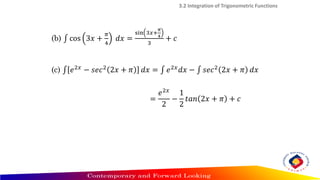
(b) ‫׬‬ cos 3𝑥 +
𝜋
4
𝑑𝑥 =
sin 3𝑥+
𝜋
4
3
+ 𝑐
3.2 Integration of Trigonometric Functions
(c) ‫׬‬ 𝑒2𝑥 − 𝑠𝑒𝑐2 2𝑥 + 𝜋 𝑑𝑥 = ‫׬‬ 𝑒2𝑥𝑑𝑥 − ‫׬‬ 𝑠𝑒𝑐2 2𝑥 + 𝜋 𝑑𝑥
=
𝑒2𝑥
2
−
1
2
𝑡𝑎𝑛 2𝑥 + 𝜋 + 𝑐
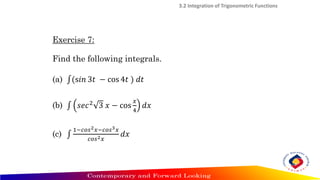
Exercise 7:
Find the following integrals.
(a) ‫׬‬(s𝑖𝑛 3𝑡 − cos 4𝑡 ) 𝑑𝑡
(b) ‫׬‬ 𝑠𝑒𝑐2
3 𝑥 − cos
𝑥
4
𝑑𝑥
(c) ‫׬‬
1−𝑐𝑜𝑠2𝑥−𝑐𝑜𝑠3𝑥
𝑐𝑜𝑠2𝑥
𝑑𝑥
3.2 Integration of Trigonometric Functions
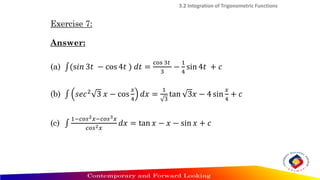
Exercise 7:
Answer:
(a) ‫׬‬(s𝑖𝑛 3𝑡 − cos 4𝑡 ) 𝑑𝑡 =
cos 3𝑡
3
−
1
4
sin 4𝑡 + 𝑐
(b) ‫׬‬ 𝑠𝑒𝑐2
3 𝑥 − cos
𝑥
4
𝑑𝑥 =
1
3
tan 3𝑥 − 4 sin
𝑥
4
+ 𝑐
(c) ‫׬‬
1−𝑐𝑜𝑠2𝑥−𝑐𝑜𝑠3𝑥
𝑐𝑜𝑠2𝑥
𝑑𝑥 = tan 𝑥 − 𝑥 − sin 𝑥 + 𝑐
3.2 Integration of Trigonometric Functions
Integration of ‫׬‬ 𝒔𝒊𝒏𝒏
𝒙 𝒅𝒙 and ‫׬‬ 𝒄𝒐𝒔𝒏
𝒙 𝒅𝒙 where
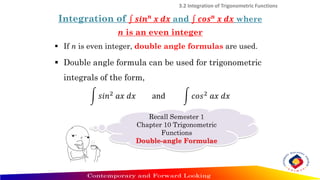
n is an even integer
3.2 Integration of Trigonometric Functions
 Double angle formula can be used for trigonometric
integrals of the form,
න 𝑠𝑖𝑛2
𝑎𝑥 𝑑𝑥 and න 𝑐𝑜𝑠2
𝑎𝑥 𝑑𝑥
 If n is even integer, double angle formulas are used.
Recall Semester 1
Chapter 10 Trigonometric
Functions
Double-angle Formulae
3.2 Integration of Trigonometric Functions
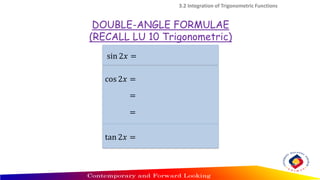
sin 2𝑥 =
cos 2𝑥 =
=
=
tan 2𝑥 =
DOUBLE-ANGLE FORMULAE
(RECALL LU 10 Trigonometric)
3.2 Integration of Trigonometric Functions
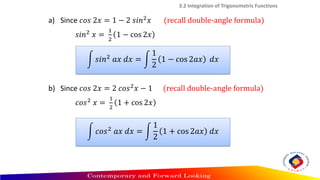
a) Since 𝑐𝑜𝑠 2𝑥 = 1 − 2 𝑠𝑖𝑛2𝑥 (recall double-angle formula)
𝑠𝑖𝑛2 𝑥 =
1
2
1 − cos 2𝑥
b) Since 𝑐𝑜𝑠 2𝑥 = 2 𝑐𝑜𝑠2𝑥 − 1 (recall double-angle formula)
𝑐𝑜𝑠2 𝑥 =
1
2
1 + cos 2𝑥
න 𝑠𝑖𝑛2
𝑎𝑥 𝑑𝑥 = න
1
2
1 − cos 2𝑎𝑥 𝑑𝑥
න 𝑐𝑜𝑠2
𝑎𝑥 𝑑𝑥 = න
1
2
1 + cos 2𝑎𝑥 𝑑𝑥
3.2 Integration of Trigonometric Functions
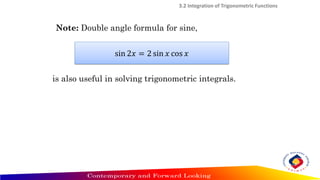
Note: Double angle formula for sine,
is also useful in solving trigonometric integrals.
sin 2𝑥 = 2 sin 𝑥 cos 𝑥
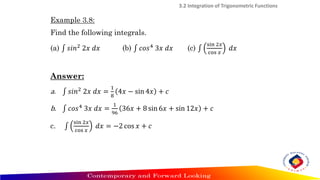
Example 3.8:
Find the following integrals.
(a) ‫׬‬ 𝑠𝑖𝑛2
2𝑥 𝑑𝑥 (b) ‫׬‬ 𝑐𝑜𝑠4
3𝑥 𝑑𝑥 (c) ‫׬‬
sin 2𝑥
cos 𝑥
𝑑𝑥
Answer:
a. ‫׬‬ 𝑠𝑖𝑛2
2𝑥 𝑑𝑥 =
1
8
4𝑥 − sin 4𝑥 + 𝑐
b. ‫׬‬ 𝑐𝑜𝑠4
3𝑥 𝑑𝑥 =
1
96
36𝑥 + 8 sin 6𝑥 + sin 12𝑥 + 𝑐
c. ‫׬‬
sin 2𝑥
cos 𝑥
𝑑𝑥 = −2 cos 𝑥 + 𝑐
3.2 Integration of Trigonometric Functions
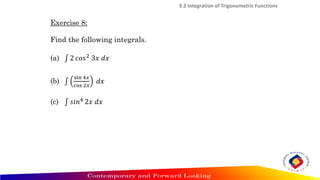
Exercise 8:
Find the following integrals.
(a) ‫׬‬ 2 𝑐𝑜𝑠2
3𝑥 𝑑𝑥
(b) ‫׬‬
sin 4𝑥
cos 2𝑥
𝑑𝑥
(c) ‫׬‬ 𝑠𝑖𝑛4
2𝑥 𝑑𝑥
3.2 Integration of Trigonometric Functions
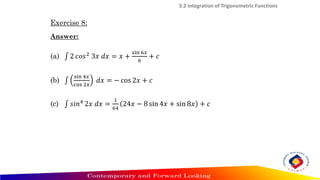
Exercise 8:
Answer:
(a) ‫׬‬ 2 𝑐𝑜𝑠2 3𝑥 𝑑𝑥 = 𝑥 +
sin 6𝑥
6
+ 𝑐
(b) ‫׬‬
sin 4𝑥
cos 2𝑥
𝑑𝑥 = − cos 2𝑥 + 𝑐
(c) ‫׬‬ 𝑠𝑖𝑛4
2𝑥 𝑑𝑥 =
1
64
24𝑥 − 8 sin 4𝑥 + sin 8𝑥 + 𝑐
3.2 Integration of Trigonometric Functions
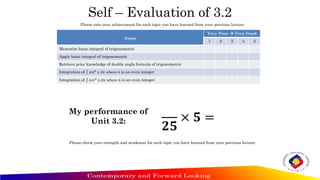
Self – Evaluation of 3.2
Items
Very Poor  Very Good
1 2 3 4 5
Memorize basic integral of trigonometric
Apply basic integral of trigonometric
Retrieve prior knowledge of double angle formula of trigonometric
Integration of ‫׬‬ 𝑠𝑖𝑛𝑛
𝑥 𝑑𝑥 where n is an even integer
Integration of ‫׬‬ 𝑐𝑜𝑠𝑛
𝑥 𝑑𝑥 where n is an even integer
Please rate your achievement for each topic you have learned from your previous lecture.
My performance of
Unit 3.2:
𝟐𝟓
× 𝟓 =
Please check your strength and weakness for each topic you have learned from your previous lecture.
THANK YOU

LU3 Integration for Pre- Uniersity Level

  • 1.
  • 2.
    Subtopics Integration of Functions 3.1 Integrationof Trigonometric Functions 3.2 Techniques of Integration 3.3 Definite Integrals 3.4
  • 3.
  • 4.
    At the endof this unit, students will be able to : relate integration and differentiation use basic rules of integration find ‫׬‬ 𝟏 𝒙 𝒅𝒙 = 𝐥𝐧 𝒙 + 𝒄 and ‫׬‬ 𝟏 𝒂𝒙+𝒃 𝒅𝒙 = 𝟏 𝒂 𝒍𝒏 𝒂𝒙 + 𝒃 + 𝒄 1 2 3 4 determine the integral of the forms (I) ‫׬‬ 𝒆𝒙 𝒅𝒙 (II) ‫׬‬ 𝒆𝒂𝒙+𝒃 𝒅𝒙 (III) ‫׬‬ 𝒂𝒙 𝒅𝒙 (IV) ‫׬‬ 𝒂𝒂𝒙+𝒃 𝒅𝒙
  • 5.
    Introduction To INTEGRATION Integrationis a way of adding slices to find the whole. Integration can be used to find areas, volumes, central points and many useful things. But it is easiest to start with finding the area under the curve of a function like this: 𝑎𝑟𝑒𝑎 𝑢𝑛𝑑𝑒𝑟 𝑐𝑢𝑟𝑣𝑒 = න 𝑓 𝑥 𝑑𝑥 𝑦 = 𝑓(𝑥) What is the area under the curve of function, 𝑓(𝑥)? Figure 1
  • 6.
    SLICES We could calculatethe function at a few points and add up slices of width Δx like this (but the answer won't be very accurate): We can make Δx a lot smaller and add up many small slices (answer is getting better): And as the slices approach zero in width, the answer approaches the true answer. We now write dx to mean the Δx slices are approaching zero in width. Figure 2a Figure 2b Figure 2c
  • 8.
    Case 1: Aphysicist who knows the velocity of a particle might wish to know its position at a given time. 3.1 Integration of Functions How is Integration Applied ??? Case 2: A biologist who knows the rate at which a bacteria population is increasing wants to deduce what the size of the population will be at some future time. Figure 3a Figure 3b
  • 9.
    • In eachcase, the problem is to find a function F whose derivative is a known function, f. • If such a function F exists, it is called an antiderivative of f. 3.1 Integration of Functions Antiderivatives Definition A function 𝑭 is called an antiderivative of 𝒇 in the given interval, if 𝐹′ 𝑥 = 𝑓 𝑥 for all 𝑥 in the interval.
  • 10.
    3.1 Integration ofFunctions Recall Chapter 1 Differentiation For example , Differentiate the following function. 𝐹′ 𝑥 = 𝑥2 = 𝑓 𝑥 𝐹(𝑥) = 𝑥3 3 derivative antiderivative
  • 11.
    3.1 Integration ofFunctions If given a derivative of a function, we can work backwards to find the function from which it is derived and otherwise. f(x) F(x) To get antiderivative 2𝑥 𝑥2 To get derivative To get derivative To get antiderivative Integration as Differentiation in Reverse Figure 4a Figure 4b
  • 12.
    3.1 Integration ofFunctions Differentiate each of the following functions. 𝐹′ 𝑥 = 𝑥2 = 𝑓 𝑥 𝐹′(𝑥) = 𝑥2 = 𝑓 𝑥 𝐹 𝑥 = 𝑥3 3 − 3 𝐹(𝑥) = 𝑥3 3 + 100 • In fact, for any constant c, we have 𝐹(𝑥) = 𝑥3 3 + 𝑐 𝐹′ 𝑥 = 𝑥2 = 𝑓 𝑥 • Therefore, all the functions 𝐹 above are antiderivatives of 𝑓 . General Notation of Integral and Form of Antiderivatives derivative derivative derivative antiderivative antiderivative antiderivative
  • 13.
    • The derivativeof 𝑥3 3 + 100 is 𝑥2 , and the derivative of 𝑥3 3 − 3 is also 𝑥2 , and so on! Because the derivative of a constant is zero. • So when we reverse the operation (to find the integral) we only know 𝑥2 , but there could have been a constant of any value. • So we wrap up the idea by just writing + C at the end of function.
  • 14.
    3.1 Integration ofFunctions • The general antiderivatives of 𝑓 are 𝒙𝟑 𝟑 + 𝒄. • By assigning specific values to the constant 𝑐, we obtain a family of antiderivatives as in Figure 5. Figure 5
  • 15.
    3.1 Integration ofFunctions • When we want to differentiate a function 𝑓(𝑥) we use the notation 𝑑 𝑑𝑥 as an instruction to differentiate. • In a similar way, when we want to integrate a function we use a special notation : ‫׬‬ 𝒇 𝒙 𝒅𝒙 • The symbol for integration, ∫ is known as an integral sign
  • 16.
    3.1 Integration ofFunctions • Hence, the notation ‫׬‬ 𝑓 𝑥 𝑑𝑥 which means “integrate the integrand 𝑓 𝑥 with respect to 𝑥” is traditionally used for an antiderivative of f and is called an indefinite integral. • An indefinite integral ‫׬‬ 𝑓(𝑥) 𝑑𝑥 is a function (or family of functions), whereas a definite integral ‫׬‬ 𝑎 𝑏 𝑓 𝑥 𝑑𝑥 is a number.
  • 17.
    An Indefinite Integralhas no actual values or interval to calculate. The result is a function. A Definite Integral has actual values to calculate between (they are put at the bottom and top of the "‫׬‬ "). The result is a value. Figure 6
  • 18.
    Simple Example: ConstantFlow Rate Integration: With a flow rate of 1, the tank volume increases by 𝑥. Derivative: If the tank volume increases by 𝑥, then the flow rate is 1. Figure 7a
  • 19.
    Now For AnIncreasing Flow Rate As the flow rate increases, the tank fills up faster and faster. Integration: With a flow rate of 2𝑥, the tank volume increases by 𝑥2. Derivative: If the tank volume increases by 𝑥2 , then the flow rate must be 2𝑥. Imagine the flow starts at 0 and gradually increases (maybe a motor is slowly opening the tap). Figure 7b
  • 20.
    Based on theprevious example, if the flow rate of water is 2𝑥 and the tank volume increases by 𝑥2 + 𝑐, explain what it means by + 𝑐 ??
  • 21.
    …maybe the tankalready has water in it! •The flow still increases the volume by the same amount •And the increase in volume can give us back the flow rate. Which teaches us to always add "+ C". Answer
  • 22.
    Example 3.1 Given that𝑦 = ln 𝑥 2𝑥 , 𝑑𝑦 𝑑𝑥 = − ln 𝑥 −1 2𝑥2 and 𝑑2𝑦 𝑑𝑥2 = 2 ln 𝑥 −3 2𝑥3 . Hence, determine a) ‫׬‬ − ln 𝑥 −1 2𝑥2 𝑑𝑥 b) ‫׬‬ 2 ln 𝑥 −3 2𝑥3 𝑑𝑥 3.1 Integration of Functions
  • 23.
    Solution 3.1 Integration ofFunctions 𝑦 = ln 𝑥 2𝑥 𝑑𝑦 𝑑𝑥 = − ln 𝑥 − 1 2𝑥2 𝑑2𝑦 𝑑𝑥2 = 2 ln 𝑥 − 3 2𝑥3 differentiate differentiate integrate integrate a) ‫׬‬ − ln 𝑥 −1 2𝑥2 𝑑𝑥 = ln 𝑥 2𝑥 + 𝑐 b) ‫׬‬ 2 ln 𝑥 −3 2𝑥3 𝑑𝑥 = − ln 𝑥 −1 2𝑥2 + 𝑐
  • 24.
    Example 3.2 a) (i)Given 𝑦 = 1 2 𝑥2 , find 𝑑𝑦 𝑑𝑥 . (ii) Hence, find ‫׬‬ 𝑥 𝑑𝑥. b) (i) Differentiate 𝑦 = 2 ln 𝑥 3𝑥 with respect to 𝑥. (ii) Hence, find ‫׬‬ 4 1−ln 𝑥 7𝑥2 𝑑𝑥 . 3.1 Integration of Functions
  • 25.
    Example 3.2 Answer: a) (i) 𝑑𝑦 𝑑𝑥 =𝑥. (ii) ‫׬‬ 𝑥 𝑑𝑥 = 1 2 𝑥2 + 𝑐. b) (i) 𝑑𝑦 𝑑𝑥 = 2 3 1−ln 𝑥 𝑥2 . (ii) ‫׬‬ 4 1−ln 𝑥 7𝑥2 𝑑𝑥 = 4 ln 𝑥 7𝑥 + 𝑐. 3.1 Integration of Functions
  • 26.
    Exercise 1 a) If𝑦 = 4𝑥 + 3 7 , then find 𝑑𝑦 𝑑𝑥 . Hence, find ‫׬‬ 28 4𝑥 + 3 6 𝑑𝑥. Exercise 2 b) If 𝑦 = 5𝑥 − 10 9 , then find 𝑑𝑦 𝑑𝑥 . Hence, find ‫׬‬ 180 5𝑥 − 10 8 𝑑𝑥. 3.1 Integration of Functions
  • 27.
    Exercise 1 Answer: a) 𝑑𝑦 𝑑𝑥 = 284𝑥 + 3 6 . ‫׬‬ 28 4𝑥 + 3 6 𝑑𝑥 = 4𝑥 + 3 7 + 𝑐. Exercise 2 b) 𝑑𝑦 𝑑𝑥 = 45 5𝑥 − 10 8 . ‫׬‬ 180 5𝑥 − 10 8 𝑑𝑥 = 4 5𝑥 − 10 9 + 𝑐. 3.1 Integration of Functions
  • 28.
     ‫׬‬ 𝑑𝑥= 𝑥 + 𝑐, where 𝑐 is a constant.  ‫׬‬ 𝑘 𝑑𝑥 = 𝑘𝑥 + 𝑐, where 𝑘 and 𝑐 are constants.  ‫׬‬ 𝑥𝑛 𝑑𝑥 = 𝑥𝑛+1 𝑛+1 + 𝑐, where 𝑛 ≠ −1.  ‫׬‬ 𝑘 𝑓 𝑥 𝑑𝑥 = 𝑘 ‫׬‬ 𝑓 𝑥 𝑑𝑥, where 𝑘 is a constant.  ‫׬‬ 𝑓(𝑥) ± 𝑔(𝑥) 𝑑𝑥 = ‫׬‬ 𝑓 𝑥 𝑑𝑥 ± ‫׬‬ 𝑔 𝑥 𝑑𝑥 Basic Rules of Integration 3.1 Integration of Functions
  • 29.
    Example 3.3 Integrate thefollowing with respect to the variable used : a) ‫׬‬ 𝑡4 𝑑𝑡 b) ‫׬‬ 1 𝑠 + 5 𝑑𝑠 c) ‫׬‬ 𝑥2 (𝑥 + 3) 𝑑𝑥 d) ‫׬‬ 𝑟5+2𝑟2−1 𝑟4 𝑑𝑟 e) Discuss, can we apply product rule and quotient rule in integration? Give your reason. 3.1 Integration of Functions
  • 30.
    Example 3.3 Answer: a) ‫׬‬𝑡4 𝑑𝑡 = 𝑡5 5 + 𝑐 b) ‫׬‬ 1 𝑠 + 5 𝑑𝑠 = 2 𝑠 + 5𝑠 + 𝑐 c) ‫׬‬ 𝑥2(𝑥 + 3) 𝑑𝑥 = 𝑥4 4 + 𝑥3 + 𝑐 d) ‫׬‬ 𝑟5+2𝑟2−1 𝑟4 𝑑𝑟 = 𝑟2 2 − 2 𝑟 + 1 3𝑟3 + 𝑐 3.1 Integration of Functions
  • 31.
    Exercise 3 Integrate thefollowing with respect to the variable used: a) ‫׬‬ 𝑡4 − 2𝑡2 + 3 𝑡 𝑑𝑡 b) ‫׬‬ 𝑎𝑥2 + 𝑏 2 𝑑𝑥 c) ‫׬‬ 𝑠3−5𝑠−1 𝑠3 𝑑𝑠 d) ‫׬‬ 1+ 𝑥 𝑥2 𝑑𝑥 3.1 Integration of Functions
  • 32.
    Answer: a) ‫׬‬ 𝑡4 −2𝑡2 + 3 𝑡 𝑑𝑡 = 𝑡5 5 − 2𝑡3 3 − 6 𝑡 + 𝑐 b) ‫׬‬ 𝑎𝑥2 + 𝑏 2 𝑑𝑥 = 𝑎2𝑥5 5 + 2𝑎𝑏𝑥3 3 + 𝑏2 𝑥 + 𝑐 c) ‫׬‬ 𝑠3−5𝑠−1 𝑠3 𝑑𝑠 = 𝑠 + 5 𝑠 + 1 2𝑠2 + 𝑐 d) ‫׬‬ 1+ 𝑥 𝑥2 𝑑𝑥 = − 1 𝑥 − 2 𝑥 + 𝑐 3.1 Integration of Functions
  • 33.
    3.1 Integration ofFunctions ‫׬‬ 1 𝑥 𝑑𝑥 = 𝑙𝑛 𝑥 + 𝑐, where 𝑥 ≠ 0 In general, න 1 𝑎𝑥 + 𝑏 𝑑𝑥 = 1 𝑎 𝑙𝑛 𝑎𝑥 + 𝑏 + 𝑐 Integration of Rational Function
  • 34.
    3.1 Integration ofFunctions Example 3.4: Integrate the following: a) ‫׬‬ 2 𝑥 𝑑𝑥 b) ‫׬‬ 5 3−2𝑥 𝑑𝑥 Answer: a) ‫׬‬ 2 𝑥 𝑑𝑥 = 2𝑙𝑛 𝑥 + 𝑐 b) ‫׬‬ 5 3−2𝑥 𝑑𝑥 = − 5𝑙𝑛 3−2𝑥 2 + 𝑐
  • 35.
    3.1 Integration ofFunctions Exercise 4: Integrate the following: a) ‫׬‬ 5 𝑥 + 3 2𝑥+1 𝑑𝑥 b) ‫׬‬ 5 2−6𝑥 + 5 5𝑥+3 𝑑𝑥 Answer: a) ‫׬‬ 5 𝑥 + 3 2𝑥+1 𝑑𝑥 = 5𝑙𝑛 𝑥 + 3𝑙𝑛 2𝑥+1 2 + 𝑐 b) ‫׬‬ 5 2−6𝑥 + 5 5𝑥+3 𝑑𝑥 = − 5𝑙𝑛 2−6𝑥 6 + 𝑙𝑛 5𝑥 + 3 + c
  • 36.
    3.1 Integration ofFunctions Integration of the Improper Form of Rational Function Given 𝑃(𝑥) 𝑄(𝑥) is an improper form, where the degree of 𝑃(𝑥) is greater than or equal to the degree of 𝑄(𝑥). We need to perform long division before integrating the rational function.
  • 37.
    3.1 Integration ofFunctions Example 3.5: Integrate the following: a) ‫׬‬ 𝑥−3 𝑥+1 𝑑𝑥 b) ‫׬‬ 4𝑥2+6𝑥+1 2𝑥+3 𝑑𝑥 Answer: a) ‫׬‬ 𝑥−3 𝑥+1 𝑑𝑥 = 𝑥 − 4 ln 𝑥 + 1 + 𝑐 b) ‫׬‬ 4𝑥2+6𝑥+1 2𝑥+3 𝑑𝑥 = 𝑥2 + ln 2𝑥+3 2 + 𝑐
  • 38.
    3.1 Integration ofFunctions Exercise 5: Integrate the following: a) ‫׬‬ 15𝑥2−9𝑥−1 5𝑥−3 𝑑𝑥 b) ‫׬‬ 𝑥3+4𝑥−2 𝑥−1 𝑑𝑥 Answer: a) ‫׬‬ 15𝑥2−9𝑥−1 5𝑥−3 𝑑𝑥 = 3𝑥2 2 − 𝑙𝑛 5𝑥−3 5 + 𝑐 b) ‫׬‬ 𝑥3+4𝑥−2 𝑥−1 𝑑𝑥 = 𝑥3 3 + 𝑥2 2 + 5𝑥 + 3𝑙𝑛 𝑥 − 1 + 𝑐
  • 39.
    3.1 Integration ofFunctions Integration of Exponential Function ‫׬‬ 𝑒𝑥 𝑑𝑥 = 𝑒𝑥 + 𝑐 ‫׬‬ 𝑎𝑥 𝑑𝑥 = 𝑎𝑥 ln 𝑎 + 𝑐 ‫׬‬ 𝑒𝑎𝑥+𝑏 𝑑𝑥 = 1 𝑎 𝑒𝑎𝑥+𝑏 + 𝑐 ‫׬‬ 𝑎𝑚𝑥+𝑛 𝑑𝑥 = 𝑎𝑚𝑥+𝑛 𝑚 ln 𝑎 + 𝑐
  • 40.
    3.1 Integration ofFunctions Example 3.6: Integrate the following: a) ‫׬‬ 𝑒3𝑥 + 1 𝑒𝑥 𝑑𝑥 b) ‫׬‬ 1+𝑒2𝑥+1 𝑒𝑥+1 𝑑𝑥 c) ‫׬‬ 2𝑥+1 𝑑𝑥
  • 41.
    3.1 Integration ofFunctions Example 3.6: Answer: a) ‫׬‬ 𝑒3𝑥 + 1 𝑒𝑥 𝑑𝑥 = 𝑒3𝑥 3 − 1 𝑒𝑥 + 𝑐 b) ‫׬‬ 1+𝑒2𝑥+1 𝑒𝑥+1 𝑑𝑥 = − 1 𝑒𝑥+1 + 𝑒𝑥 + 𝑐 c) ‫׬‬ 2𝑥+1 𝑑𝑥 = 2𝑥+1 ln 2 + 𝑐
  • 42.
    3.1 Integration ofFunctions Exercise 6: Integrate the following: a) ‫׬‬ 𝑒2𝑥 + 3 𝑒𝑥 𝑑𝑥 b) ‫׬‬ 22−3𝑥 − 3𝑒4𝑥−3 𝑑𝑥 c) ‫׬‬ 4 + 𝑒𝑥 3 + 1 𝑒𝑥 𝑑𝑥
  • 43.
    3.1 Integration ofFunctions Exercise 6: Answer: a) ‫׬‬ 𝑒2𝑥 + 3 𝑒𝑥 𝑑𝑥 = 𝑒2𝑥 2 − 3 𝑒𝑥 + 𝑐 b) ‫׬‬ 22−3𝑥 − 3𝑒4𝑥−3 𝑑𝑥 = 22−3𝑥 −3 ln 2 − 3𝑒4𝑥−3 4 + 𝑐 c) ‫׬‬ 4 + 𝑒𝑥 3 + 1 𝑒𝑥 𝑑𝑥 = 13𝑥 − 4 𝑒𝑥 + 3𝑒𝑥 + 𝑐
  • 44.
    PSS 3.2 Discuss howcan we prevent the integration mistake as below? (a) ‫׬‬ 1 𝑥 𝑑𝑥 = 𝑥−2 −2 + 𝑐 𝑜𝑟 𝑥0 0 + 𝑐 (b) ‫׬‬ 32𝑥 𝑑𝑥 = 32𝑥 2 𝑙𝑛 3 + 𝑐 3.1 Integration of Functions
  • 45.
    Self – Evaluationof 3.1 Items Very Poor  Very Good 1 2 3 4 5 Introduction to integration How integration is applied Antiderivative Integration as differentiation in reverse General notation of integral and form of antiderivatives Simple Example of flow rate (constant rate and increase rate) Basic rules of integration Integration of rational Function Integration of the improper form of rational function Integration of exponential function Please rate your achievement for each topic you have learned from your lecture. My performance of Unit 3.1: 𝟓𝟎 × 𝟓 = Please check your strength and weakness for each topic you have learned from your previous lecture.
  • 46.
  • 47.
    න cos 𝑎𝑥𝑑𝑥 න 𝑠𝑖𝑛 𝑎𝑥 𝑑𝑥 ‫׬‬ 𝑠𝑒𝑐2 𝑎𝑥 𝑑𝑥 At the end of this unit, students will be able to find the following integrals ;
  • 48.
    න cos 𝑥𝑑𝑥 = sin 𝑥 + 𝑐 න sin 𝑥 𝑑𝑥 = − cos 𝑥 + 𝑐 න 𝑠𝑒𝑐2𝑥 𝑑𝑥 = tan 𝑥 + 𝑐 3.2 Integration of Trigonometric Functions න cos 𝑎𝑥 𝑑𝑥 = 1 𝑎 sin 𝑎𝑥 + 𝑐 න sin 𝑎𝑥 𝑑𝑥 = − 1 𝑎 cos 𝑎𝑥 + 𝑐 න 𝑠𝑒𝑐2𝑎𝑥 𝑑𝑥 = 1 𝑎 tan 𝑎𝑥 + 𝑐 The integral of trigonometric functions given above can be generalised as follows,
  • 49.
    Similarly, 3.2 Integration ofTrigonometric Functions න cos 𝑎𝑥 + 𝑏 𝑑𝑥 = 1 𝑎 sin 𝑎𝑥 + 𝑏 + 𝑐 න sin 𝑎𝑥 + 𝑏 𝑑𝑥 = − 1 𝑎 cos 𝑎𝑥 + 𝑏 + 𝑐 න 𝑠𝑒𝑐2 𝑎𝑥 + 𝑏 𝑑𝑥 = 1 𝑎 tan 𝑎𝑥 + 𝑏 + 𝑐
  • 50.
    Example 3.7: Find thefollowing integrals. (a) ‫׬‬(cos 𝑥 − 2 sin 3𝑥 ) 𝑑𝑥 (b) ‫׬‬ cos 3𝑥 + 𝜋 4 𝑑𝑥 (c) ‫׬‬ 𝑒2𝑥 − 𝑠𝑒𝑐2 2𝑥 + 𝜋 𝑑𝑥 Solution (a) ‫׬‬(cos 𝑥 − 2 sin 3𝑥 ) 𝑑𝑥 = ‫׬‬cos 𝑥 𝑑𝑥 − 2 ‫׬‬ sin 3𝑥 𝑑𝑥 = sin 𝑥 − 2(− 1 3 cos 3𝑥) + 𝑐 3.2 Integration of Trigonometric Functions = sin 𝑥 + 2 3 cos 3𝑥 + 𝑐
  • 51.
    (b) ‫׬‬ cos3𝑥 + 𝜋 4 𝑑𝑥 = sin 3𝑥+ 𝜋 4 3 + 𝑐 3.2 Integration of Trigonometric Functions (c) ‫׬‬ 𝑒2𝑥 − 𝑠𝑒𝑐2 2𝑥 + 𝜋 𝑑𝑥 = ‫׬‬ 𝑒2𝑥𝑑𝑥 − ‫׬‬ 𝑠𝑒𝑐2 2𝑥 + 𝜋 𝑑𝑥 = 𝑒2𝑥 2 − 1 2 𝑡𝑎𝑛 2𝑥 + 𝜋 + 𝑐
  • 52.
    Exercise 7: Find thefollowing integrals. (a) ‫׬‬(s𝑖𝑛 3𝑡 − cos 4𝑡 ) 𝑑𝑡 (b) ‫׬‬ 𝑠𝑒𝑐2 3 𝑥 − cos 𝑥 4 𝑑𝑥 (c) ‫׬‬ 1−𝑐𝑜𝑠2𝑥−𝑐𝑜𝑠3𝑥 𝑐𝑜𝑠2𝑥 𝑑𝑥 3.2 Integration of Trigonometric Functions
  • 53.
    Exercise 7: Answer: (a) ‫׬‬(s𝑖𝑛3𝑡 − cos 4𝑡 ) 𝑑𝑡 = cos 3𝑡 3 − 1 4 sin 4𝑡 + 𝑐 (b) ‫׬‬ 𝑠𝑒𝑐2 3 𝑥 − cos 𝑥 4 𝑑𝑥 = 1 3 tan 3𝑥 − 4 sin 𝑥 4 + 𝑐 (c) ‫׬‬ 1−𝑐𝑜𝑠2𝑥−𝑐𝑜𝑠3𝑥 𝑐𝑜𝑠2𝑥 𝑑𝑥 = tan 𝑥 − 𝑥 − sin 𝑥 + 𝑐 3.2 Integration of Trigonometric Functions
  • 54.
    Integration of ‫׬‬𝒔𝒊𝒏𝒏 𝒙 𝒅𝒙 and ‫׬‬ 𝒄𝒐𝒔𝒏 𝒙 𝒅𝒙 where n is an even integer 3.2 Integration of Trigonometric Functions  Double angle formula can be used for trigonometric integrals of the form, න 𝑠𝑖𝑛2 𝑎𝑥 𝑑𝑥 and න 𝑐𝑜𝑠2 𝑎𝑥 𝑑𝑥  If n is even integer, double angle formulas are used. Recall Semester 1 Chapter 10 Trigonometric Functions Double-angle Formulae
  • 55.
    3.2 Integration ofTrigonometric Functions sin 2𝑥 = cos 2𝑥 = = = tan 2𝑥 = DOUBLE-ANGLE FORMULAE (RECALL LU 10 Trigonometric)
  • 57.
    3.2 Integration ofTrigonometric Functions a) Since 𝑐𝑜𝑠 2𝑥 = 1 − 2 𝑠𝑖𝑛2𝑥 (recall double-angle formula) 𝑠𝑖𝑛2 𝑥 = 1 2 1 − cos 2𝑥 b) Since 𝑐𝑜𝑠 2𝑥 = 2 𝑐𝑜𝑠2𝑥 − 1 (recall double-angle formula) 𝑐𝑜𝑠2 𝑥 = 1 2 1 + cos 2𝑥 න 𝑠𝑖𝑛2 𝑎𝑥 𝑑𝑥 = න 1 2 1 − cos 2𝑎𝑥 𝑑𝑥 න 𝑐𝑜𝑠2 𝑎𝑥 𝑑𝑥 = න 1 2 1 + cos 2𝑎𝑥 𝑑𝑥
  • 58.
    3.2 Integration ofTrigonometric Functions Note: Double angle formula for sine, is also useful in solving trigonometric integrals. sin 2𝑥 = 2 sin 𝑥 cos 𝑥
  • 59.
    Example 3.8: Find thefollowing integrals. (a) ‫׬‬ 𝑠𝑖𝑛2 2𝑥 𝑑𝑥 (b) ‫׬‬ 𝑐𝑜𝑠4 3𝑥 𝑑𝑥 (c) ‫׬‬ sin 2𝑥 cos 𝑥 𝑑𝑥 Answer: a. ‫׬‬ 𝑠𝑖𝑛2 2𝑥 𝑑𝑥 = 1 8 4𝑥 − sin 4𝑥 + 𝑐 b. ‫׬‬ 𝑐𝑜𝑠4 3𝑥 𝑑𝑥 = 1 96 36𝑥 + 8 sin 6𝑥 + sin 12𝑥 + 𝑐 c. ‫׬‬ sin 2𝑥 cos 𝑥 𝑑𝑥 = −2 cos 𝑥 + 𝑐 3.2 Integration of Trigonometric Functions
  • 60.
    Exercise 8: Find thefollowing integrals. (a) ‫׬‬ 2 𝑐𝑜𝑠2 3𝑥 𝑑𝑥 (b) ‫׬‬ sin 4𝑥 cos 2𝑥 𝑑𝑥 (c) ‫׬‬ 𝑠𝑖𝑛4 2𝑥 𝑑𝑥 3.2 Integration of Trigonometric Functions
  • 61.
    Exercise 8: Answer: (a) ‫׬‬2 𝑐𝑜𝑠2 3𝑥 𝑑𝑥 = 𝑥 + sin 6𝑥 6 + 𝑐 (b) ‫׬‬ sin 4𝑥 cos 2𝑥 𝑑𝑥 = − cos 2𝑥 + 𝑐 (c) ‫׬‬ 𝑠𝑖𝑛4 2𝑥 𝑑𝑥 = 1 64 24𝑥 − 8 sin 4𝑥 + sin 8𝑥 + 𝑐 3.2 Integration of Trigonometric Functions
  • 62.
    Self – Evaluationof 3.2 Items Very Poor  Very Good 1 2 3 4 5 Memorize basic integral of trigonometric Apply basic integral of trigonometric Retrieve prior knowledge of double angle formula of trigonometric Integration of ‫׬‬ 𝑠𝑖𝑛𝑛 𝑥 𝑑𝑥 where n is an even integer Integration of ‫׬‬ 𝑐𝑜𝑠𝑛 𝑥 𝑑𝑥 where n is an even integer Please rate your achievement for each topic you have learned from your previous lecture. My performance of Unit 3.2: 𝟐𝟓 × 𝟓 = Please check your strength and weakness for each topic you have learned from your previous lecture.

  • 63.