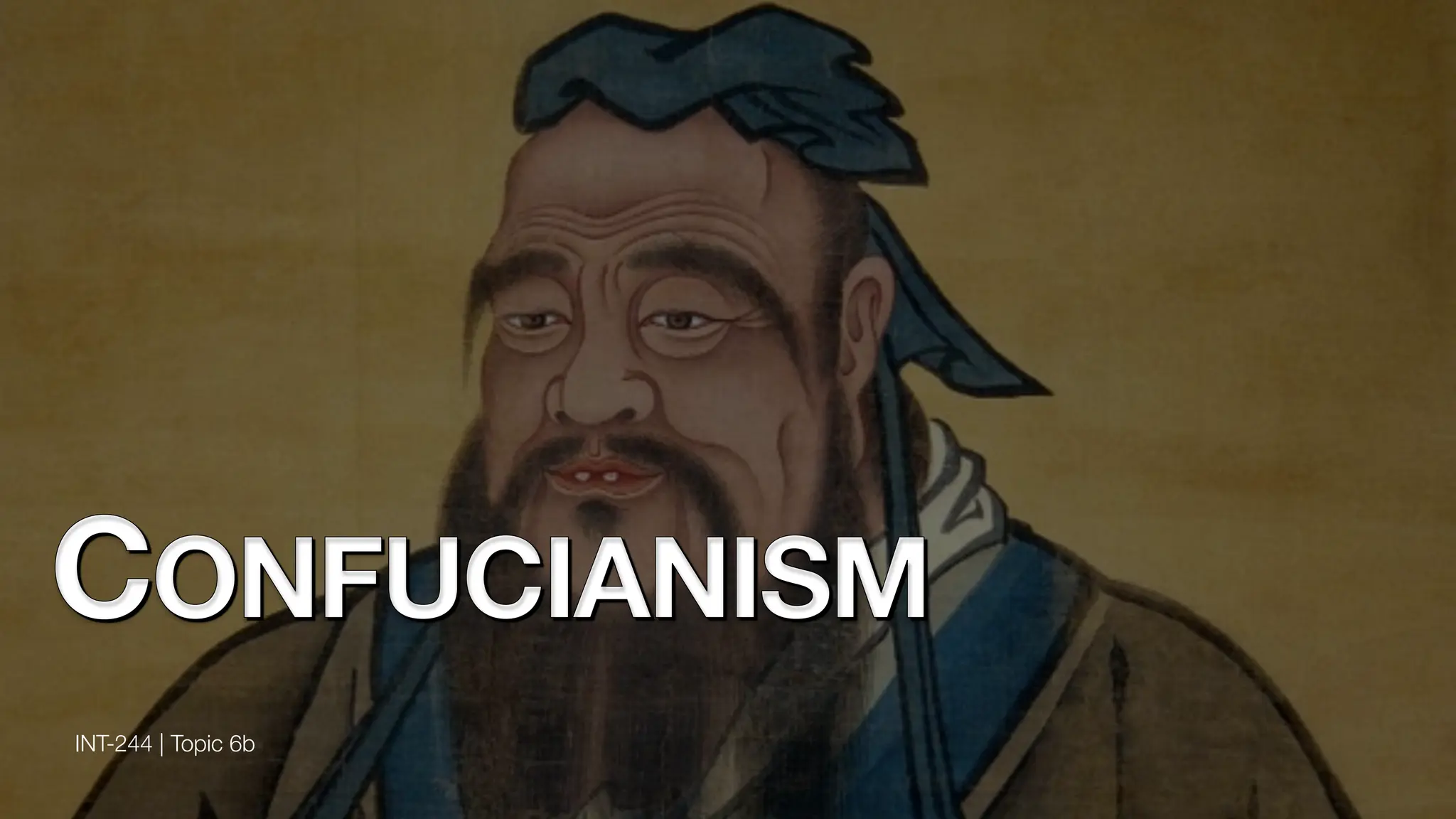
CONFUCIANISM
INT-244 | Topic 6b
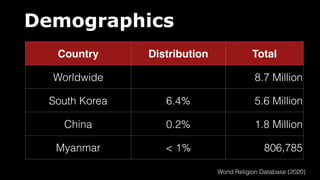
Demographics
Country Distribution Total
Worldwide 8.7 Million
South Korea 6.4% 5.6 Million
China 0.2% 1.8 Million
Myanmar < 1% 806,785
World Religion Database (2020)
History
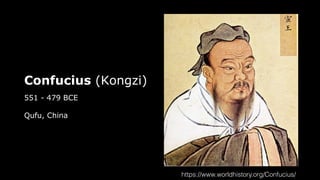
Confucius (Kongzi)
551 - 479 BCE
Qufu, China
https://www.worldhistory.org/Confucius/
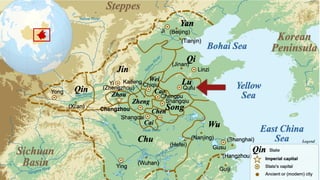
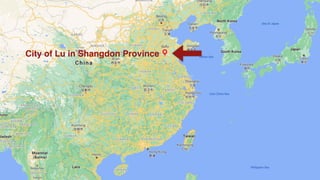
City of Lu in Shangdon Province
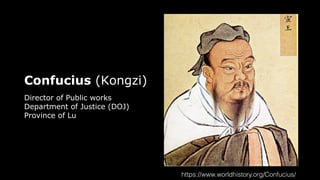
Confucius (Kongzi)
Director of Public works
Department of Justice (DOJ)
Province of Lu
https://www.worldhistory.org/Confucius/
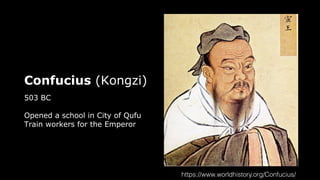
Confucius (Kongzi)
503 BC
Opened a school in City of Qufu
Train workers for the Emperor
https://www.worldhistory.org/Confucius/
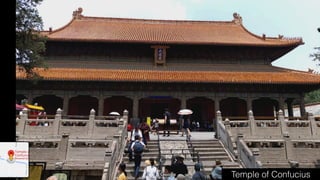
Temple of Confucius
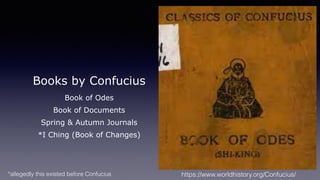
Books by Confucius
Book of Odes
Book of Documents
Spring & Autumn Journals
*I Ching (Book of Changes)
https://www.worldhistory.org/Confucius/
*allegedly this existed before Confucius
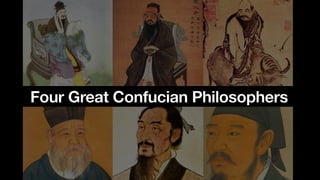
Four Great Confucian Philosophers
Zisi (483 - 402 BCE)
Mozi (470 - 391 BCE)
Mencius (371 - 289 BCE)
Xunzi (300 - 230 BCE)
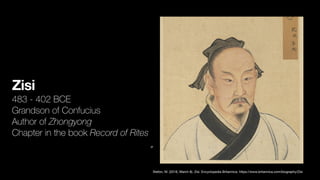
Zisi
483 - 402 BCE
Grandson of Confucius
Author of Zhongyong
Chapter in the book Record of Rites
„
Stefon, M. (2016, March 8). Zisi. Encyclopedia Britannica. https://www.britannica.com/biography/Zisi
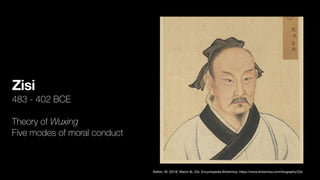
Zisi
483 - 402 BCE
Theory of Wuxing
Five modes of moral conduct
Stefon, M. (2016, March 8). Zisi. Encyclopedia Britannica. https://www.britannica.com/biography/Zisi
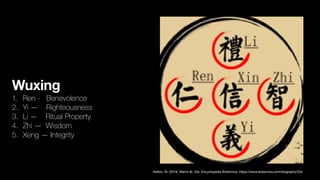
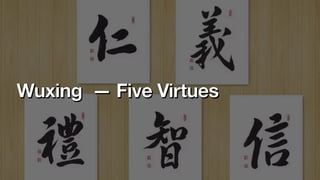
Wuxing
1. Ren - Benevolence
2. Yi — Righteousness
3. Li — Ritual Property
4. Zhi — Wisdom
5. Xeng — Integrity
Stefon, M. (2016, March 8). Zisi. Encyclopedia Britannica. https://www.britannica.com/biography/Zisi
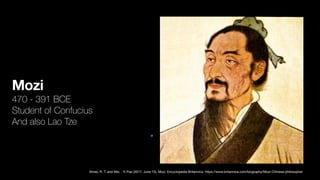
Mozi
470 - 391 BCE
Student of Confucius
And also Lao Tze
„
Ames, R. T. and Mei, . Yi Pao (2017, June 15). Mozi. Encyclopedia Britannica. https://www.britannica.com/biography/Mozi-Chinese-philosopher
Mozi
Authored The Mozi
Developed a criteria for making wise
decisions and determining moral
behavior.
Ames, R. T. and Mei, . Yi Pao (2017, June 15). Mozi. Encyclopedia Britannica. https://www.britannica.com/biography/Mozi-Chinese-philosopher
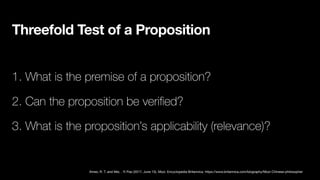
Threefold Test of a Proposition
1. What is the premise of a proposition?
2. Can the proposition be veri
fi
ed?
3. What is the proposition’s applicability (relevance)?
Ames, R. T. and Mei, . Yi Pao (2017, June 15). Mozi. Encyclopedia Britannica. https://www.britannica.com/biography/Mozi-Chinese-philosopher
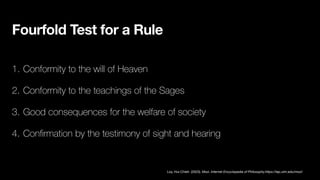
Fourfold Test for a Rule
1. Conformity to the will of Heaven
2. Conformity to the teachings of the Sages
3. Good consequences for the welfare of society
4. Con
fi
rmation by the testimony of sight and hearing
Loy, Hui-Chieh. (2023). Mozi. Internet Encyclopedia of Philosophy.https://iep.utm.edu/mozi/
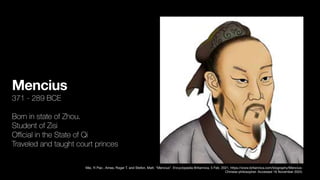
Mencius
371 - 289 BCE
Born in state of Zhou.
Student of Zisi
O
ffi
cial in the State of Qi
Traveled and taught court princes
Mei, Yi Pao , Ames, Roger T. and Stefon, Matt. "Mencius". Encyclopedia Britannica, 5 Feb. 2021, https://www.britannica.com/biography/Mencius-
Chinese-philosopher. Accessed 16 November 2023.
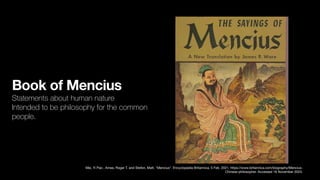
Book of Mencius
Statements about human nature
Intended to be philosophy for the common
people.
Mei, Yi Pao , Ames, Roger T. and Stefon, Matt. "Mencius". Encyclopedia Britannica, 5 Feb. 2021, https://www.britannica.com/biography/Mencius-
Chinese-philosopher. Accessed 16 November 2023.
Teachings of Mencius
• Guidance for Rulers
Ruler should provide for his people
Ruler should educate his people
Rulers need to cultivate moral power rather than power by force
Rulers should govern for the good of people, not themselves
25
Teachings of Mencius
• Guidance for Rulers
Ruler should provide for his people
Ruler should educate his people
Rulers need to cultivate moral power rather than power by force
Rulers should govern for the good of people, not themselves
• The Doctrine of Human Nature
Feeling of empathy
Feeling of shame
Feeling of courtesy
Feeling of right and wrong
26
Teachings of Mencius
• Guidance for Rulers
Ruler should provide for his people
Ruler should educate his people
Rulers need to cultivate moral power rather than power by force
Rulers should govern for the good of people, not themselves
• The Doctrine of Human Nature
Feeling of empathy
Feeling of shame
Feeling of courtesy
Feeling of right and wrong
• Nature of Man
All humans are innately good
Goodness must be cultivated through education and self-discipline.
Goodness is squandered through neglect and negative in
fl
uences
Goodness can never be lost
27
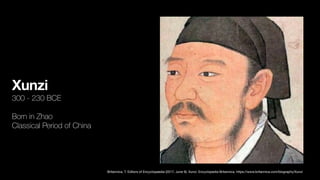
Xunzi
300 - 230 BCE
Born in Zhao
Classical Period of China
Britannica, T. Editors of Encyclopaedia (2017, June 9). Xunzi. Encyclopedia Britannica. https://www.britannica.com/biography/Xunzi
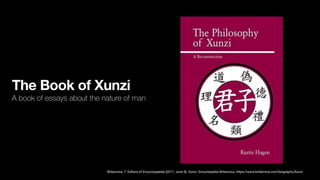
The Book of Xunzi
A book of essays about the nature of man
Britannica, T. Editors of Encyclopaedia (2017, June 9). Xunzi. Encyclopedia Britannica. https://www.britannica.com/biography/Xunzi
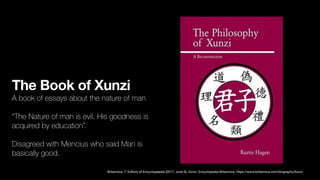
The Book of Xunzi
A book of essays about the nature of man
“The Nature of man is evil. His goodness is
acquired by education”.
Disagreed with Mencius who said Man is
basically good.
Britannica, T. Editors of Encyclopaedia (2017, June 9). Xunzi. Encyclopedia Britannica. https://www.britannica.com/biography/Xunzi
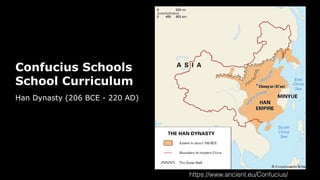
Confucius Schools
School Curriculum
Han Dynasty (206 BCE - 220 AD)
https://www.ancient.eu/Confucius/
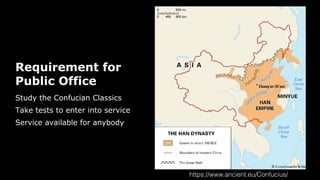
Requirement for
Public Office
Study the Confucian Classics
Take tests to enter into service
Service available for anybody
https://www.ancient.eu/Confucius/
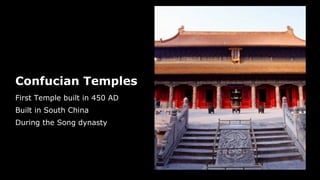
Confucian Temples
First Temple built in 450 AD
Built in South China
During the Song dynasty
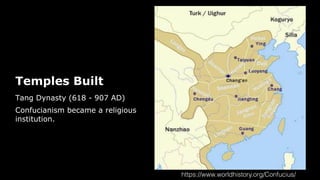
Temples Built
Tang Dynasty (618 - 907 AD)
Confucianism became a religious
institution.
https://www.worldhistory.org/Confucius/
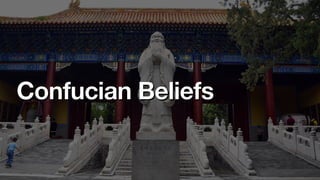
Confucian Beliefs
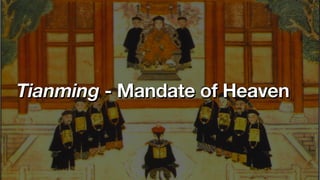
Tianming - Mandate of Heaven
Tianming — The Mandate of Heaven
The divine source of authority and the right to rule of China's early kings and
then emperors. The ancient god or divine force known as Heaven or Sky
selected a particular individual to rule on its behalf on earth.
Cartwright, M. (2017, July 25). Mandate of Heaven. World History Encyclopedia. Retrieved from https://www.worldhistory.org/Mandate_of_Heaven/
Tianming — The Mandate of Heaven
Although a ruler was given great power, he also had a moral obligation to use it
for the good of his people. If a ruler did not do this, then his state would su
ff
er
terrible disasters and he would lose the right to govern.
Cartwright, M. (2017, July 25). Mandate of Heaven. World History Encyclopedia. Retrieved from https://www.worldhistory.org/Mandate_of_Heaven/
Tianming — The Mandate of Heaven
1. Ruler has an obligation to rule morally
2. Ruler must depend on his advisors
3. Ruler is limited by his predecessors and the founders of the dynasty
Cartwright, M. (2017, July 25). Mandate of Heaven. World History Encyclopedia. Retrieved from https://www.worldhistory.org/Mandate_of_Heaven/
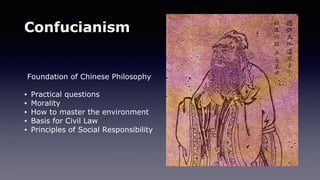
Confucianism
Foundation of Chinese Philosophy
• Practical questions
• Morality
• How to master the environment
• Basis for Civil Law
• Principles of Social Responsibility
Philosophy
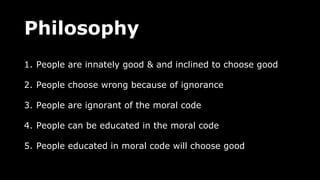
1. People are innately good & and inclined to choose good
2. People choose wrong because of ignorance
3. People are ignorant of the moral code
4. People can be educated in the moral code
5. People educated in moral code will choose good
Philosophy
6. Tian (Heaven) is the source and sustainer of life
7. Understanding one’s relationship to Tian and one’s place in
the universe establishes order
https://www.worldhistory.org/Confucianism/
Wuxing — Five Virtues
Ren - Benevolence
Literally “humanity” or “humanness” bearing behavior that is
authentically human. To embody goodness in one’s
relationship with another.
https://plato.stanford.edu/entries/confucius/
Yi - Righteousness
Righteousness entails unselfishness, the steadfastness to do
what is right in the face of temptation.
https://plato.stanford.edu/entries/confucius/
Li - Ritual Propriety
“ritual propriety” expresses a sensitivity to one’s social place,
and willingness to play all of one’s multiple ritual roles.
https://plato.stanford.edu/entries/confucius/
Zhi - Wisdom
Ability to appraise people and situations. In
the Analects, wisdom allows a gentleman to discern crooked
and straight behavior in others (12.22), and discriminate
between those who may be reformed and those who may not
https://plato.stanford.edu/entries/confucius/
Xin - Integrity
Trustworthiness, sincerity, faithfulness, something that
qualifies a gentleman to give advice to a ruler, and a ruler the
right to manage others. Faithfulness and honesty.
https://plato.stanford.edu/entries/confucius/
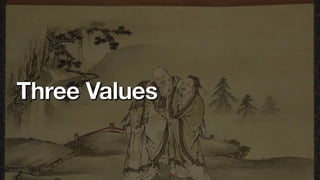
Three Values
Xiao - Filial Piety
Right behavior toward parents, superiors, siblings, and the
emperor
https://plato.stanford.edu/entries/confucius/
Xiao - Filial Piety
1. Subjects to Emperor
2. Wife to Husband (family head)
3. Younger brother to Older brother
4. Younger friend to Older friend
https://plato.stanford.edu/entries/confucius/
Ren — Humanness
Altruism, empathy, authenticity, human morality
https://plato.stanford.edu/entries/confucius/
Li — Ritual
Importance of tradition, ritual, honoring the ancestors, and
honoring the gods
https://plato.stanford.edu/entries/confucius/
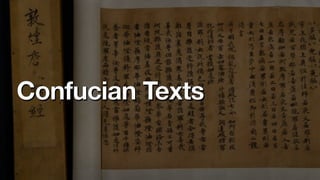
Confucian Texts
Confucian Canon
• Analects & the books written before 300 BCE
• Tradition says Analects written by Confucius (probably not)
• 12th century CE — Zhu Xi, Song Dynasty, selected them as Canon
• 1368 - 1644 — Became required for public service during Ming Dynasty
58
Imperial Examination
1. Shengyan — Local and county graduate, able to serve in the village
2. Juren — Provincial graduate, able to serve in a provincial capital
3. Jinshi — Metropolitan graduate, able to serve in the capital nationally.
Imperial Examinations (Keju). (2023, February 4). New World Encyclopedia, . Retrieved 17:48, November 28, 2023 from
https://www.newworldencyclopedia.org/p/index.php?title=Imperial_Examinations_(Keju)&oldid=1099292.
The Four Texts
1. Book of Analects
2. Book of Mencius
3. Book of Great Learning
4. Doctrine of the Mean
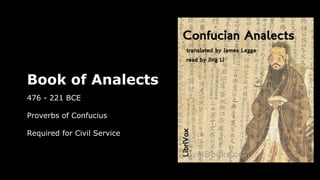
Book of Analects
476 - 221 BCE
Proverbs of Confucius
Required for Civil Service
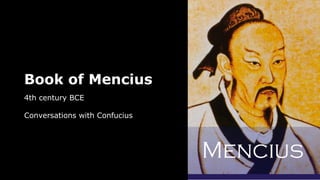
Book of Mencius
4th century BCE
Conversations with Confucius
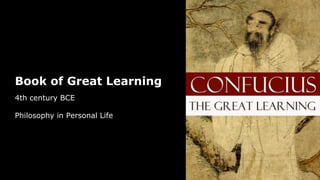
Book of Great Learning
4th century BCE
Philosophy in Personal Life
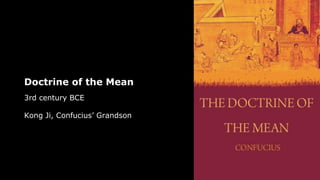
Doctrine of the Mean
3rd century BCE
Kong Ji, Confucius’ Grandson
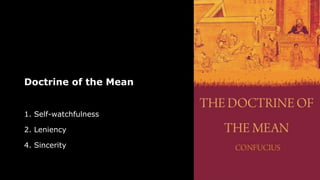
Doctrine of the Mean
1. Self-watchfulness
2. Leniency
4. Sincerity
https://sacred-texts.com/cfu/index.htm
66
Famous Quotes
“Everything has beauty, but not everyone sees it.”
“Life is really simple, but we insist on making it complicated.”
“If you make a mistake and do not correct it, this is called a mistake.”
“Before you embark on a journey of revenge, dig two graves.”
Analects
Famous Quotes
“To be wronged is nothing, unless you continue to remember it.”
“The man who asks a question is a fool for a minute, the man who does not ask is a fool for
life.”
“Life is really simple, but we insist on making it complicated.”
“By three methods we may learn: 1st by re
fl
ection, which is the noblest, 2nd is by imitation
which is the easiest, 3rd by experience which is the bitterest
Analects
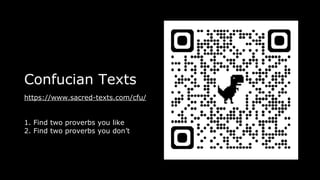
Confucian Texts
https://www.sacred-texts.com/cfu/
1. Find two proverbs you like
2. Find two proverbs you don’t
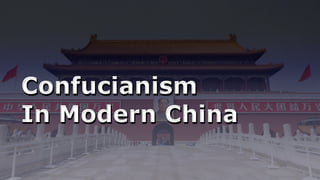
Confucianism
In Modern China
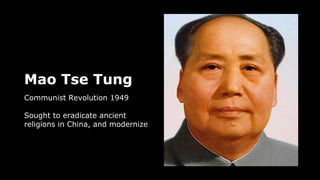
Mao Tse Tung
Communist Revolution 1949
Sought to eradicate ancient
religions in China, and modernize
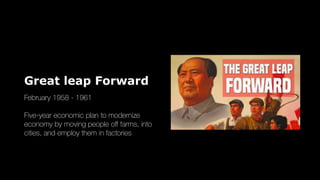
Great leap Forward
February 1958 - 1961
Five-year economic plan to modernize
economy by moving people o
ff
farms, into
cities, and employ them in factories
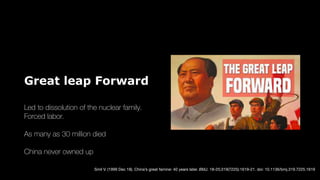
Great leap Forward
Led to dissolution of the nuclear family.
Forced labor.
As many as 30 million died
China never owned up
Smil V. (1999 Dec 18). China’s great famine: 40 years later. BMJ. 18-25;319(7225):1619-21. doi: 10.1136/bmj.319.7225.1619
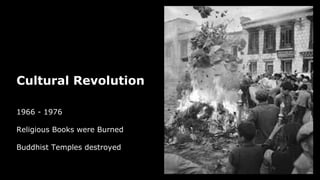
Cultural Revolution
1966 - 1976
Religious Books were Burned
Buddhist Temples destroyed
Confucianism survives in Taiwan
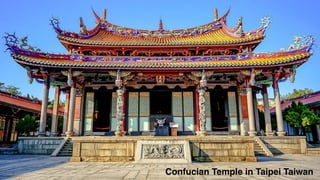
Confucian Temple in Taipei Taiwan
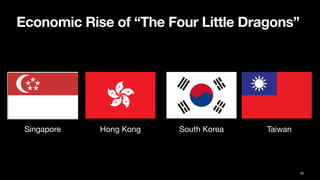
Economic Rise of “The Four Little Dragons”
78
Singapore Hong Kong South Korea Taiwan
Economic Confucianism
Over our decades…“four little dragons”- Taiwan, South Korea, Hong Kong and
Singapore…progressed toward becoming…the three mainstays of the advanced
economic world order…Their achievement…originated from…social practices
established in the Confucian custom…adjusted to the necessities of a modern
society- [known as] “neo-Confucianism." This economic philosophy incorporates a
meritocratic organization, a selection test framework, the signi
fi
cance of gathering
knowledge, and the goal of advancement.
Dangayach & Gupta. (2018). Four Asian Dragons . International Journal of Advance Research. 3 (1):158 - 162. http://www.ijarnd.com/
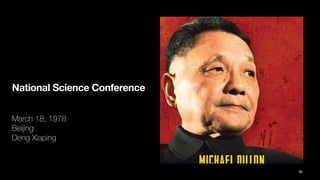
National Science Conference
March 18, 1978
Be
ij
ing
Deng Xiaping
80
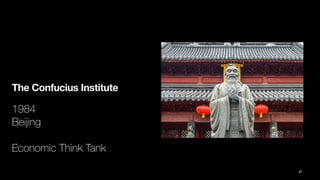
The Confucius Institute
1984
Be
ij
ing
Economic Think Tank
81
Return of Confucianism
Confucianism has made comeback as the Communist Party looked
for ways to justify its authoritarianism and forge a common Chinese
identity. In the 1990s, Confucianism was promoted to provide moral
teachings and counteract the decadence and materialism brought
about by the Deng reforms. In the early 2000s, a number of schools
opened up to teach Confucian values to youngsters and an institute
was set up at Renmin University devoted to the study of Confucius
and Confucian thought.
Hays, (Sep 2016) “Confucianism Today”
Chinese Ruism
1. Chinese value on Education in China
2. Structure of Education in China
3. Examinations Required for Civil Service
4. Social hierarchy in the context of Communism

INT-244 Topic 6b Confucianism

  • 1.
  • 2.
    Demographics Country Distribution Total Worldwide8.7 Million South Korea 6.4% 5.6 Million China 0.2% 1.8 Million Myanmar < 1% 806,785 World Religion Database (2020)
  • 3.
  • 4.
    Confucius (Kongzi) 551 -479 BCE Qufu, China https://www.worldhistory.org/Confucius/
  • 6.
    City of Luin Shangdon Province
  • 7.
    Confucius (Kongzi) Director ofPublic works Department of Justice (DOJ) Province of Lu https://www.worldhistory.org/Confucius/
  • 8.
    Confucius (Kongzi) 503 BC Openeda school in City of Qufu Train workers for the Emperor https://www.worldhistory.org/Confucius/
  • 9.
  • 10.
    Books by Confucius Bookof Odes Book of Documents Spring & Autumn Journals *I Ching (Book of Changes) https://www.worldhistory.org/Confucius/ *allegedly this existed before Confucius
  • 11.
  • 12.
    Four Great ConfucianPhilosophers Zisi (483 - 402 BCE) Mozi (470 - 391 BCE) Mencius (371 - 289 BCE) Xunzi (300 - 230 BCE)
  • 13.
    Zisi 483 - 402BCE Grandson of Confucius Author of Zhongyong Chapter in the book Record of Rites „ Stefon, M. (2016, March 8). Zisi. Encyclopedia Britannica. https://www.britannica.com/biography/Zisi
  • 14.
    Zisi 483 - 402BCE Theory of Wuxing Five modes of moral conduct Stefon, M. (2016, March 8). Zisi. Encyclopedia Britannica. https://www.britannica.com/biography/Zisi
  • 15.
    Wuxing 1. Ren -Benevolence 2. Yi — Righteousness 3. Li — Ritual Property 4. Zhi — Wisdom 5. Xeng — Integrity Stefon, M. (2016, March 8). Zisi. Encyclopedia Britannica. https://www.britannica.com/biography/Zisi
  • 16.
    Mozi 470 - 391BCE Student of Confucius And also Lao Tze „ Ames, R. T. and Mei, . Yi Pao (2017, June 15). Mozi. Encyclopedia Britannica. https://www.britannica.com/biography/Mozi-Chinese-philosopher
  • 17.
    Mozi Authored The Mozi Developeda criteria for making wise decisions and determining moral behavior. Ames, R. T. and Mei, . Yi Pao (2017, June 15). Mozi. Encyclopedia Britannica. https://www.britannica.com/biography/Mozi-Chinese-philosopher
  • 18.
    Threefold Test ofa Proposition 1. What is the premise of a proposition? 2. Can the proposition be veri fi ed? 3. What is the proposition’s applicability (relevance)? Ames, R. T. and Mei, . Yi Pao (2017, June 15). Mozi. Encyclopedia Britannica. https://www.britannica.com/biography/Mozi-Chinese-philosopher
  • 19.
    Fourfold Test fora Rule 1. Conformity to the will of Heaven 2. Conformity to the teachings of the Sages 3. Good consequences for the welfare of society 4. Con fi rmation by the testimony of sight and hearing Loy, Hui-Chieh. (2023). Mozi. Internet Encyclopedia of Philosophy.https://iep.utm.edu/mozi/
  • 20.
    Mencius 371 - 289BCE Born in state of Zhou. Student of Zisi O ffi cial in the State of Qi Traveled and taught court princes Mei, Yi Pao , Ames, Roger T. and Stefon, Matt. "Mencius". Encyclopedia Britannica, 5 Feb. 2021, https://www.britannica.com/biography/Mencius- Chinese-philosopher. Accessed 16 November 2023.
  • 21.
    Book of Mencius Statementsabout human nature Intended to be philosophy for the common people. Mei, Yi Pao , Ames, Roger T. and Stefon, Matt. "Mencius". Encyclopedia Britannica, 5 Feb. 2021, https://www.britannica.com/biography/Mencius- Chinese-philosopher. Accessed 16 November 2023.
  • 22.
    Teachings of Mencius •Guidance for Rulers Ruler should provide for his people Ruler should educate his people Rulers need to cultivate moral power rather than power by force Rulers should govern for the good of people, not themselves 25
  • 23.
    Teachings of Mencius •Guidance for Rulers Ruler should provide for his people Ruler should educate his people Rulers need to cultivate moral power rather than power by force Rulers should govern for the good of people, not themselves • The Doctrine of Human Nature Feeling of empathy Feeling of shame Feeling of courtesy Feeling of right and wrong 26
  • 24.
    Teachings of Mencius •Guidance for Rulers Ruler should provide for his people Ruler should educate his people Rulers need to cultivate moral power rather than power by force Rulers should govern for the good of people, not themselves • The Doctrine of Human Nature Feeling of empathy Feeling of shame Feeling of courtesy Feeling of right and wrong • Nature of Man All humans are innately good Goodness must be cultivated through education and self-discipline. Goodness is squandered through neglect and negative in fl uences Goodness can never be lost 27
  • 25.
    Xunzi 300 - 230BCE Born in Zhao Classical Period of China Britannica, T. Editors of Encyclopaedia (2017, June 9). Xunzi. Encyclopedia Britannica. https://www.britannica.com/biography/Xunzi
  • 26.
    The Book ofXunzi A book of essays about the nature of man Britannica, T. Editors of Encyclopaedia (2017, June 9). Xunzi. Encyclopedia Britannica. https://www.britannica.com/biography/Xunzi
  • 27.
    The Book ofXunzi A book of essays about the nature of man “The Nature of man is evil. His goodness is acquired by education”. Disagreed with Mencius who said Man is basically good. Britannica, T. Editors of Encyclopaedia (2017, June 9). Xunzi. Encyclopedia Britannica. https://www.britannica.com/biography/Xunzi
  • 28.
    Confucius Schools School Curriculum HanDynasty (206 BCE - 220 AD) https://www.ancient.eu/Confucius/
  • 29.
    Requirement for Public Office Studythe Confucian Classics Take tests to enter into service Service available for anybody https://www.ancient.eu/Confucius/
  • 30.
    Confucian Temples First Templebuilt in 450 AD Built in South China During the Song dynasty
  • 31.
    Temples Built Tang Dynasty(618 - 907 AD) Confucianism became a religious institution. https://www.worldhistory.org/Confucius/
  • 32.
  • 33.
  • 34.
    Tianming — TheMandate of Heaven The divine source of authority and the right to rule of China's early kings and then emperors. The ancient god or divine force known as Heaven or Sky selected a particular individual to rule on its behalf on earth. Cartwright, M. (2017, July 25). Mandate of Heaven. World History Encyclopedia. Retrieved from https://www.worldhistory.org/Mandate_of_Heaven/
  • 35.
    Tianming — TheMandate of Heaven Although a ruler was given great power, he also had a moral obligation to use it for the good of his people. If a ruler did not do this, then his state would su ff er terrible disasters and he would lose the right to govern. Cartwright, M. (2017, July 25). Mandate of Heaven. World History Encyclopedia. Retrieved from https://www.worldhistory.org/Mandate_of_Heaven/
  • 36.
    Tianming — TheMandate of Heaven 1. Ruler has an obligation to rule morally 2. Ruler must depend on his advisors 3. Ruler is limited by his predecessors and the founders of the dynasty Cartwright, M. (2017, July 25). Mandate of Heaven. World History Encyclopedia. Retrieved from https://www.worldhistory.org/Mandate_of_Heaven/
  • 37.
    Confucianism Foundation of ChinesePhilosophy • Practical questions • Morality • How to master the environment • Basis for Civil Law • Principles of Social Responsibility
  • 38.
    Philosophy 1. People areinnately good & and inclined to choose good 2. People choose wrong because of ignorance 3. People are ignorant of the moral code 4. People can be educated in the moral code 5. People educated in moral code will choose good
  • 39.
    Philosophy 6. Tian (Heaven)is the source and sustainer of life 7. Understanding one’s relationship to Tian and one’s place in the universe establishes order https://www.worldhistory.org/Confucianism/
  • 40.
  • 41.
    Ren - Benevolence Literally“humanity” or “humanness” bearing behavior that is authentically human. To embody goodness in one’s relationship with another. https://plato.stanford.edu/entries/confucius/
  • 42.
    Yi - Righteousness Righteousnessentails unselfishness, the steadfastness to do what is right in the face of temptation. https://plato.stanford.edu/entries/confucius/
  • 43.
    Li - RitualPropriety “ritual propriety” expresses a sensitivity to one’s social place, and willingness to play all of one’s multiple ritual roles. https://plato.stanford.edu/entries/confucius/
  • 44.
    Zhi - Wisdom Abilityto appraise people and situations. In the Analects, wisdom allows a gentleman to discern crooked and straight behavior in others (12.22), and discriminate between those who may be reformed and those who may not https://plato.stanford.edu/entries/confucius/
  • 45.
    Xin - Integrity Trustworthiness,sincerity, faithfulness, something that qualifies a gentleman to give advice to a ruler, and a ruler the right to manage others. Faithfulness and honesty. https://plato.stanford.edu/entries/confucius/
  • 46.
  • 47.
    Xiao - FilialPiety Right behavior toward parents, superiors, siblings, and the emperor https://plato.stanford.edu/entries/confucius/
  • 48.
    Xiao - FilialPiety 1. Subjects to Emperor 2. Wife to Husband (family head) 3. Younger brother to Older brother 4. Younger friend to Older friend https://plato.stanford.edu/entries/confucius/
  • 49.
    Ren — Humanness Altruism,empathy, authenticity, human morality https://plato.stanford.edu/entries/confucius/
  • 50.
    Li — Ritual Importanceof tradition, ritual, honoring the ancestors, and honoring the gods https://plato.stanford.edu/entries/confucius/
  • 51.
  • 52.
    Confucian Canon • Analects& the books written before 300 BCE • Tradition says Analects written by Confucius (probably not) • 12th century CE — Zhu Xi, Song Dynasty, selected them as Canon • 1368 - 1644 — Became required for public service during Ming Dynasty 58
  • 53.
    Imperial Examination 1. Shengyan— Local and county graduate, able to serve in the village 2. Juren — Provincial graduate, able to serve in a provincial capital 3. Jinshi — Metropolitan graduate, able to serve in the capital nationally. Imperial Examinations (Keju). (2023, February 4). New World Encyclopedia, . Retrieved 17:48, November 28, 2023 from https://www.newworldencyclopedia.org/p/index.php?title=Imperial_Examinations_(Keju)&oldid=1099292.
  • 54.
    The Four Texts 1.Book of Analects 2. Book of Mencius 3. Book of Great Learning 4. Doctrine of the Mean
  • 55.
    Book of Analects 476- 221 BCE Proverbs of Confucius Required for Civil Service
  • 56.
    Book of Mencius 4thcentury BCE Conversations with Confucius
  • 57.
    Book of GreatLearning 4th century BCE Philosophy in Personal Life
  • 58.
    Doctrine of theMean 3rd century BCE Kong Ji, Confucius’ Grandson
  • 59.
    Doctrine of theMean 1. Self-watchfulness 2. Leniency 4. Sincerity
  • 60.
  • 61.
    Famous Quotes “Everything hasbeauty, but not everyone sees it.” “Life is really simple, but we insist on making it complicated.” “If you make a mistake and do not correct it, this is called a mistake.” “Before you embark on a journey of revenge, dig two graves.” Analects
  • 62.
    Famous Quotes “To bewronged is nothing, unless you continue to remember it.” “The man who asks a question is a fool for a minute, the man who does not ask is a fool for life.” “Life is really simple, but we insist on making it complicated.” “By three methods we may learn: 1st by re fl ection, which is the noblest, 2nd is by imitation which is the easiest, 3rd by experience which is the bitterest Analects
  • 63.
    Confucian Texts https://www.sacred-texts.com/cfu/ 1. Findtwo proverbs you like 2. Find two proverbs you don’t
  • 64.
  • 65.
    Mao Tse Tung CommunistRevolution 1949 Sought to eradicate ancient religions in China, and modernize
  • 66.
    Great leap Forward February1958 - 1961 Five-year economic plan to modernize economy by moving people o ff farms, into cities, and employ them in factories
  • 67.
    Great leap Forward Ledto dissolution of the nuclear family. Forced labor. As many as 30 million died China never owned up Smil V. (1999 Dec 18). China’s great famine: 40 years later. BMJ. 18-25;319(7225):1619-21. doi: 10.1136/bmj.319.7225.1619
  • 68.
    Cultural Revolution 1966 -1976 Religious Books were Burned Buddhist Temples destroyed
  • 70.
  • 71.
    Confucian Temple inTaipei Taiwan
  • 72.
    Economic Rise of“The Four Little Dragons” 78 Singapore Hong Kong South Korea Taiwan
  • 73.
    Economic Confucianism Over ourdecades…“four little dragons”- Taiwan, South Korea, Hong Kong and Singapore…progressed toward becoming…the three mainstays of the advanced economic world order…Their achievement…originated from…social practices established in the Confucian custom…adjusted to the necessities of a modern society- [known as] “neo-Confucianism." This economic philosophy incorporates a meritocratic organization, a selection test framework, the signi fi cance of gathering knowledge, and the goal of advancement. Dangayach & Gupta. (2018). Four Asian Dragons . International Journal of Advance Research. 3 (1):158 - 162. http://www.ijarnd.com/
  • 74.
    National Science Conference March18, 1978 Be ij ing Deng Xiaping 80
  • 75.
  • 76.
    Return of Confucianism Confucianismhas made comeback as the Communist Party looked for ways to justify its authoritarianism and forge a common Chinese identity. In the 1990s, Confucianism was promoted to provide moral teachings and counteract the decadence and materialism brought about by the Deng reforms. In the early 2000s, a number of schools opened up to teach Confucian values to youngsters and an institute was set up at Renmin University devoted to the study of Confucius and Confucian thought. Hays, (Sep 2016) “Confucianism Today”
  • 77.
    Chinese Ruism 1. Chinesevalue on Education in China 2. Structure of Education in China 3. Examinations Required for Civil Service 4. Social hierarchy in the context of Communism