CONFUCIANISM
CODEOFCONDUCT
SOURCE OF LIFE
CONFUCIANISM
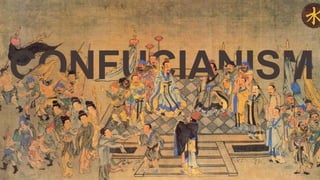
CONFUCIANISM
• Major system of thought in China
• Developed from the teachings of Confucius and his
disciples:Mencius and Hzun Tzu
• Has influenced the Chinese attitude toward life, set the
patterns of living and standards of social value and
provided the background for Chinese political theories
and institutions.
• Also known as Ruism, Confucianism can be regarded
as a religion, tradition, teaching or an ideology.
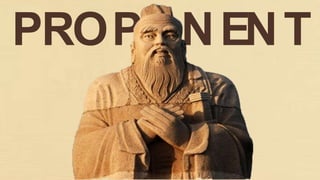
PROPONENT
CONFUCIUS
• Is the Latinized name for Kong-Tzu or K’ung Fu-tzu
• born on September 28, 551 BC during the Zhou dynasty.
• He was born into a middle-class family but after his
father’s death, the family was consigned to poverty.
• Confucius worked in the fields and as a bookkeeper but
later on became a teacher.
• He became an influential philosopher, politician and
educator during a tumultuous period of Chinese history.
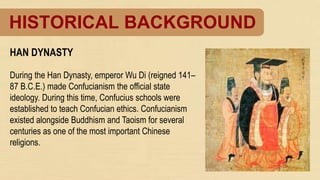
HISTORICAL BACKGROUND
HAN DYNASTY
During the Han Dynasty, emperor Wu Di (reigned 141–
87 B.C.E.) made Confucianism the official state
ideology. During this time, Confucius schools were
established to teach Confucian ethics. Confucianism
existed alongside Buddhism and Taoism for several
centuries as one of the most important Chinese
religions.
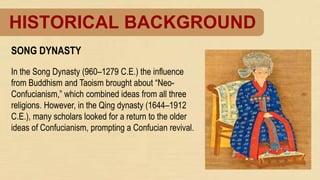
HISTORICAL BACKGROUND
SONG DYNASTY
In the Song Dynasty (960–1279 C.E.) the influence
from Buddhism and Taoism brought about “Neo-
Confucianism,” which combined ideas from all three
religions. However, in the Qing dynasty (1644–1912
C.E.), many scholars looked for a return to the older
ideas of Confucianism, prompting a Confucian revival.
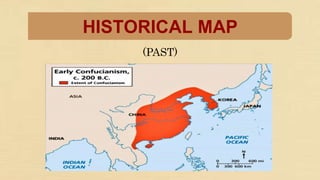
HISTORICAL MAP
(PAST)
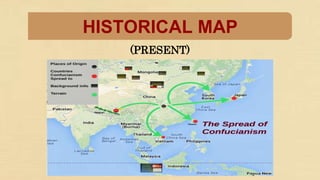
HISTORICAL MAP
(PRESENT)
BELIEFS AND PRACTICE
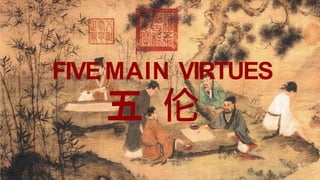
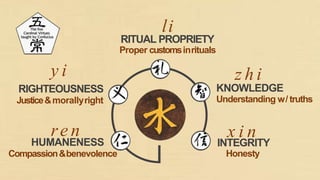
FIVE MAIN VIRTUES
五 伦
re n
HUMANENESS
Compassion&benevolence
y i
RIGHTEOUSNESS
Justice&morallyright
li
RITUAL PROPRIETY
Proper customsinrituals
z h i
KNOWLEDGE
Understanding w/ truths
x i n
INTEGRITY
Honesty
FIVE CONSTANTS
五 伦
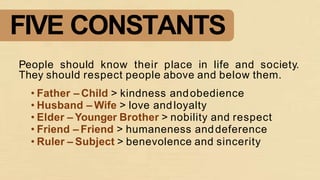
FIVE CONSTANTS
People should know their place in life and society.
They should respect people above and below them.
• Father – Child > kindness andobedience
• Husband – Wife > love andloyalty
• Elder – Younger Brother > nobility and respect
• Friend – Friend > humaneness anddeference
• Ruler – Subject > benevolence and sincerity
SACRED SCRIPTURE
There are two main scriptures that
Confucian people follow. The two
scriptures are the Four Books of
Confucianism and the Five Classics. The
book that is most known and most
followed is the Analects. The Analects are
saying and ideas of Confucius. The
Analects are one of the most studied
books in China.
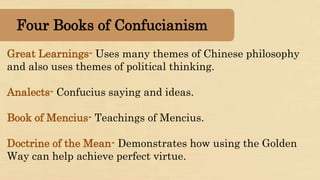
Great Learnings- Uses many themes of Chinese philosophy
and also uses themes of political thinking.
Analects- Confucius saying and ideas.
Book of Mencius- Teachings of Mencius.
Doctrine of the Mean- Demonstrates how using the Golden
Way can help achieve perfect virtue.
Four Books of Confucianism
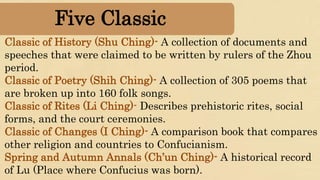
Five Classic
Classic of History (Shu Ching)- A collection of documents and
speeches that were claimed to be written by rulers of the Zhou
period.
Classic of Poetry (Shih Ching)- A collection of 305 poems that
are broken up into 160 folk songs.
Classic of Rites (Li Ching)- Describes prehistoric rites, social
forms, and the court ceremonies.
Classic of Changes (I Ching)- A comparison book that compares
other religion and countries to Confucianism.
Spring and Autumn Annals (Ch’un Ching)- A historical record
of Lu (Place where Confucius was born).
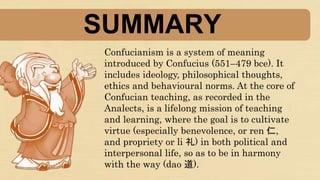
SUMMARY
Confucianism is a system of meaning
introduced by Confucius (551–479 bce). It
includes ideology, philosophical thoughts,
ethics and behavioural norms. At the core of
Confucian teaching, as recorded in the
Analects, is a lifelong mission of teaching
and learning, where the goal is to cultivate
virtue (especially benevolence, or ren 仁,
and propriety or li 礼) in both political and
interpersonal life, so as to be in harmony
with the way (dao 道).
CONCLUSION
In conclusion, Confucianism was a
philosophy; an outline of moral,
social, spiritual and political aspects.
Confucianism teaches the people
during the age of philosopher to
learn how to respect and help each
other in a better way.
REFLECTION
The aforementioned Confucianist belief conveys the message that respect for
parents is not only something that should be done in the presence of others, but it is
something that must be embodied in order to be an effective tenet of the human
relationship or relationships between senior and junior members of the family.
The idea behind the passage that we chose to reflect upon is simple. We
understand that children are being trained to know, from an early age, that if one
shows respect to his elders, then he will not need to demand that his elders respect
him as well. The true respect and family relationship is built when the young
generation shows support for his elders, without feeling obligated to do so. It then
becomes important for children to understand that showing respect for their elders,
and not showing them a bad face is the kind of payback that is expected or accorded
to people who have nurtured them since conception and helped them become
contributing members of society.
• Britannica (2019) Confucianism. Retrieved from https://www.britannica.com/topic/Confucianism
• Adhikari, S. (2019, August 13). Top 10 Contributions of Confucius. Retrieved from
https://www.ancienthistorylists.com/china-history/contributions-of-confucius/
• Anon, (2019). [online] Available at: https://brainly.ph/question/410994 [Accessed 17 Oct. 2019].
• Berling, J. A. (n.d). Confucianism [blog]. Retrieved from https://asiasociety.org/education/confucianism
• Eighty Six (n.d). The Confucian Education System – Can It Positively Influence U.S. Education? [blog].
Retrieved fromhttps://www.brighthubeducation.com/education-industry/129048-confucianism-can-
change-modern-education/
• Goscha, C. (2017, March 9). What is Confucianism? A short introduction to the Chinese ethical system.
Retrieved from https://www.historytoday.com/history-matters/what-confucianism
• McEnroe, A. M. (2014, April 30). Confucius's Educational Theory. Retrieved from
https://www.newfoundations.com/GALLERY/Confucius.html
QUIZ TIME !!!!!!
IDENTIFICATION
1. Confucianism originated in what country?
2. Who is the founder of Confucianism?
3. In what dynasty did Confucianism become the
official state of ideology?
4. Give at least two main virtues taught by
Confucius.
5. What are the two main scriptures that
Confucian people follow?
6. Give at least two books of Confucianism.
7. Give at least one classic of Confucianism.
TRUE OR FALSE
1. Confucius was born on September 28, 551 BC,
during the Zhou dynasty.
2. Confucius was born into an upper-class family, but
after hisfather’s death, the family was consigned to
poverty.
3. Confucius worked in the fields and as a bookkeeper,
but later became a doctor.
4. Classic of Poetry (Shih Ching) is a collection of
429 poems that are broken up into 180 folk
songs.
5. Confucianism is a major system of thought in
China.

Confucianism Group Report.pptx

  • 1.
  • 2.
  • 3.
  • 4.
    CONFUCIANISM • Major systemof thought in China • Developed from the teachings of Confucius and his disciples:Mencius and Hzun Tzu • Has influenced the Chinese attitude toward life, set the patterns of living and standards of social value and provided the background for Chinese political theories and institutions. • Also known as Ruism, Confucianism can be regarded as a religion, tradition, teaching or an ideology.
  • 5.
  • 6.
    CONFUCIUS • Is theLatinized name for Kong-Tzu or K’ung Fu-tzu • born on September 28, 551 BC during the Zhou dynasty. • He was born into a middle-class family but after his father’s death, the family was consigned to poverty. • Confucius worked in the fields and as a bookkeeper but later on became a teacher. • He became an influential philosopher, politician and educator during a tumultuous period of Chinese history.
  • 7.
    HISTORICAL BACKGROUND HAN DYNASTY Duringthe Han Dynasty, emperor Wu Di (reigned 141– 87 B.C.E.) made Confucianism the official state ideology. During this time, Confucius schools were established to teach Confucian ethics. Confucianism existed alongside Buddhism and Taoism for several centuries as one of the most important Chinese religions.
  • 8.
    HISTORICAL BACKGROUND SONG DYNASTY Inthe Song Dynasty (960–1279 C.E.) the influence from Buddhism and Taoism brought about “Neo- Confucianism,” which combined ideas from all three religions. However, in the Qing dynasty (1644–1912 C.E.), many scholars looked for a return to the older ideas of Confucianism, prompting a Confucian revival.
  • 9.
  • 10.
  • 11.
  • 12.
  • 13.
    re n HUMANENESS Compassion&benevolence y i RIGHTEOUSNESS Justice&morallyright li RITUALPROPRIETY Proper customsinrituals z h i KNOWLEDGE Understanding w/ truths x i n INTEGRITY Honesty
  • 14.
  • 15.
    FIVE CONSTANTS People shouldknow their place in life and society. They should respect people above and below them. • Father – Child > kindness andobedience • Husband – Wife > love andloyalty • Elder – Younger Brother > nobility and respect • Friend – Friend > humaneness anddeference • Ruler – Subject > benevolence and sincerity
  • 16.
  • 17.
    There are twomain scriptures that Confucian people follow. The two scriptures are the Four Books of Confucianism and the Five Classics. The book that is most known and most followed is the Analects. The Analects are saying and ideas of Confucius. The Analects are one of the most studied books in China.
  • 18.
    Great Learnings- Usesmany themes of Chinese philosophy and also uses themes of political thinking. Analects- Confucius saying and ideas. Book of Mencius- Teachings of Mencius. Doctrine of the Mean- Demonstrates how using the Golden Way can help achieve perfect virtue. Four Books of Confucianism
  • 19.
    Five Classic Classic ofHistory (Shu Ching)- A collection of documents and speeches that were claimed to be written by rulers of the Zhou period. Classic of Poetry (Shih Ching)- A collection of 305 poems that are broken up into 160 folk songs. Classic of Rites (Li Ching)- Describes prehistoric rites, social forms, and the court ceremonies. Classic of Changes (I Ching)- A comparison book that compares other religion and countries to Confucianism. Spring and Autumn Annals (Ch’un Ching)- A historical record of Lu (Place where Confucius was born).
  • 20.
    SUMMARY Confucianism is asystem of meaning introduced by Confucius (551–479 bce). It includes ideology, philosophical thoughts, ethics and behavioural norms. At the core of Confucian teaching, as recorded in the Analects, is a lifelong mission of teaching and learning, where the goal is to cultivate virtue (especially benevolence, or ren 仁, and propriety or li 礼) in both political and interpersonal life, so as to be in harmony with the way (dao 道).
  • 21.
    CONCLUSION In conclusion, Confucianismwas a philosophy; an outline of moral, social, spiritual and political aspects. Confucianism teaches the people during the age of philosopher to learn how to respect and help each other in a better way.
  • 22.
    REFLECTION The aforementioned Confucianistbelief conveys the message that respect for parents is not only something that should be done in the presence of others, but it is something that must be embodied in order to be an effective tenet of the human relationship or relationships between senior and junior members of the family. The idea behind the passage that we chose to reflect upon is simple. We understand that children are being trained to know, from an early age, that if one shows respect to his elders, then he will not need to demand that his elders respect him as well. The true respect and family relationship is built when the young generation shows support for his elders, without feeling obligated to do so. It then becomes important for children to understand that showing respect for their elders, and not showing them a bad face is the kind of payback that is expected or accorded to people who have nurtured them since conception and helped them become contributing members of society.
  • 23.
    • Britannica (2019)Confucianism. Retrieved from https://www.britannica.com/topic/Confucianism • Adhikari, S. (2019, August 13). Top 10 Contributions of Confucius. Retrieved from https://www.ancienthistorylists.com/china-history/contributions-of-confucius/ • Anon, (2019). [online] Available at: https://brainly.ph/question/410994 [Accessed 17 Oct. 2019]. • Berling, J. A. (n.d). Confucianism [blog]. Retrieved from https://asiasociety.org/education/confucianism • Eighty Six (n.d). The Confucian Education System – Can It Positively Influence U.S. Education? [blog]. Retrieved fromhttps://www.brighthubeducation.com/education-industry/129048-confucianism-can- change-modern-education/ • Goscha, C. (2017, March 9). What is Confucianism? A short introduction to the Chinese ethical system. Retrieved from https://www.historytoday.com/history-matters/what-confucianism • McEnroe, A. M. (2014, April 30). Confucius's Educational Theory. Retrieved from https://www.newfoundations.com/GALLERY/Confucius.html
  • 25.
  • 26.
    IDENTIFICATION 1. Confucianism originatedin what country? 2. Who is the founder of Confucianism? 3. In what dynasty did Confucianism become the official state of ideology? 4. Give at least two main virtues taught by Confucius.
  • 27.
    5. What arethe two main scriptures that Confucian people follow? 6. Give at least two books of Confucianism. 7. Give at least one classic of Confucianism.
  • 28.
    TRUE OR FALSE 1.Confucius was born on September 28, 551 BC, during the Zhou dynasty. 2. Confucius was born into an upper-class family, but after hisfather’s death, the family was consigned to poverty. 3. Confucius worked in the fields and as a bookkeeper, but later became a doctor.
  • 29.
    4. Classic ofPoetry (Shih Ching) is a collection of 429 poems that are broken up into 180 folk songs. 5. Confucianism is a major system of thought in China.